通胀指标

Search documents
美低收入家庭“负重前行” 收入与开销鸿沟日益扩大
智通财经网· 2025-05-12 12:33
Group 1 - The report highlights a growing gap between income and actual living costs for low-income families in the U.S., with a shortfall exceeding $29,000 for the bottom 60% of households [1] - The study indicates that traditional inflation metrics fail to accurately reflect the economic pressures faced by these families, as their spending on necessities is disproportionately high compared to wealthier households [1][2] - Since 2001, the median household income in the U.S. has decreased by 4% when adjusted for the "Minimum Quality of Life Index," while the commonly used Consumer Price Index (CPI) shows an 11% increase in income during the same period [1] Group 2 - The rising cost of child-rearing has significantly contributed to the economic strain on low-income families, with expenses for raising children more than doubling since 2001, exceeding $30,000 for a typical family of four in 2023 [2] - High-income families have experienced stable economic surpluses, maintaining over 60% above the minimum quality of life standard, with an average annual income of approximately $200,000 in 2023, leaving a surplus of nearly $128,000 after basic living expenses [2]
英国央行货币政策委员格林:工资和通胀指标正朝着正确的方向发展,但仍然偏高。
news flash· 2025-05-12 10:44
Core Viewpoint - The Bank of England's monetary policy committee member, Green, indicates that wage and inflation indicators are moving in the right direction but remain elevated [1] Group 1 - Wage indicators are showing improvement, suggesting a positive trend in the labor market [1] - Inflation metrics are also trending positively, although they are still considered high [1]
美国财长贝森特:美联储偏爱的通胀指标已下降,但市场尚未将通胀预期反映在价格中。硬数据仍然具有韧性。
news flash· 2025-05-05 16:05
Core Insights - The preferred inflation indicator of the Federal Reserve has decreased, indicating a potential easing of inflation pressures [1] - However, the market has not yet reflected these inflation expectations in prices, suggesting a disconnect between economic indicators and market sentiment [1] - Hard data remains resilient, indicating that underlying economic conditions may still support growth despite inflation concerns [1]
美联储,突传利好!
Sou Hu Cai Jing· 2025-05-01 07:29
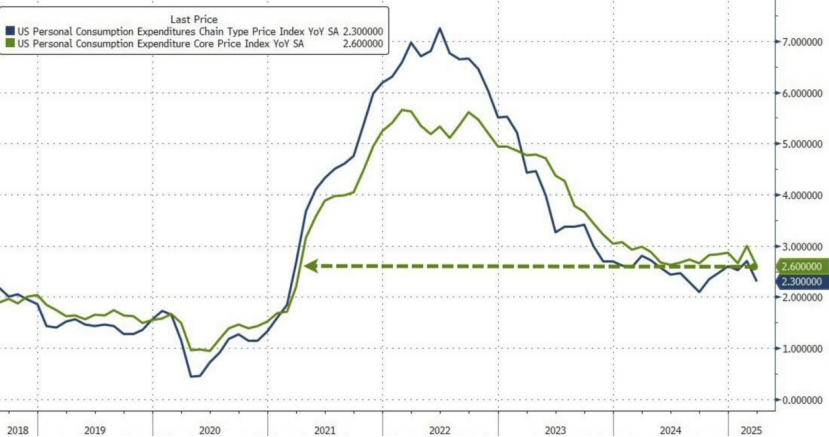
Core Points - The latest PCE price index data shows a surprising cooling in inflation, with March's year-on-year growth at 2.3%, the lowest since last fall, and core PCE at 2.6%, down from 2.8% [1][2][4] - Market expectations for Fed rate cuts have increased, with traders anticipating four 25 basis point cuts by the end of 2025, and a 65.5% probability of a rate cut in June [1][10] - The upcoming April non-farm payroll data is being closely monitored, as significant labor market disruptions due to tariff policies could increase the likelihood of a June rate cut [1][11] Inflation Data - March PCE price index year-on-year growth was 2.3%, slightly above the expected 2.2%, while the month-on-month change was 0%, matching expectations [2][4] - Core PCE year-on-year growth was 2.6%, in line with expectations, and month-on-month change was also 0%, marking the mildest increase in five years [2][4][5] - Consumer spending in March rose by 0.7%, the largest increase since early 2023, indicating proactive consumer behavior ahead of new tariffs [5][6] Market Reactions - Following the PCE data release, U.S. stock markets rebounded, with the Dow and S&P 500 closing higher, while the Nasdaq's decline was minimized [4] - Analysts suggest that weak economic data from Q1 may prompt the Fed to act more quickly on rate cuts, especially if trade agreements are reached soon [10][11] Fed's Position - Fed officials, including Waller, have indicated a shift towards a more dovish stance, particularly if high tariffs lead to significant layoffs [1][10] - The FOMC meeting scheduled for May 6-7 will be crucial in determining the Fed's next steps [9][10]

EBC黄金ETF持仓量报告解读(2025-3-25)特朗普关税政策立场软化
Sou Hu Cai Jing· 2025-03-25 10:28
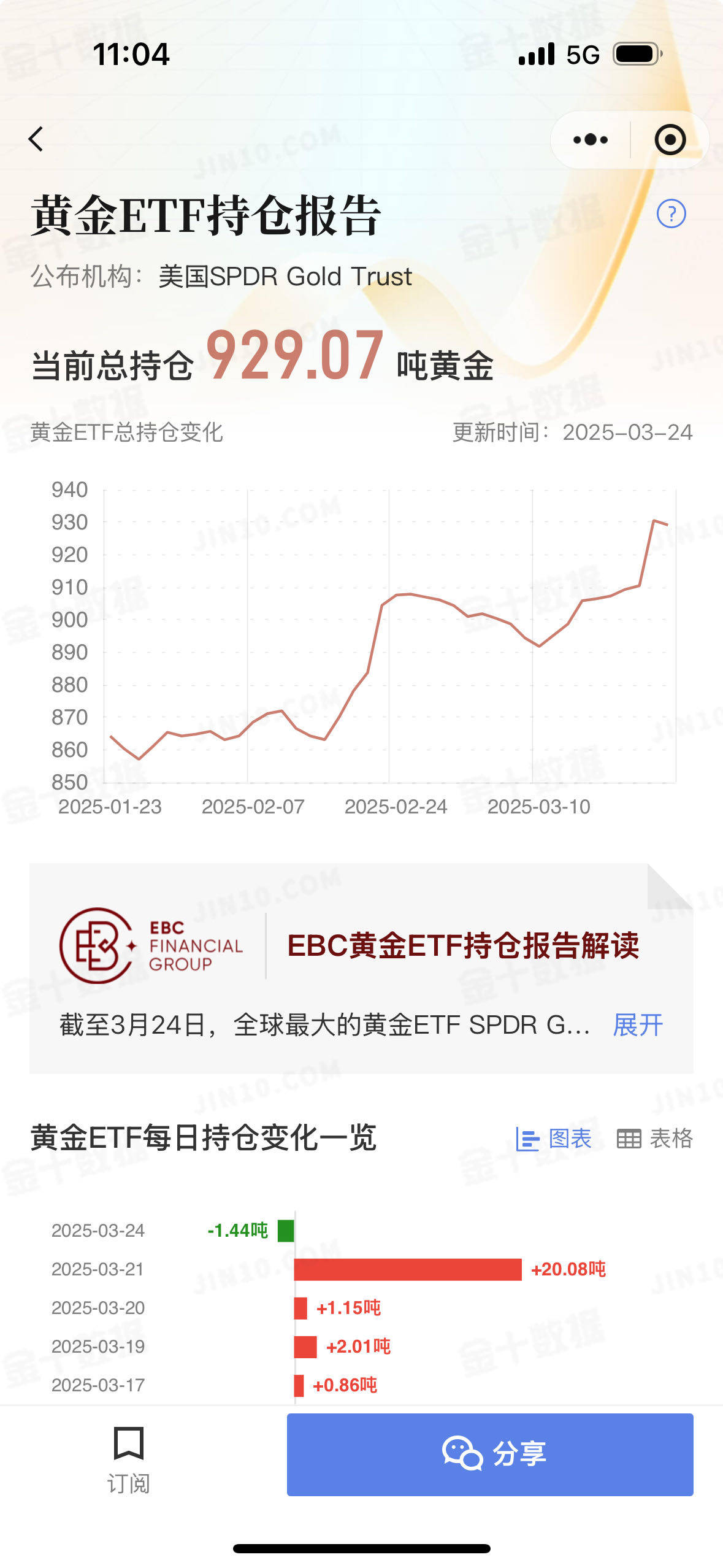
Group 1 - As of March 24, the largest gold ETF, SPDR Gold Trust, held 929.07 tons, a decrease of 1.44 tons from the previous trading day [4] - On March 24, spot gold fell for the second consecutive day, reaching a low of $3002.37 per ounce and closing at $3012.08 per ounce, a decline of 0.37% [4] - The recent softening of Trump's tariff policy has boosted market risk sentiment, putting pressure on gold prices [4] Group 2 - The market is also focused on the core Personal Consumption Expenditures (PCE) price index report, which may provide guidance on the Federal Reserve's monetary policy direction [5] - Last week, the Federal Reserve maintained its stance, raised inflation expectations, and lowered economic growth forecasts, with Powell reiterating the temporary nature of inflation [5] - Technical analysis indicates that the 14-day Relative Strength Index (RSI) is declining, suggesting potential continued adjustment in gold prices [5] Group 3 - If gold prices continue to decline, initial support is at $3000, with further testing of last week's low around $2980 if this level is breached [5] - On the upside, if buyers return, gold prices may retest historical highs of $3058, followed by $3080 [5]
突然,大跌!发生了什么?
券商中国· 2025-02-28 10:11
Core Viewpoint - The recent significant drop in gold prices has sparked widespread discussion, with the market experiencing a notable decline after reaching historical highs earlier in the week [1][3]. Price Movement - Gold prices have seen a continuous decline, with COMEX gold futures dropping over 1% and spot gold falling nearly 0.9%. As of the latest report, COMEX gold futures were down 0.83% at $2871.8 per ounce. The previous day, spot gold and COMEX futures had declines of 1.36% and 1.46%, respectively [2][4]. - Domestic gold jewelry prices also fell sharply, with a notable drop of 9 yuan per gram in just three days, indicating a total decline of 18 yuan per gram [2]. Market Influences - The cumulative decline in international gold prices this week has exceeded 2%, potentially marking the first weekly drop since 2025. This decline is primarily attributed to the strengthening of the US dollar and profit-taking activities [2][4]. - The recent surge in the US dollar has diminished the appeal of gold for foreign investors, as gold is priced in dollars. This has contributed to the recent price adjustments following the historical highs reached earlier in the week [7][8]. Bull Market Status - The current bull market for gold, which began in November 2022 with prices around $1629 per ounce, saw a peak of $2956 per ounce, representing an increase of 81%. Even after recent corrections, the price remains over 75% higher than the starting point [10][11]. - There are ongoing discussions regarding whether the bull market has ended, with factors such as increasing geopolitical risks and US tariff policies influencing market sentiment [11][12]. Future Outlook - Analysts suggest that while gold prices have paused their rapid ascent, several favorable factors may support a relative high-level fluctuation. These include potential downward movement in dollar interest rates and ongoing volatility in US equities, which may bolster safe-haven demand for gold [14]. - The market is closely monitoring the Federal Reserve's policy direction, as a hawkish stance could increase the opportunity cost of holding gold, while a dovish approach may provide strong upward momentum for gold prices [14].