
通胀指标

Search documents
图解PPI:为啥它的涨跌会影响你的钱包?
雪球· 2026-03-21 05:08
Core Viewpoint - The article discusses the significance of the Producer Price Index (PPI) and its relationship with the Consumer Price Index (CPI), emphasizing how these indices reflect price fluctuations in the economy and their implications for investment decisions [12][44]. Group 1: Understanding PPI - PPI reflects the price fluctuations of various products at the production level, including both production materials and finished goods [12][14]. - The PPI is calculated monthly based on sampled production prices from factories, weighted according to the importance of each product category [16]. - Analyzing PPI trends through year-on-year (YoY) and month-on-month (MoM) comparisons provides insights into market demand and economic health [20][25]. Group 2: Implications of PPI Trends - A positive YoY PPI indicates strong demand, suggesting that upstream companies are successfully selling products and can raise prices, leading to overall positive business conditions [21]. - Conversely, a negative YoY PPI suggests weakened market demand, forcing companies to lower prices, which can lead to reduced revenues and increased pressure on the industry [23]. - MoM increases in PPI benefit upstream companies, while continuous declines indicate overcapacity and pressure on manufacturing and cyclical stocks [26]. Group 3: PPI and CPI Relationship - The relationship between PPI and CPI can be affected by various factors, leading to scenarios where PPI rises but CPI does not, indicating a disconnect in price transmission [34]. - When PPI and CPI both rise, it signals inflation and a robust economic environment, benefiting cyclical and consumer stocks but potentially negatively impacting the bond market [36]. - A simultaneous decline in both PPI and CPI suggests poor market conditions, leading to lower consumer and investment confidence, which typically results in a lackluster stock market performance [38]. Group 4: Investment Insights - PPI influences stock prices as they reflect corporate profitability; rising profits generally lead to higher stock prices [40]. - Investors often assess a company's position within the supply chain to understand how various factors, including PPI, may impact its profitability [42].


国债期货周报:暂缺利多驱动-20260316
Yin He Qi Huo· 2026-03-16 07:14
1. Report Industry Investment Rating - Not mentioned in the provided content 2. Core Viewpoints of the Report - In the short - term, the bond market lacks substantial bullish drivers, but the low - fluctuating capital prices, the mediocre profit - making effect of the equity market, and the relatively weak domestic demand support the bond market. It is recommended to adopt a bearish approach in the short - term. Future attention should be paid to changes in external demand and the central bank's liquidity injection attitude [6][7] 3. Summary by Relevant Catalogs First Part: Weekly Core Points Analysis and Strategy Recommendations - **Comprehensive Analysis** - February's macro indicators were generally better than expected. Strong external demand and high corporate foreign exchange settlement willingness drove the improvement of industrial product prices, corporate financing, and currency activation. However, the household sector continued to "shrink its balance sheet," and the price index structure remained differentiated, indicating weak domestic terminal demand. In March, there was a divergence between overseas leading indicators and domestic high - frequency data, and the sustainability of strong external demand needs further observation [6] - The market liquidity was balanced this week, and news of stricter self - regulation of non - bank current deposit pricing helped keep certificate of deposit rates low. Next week, the tax period and increased government bond net payment may cause fluctuations in the market liquidity. The central bank's attitude towards liquidity injection is crucial. Recently, the central bank has shown a net withdrawal of long - term funds, with a cumulative reduction of 300 billion yuan in the renewal of repurchase agreements this month. Although external factors pushing up short - term inflation are unlikely to change the loose monetary policy, the central bank may be more cautious in liquidity management [6] - **Strategy Recommendations** - Unilateral trading: Adopt a bearish approach - Arbitrage: Stay on the sidelines [8] Second Part: Relevant Data Tracking - **Credit and Social Financing** - In February, the year - on - year growth rate of domestic loan balances was 6.0%, down 0.1 percentage points from the previous month; the year - on - year growth rate of social financing stock was 8.2%, the same as the previous month. The corporate sector's financing demand improved, with a year - on - year increase of 7.9%, up 0.27 percentage points. The government and household sectors' financing growth rates were 16.6% and 0.23% respectively, down 0.7 and 0.31 percentage points [12] - **Money Supply** - In February, M2 increased by 9.0% year - on - year, the same as the previous month; M1 increased by 5.9% year - on - year, up 1.0 percentage point from the previous month. The increase in currency activation may be due to strong external demand and high corporate foreign exchange settlement willingness. Non - bank financial institutions' deposits reached a record high in the same period [17] - **Foreign Trade** - From January to February, China's exports and imports increased by 21.8% and 19.8% respectively year - on - year in US dollars, far exceeding market expectations. However, in the first two weeks of March, the year - on - year growth of port cargo throughput was not significant, and the sustainability of strong external demand needs further observation [19][23] - **Inflation** - In February, PPI was - 0.9% year - on - year, up 0.5 percentage points from the previous month, and + 0.4% month - on - month, the same as the previous month. The price of upstream and mid - stream production materials was the main driver of the increase. CPI and core CPI increased by 1.3% and 1.8% year - on - year respectively, up 1.1 and 1.0 percentage points from the previous month, mainly due to the Spring Festival factor [28][30] - **Industrial Production** - This week, the operating rates of petroleum asphalt, olefins, PTA, and PVC were 23.0%, 78.44%, 80.33%, and 81.35% respectively, with month - on - month changes of - 0.3, + 0.73, + 0.64, and + 0.24 percentage points. Some petrochemical operating rates were weaker than seasonal levels, while some coal - chemical products' operating rates were at seasonal highs [36] - **Real Estate** - The real estate market in March was fair. The sales area of new houses in 30 large - and medium - sized cities and the number of second - hand house sales in five cities have basically returned to the same period last year. However, the "price - for - volume" strategy in the second - hand housing market may still be ongoing, with the week - on - week decline of the second - hand housing listing price index continuing for the second week [42] - **Market Liquidity** - This week, the market liquidity was balanced and loose. DR001 and DR007 were 1.3216% and 1.4616% respectively. The long - term capital interest rate of joint - stock banks' 1 - year certificates of deposit fluctuated around 1.55 - 1.56%. Next week, the tax period and increased government bond net payment may cause liquidity fluctuations. The central bank's attitude is crucial, as it has shown a net withdrawal of long - term funds recently [48] - **Treasury Bond Futures Valuation and Positioning** - As of Friday's close, the IRR of TS, TF, T, and TL main contracts were 1.3488%, 1.4253%, 1.3778%, and 1.6407% respectively. The net long - position ratios of the top ten seats in TS, TF, T, and TL were - 21.35%, - 5.34%, - 1.12%, and - 4.89% respectively, with changes of + 2.36, + 2.44, + 0.17, and - 1.91 percentage points compared to last Friday [53][54] - **Other Data** - The report also provides data on the price spreads between treasury bond futures contracts, trading volume and open interest, spot bond yields and spreads, and US treasury bond yields and exchange rates [62][65][68][71]
巴西央行下调通胀指标至3.97%
Shang Wu Bu Wang Zhan· 2026-02-27 16:11
Group 1 - The Central Bank of Brazil has lowered its inflation forecast for the broad consumer price index (IPCA) for the end of 2026 from 3.99% to 3.97% [1] - The inflation forecast for 2027 remains unchanged at 3.8%, while the expectations for 2028 and 2029 are both set at 3.5% [1] - This marks the fifth consecutive week of downward adjustments to the 2026 inflation forecast, which is now within the Central Bank's target range [1]
2.27黄金70美金震荡 多空角力
Sou Hu Cai Jing· 2026-02-27 06:47
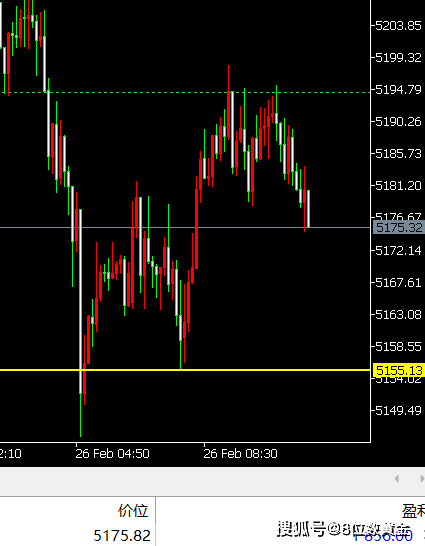
Market Overview - Gold experienced significant volatility, with a sharp drop followed by a strong rebound, encountering resistance around 5200, and subsequently undergoing a V-shaped recovery of 70 USD [1][6][11] - The market is currently in a phase of consolidation, with ongoing battles between bulls and bears, and potential resistance levels identified at 5210 and 5250 [8][11] Recent Price Movements - The price of gold touched a low of 5130 before rebounding back to 5200, indicating a pattern of deep V-shaped recoveries [5][6][11] - The market has shown a tendency for three significant reversals this month, with each drop being followed by a recovery, suggesting a strong bullish sentiment overall [11] Economic Factors - Recent U.S. unemployment claims showed unexpected improvement, which may influence Federal Reserve policy and strengthen the dollar, leading to gold's price adjustments [12] - Additionally, reports of potential shortages in rare earth materials have increased demand for precious metals, contributing to market fluctuations [12] Upcoming Indicators - Attention is drawn to the upcoming U.S. PPI monthly rate, which is a critical inflation indicator that could impact Federal Reserve policy expectations [13] - The market is also cautious of potential volatility on Fridays, particularly in light of unusual movements in the U.S. stock market [13] Investment Strategy - The overall outlook for gold remains bullish, with a focus on buying opportunities around support levels of 5145 and 5093, while also considering short positions near resistance levels of 5210 and 5250 [11]
2.23黄金高开急涨70美金 再战5200
Sou Hu Cai Jing· 2026-02-23 10:43
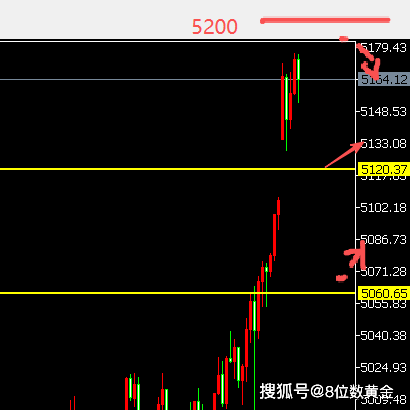
Market Overview - Gold experienced significant volatility last week, initially dropping by $200 before staging a V-shaped recovery, ultimately rising by $70 to challenge the $5200 mark [1] - The price of gold rebounded from a low of $4840, climbing back to the $5100 level and further surging to above $5170 [3] - The market is currently observing a strong bullish trend, with potential resistance levels at $5200 and $5300, while support levels are noted at $5060 and $5120 [4][5][6] Influencing Factors - The recent fluctuations in gold prices were influenced by geopolitical tensions, particularly the ongoing discussions between the US and Iran, which have eased global tensions [7] - Additionally, the US stock market faced significant declines, particularly in the tech sector, which triggered a sell-off in precious metals, including gold [7] - The US Supreme Court's ruling on tariffs has also contributed to rising geopolitical risks, benefiting gold prices as investors seek safe-haven assets [8] Upcoming Data - Attention is drawn to the upcoming data releases, particularly the January PPI month-on-month figures, which are crucial for assessing inflation trends [9] - December's economic indicators will also play a significant role in evaluating the strength of the US economy and its impact on the gold market [10] Investment Strategy - The analysis emphasizes the importance of accurately determining entry and exit points for gold investments, which is essential for achieving stable profits [10] - A focus on risk management and maintaining low-risk positions is highlighted as a fundamental aspect of maximizing profit opportunities in gold trading [10] - The expertise of seasoned traders is recommended for achieving higher accuracy rates in trading decisions [10]
美股周五开盘点评:宏观数据不佳,企业财报超预期
Xin Lang Cai Jing· 2026-02-20 19:40
Group 1 - The core Personal Consumption Expenditures (PCE) price index remains high, with a month-on-month increase of 2.9% in December, up from 2.8% in November, indicating a stronger inflation signal compared to the Consumer Price Index (CPI) data [1] - In Europe, stock markets are rebounding from previous lows, supported by positive macroeconomic indicators, including a three-month high in the Eurozone PMI index, driven by favorable German economic data and a return to expansion in manufacturing [1] - The UK PMI index reached a 22-month high, with strong retail sales in January and a significant public sector budget surplus, reinforcing expectations of improved economic growth in the region [1] Group 2 - In the Asia-Pacific region, stock markets showed mixed results, with South Korea leading gains while Japan and Hong Kong lagged behind, despite improved PMI data and easing inflation [2] - The Nikkei index fell by over 1%, influenced by weak performance from large internet platforms and a shift in funds towards smaller AI concept stocks [2] - Core CPI in Japan remained unchanged at 2.0%, with overall inflation declining, while PMI updates from Japan, India, and Australia indicate continued economic expansion, and Southeast Asia's trade data highlights strong demand for electronic products [2]
US stocks open in the green: Dow surges 300 points, S&P up 0.3%
Invezz· 2026-02-12 14:46
Core Viewpoint - US equities experienced modest gains as investors reacted to a strong January jobs report and new labor market data while monitoring inflation indicators that may influence interest rate decisions [1] Group 1: Market Performance - The Dow Jones Industrial Average increased by 295 points, approximately 0.6% [1]

有色金属周度观点-20260210
Guo Tou Qi Huo· 2026-02-10 12:16
1. Report Industry Investment Rating - No information provided 2. Core Viewpoints of the Report - The report provides weekly views on various non - ferrous metals, analyzing their market trends, supply - demand situations, and suggesting corresponding investment strategies based on these analyses [2] 3. Summary by Variety Copper - **Market Trend**: Last week, copper prices oscillated at a relatively high level, similar to gold. Before the Spring Festival, the overall open interest may shrink to 550,000 lots. In the long - term, the US $12 billion commercial stockpiling plan and the call from the China Non - Ferrous Metals Industry Association to increase commercial reserves may encourage long - term funds to go long on copper at low prices. The price is expected to be lower before the Spring Festival and higher after it [2] - **Domestic Supply and Demand**: Copper concentrate supply is tight. Domestic smelter output is expected to be stable around the Spring Festival. The Shanghai copper premium is 35 yuan, and the Guangdong discount is 105 yuan. The social inventory is 331,300 tons [2] - **Overseas Situation**: There are many news of production cuts from traditional mainstream mining companies. The market is concerned about the US government's control over long - term copper resources. The LME copper inventory has increased to 184,300 tons, and the LME spot discount is $77 [2] - **Investment Strategy**: Hold a light position or conduct inter - period reverse arbitrage during the Spring Festival [2] Aluminum and Alumina - **Market Trend**: The market continues to oscillate. The domestic operating capacity of alumina is 95.05 million tons, with a month - on - month decrease of 1.5 million tons. The alumina balance remains in surplus, and the weekly inventory has increased by 55,000 tons to 5.114 million tons [2] - **Demand**: The operating rate of domestic downstream leading aluminum enterprises decreased by 1.5% to 59.4% last week. High aluminum prices have continuously suppressed downstream demand, and some processing enterprises have entered the holiday in advance [2] - **Inventory and Spot**: The overall demand is weak. The social inventory of aluminum ingots increased by 33,000 tons to 829,000 tons, and the social inventory of aluminum rods increased by 26,000 tons to 267,000 tons. The spot premium and discount have declined [2] - **Investment Strategy**: Pay attention to the support effectiveness of the recent low point of 23,800 yuan. If it breaks, it will seek support at 23,000 yuan. Consider selling out - of - the - money call options [2] Zinc - **Market Trend**: The "Wash Panic" accelerated the release of bearish sentiment. The Shanghai zinc price fell 5.36% last week, and the decline slowed down at the 24,500 yuan/ton level. The LME zinc price oscillated at a high level and remained in the rebound channel [2] - **Spot and Supply**: The LME zinc inventory decreased slightly to 107,600 tons, and the 0 - 3 month spot discount narrowed to $21.56/ton. The SMM zinc social inventory increased to 148,500 tons, and the fundamental strength of the domestic and foreign markets showed differentiation again. The loss of zinc spot imports expanded to over 3,000 yuan/ton [2] - **Consumption**: As the Spring Festival approaches, most terminals are on holiday, and the operating rate of downstream zinc enterprises has dropped significantly. Only a small number of enterprises make rigid purchases at low prices. High prices suppress demand, and the downstream operating rate is expected to continue to decline in the next two weeks [2] - **Investment Strategy**: The Shanghai zinc market starts to reduce volatility for adjustment. The option double - selling strategy has good returns, and the profit space for single - side futures trading is limited. It is recommended to wait and see [2] Lead - **Market Trend**: Last week, the lead prices of both domestic and foreign markets accelerated to test the lower support of the consolidation range. The Shanghai lead price fell 2.1%, and the LME lead price fell 1.48%. The import window remained open [2] - **Spot and Supply**: The LME lead inventory increased to 233,000 tons. The overseas surplus pressure was transmitted to the domestic market. The operating rates of SMM primary lead smelters and secondary lead smelters decreased. Some primary lead smelters in Hunan and Yunnan carried out maintenance or production cuts, and smelters were reluctant to sell at low prices [2] - **Consumption**: As the Spring Festival approaches, only a small number of downstream enterprises make rigid purchases at low prices. The spot trading volume has declined. The holiday time of battery enterprises has increased compared with previous years. Pay attention to the lead ingot inventory accumulation after the festival [2] - **Investment Strategy**: The lead price is at a low level, and the capital divergence has increased. The overall surplus situation remains unchanged. In the short term, both supply and demand are weak. The Shanghai lead price is expected to oscillate in the range of 16,500 - 17,800 yuan/ton [2] Nickel and Stainless Steel - **Market Trend**: The Shanghai nickel price fell from a high level last week, and the market trading volume decreased while the open interest slowly increased. The Shanghai stainless steel price showed a similar trend [2] - **Macro and Demand**: The social inventory of stainless steel has continued to increase. Market confidence has declined, and trading is light. Only a small amount of rigid replenishment is made. Terminal downstream procurement has basically ended [2] - **Spot and Supply**: The Jinchuan nickel premium is 9,500 yuan, the imported nickel discount is 50 yuan, and the electrowon nickel is at par. The pure nickel inventory increased by 3,000 tons to 73,000 tons, and the stainless steel inventory increased by 15,000 tons to 869,000 tons [2] - **Investment Strategy**: Market fear of high prices has emerged. It is recommended to be cautious [2] Tin - **Market Trend**: The Shanghai tin price is prone to follow the silver price. It shows a unilateral downward trend with relatively limited rebound. It is a small - volume variety, and the trading volume and open interest have a great impact around the Spring Festival [2] - **Supply**: The Indonesian exchange traded 2,720 tons of tin ingots in late January. There was a landslide in an Indonesian tin mine, but there is no news of impact on production. The earthquake in Myanmar is far from the Wa State production area. The market is concerned about the resumption of supply in the Wa State [2] - **Consumption**: The sharp decline in tin prices gives downstream enterprises an opportunity to stock up before the festival. The Steel Union tin inventory decreased by 1,658 tons to 9,898 tons last week. The global semiconductor sales in December 2025 continued to increase month - on - month [2] - **Investment Strategy**: Pay attention to the high volatility of the overseas market with light trading. Also, pay attention to the inventory changes during and after the Spring Festival. The out - of - the - money call option selling strategy for the 2603 contract has realized profits. It was recommended to wait and see or go short with a light position against the MA20 moving average last week [2] Lithium Carbonate - **Futures Market**: The lithium carbonate futures oscillated downward last week, and the market trading was active. The exchange policy affected market participation. A large number of hedging positions have been closed during the rapid price increase [2] - **Spot Performance**: The spot price of Shanghai battery - grade lithium carbonate has dropped sharply. Mines are not willing to sell due to the price decline, and downstream enterprises have sufficient previous inventory and have lowered their acceptance prices for new orders [2] - **Macro and Demand**: The external strength has weakened significantly. The rebound of precious metals and non - ferrous metals is not enough to support market confidence. The power battery orders may decline, and the production schedule in February is expected to be greatly affected [2] - **Supply Factors**: The total market inventory decreased by 2,000 tons to 105,000 tons. The smelter inventory decreased by 1,300 tons to 18,000 tons, the downstream inventory increased by 3,000 tons to 43,700 tons, and the trader inventory decreased by 3,400 tons to 43,000 tons. The de - stocking speed has slowed down [2] - **Investment Strategy**: The lithium carbonate futures price has crashed, and the short - term uncertainty is extremely high. Pay attention to risk prevention and control [2] Industrial Silicon - **Price**: The industrial silicon futures oscillated downward, dragged down by the general decline of the non - ferrous metal sector and the expected implementation of organic silicon emission reduction. As the Spring Festival approaches, the market stocking is coming to an end, and the trading activity has decreased [2] - **Supply and Demand**: The supply side has shrunk significantly. The production cuts of large Xinjiang factories have led to a significant decline in the number of open furnaces. Downstream polysilicon is expected to cut production by more than 20,000 tons month - on - month. If the organic silicon industry achieves its emission reduction target in the first quarter, the industrial silicon demand will be dragged down by about 90,000 tons [2] - **Inventory**: The Xinjiang factory inventory has decreased slightly, and the social inventory has climbed to 562,000 tons, with a weekly inventory increase of 8,000 tons [2] - **Investment Strategy**: In the short term, the price is affected by the volatility transmission of the metal sector and the negative news of the organic silicon industry. Pay attention to the support at 8,400 yuan/ton [2] Polysilicon - **Price**: The spot price of polysilicon has increased. The N - type re - feed material is 53,600 yuan/ton, with a weekly increase of 2,300 yuan/ton. Affected by the industry meeting last week, enterprises are holding up prices, but there is no spot transaction. The futures price briefly soared due to news, but the capacity expectation has not been realized, and the price has returned to oscillate around the 50,000 yuan/ton mark [2] - **Supply and Demand**: The production of leading enterprises decreased in January, and the monthly output dropped to around 100,000 tons. The output in February is expected to further drop below 80,000 tons. The production schedule of the silicon wafer sector in February is generally stable, and there may be a small supply - demand gap in polysilicon in February [2] - **Inventory**: The latest inventory of silicon material manufacturers is 341,000 tons, with a month - on - month increase of 8,000 tons [2] - **Investment Strategy**: The industry association announced the domestic photovoltaic new installation target of 180 - 240 GW in 2026, which meets market expectations. The Ministry of Industry and Information Technology reiterated the anti - involution orientation of the industry. After the emotional correction of the market, it is expected to oscillate around the 50,000 yuan/ton mark [2]
英国企业信心指数跃升至八个月高点 央行按兵不动预期强化
Zhi Tong Cai Jing· 2026-02-02 09:36
Group 1 - The UK business confidence index has risen to its highest level in eight months, indicating a potential recovery in economic growth following the budget announcement [1] - The Institute of Directors (IoD) reported that the business confidence index increased from -66% in December 2025 to -48% in January 2026, showing a rebound trend from near historical lows [1] - CEOs' confidence in their own companies rose to +14% in January from -4% in December, reflecting improved expectations for investment, hiring, and sales [1] Group 2 - Despite plans to increase taxes by £26 billion ($36 billion), businesses are largely exempt from these measures, while households are feeling the impact of increased taxation [2] - The hospitality sector, including pubs and live music venues, is receiving support from the Chancellor, which is crucial given the previous backlash against rising business tax rates [2] - The IoD noted that revenue expectations reached their highest point since September 2024, with key indicators tracking employee numbers and investment intentions also showing significant increases [2] Group 3 - The rise in business confidence and PMI is seen as a strong signal of economic recovery, while rising inflation indicators set a higher threshold for interest rate cuts by the Bank of England [3] - Economists expect the Bank of England to maintain interest rates at 3.75% in the upcoming meeting, with only one more rate cut anticipated this year [3] - The Monetary Policy Committee has been cautious since August 2024, having previously lowered rates from 5.25%, and there is a consensus to slow down the pace of rate cuts unless unexpected circumstances arise [3]
股指期货将偏强震荡,黄金、白银期货价格再创历史新高,白银期货将震荡偏强,黄金、锡、焦煤期货将偏强震荡,碳酸锂期货将偏强宽幅震荡
Guo Tai Jun An Qi Huo· 2026-01-23 01:44
Report Industry Investment Rating No relevant content provided. Core Viewpoints of the Report - Through macro - fundamental and technical analysis, the report predicts the trend, resistance levels, and support levels of various futures contracts on January 23, 2026, and the trend of futures main (continuous) contracts in January 2026 [2][4]. Summary by Related Catalogs Macro News and Trading Tips - The central bank will continue to implement a moderately loose monetary policy in 2026, with room for reserve requirement ratio cuts and interest rate cuts. It will also maintain the stability of the financial market and support the capital market [5]. - The first batch of 93.6 billion yuan of ultra - long - term special treasury bonds for equipment renewal funds has been allocated, which will drive total investment of over 460 billion yuan [5]. - The central bank will conduct 900 billion yuan of MLF operations on January 23, with a net injection of 700 billion yuan [5]. - Six major state - owned banks will implement the fiscal discount policy for personal consumer loans, and the actual interest rate for some high - quality customers can enter the "2%" range [6]. - China will conduct a pilot program to extend the second - round land contracts by 30 years on a provincial - wide basis this year [6]. - From January 1, 2026, a project to provide pension service consumption subsidies to moderately and severely disabled elderly people will be implemented nationwide [6]. - The 2026 national college entrance examination will be held on June 7 and 8, and efforts will be made to optimize the discipline and major settings [6]. - In December 2025, the unemployment rates of the urban labor force aged 16 - 24, 25 - 29, and 30 - 59 were 16.5%, 6.9%, and 3.9% respectively [7]. - The US 2025 Q3 GDP final annualized quarterly growth was 4.4%, and the core PCE price index in November met expectations. The number of initial jobless claims last week was 200,000, lower than expected [7]. - Goldman Sachs significantly raised its gold price forecast for December 2026 from $4,900/oz to $5,400/oz [7]. - International precious metal futures generally rose, while US crude oil futures fell. London base metals generally rose [7][8]. Futures Market Analysis and Forecast Stock Index Futures - On January 22, the main contracts of CSI 300, SSE 50, CSI 500, and CSI 1000 stock index futures had different performances. The short - term downward pressure of IF2603 and IH2603 increased slightly, while IC2603 and IM2603 showed a slight upward trend [9][10][11]. - It is expected that in January 2026, the main continuous contracts of stock index futures will be mostly in a strong or moderately strong oscillation. On January 23, the stock index futures will be in a strong oscillation [13]. Gold Futures - On January 22, the main contract AU2604 of gold futures had a slight downward oscillation. The short - term upward momentum weakened, and the downward pressure increased slightly [29]. - It is expected that in January 2026, the main continuous contract of gold futures will be in a moderately strong oscillation and will reach a record high. On January 23, AU2604 will be in a strong oscillation and may reach a new high [29][30]. Silver Futures - On January 22, the main contract AG2604 of silver futures showed an upward oscillation. It is expected that in January 2026, the main continuous contract will be in a moderately strong oscillation and reach a new high. On January 23, AG2604 will be in a moderately strong oscillation and may reach a new high [33][34]. Copper Futures - On January 21, the main contract CU2603 of copper futures had a slight downward oscillation. It is expected that in January 2026, the main continuous contract will be in a moderately strong oscillation and reach a new high. On January 22, CU2603 will be in a weak oscillation [39]. Tin Futures - On January 22, the main contract SN2603 of tin futures had a downward oscillation. It is expected that in January 2026, the main continuous contract will be in a moderately strong oscillation and reach a new high. On January 23, SN2603 will be in a strong oscillation [42]. Lithium Carbonate Futures - On January 22, the main contract LC2605 of lithium carbonate futures showed an upward oscillation. It is expected that in January 2026, its main continuous contract will be in a moderately strong oscillation. On January 23, LC2605 will be in a wide - range strong oscillation [48][49]. Coking Coal Futures - On January 22, the main contract JM2605 of coking coal futures had a slight upward oscillation. It is expected that in January 2026, it will be in a wide - range oscillation. On January 23, it will be in a strong oscillation [51]. Glass Futures - On January 22, the main contract FG605 of glass futures showed an upward oscillation. It is expected that in January 2026, it will be in a wide - range weak oscillation. On January 23, it will be in a strong oscillation [57][58]. Soda Ash Futures - On January 22, the main contract SA605 of soda ash futures showed an upward oscillation. It is expected that in January 2026, it will be in a wide - range weak oscillation. On January 23, it will be in a strong oscillation [62]. PTA Futures - On January 22, the main contract TA605 of PTA futures showed a strong upward oscillation. It is expected that on January 23, it will be in a strong oscillation [68]. PVC Futures - On January 22, the main contract V2605 of PVC futures showed a strong upward oscillation. It is expected that on January 23, it will be in a strong oscillation [70]. Methanol Futures - On January 22, the main contract MA605 of methanol futures showed a strong upward oscillation. It is expected that on January 23, it will be in a strong oscillation [71]. Soybean Meal Futures - On January 22, the main contract M2605 of soybean meal futures showed an upward oscillation. It is expected that on January 23, it will be in a weak oscillation [73]. Natural Rubber Futures - On January 22, the main contract RU2605 of natural rubber futures showed an upward oscillation. It is expected that on January 23, it will be in a moderately strong oscillation [76].