PCE物价指数

Search documents
startrader:CPI报告落地 华尔街上调美联储年内降息预期至2.5次
Sou Hu Cai Jing· 2026-02-14 05:14
Core Viewpoint - The January CPI report released by the U.S. Bureau of Labor Statistics has triggered volatility in global financial markets, leading Wall Street institutions to adjust their expectations for the Federal Reserve's monetary policy, with a consensus now anticipating a total rate cut of approximately 63 basis points this year, equivalent to about "2.5 rate cuts" [1] Group 1: CPI Data and Market Reactions - The January CPI data shows a cooling trend, with a year-on-year increase of 2.4%, below the market expectation of 2.5%, and down 0.3 percentage points from December 2025's 2.7%, marking the lowest level since May 2025 [3] - The core CPI, excluding food and energy, rose by 2.5% year-on-year, meeting expectations and representing the lowest level since 2021, while the month-on-month increase was 0.3%, indicating a slight rebound but not altering the overall trend of declining inflation [3] - Energy prices significantly contributed to the cooling of inflation, with the energy price index decreasing by 1.5% month-on-month, including a 3.2% drop in gasoline prices, alleviating overall price pressures [3] Group 2: Wall Street's Rate Cut Expectations - Prior to the CPI data release, Wall Street's expectations for rate cuts were conservative, with traders anticipating a total cut of only 58 basis points for the year, and significant disagreement on the timing of cuts [4] - Following the CPI data, expectations surged, with the probability of a June rate cut rising to over 80%, and April's cut probability increasing to 30%, leading to an adjusted total rate cut expectation of 63 basis points [4] - Different Wall Street institutions have varying interpretations of the rate cut path, with Goldman Sachs Asset Management predicting two cuts this year, the first potentially in June, while Pacific Investment Management Company believes two cuts are reasonable based on the encouraging inflation report [4] Group 3: Constraints on Federal Reserve's Decision-Making - Despite rising rate cut expectations, the Federal Reserve's policy decisions face multiple constraints, as both CPI and core CPI remain above the Fed's long-term inflation target of 2%, and strong non-farm payroll data indicates a resilient labor market [5] - The robust performance of the labor market diminishes the necessity for rapid rate cuts, as noted by Nomura Securities, highlighting that the positive response from inflation data is still limited by employment resilience [5] - Following the CPI data release, market reactions included rising U.S. Treasury prices, a declining dollar index, and increased attractiveness of precious metals, indicating a re-pricing of global financial markets around new interest rate expectations [5]


市场预计美国11月通胀压力保持稳定 美联储下周维持利率不变概率达95%
Zhi Tong Cai Jing· 2026-01-21 22:21
Core Insights - The upcoming inflation report is expected to show stable inflation pressures in the U.S., explaining the Federal Reserve's cautious stance on interest rate cuts [1][2] - The November core PCE price index is projected to rise by 0.2% month-over-month and 2.8% year-over-year, indicating inflation levels remain significantly above the Fed's 2% target [1] - Despite some indicators suggesting a gradual cooling of inflation pressures, the core PCE typically exhibits less volatility compared to the Consumer Price Index (CPI) [1] Inflation Indicators - The overall PCE is also expected to increase by 0.2% month-over-month and 2.8% year-over-year, indicating a sideways movement in inflation levels [1] - Citigroup economists noted that the core PCE inflation may show "sticky rather than accelerating" characteristics towards the end of 2025 [1] - The data disturbances from last year's government shutdown continue to affect the November readings, with seasonal adjustments likely to revise recent data in the coming months [1] Wage Growth and Service Sector - Signs of inflation easing are accumulating, with wage growth significantly slowing down, approaching pre-pandemic levels according to the Atlanta Fed's wage tracking indicator [1] - The cooling of wage growth complicates maintaining high service sector inflation, especially with expected declines in housing costs this year [1] Federal Reserve's Position - Federal Reserve officials are weighing conflicting signals, as inflation has not worsened but the cooling rate is insufficient to clearly support recent interest rate cuts [2] - The upcoming PCE report will be an important reference for policymakers, but it is unlikely to lead to immediate policy changes [2] - Investors currently anticipate a 95% probability that the Federal Reserve will keep interest rates unchanged at the upcoming policy meeting [3]
ATFX汇市前瞻:日央行新年首份决议 迟来的美国PCE数据
Xin Lang Cai Jing· 2026-01-19 09:47
Group 1: Japan's Monetary Policy - The Bank of Japan will hold its first interest rate decision of 2026 on January 22-23, with results expected between 11:00 and 13:00 [4][14] - Institutions predict that the Bank of Japan will maintain its current interest rates and not implement a rate hike, supported by the lack of media speculation ahead of the decision [4][14] - The core CPI for December is expected to be 2.4%, significantly lower than the previous value of 3%, indicating a low probability of a rate hike if expectations are met [4][14] Group 2: U.S. Economic Data - The U.S. PCE data for November is considered more significant than Japan's interest rate decision, although it is seen as lagging and less impactful due to its timing [5][15] - The core PCE year-on-year rate is forecasted to be 2.8%, consistent with the previous month, suggesting stable price levels in the U.S. from September to November [5][18] - The upcoming unemployment claims data is expected to rise to 212,000 from the previous 198,000, indicating an increase in jobless claims [8][19] Group 3: UK Economic Indicators - The UK unemployment rate for November is expected to be 5%, slightly lower than the previous 5.1%, indicating minimal change [9][21] - The core CPI for December is anticipated to remain at 3.2%, unchanged from the previous value, reflecting stable inflation [9][21] - Overall, the stability in unemployment and inflation suggests a low necessity for adjustments in the UK's monetary policy, with GBP/USD fluctuations more influenced by the U.S. dollar index and Federal Reserve actions [11][22]

美联储“最青睐”的通胀数据不及预期!12月降息“最后一块拼图”就位?
Sou Hu Cai Jing· 2025-12-05 15:27
Group 1 - The core inflation indicator, the core Personal Consumption Expenditures (PCE) price index, rose by 0.2% month-on-month in September, matching August's data and meeting market expectations. Year-on-year growth unexpectedly fell to 2.8%, the lowest in three months, while the market had anticipated a continuous 2.9% increase [2][5]. - The report on inflation was delayed due to a government shutdown, which paused all data collection and economic reporting during that period. The next release date for the PCE data has not yet been rescheduled [5]. - Consumer spending showed signs of slowing down before the longest government shutdown in history began on October 1. Although recent data indicated strong sales performance during "Black Friday," consumer anxiety regarding the job market is rising, with spending primarily driven by wealthier households [6]. Group 2 - The Federal Reserve officials consider the PCE price index as a primary tool for measuring inflation. They generally view core data as a superior indicator for assessing long-term inflation trends, despite also referencing overall data [5]. - A separate report indicated that consumer confidence rose for the first time in five months in early December, reflecting improved inflation expectations and a more optimistic outlook on personal financial situations [6].

能源成本上涨推高美国9月PPI,通胀粘性持续考验美联储
智通财经网· 2025-11-25 14:19
Core Insights - The Producer Price Index (PPI) for September in the U.S. increased compared to August, driven by rising energy and food prices [1] - The PPI rose by 0.3% month-over-month, aligning with market expectations, while the year-over-year increase rose from 2.60% in August to 2.7% in September, also meeting market forecasts [1] - Core PPI, which excludes food and energy, increased by 0.1% month-over-month, below the expected 0.2%, but improved from a previous value of -0.1% [1] - Year-over-year, the core PPI rose by 2.6%, slightly lower than analysts' estimates of 2.7% [1] Price Movements - Wholesale commodity prices increased by 0.9%, with 60% of this increase attributed to rising gasoline prices [1] - Service prices remained unchanged after a decline in the previous month [1] - In the services sector, wholesale profit margins for machinery decreased, while those for food increased [1] - Costs for airline passenger services also saw an increase [1] Economic Context - The PPI data was released after a delay due to a government shutdown and provides critical insights for assessing the inflation trajectory in the U.S. [1] - The previous month's PPI had unexpectedly declined, primarily due to a drop in service category prices, but the September data indicates a return to typical growth patterns [1] - The PPI is a leading indicator for the Personal Consumption Expenditures (PCE) price index, which is set to be released on December 5 [2] - Current inflation persistence contrasts with a weak labor market, leading to divided opinions within the Federal Reserve, making the PPI data significant for the upcoming monetary policy meeting in December [2]
本周热点前瞻20251124
Qi Huo Ri Bao Wang· 2025-11-24 02:35
Group 1 - The National Bureau of Statistics of China will announce the prices of important production materials in circulation as of mid-November, covering nine categories and 50 products [1] - The People's Bank of China is expected to roll over 900 billion MLF (Medium-term Lending Facility) on November 25, with the specific amount depending on market demand [2] - The U.S. Labor Department will release the Producer Price Index (PPI) for September, with expectations of a year-on-year increase of 2.7%, slightly up from the previous value of 2.6% [3] Group 2 - The U.S. Commerce Department will announce the PCE price index for September, with expectations for the year-on-year rate to remain at 2.7% and a slight increase in the month-on-month rate to 0.3% [4] - The U.S. Commerce Department will also release the revised GDP for the third quarter, with expectations of a downward revision to 3.0% from the initial estimate of 3.8% [5] - The Federal Reserve will publish its Beige Book on economic conditions, which will be closely monitored for its impact on related futures prices [6] Group 3 - The Guangzhou Futures Exchange has announced the listing of platinum and palladium futures and options, with trading set to begin on November 27 and 28, 2025, respectively [7] - The National Bureau of Statistics and the China Logistics Purchasing Federation will release the official manufacturing and non-manufacturing PMIs for November, with expectations of slight declines in both indices [8][9] - The 40th OPEC and non-OPEC ministerial meeting will take place on November 30, with attention on the outcomes and their potential impact on oil and related commodity futures prices [9]
美政府关门“污染”!美国9月CPI报告恐失真?
Jin Shi Shu Ju· 2025-10-14 12:26
Core Insights - The U.S. government shutdown is threatening the quality of key inflation data, particularly the Consumer Price Index (CPI) report scheduled for release next month [1] - The Bureau of Labor Statistics (BLS) has been instructed to recall some employees to prepare the September CPI report, but has been unable to collect new price information since the shutdown began on October 1 [1][2] - The labor-intensive nature of CPI data collection, which involves gathering information on approximately 80,000 items nationwide, is particularly impacted by the funding interruption [1] Data Collection Challenges - The BLS may resort to more estimations due to the inability to collect certain prices, as noted by former BLS officials [2] - If the shutdown continues, the BLS might adjust the weights of various categories based on longer-term price changes [2] - The collection rate of prices has declined, which poses further risks to data quality [3] Impact on Reports - Any issues with the October CPI report could affect the release of other reports, including the PCE price index, which relies on CPI data [3] - The September CPI report, initially scheduled for release, has been delayed to October 24 due to the need to recall staff for Social Security adjustments [2][3] Caution on Data Interpretation - Economists advise against overinterpreting any single data point, especially for the October report [4] - Analysts recommend a cautious approach to any anomalies in the October data [5]
美国通胀压力回来了?PPI大超预期,9月降息悬了
Sou Hu Cai Jing· 2025-08-15 08:31
Group 1 - The core point of the article is the significant increase in the U.S. Producer Price Index (PPI) for July, which saw its largest rise in three years, with a year-on-year increase of 3.3% compared to 2.3% in June, and a month-on-month increase of 0.9%, far exceeding market expectations of 0.2% [1][3] - The core PPI, excluding food and energy, also rose sharply, with a year-on-year increase of 3.7%, the highest since February, and a month-on-month increase of 0.9%, the highest since April 2022 [3][5] - The surge in PPI has led to a decline in U.S. stock index futures, with the Nasdaq futures down 0.36%, S&P 500 down 0.35%, and Dow futures down 0.29%, while the dollar index rose by 0.21% [3][5] Group 2 - A key driver of the PPI increase is the rise in service costs, which increased by 1.1% in July, the largest increase since March 2022, and wholesale and retail profit margins jumped by 2% due to mechanical equipment wholesale [3][5] - The article highlights that the increase in PPI has dampened expectations for a rate cut by the Federal Reserve in September, as traders are now less confident in the likelihood of a rate cut due to the unexpected inflation data [5][6] - There is a lack of consensus among Federal Reserve officials regarding interest rate cuts, with some advocating for caution until inflation is fully under control, while others support immediate cuts [6][8]
美联储最爱通胀指标温和上升,5月核心PCE物价环比上涨0.2%,消费支出创年初最大降幅
Hua Er Jie Jian Wen· 2025-06-27 13:50
Core Insights - The core Personal Consumption Expenditures (PCE) price index in May rose by 0.2%, slightly exceeding expectations, indicating persistent price pressures [1][5] - Consumer spending in the U.S. experienced its largest decline since the beginning of the year, reflecting growing uncertainty in the economic outlook due to government policies [1][8] Inflation Indicators - The year-on-year core PCE price index for May was 2.68%, above the expected 2.6% and the previous value of 2.5% [3] - The overall PCE price index for May showed a year-on-year increase of 2.3%, matching expectations but up from 2.1% previously [4] - SuperCore PCE, which excludes food and energy, increased slightly to 3.12% year-on-year from 3.07% [5] Consumer Spending and Income - Personal consumption expenditures fell by 0.3% in May, with a notable 6% drop in automobile purchases, reversing previous gains [11] - Personal income also declined, marking the largest drop since 2021, primarily due to reduced government transfer payments [12] - The savings rate decreased significantly to 4.5% of disposable income [14] Economic Outlook - Many economists anticipate a rise in inflation in the coming months as higher import tariffs are passed on to consumers [9] - Federal Reserve officials have indicated potential support for interest rate cuts if inflation remains moderate, with discussions around a possible cut as early as the next policy meeting [16] Market Reaction - The U.S. dollar index experienced a short-term decline, dropping 0.16% to 97.12 [18]
美联储,突传利好!
Sou Hu Cai Jing· 2025-05-01 07:29
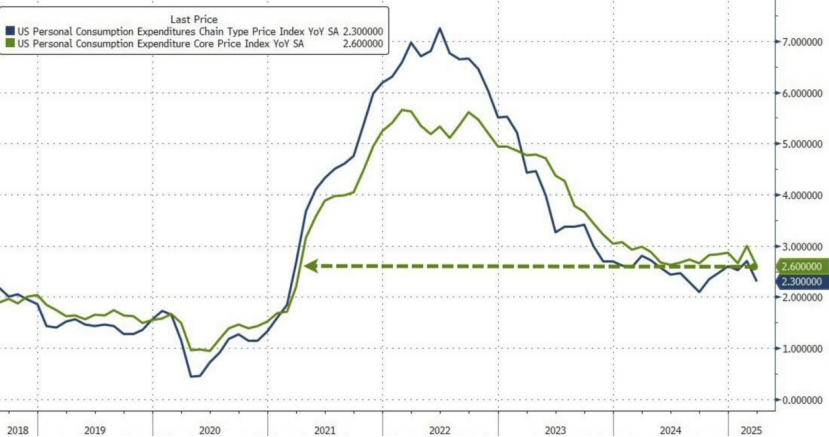
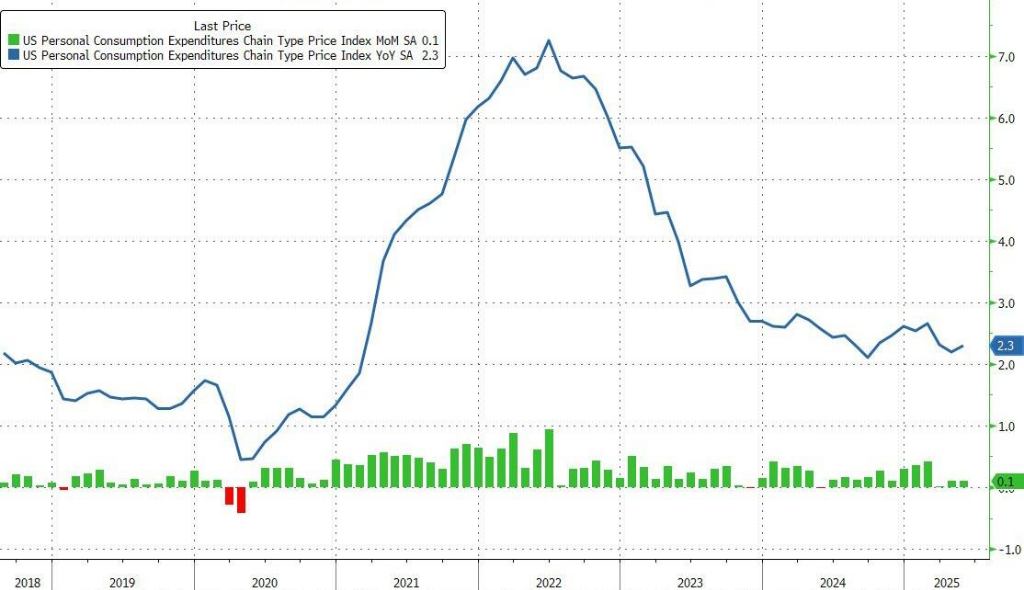
Core Points - The latest PCE price index data shows a surprising cooling in inflation, with March's year-on-year growth at 2.3%, the lowest since last fall, and core PCE at 2.6%, down from 2.8% [1][2][4] - Market expectations for Fed rate cuts have increased, with traders anticipating four 25 basis point cuts by the end of 2025, and a 65.5% probability of a rate cut in June [1][10] - The upcoming April non-farm payroll data is being closely monitored, as significant labor market disruptions due to tariff policies could increase the likelihood of a June rate cut [1][11] Inflation Data - March PCE price index year-on-year growth was 2.3%, slightly above the expected 2.2%, while the month-on-month change was 0%, matching expectations [2][4] - Core PCE year-on-year growth was 2.6%, in line with expectations, and month-on-month change was also 0%, marking the mildest increase in five years [2][4][5] - Consumer spending in March rose by 0.7%, the largest increase since early 2023, indicating proactive consumer behavior ahead of new tariffs [5][6] Market Reactions - Following the PCE data release, U.S. stock markets rebounded, with the Dow and S&P 500 closing higher, while the Nasdaq's decline was minimized [4] - Analysts suggest that weak economic data from Q1 may prompt the Fed to act more quickly on rate cuts, especially if trade agreements are reached soon [10][11] Fed's Position - Fed officials, including Waller, have indicated a shift towards a more dovish stance, particularly if high tariffs lead to significant layoffs [1][10] - The FOMC meeting scheduled for May 6-7 will be crucial in determining the Fed's next steps [9][10]