
人民币汇率

Search documents
人民币对美元中间价报7.0856 调升25个基点
Zhong Guo Jing Ji Wang· 2025-10-28 01:36
(责任编辑:关婧) 中国经济网北京10月28日讯 今日,人民币对美元汇率中间价报7.0856,较前一交易日调升25个基 点。 中国人民银行授权中国外汇交易中心公布,2025年10月28日银行间外汇市场人民币汇率中间价为: 1美元对人民币7.0856元,1欧元对人民币8.2622元,100日元对人民币4.6459元,1港元对人民币0.91228 元,1英镑对人民币9.4611元,1澳大利亚元对人民币4.6510元,1新西兰元对人民币4.0992元,1新加坡 元对人民币5.4730元,1瑞士法郎对人民币8.9232元,1加拿大元对人民币5.0708元,人民币1元对1.1296 澳门元,人民币1元对0.59313马来西亚林吉特,人民币1元对11.1576俄罗斯卢布,人民币1元对2.4289南 非兰特,人民币1元对201.77韩元,人民币1元对0.51796阿联酋迪拉姆,人民币1元对0.52880沙特里亚 尔,人民币1元对47.0175匈牙利福林,人民币1元对0.51220波兰兹罗提,人民币1元对0.9039丹麦克朗, 人民币1元对1.3221瑞典克朗,人民币1元对1.4075挪威克朗,人民币1元对5.91500土耳 ...
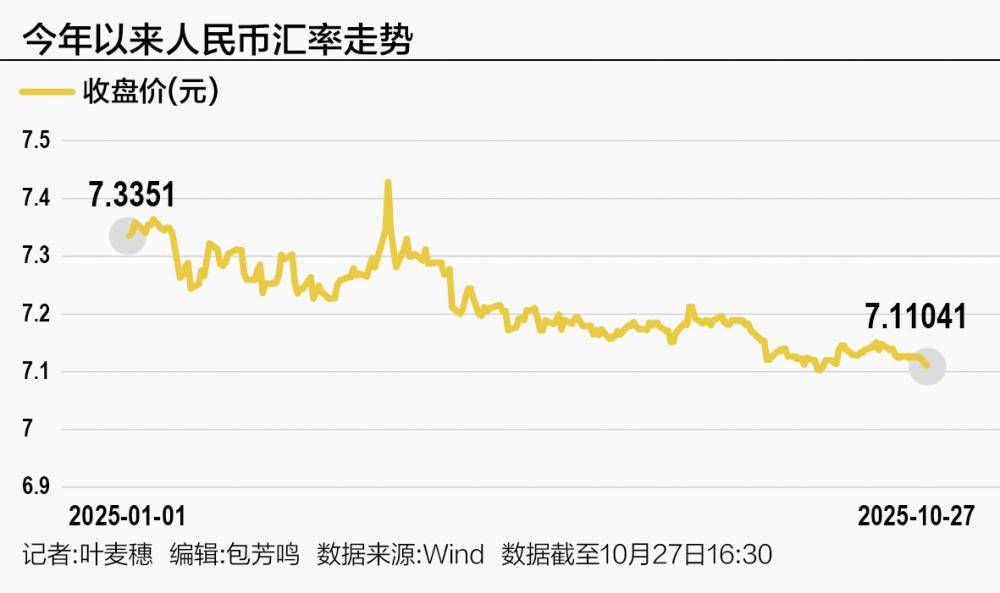
年内人民币中间价涨近千点,年底“破7”概率加大未来以稳为主
Sou Hu Cai Jing· 2025-10-27 23:13
Core Viewpoint - The recent strengthening of the Renminbi (RMB) against the US dollar is attributed to multiple factors, including expectations of US Federal Reserve interest rate cuts, positive domestic economic indicators, and progress in US-China trade negotiations [3][4][6]. Group 1: Currency Exchange Rates - As of October 27, the RMB to USD central parity rate is reported at 7.0881, marking an increase of 47 basis points from the previous day, the highest since October 15, 2024 [1]. - The RMB has appreciated approximately 1000 basis points year-to-date, with the onshore USD/RMB exchange rate down 2.56% and the offshore rate down 3.05% [1]. - The market anticipates that the USD/RMB exchange rate may "break 7" by the end of the year due to the accelerating pace of Fed rate cuts [1][6]. Group 2: Economic Factors Influencing RMB Strength - The recent rise in RMB value is supported by a 9% increase in export growth in September, the structural recovery of prices, and a stable economic foundation [3]. - Progress in US-China trade talks and the positive outlook from the 20th National Congress of the Communist Party of China have bolstered market confidence and the attractiveness of RMB-denominated assets [3][4]. - The Fed's expected rate cut of 25 basis points in October is likely to further weaken the USD, reducing external pressure on the RMB [4][6]. Group 3: Market Sentiment and Future Outlook - Analysts predict that the RMB will continue to operate in a strong position in the short term, with a focus on USD trends and RMB central parity adjustments [6]. - The RMB's potential to test the "7" threshold is supported by a weak USD environment and seasonal demand for currency exchange [7]. - The overall sentiment in the market is optimistic, with projections suggesting that the USD/RMB exchange rate could approach 7.0 by year-end under baseline scenarios [7][8].

10月23日人民币对美元中间价报7.0918元 上调36个基点
Zhong Guo Xin Wen Wang· 2025-10-27 17:25
中新网10月23日电 据中国外汇交易中心网站消息,中国人民银行授权中国外汇交易中心公布,2025年 10月23日银行间外汇市场人民币汇率中间价为:1美元对人民币7.0918,上调36个基点。 10月23日人民币对美元中间价报7.0918元 上调36个基点 编辑:付健青 广告等商务合作,请点击这里 本文为转载内容,授权事宜请联系原著作权人 中新经纬版权所有,未经书面授权,任何单位及个人不得转载、摘编或以其它方式使用。 关注中新经纬微信公众号(微信搜索"中新经纬"或"jwview"),看更多精彩财经资讯。 中国外汇交易中心网站截图 来源:中国新闻网 ...

10月24日人民币对美元中间价报7.0928元 下调10个基点
Zhong Guo Xin Wen Wang· 2025-10-27 17:25
10月24日人民币对美元中间价报7.0928元 下调10个基点 广告等商务合作,请点击这里 本文为转载内容,授权事宜请联系原著作权人 中新经纬版权所有,未经书面授权,任何单位及个人不得转载、摘编或以其它方式使用。 关注中新经纬微信公众号(微信搜索"中新经纬"或"jwview"),看更多精彩财经资讯。 中国外汇交易中心网站截图 来源:中国新闻网 编辑:付健青 中新网10月24日电 据中国外汇交易中心网站消息,中国人民银行授权中国外汇交易中心公布,2025年 10月24日银行间外汇市场人民币汇率中间价为:1美元对人民币7.0928,下调10个基点。 ...

人民币汇率年底或破7
2 1 Shi Ji Jing Ji Bao Dao· 2025-10-27 13:21
Core Viewpoint - The Chinese Yuan (RMB) is strengthening against the US Dollar (USD), with the central parity rate reported at 7.0881, marking the highest level since October 15, 2024, and a year-to-date increase of approximately 1000 basis points [1] Group 1: Factors Contributing to RMB Strength - The recent appreciation of the RMB is attributed to multiple factors, including a strong domestic economic performance, progress in US-China trade negotiations, and a favorable external environment [2][4] - The RMB's rise is supported by a significant increase in September's export growth, which reached a six-month high, and a structural recovery in prices, providing a stable foundation for the currency [4] - The anticipated interest rate cuts by the Federal Reserve are expected to weaken the USD further, reducing external pressure on the RMB [4][5] Group 2: Market Dynamics and Predictions - The USD has shown a consistent downward trend against the RMB this year, with the offshore RMB reaching a low of 7.42879 in April before rebounding as the Fed's easing stance became clearer [6] - Analysts predict that the RMB may test the 7.0 level against the USD by year-end, driven by a combination of domestic economic policies and external market conditions [8] - The market is currently rational and orderly, with expectations that the RMB will maintain stability at reasonable levels, avoiding rapid appreciation or depreciation [4][7] Group 3: Economic Implications - The strengthening RMB is expected to enhance the flexibility of China's monetary policy, allowing for better support of the real economy and reducing financing costs for small and medium enterprises [9][10] - The overall sentiment in the market is optimistic regarding China's economic recovery, which is further bolstered by the RMB's appreciation [10]
人民币汇率年底或破7
凤凰网财经· 2025-10-27 13:05
Group 1 - The core viewpoint of the article is that the Chinese yuan (RMB) is expected to strengthen against the US dollar, with predictions that the USD/RMB exchange rate may break the 7.0 mark by the end of the year due to various supportive factors [2][8][9]. - The RMB's recent appreciation is attributed to three main factors: a significant increase in export growth, progress in US-China trade negotiations, and anticipated interest rate cuts by the Federal Reserve [3][4]. - The RMB's mid-price has risen approximately 1000 basis points this year, reflecting a strong upward trend in the currency [2][5]. Group 2 - The article highlights that the RMB's strength is supported by a favorable domestic economic environment, including a structural recovery in prices and a stable economic outlook [4][11]. - Market sentiment has improved due to the ongoing US-China trade talks and the Chinese government's economic development plans, which enhance the attractiveness of RMB-denominated assets [4][11]. - The Federal Reserve is expected to cut interest rates, which would likely weaken the US dollar further, providing additional support for the RMB [5][10]. Group 3 - Analysts predict that the RMB will maintain a stable position against the USD, with a low likelihood of rapid appreciation or depreciation in the near term [8][9]. - The RMB's exchange rate is influenced by multiple factors, including seasonal demand for currency exchange and the central bank's intention to stabilize the currency [9][10]. - The overall market behavior is described as rational and orderly, indicating that the RMB is likely to remain within a reasonable range [5][6].

人民币年底或破7
Sou Hu Cai Jing· 2025-10-27 12:55
Core Viewpoint - The recent strengthening of the Renminbi (RMB) against the US dollar is attributed to multiple factors, including economic performance, trade negotiations, and anticipated interest rate cuts by the Federal Reserve, leading to expectations that the RMB may break the 7.0 mark by year-end [1][4][9]. Group 1: Economic Factors - The RMB's midpoint rate has increased approximately 1000 basis points this year, with the onshore and offshore RMB rates showing declines of 2.56% and 3.05% against the US dollar, respectively [1]. - September's export growth reached a six-month high, and structural price recovery supports the stability of the RMB [4]. - The Chinese economy's resilience and the recent progress in US-China trade negotiations have bolstered market confidence, enhancing the attractiveness of RMB-denominated assets [4][10]. Group 2: Federal Reserve Influence - The Federal Reserve is expected to cut interest rates by 25 basis points in its upcoming meeting, with a 98.9% probability of this outcome, which is anticipated to weaken the US dollar further [4][5]. - The US dollar index has dropped below 99, marking an 8.8% decline this year, with the potential for further depreciation due to the Fed's easing policies [5][9]. Group 3: Market Sentiment and Predictions - Analysts predict that the RMB will likely remain strong in the short term, with a focus on the US dollar's performance and the central bank's management of the RMB midpoint [7]. - The RMB's potential to test the 7.0 level is supported by favorable domestic fundamentals and seasonal demand for currency exchange [8]. - Optimistic forecasts suggest that the RMB could approach 7.0 by year-end, with a new equilibrium potentially settling around 6.7 under favorable conditions [9].

人民币汇率年底或破7
21世纪经济报道· 2025-10-27 12:16
Core Viewpoint - The article discusses the recent strengthening of the Chinese yuan against the US dollar, attributing it to multiple factors including economic performance, trade negotiations, and anticipated interest rate cuts by the Federal Reserve [2][3][4]. Group 1: Factors Contributing to Yuan Strength - The yuan's middle rate has increased by approximately 1000 basis points this year, with the onshore and offshore dollar-to-yuan rates declining by 2.56% and 3.05% respectively [1][3]. - Key factors driving the yuan's appreciation include a significant rise in export growth in September, structural recovery in prices, and positive economic fundamentals supporting stable exchange rates [3][4]. - Progress in US-China trade negotiations and a favorable outlook from the 20th National Congress of the Communist Party have boosted market confidence and the attractiveness of yuan-denominated assets [3][4]. Group 2: Federal Reserve's Impact - The Federal Reserve is expected to cut interest rates by 25 basis points in October, with a high probability of further cuts by December, which is likely to weaken the US dollar [4][5]. - The dollar index has dropped below 99 points, marking an 8.8% decline this year, with the maximum drop reaching 11%, the worst performance since 1973 [4][5]. - The anticipated rate cuts by the Federal Reserve are seen as a significant factor in the yuan's recent strength, as they reduce external pressure on the yuan [4][5]. Group 3: Future Outlook - Analysts predict that the yuan will continue to operate in a strong position in the short term, with a focus on the dollar's performance and the central bank's management of the yuan's middle rate [8][9]. - The yuan may test the "7" level against the dollar, supported by a weak dollar environment and seasonal demand for currency exchange [9][10]. - The overall sentiment is that the yuan will maintain stability, with limited risks of rapid appreciation or depreciation, as domestic economic policies provide a solid foundation for the currency [9][10].

攻势再起!年内人民币中间价涨近千点,年底“破7”概率加大
2 1 Shi Ji Jing Ji Bao Dao· 2025-10-27 12:07
Core Viewpoint - The Chinese yuan has strengthened significantly against the US dollar, with the midpoint rate rising nearly 1000 basis points this year, increasing the likelihood of the yuan breaking the 7.0 mark by year-end [1][2][4]. Exchange Rate Trends - As of October 27, the yuan's midpoint rate against the dollar was reported at 7.0881, marking the highest level since October 15, 2024, with a daily increase of 47 basis points [1]. - The onshore yuan has depreciated by 2.56% against the dollar, while the offshore yuan has seen a more significant decline of 3.05% [1]. - The dollar index has dropped below 99, with an 8.8% decline this year, marking its worst performance since 1973 [3]. Economic Factors Influencing the Yuan - Factors contributing to the yuan's strength include a rise in September's export growth, structural recovery in prices, and progress in US-China trade negotiations, which have bolstered market confidence [2][5]. - The Federal Reserve is expected to lower interest rates, with a 98.9% probability of a 25 basis point cut in October, further weakening the dollar and alleviating external pressures on the yuan [2][3]. Future Outlook - Analysts predict that the yuan will continue to operate in a strong position in the short term, with a focus on the dollar's performance and the central bank's management of the midpoint rate [4]. - The potential for the yuan to test the 7.0 mark is supported by favorable domestic fundamentals and seasonal demand for currency exchange [5][6]. - The central bank's ample policy tools and flexible approach to managing the exchange rate are expected to maintain stability in the yuan's value [5][6].
宏观深度报告:人民币汇率再审视
Ping An Securities· 2025-10-27 10:11
Group 1: RMB Exchange Rate Trends - Since August 25, 2025, the RMB has experienced a smooth appreciation trend, ending a previous three-week narrow fluctuation[6] - The RMB exchange rate is expected to remain above 7 for the year, with significant appreciation dependent on the stability of the Chinese economy and high-quality development[3] - The RMB has a considerable "rebound" potential, contingent on the pace of the decline in the US-China interest rate differential[7] Group 2: Market Influences - Recent adjustments in the RMB central parity rate are primarily driven by a weakening US dollar, aligning with normal pricing mechanisms[17] - The RMB's relative weakness against the US dollar reflects the impact of the second round of US-China trade disputes, with a maximum depreciation of 9.2% noted[9] - The RMB's exchange rate is closely related to the US-China interest rate differential, with a significant correlation observed since 2022[14] Group 3: Capital Flow Dynamics - Positive changes in cross-border capital flows are noted, including a sustained high trade surplus and a slowdown in China's outward direct investment[43] - The average monthly trade surplus in foreign exchange payments increased from $33.9 billion to $70.7 billion, indicating a doubling effect[27] - The shift from "currency hoarding" to "currency settlement" among foreign trade enterprises has catalyzed RMB appreciation, with the critical threshold around 7[30] Group 4: Risk Factors - Risks include the potential underperformance of growth stabilization policies, deterioration in US-China trade negotiations, and unexpected resilience in the US economy[2] - The RMB's appreciation may face challenges if the market's expectations for its stability do not solidify, particularly around the 7 mark[41]