
一核两翼

Search documents
“一核两翼”!京津冀布局现代化首都都市圈
Yang Shi Wang· 2026-02-12 18:29
Core Viewpoint - The article discusses the introduction of the "Modern Capital Urban Circle Spatial Coordination Plan (2023-2035)" by the State Council Information Office, emphasizing its role in implementing national land spatial planning and the coordinated development of the Beijing-Tianjin-Hebei region [1] Group 1 - The plan is a deepened implementation of the national land spatial planning outline and the coordinated development planning outline for the Beijing-Tianjin-Hebei region [1] - The concept of "one core and two wings" is introduced to layout the modern capital urban circle [1] - The article highlights the importance of spatial coordination in achieving the objectives of the plan [1]
首都都市圈“四区一引擎”战略定位明确
Zhong Guo Qing Nian Bao· 2026-02-12 07:20
Core Viewpoint - The approval of the "Modern Capital Urban Circle Spatial Coordination Plan (2023-2035)" marks the first urban circle plan officially approved by the Central Committee of the Communist Party of China and the State Council, aiming to enhance the capital's functions and promote regional collaboration [1] Group 1: Strategic Positioning - The plan defines the strategic positioning of the capital urban circle as "four zones and one engine," focusing on optimizing and safeguarding the capital's functions, building a world-class urban agglomeration, preserving Chinese civilization, leading regional governance, and advancing beautiful China initiatives [1] - The plan aims to create a spatial layout of "one core, two wings, dual cities, multiple points, and dual corridors" to support the development of a world-class urban circle [1] Group 2: Regional Integration and Development - The plan includes the integration of Tianjin's Wuqing District into the commuting circle and the entire Tianjin area into the functional circle, emphasizing the acceleration of the Beijing-Tianjin-Hebei innovation triangle [1] - The plan supports the coordinated development of Tianjin Binhai New Area with Hebei Xiong'an New Area and Beijing's sub-center, positioning Tianjin Port as a key strategic hub for connecting domestic and international dual circulation [1] Group 3: Implementation Strategies - Tianjin aims to leverage its advantages in location, port facilities, talent, industry, and public services to enhance its comprehensive carrying capacity and promote technological innovation and industrial upgrades [2] - The city plans to utilize platforms such as Tianjin Kai High Education and Technology Innovation Park and Binhai-Zhongguancun Science Park to support major productivity layouts and integrate deeply into the "Eight Corridors and Two Rings" transportation network [2]
中共中央、国务院:构建“一核两翼、双城多点、双廊多圈”的首都都市圈空间格局
Xin Lang Cai Jing· 2026-02-02 09:41
Core Viewpoint - The approval of the "Modern Capital Urban Circle Spatial Collaborative Planning (2023-2035)" emphasizes the construction of a spatial pattern characterized by "one core, two wings, dual cities, multiple points, and dual corridors" for the capital urban area [1] Group 1 - The plan aims to leverage Beijing as the "one core" to enhance its radiating and driving role [1] - It highlights the importance of strengthening the "four centers" functions and improving the "four services" levels to create a top-tier central government environment [1] - The high-standard and high-quality development of the Xiong'an New Area in Hebei is prioritized, with the goal of establishing Beijing's urban sub-center as a new growth pole for capital development [1] Group 2 - The plan promotes the coordinated development of the "two wings," encouraging Tianjin to enhance its role as a core area for northern international shipping [1] - It aims to jointly create a regional development highland through the collaboration of Beijing, Tianjin, and Hebei [1] - The plan emphasizes the supportive role of Hebei's node cities to form a functional pattern of mutual advantages and coordinated development [1]
中办、国办:着力优化京津冀城市体系
Xin Lang Cai Jing· 2026-02-02 09:23
Core Viewpoint - The approval of the "Modern Capital Metropolitan Area Spatial Collaborative Planning (2023-2035)" emphasizes optimizing the Beijing-Tianjin-Hebei urban system and establishing a spatial pattern of "one core, two wings, dual cities, multiple points, and multiple corridors" for the capital metropolitan area [1] Group 1: Urban Development Strategy - The plan aims to leverage Beijing's role as the "core" to enhance the construction of the "four centers" and improve the level of the "four services," creating a top-tier central government environment [1] - High standards and quality will be applied in the construction of the Xiong'an New Area in Hebei, while the Beijing urban sub-center is to be developed into a new growth pole for the capital [1] Group 2: Regional Collaboration - The strategy promotes the "dual city" narrative of Beijing and Tianjin, with Tianjin focusing on strengthening its position as a northern international shipping core area [1] - The plan aims to create a highland for regional development by fostering a functional pattern of mutual advantages and coordinated development among Hebei's node cities [1]
在“舍”中得活力 在“疏”中提质量
Xin Lang Cai Jing· 2025-12-20 22:07
Group 1 - The report highlights the establishment of a dynamic mechanism for urban planning in Beijing, featuring an annual assessment and a five-year evaluation, which serves as a practical model for achieving long-term urban development goals [1] - Beijing's "Four Centers" development strategy focuses on enhancing its political, cultural, international exchange, and technological innovation capabilities, with significant events and infrastructure projects supporting this initiative [2] - The city has successfully implemented measures to improve urban quality and governance, addressing challenges associated with large urban populations through targeted interventions and urban renewal projects [3] Group 2 - The Beijing-Tianjin-Hebei region is experiencing significant economic growth, with a reported GDP of 11.5 trillion yuan in 2024, which is 2.1 times that of 2013, indicating a robust regional development trajectory [4] - The development of the Xiong'an New Area has progressed, with over 200 square kilometers developed and investments exceeding 830 billion yuan, showcasing the region's commitment to modernization [4] - The integration of social services across the Beijing-Tianjin-Hebei region has improved, with a unified social security card system facilitating access to healthcare and transportation for residents [5]
北京亮出七大领域年度成绩单
Xin Lang Cai Jing· 2025-12-20 06:42
Group 1 - The report highlights the annual achievements in the construction and development of Beijing, focusing on seven key areas including capital functions, urban scale, spatial layout, ecological baseline, urban governance, safety resilience, and regional collaboration [1] - Beijing has established a dynamic mechanism of "annual health check and five-year assessment," making it the first super-large city in the country to implement such a system, providing a practical example for achieving long-term urban planning [1] - The inclusion of "Beijing Central Axis" in the UNESCO World Heritage List marks a significant cultural achievement, bringing the total number of World Heritage sites in China to 59 and enhancing Beijing's status as a global cultural heritage city [2] Group 2 - The report emphasizes the importance of the "Four Centers" as the driving force for the capital's development, with significant improvements in political, cultural, international exchange, and technological innovation centers [2] - Beijing has focused on enhancing its political center role by successfully organizing major events, while also promoting cultural heritage through public access to historical sites and the development of cultural centers [2] - The construction of the second phase of the National Conference Center and the official operation of the Capital International Exhibition Center are key steps in advancing international exchange capabilities [2] Group 3 - The report outlines innovative practices in urban governance, addressing challenges of large city management through targeted solutions rather than expansive growth [3] - Significant upgrades and new constructions of parks and green spaces are planned, including the development of 20 parks in the first green isolation area and the construction of the second phase of the city's largest park, the Wenyu River Park [3] - The report indicates that urban renewal efforts are systematically optimizing spatial layouts and achieving historical results in managing urban challenges [3] Group 4 - The overall strength of the Beijing-Tianjin-Hebei region is improving, with the development of the Xiong'an New Area and the relocation of government agencies to the city sub-center contributing to regional collaboration [4] - The report states that the GDP of the Beijing-Tianjin-Hebei region is projected to reach 11.5 trillion yuan in 2024, which is 2.1 times that of 2013, indicating robust economic growth [4] - The expansion of high-speed rail coverage and the implementation of a unified social security card system across the region are enhancing connectivity and convenience for residents [4]
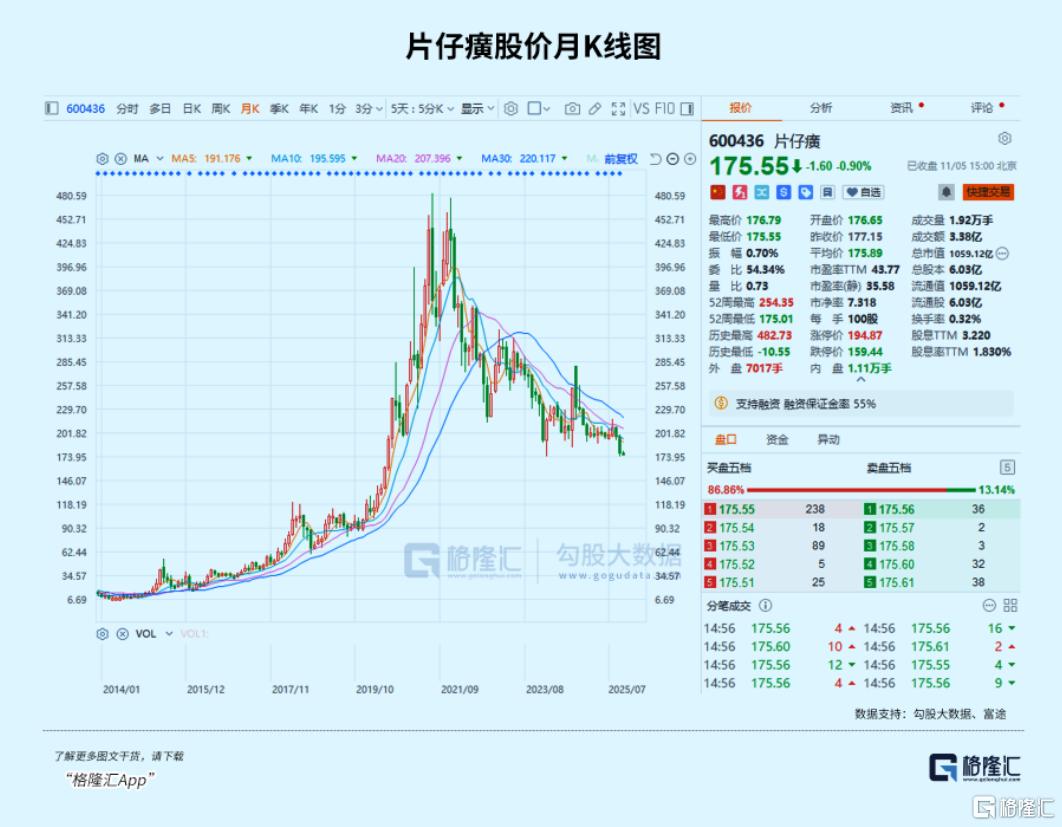
4年跌去1800亿!“药茅”跌落神坛?
Ge Long Hui· 2025-11-05 09:48
Core Viewpoint - The myth surrounding the "medicine Maotai" is gradually collapsing, as evidenced by the significant decline in the prices and performance of Pizhouhuang, a high-end traditional Chinese medicine [1][2]. Group 1: Price and Performance Decline - Pizhouhuang's price has dropped from a peak of 1600 yuan per piece to around 600 yuan, even below the official guidance price of 760 yuan [2][10]. - Since its historical high in July 2021, Pizhouhuang's stock price has decreased by 60%, with its market capitalization shrinking from nearly 300 billion yuan to 105.9 billion yuan, resulting in a loss of over 180 billion yuan [3][12]. - The third quarter of 2025 marked the worst performance in Pizhouhuang's history, with revenue down 11.93% and net profit down 20.74% year-on-year [12][15]. Group 2: Cost and Margin Pressures - The core product, liver disease medication, saw a revenue decline of 9.41% to 3.88 billion yuan in the first three quarters of 2025 [15][32]. - The overall gross margin fell below 40% for the first time in a decade, with the gross margin for Pizhouhuang series products dropping nearly 10 percentage points [15][16]. - The price of key raw materials, such as natural bezoar, has surged over 400% since 2019, further squeezing profit margins [15][16]. Group 3: Market Dynamics and Consumer Behavior - The rising prices have led to a decrease in sales volume, with some retailers reporting that they may sell only a few pieces per month due to high prices [16][18]. - The market's enthusiasm for Pizhouhuang has waned following the end of speculative trading, leading to a price-volume paradox where higher prices result in lower sales [18][19]. Group 4: Strategic Challenges and Future Outlook - Pizhouhuang's efforts to diversify its product line have not yet yielded significant results, with its cosmetics business revenue declining by 23.82% [29][33]. - The company has made several acquisitions and investments to seek new growth avenues, but these initiatives have not produced notable outcomes [37][39]. - Despite the challenges, Pizhouhuang retains its core appeal due to its unique formula and brand influence, but it must find a balance between short-term performance pressures and long-term strategic investments to transition into a modern pharmaceutical enterprise [50][51].


上海宝山晒“十四五”转型答卷,勾勒“一核两翼”未来蓝图
Guo Ji Jin Rong Bao· 2025-10-23 11:37
Core Insights - The article discusses the achievements and future plans of Baoshan District in Shanghai during the "14th Five-Year Plan" period, emphasizing its role as a model for modernization and transformation in the context of Shanghai's development strategy [1][3]. Economic Development - Baoshan's GDP surpassed 210 billion yuan, with an annual growth rate of over 5.7% in retail sales [3][5]. - The district's industrial output reached 260 billion yuan, and fixed asset investment exceeded 240 billion yuan over four years, with industrial investment accounting for 20% [3][5]. - The average annual growth rate of revenue from the service industry was 6.1%, with service sector value added exceeding 70% of the economy [3][5]. Innovation and Technology - R&D investment intensity reached 4.69%, with a 20.3% annual growth in high-tech enterprises [3][4]. - Baoshan established 36 innovation and entrepreneurship incubation platforms and collaborated with major universities to create technology parks, resulting in nearly 300 technology achievements being commercialized [4][5]. Industrial Transformation - The district is focusing on six key industries, including high-end materials and robotics, aiming to create billion-yuan industrial clusters [5][6]. - By mid-2025, Baoshan aims to handle 51% of the national cruise ship arrivals and 70% of passenger traffic, with the launch of the domestically produced cruise ship "Aida·Modu" [5][6]. Urban Development - Baoshan is undergoing significant urban renewal, with projects like the Wu Song Innovation City and the integration of high-speed rail and urban development [7][8]. - The district is enhancing its cultural and recreational offerings, including the establishment of the first cruise-themed cultural complex in the city [7][9]. Social Welfare - Baoshan has been recognized as a national civilized city, improving public services and living conditions through urban digital transformation and community development projects [8][9]. - The district is committed to enhancing the quality of life for residents by focusing on beauty, convenience, culture, and safety [8][9]. Future Vision - By 2030, Baoshan aims to become a leading area for innovation and a vibrant, open, and livable international urban center, contributing to the Yangtze River Delta integration and serving as a strategic space for Shanghai's development [10].
崇德科技2025年上半年营收净利双增 破局“内卷”全球市场连获突破
Zheng Quan Shi Bao Wang· 2025-08-26 11:02
Core Viewpoint - The global energy landscape is undergoing significant changes, driven by advancements in artificial intelligence and a shift towards renewable energy, creating new market opportunities for competitive bearing companies like Chongde Technology [1] Group 1: Financial Performance - Chongde Technology reported a revenue of 283 million yuan, an increase of 8.59% year-on-year, and a net profit attributable to shareholders of 66.28 million yuan, up 5.15% year-on-year [1] - The company plans to distribute a cash dividend of 2.00 yuan per 10 shares, totaling 17.31 million yuan [1] Group 2: Technological Advancements - The company achieved multiple breakthroughs in technology research and development, including successful applications of high-performance bearings in the petrochemical sector and continuous iterations of wind power sliding bearings [2] - New product lines such as water-lubricated bearings and air-floating bearings are accelerating in research and industrialization, gaining initial customer recognition [2] - Chongde Technology has redesigned its production system and implemented a new workshop and intelligent team model, significantly enhancing production efficiency and shortening delivery cycles [2] Group 3: International Market Expansion - Chongde Technology's international revenue grew by 14.58% year-on-year, with an overseas business gross margin of 50.04% [3] - The company successfully won multiple international client projects and signed a strategic acquisition agreement with Germany's Levicron, enhancing its global brand influence and technical collaboration [3] - The business model has shifted from backend empowerment to proactive market engagement, providing comprehensive solutions to clients and marking a significant advancement in marketization [3] Group 4: Strategic Direction - The domestic bearing industry is experiencing accelerated restructuring, with a shift from price competition to high-value creation, increasing customer demands for product reliability and advanced technology [4] - Chongde Technology aims to leverage its technological barriers and brand effects to expand market share, guided by its "one core, two wings" strategy [4] - The company plans to strengthen its core competitiveness in industrial bearings and international client development while seizing opportunities in global energy transition and equipment upgrades for high-quality growth [4]
建设工业:主营业务保持稳定,“一核两翼”向新发展-20250605
Tai Ping Yang Zheng Quan· 2025-06-05 00:45
Investment Rating - The report assigns an "Accumulate" rating for the company with a target price of 21.00, compared to the last closing price of 20.44 [1]. Core Insights - The company's main business remains stable, and it is advancing its "one core, two wings" development strategy. The focus is on enhancing its weaponry supply system and transitioning its automotive parts business towards electric and integrated solutions [4][5]. - The company has significantly increased its R&D investment, reaching 2.79 billion in 2024, a 36.29% increase year-on-year, indicating a strong commitment to technological innovation [5]. - The financial forecast predicts net profits of 2.67 billion, 2.69 billion, and 2.73 billion for 2025 to 2027, with corresponding EPS of 0.26 for each year, reflecting a stable outlook [5][7]. Financial Performance - In 2024, the company achieved a revenue of 4.36 billion, a 2.32% increase from the previous year, while net profit decreased by 10.70% to 2.60 billion [3][7]. - The projected revenue growth rates for the next three years are modest, with expected increases of 0.50%, 1.50%, and 2.50% from 2025 to 2027 [7]. - The company holds a total market capitalization of 211.15 billion, with a circulating market value of 82.39 billion [3].
