不确定性对冲

Search documents
黄金25年长牛为何突然爆发?央行在低配警报下加速购金!
Jin Shi Shu Ju· 2025-12-11 06:45
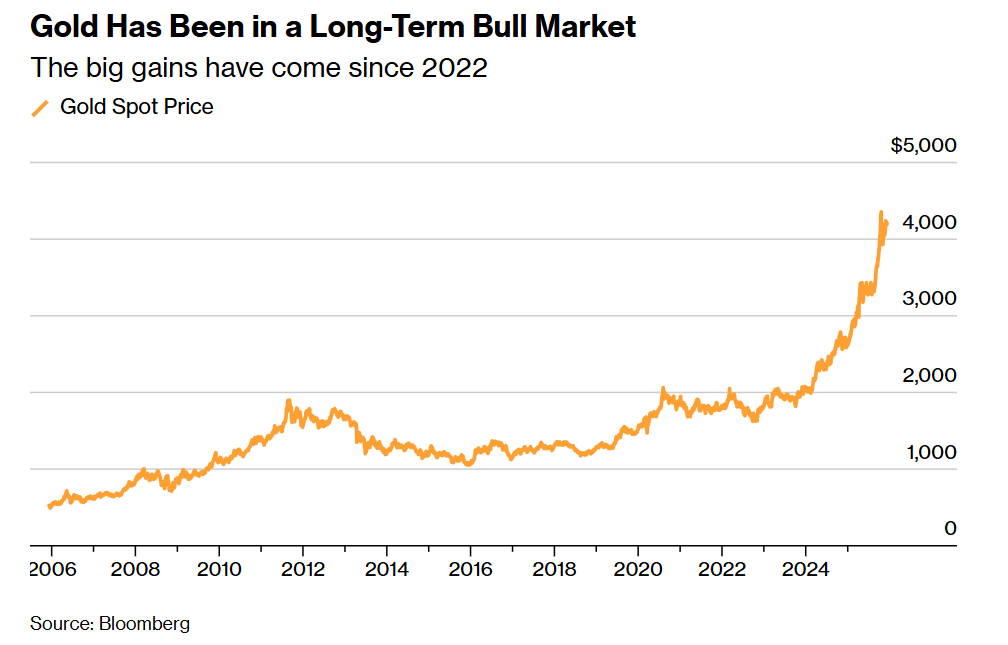
Group 1 - Central banks worldwide are selling dollars and increasing gold reserves, with gold becoming a key hedge against rising dollar risks amid the Federal Reserve's third interest rate cut this year [1] - Gold demand is primarily driven by central banks seeking to hedge dollar exposure, helping to stabilize gold prices above $4,000 per ounce [1] - Compared to historical levels, central banks' gold allocations remain low, with non-monetary investors showing even lower allocations [1][4] Group 2 - The ongoing bull market for gold, which has lasted 25 years, saw a significant acceleration in prices starting in 2022, driven more by uncertainty than inflation [2][4] - Central banks are increasingly replacing part of their dollar reserves with gold, a trend that began after the Russia-Ukraine conflict in 2022 [6] - Countries like Poland, Brazil, Uzbekistan, Indonesia, Turkey, and China have significantly increased their gold purchases, with Poland alone purchasing over 1 ton in October [7] Group 3 - Economic strategist David Rosenberg emphasizes that central banks recognize gold as a low-allocated asset, with current gold reserves at 25% of total reserves compared to a historical average of 35% [7] - The annual growth rate of gold supply is estimated at 1%, while demand is growing at 2.5%, indicating a significant supply-demand imbalance [7] - Despite record high gold ETF holdings, only 1% of global investment portfolios are allocated to gold, down from nearly 25% in the early 1980s [7] Group 4 - Silver is also gaining traction, with its price doubling from pre-pandemic lows, and it is expected to continue rising due to its industrial applications [9] - The recent geopolitical uncertainties have made strategic commodity reserves increasingly important, highlighting the need for security in commodity procurement [12] Group 5 - The Federal Reserve's dovish stance contrasts with other central banks, which may lead to favorable conditions for gold as monetary and inflation risks shift [13]

Opinion | What Is the Price of Gold Telling Us?
WSJ· 2025-10-07 21:00
Core Viewpoint - There is an increasing need for hedging against uncertainty in the current environment [1] Group 1 - The current economic climate presents various uncertainties that investors are facing [1] - Investors are actively seeking strategies to mitigate risks associated with market volatility [1] - The demand for hedging instruments is rising as a response to these uncertainties [1]

黄金上周玩起“过山车”,帮主带你看透背后的逻辑
Sou Hu Cai Jing· 2025-04-28 03:22
Core Viewpoint - The recent volatility in the gold market is driven by various factors, including U.S. economic data and geopolitical tensions, highlighting the importance of maintaining a long-term investment perspective in the face of short-term fluctuations [3][4]. Market Dynamics - Gold serves as both a safe-haven asset and a barometer for the U.S. dollar, with recent price movements reflecting the tug-of-war between positive U.S. economic indicators and concerns over financial stability [3]. - Strong employment data in the U.S. raised expectations for continued interest rate hikes by the Federal Reserve, leading to a temporary decline in gold prices due to increased opportunity costs associated with holding gold [3]. - Subsequent concerns about the U.S. banking system and ongoing geopolitical issues in regions like the Middle East and Eastern Europe reignited demand for gold as a safe-haven asset, causing price fluctuations [3]. Long-term Investment Perspective - The current economic environment remains uncertain, with debates over whether the global economy is experiencing a "soft landing" or a "hard landing," making gold's role as a hedge against uncertainty particularly relevant [4]. - Historically, gold prices tend to rise as the Federal Reserve approaches the end of its interest rate hike cycles, suggesting potential long-term investment opportunities in gold [4]. - Investors are encouraged to focus on two key factors: the trajectory of U.S. real interest rates, which influences gold's mid-term valuation, and the evolving global geopolitical and economic landscape, which affects long-term demand for gold [4].