业技融合

Search documents
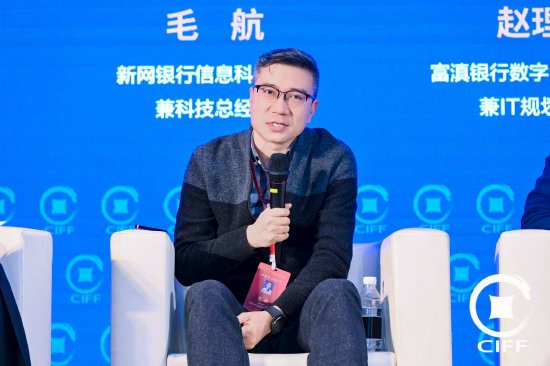
毛航升任新网银行首席信息官
2 1 Shi Ji Jing Ji Bao Dao· 2026-02-27 12:08
Core Viewpoint - The appointment of Mao Hang as the Chief Information Officer of Sichuan Xinwang Bank marks a significant step in enhancing the bank's digital and intelligent transformation efforts, leveraging his extensive experience in financial technology [1][3]. Company Overview - Sichuan Xinwang Bank, one of the three internet banks in China, was officially established on December 28, 2016, with a registered capital of 3 billion yuan. It was initiated by shareholders including New Hope Group, Xiaomi, and Hongqi Chain, and is recognized as the seventh private bank approved by the former China Banking Regulatory Commission [4]. - As of June 30, 2025, the total asset scale of Xinwang Bank reached 105.696 billion yuan, with operating income of 3.412 billion yuan in the first half of 2025, reflecting a year-on-year growth of 14.17%. The net profit attributable to shareholders was 486 million yuan, showing a year-on-year increase of 21.59% [4]. Leadership and Strategy - Mao Hang, with a background in computer science and technology, has held various positions in the China Industrial and Commercial Bank and has been the Information Technology Director and General Manager of the Technology Department at Xinwang Bank [3]. - During the "China International Financial Forum" on December 19-20, 2025, Mao emphasized that "business-technology integration" is fundamental for successful digital transformation, advocating for a deeper integration in the future [3]. - Mao noted that currently, 20% of the bank's telemarketing and 60% of debt collection calls are handled by AI, indicating significant improvements in customer experience through AI empowerment. However, he acknowledged the need for further restructuring of processes to fully realize the potential of AI [4].


融业技之智 聚技术之力 做实金融“五篇大文章”
Jin Rong Shi Bao· 2026-02-11 01:43
Core Viewpoint - The Central Financial Work Conference emphasizes the importance of focusing on five key areas: technology finance, green finance, inclusive finance, pension finance, and digital finance, highlighting the interconnected roles of technology and finance in supporting the real economy [1][2]. Group 1: Technology and Finance Integration - The conference theme "Technology Bridges, Finance Foundations" illustrates the relationship between technology and finance, where technology acts as a bridge to overcome development obstacles and connect innovative resources, while finance serves as a foundation to support the real economy [1]. - The continuous innovation in financial technology is evident from recent awards and applications, showcasing the vibrant development of technology within the financial sector [1]. Group 2: Promotion and Sharing of Financial Technology Achievements - Effective promotion and sharing of financial technology achievements will rely on authoritative channels and industry consensus, with a focus on leveraging professional financial media for deep reporting and case studies [2]. - Establishing a collaborative ecosystem for the effective transformation and sharing of financial technology results is crucial, particularly for small and medium-sized institutions, to reduce costs and foster a culture of collaboration [2]. Group 3: Serving the Real Economy - The value of financial technology achievements will increasingly be measured by their ability to meet the real needs of the economy, such as addressing financing challenges for tech enterprises and enhancing the accessibility of inclusive finance [2]. - The commitment to ensuring that technological innovations serve the core business and enhance service coverage, accessibility, and satisfaction is essential to prevent a disconnect from the real economy [2].
新网银行毛航:“业技融合”是做好数字化转型的基础
Xin Lang Cai Jing· 2025-12-22 09:26
Core Viewpoint - The 22nd China International Financial Forum was held in Shanghai, focusing on building an intelligent financial ecosystem in the digital economy era [1][4]. Group 1: Company Strategy - Xinwang Bank aims to drive business through financial technology innovation since its establishment at the end of 2016, focusing on differentiated digital inclusive finance [3][6]. - The bank emphasizes the integration of business and technology as a foundation for successful digital transformation, with a focus on delivering business value and transparency in technology resources [3][6]. Group 2: Challenges and Opportunities - The transition from "+AI" to "AI+" is highlighted, with 20% of outbound sales and 60% of debt collection calls currently handled by AI, indicating significant improvements in customer experience [3][6]. - The bank recognizes the importance of enterprise-level knowledge accumulation and modeling in the era of large models, suggesting that knowledge management will be a key differentiator for future development [3][6]. - The notion of technological equality brought by large models is discussed, with a caution that equality does not equate to equal capabilities, raising concerns about the widening capability gap between large and small banks [3][6].
东吴证券:科技践行专业文化理念,助力企业高质量发展
Zhong Guo Jing Ji Wang· 2025-11-14 06:47
Core Insights - The securities industry is entering a new phase of cultural development, with technology becoming the core engine for reshaping the industry ecosystem and strengthening professional foundations [1] - East Wu Securities is actively responding to national strategies such as "technological self-reliance" and is committed to deepening the integration of technology and culture [2][11] - The company aims to build a modern securities holding group characterized by standardization, marketization, technological advancement, and internationalization [3] Group 1: Digital Transformation Strategy - East Wu Securities has launched a digital transformation strategy focused on "business-technology integration" to create a four-layer digital transformation system [3][4] - The company emphasizes the integration of resources across various lines to ensure that digitalization permeates every aspect of business processes and management operations [4] - The digital transformation aims to evolve the organization from a "control-type" to a "platform-enabled" model, fostering a data-driven and collaborative mechanism [3] Group 2: Technological Innovations and Achievements - In October 2023, East Wu Securities released the industry's first fully self-innovated core trading system, A5, which utilizes domestic software and hardware technology [6] - The company has developed its own large model, "Dongwu Xiucai GPT," which is the first self-developed model in the domestic securities industry to complete algorithm filing [6] - East Wu Securities has launched various AI-driven products and services, enhancing the personalization and efficiency of financial services [6] Group 3: Cultural Integration and Talent Development - The company promotes a culture of innovation by integrating technology into its core values and operational practices [8][11] - East Wu Securities has organized training programs to enhance employees' understanding and application of AI technology, fostering a learning-oriented organization [8] - The company encourages participation in industry competitions to establish professional value benchmarks and recognize technological breakthroughs [10] Group 4: Compliance and Risk Management - East Wu Securities has developed a comprehensive anti-money laundering system and a risk management platform to meet regulatory requirements [7] - The company aims to create a real-time dynamic compliance and risk management tracking process, supporting its business operations [7] Group 5: Future Directions and Goals - East Wu Securities is committed to enhancing its professional investment research capabilities and expanding its overseas business presence [11] - The company aims to leverage technology and culture to drive internal motivation and resilience, contributing to the high-quality development of the financial sector [11]

《2025年中国金融科技行业发展洞察报告——卓越榜单与典型案例分享》
艾瑞咨询· 2025-05-18 10:48
Core Insights - The financial technology (FinTech) industry is experiencing significant growth, with projections indicating a compound annual growth rate (CAGR) of approximately 13.3%, expected to exceed 650 billion yuan by 2028 [1] - The report emphasizes the importance of a technology-driven financial value enhancement system, focusing on the "technology-industry-finance" cycle and the diversified, compliant application of data elements in financial business scenarios [1] Industry Trends - The current core development trends in the domestic FinTech market include a focus on scenario finance and the integration of technology with business value, as financial institutions increasingly prioritize the contribution of technology to business outcomes [33] - The domestic market is entering a dual development phase characterized by deep technological cultivation and value release, with a growing emphasis on compliance technology [33] - The trend of domestic financial technology regulation is becoming clearer, leading to increased attention on compliance technology in the future [33] Notable Companies and Innovations - Softstone Technology is leveraging generative AI to drive innovation in financial technology applications, focusing on areas such as intelligent marketing and risk control [11][13] - Chexiao Technology specializes in credit risk control, offering a comprehensive suite of platforms for automotive finance and risk management [15][16] - China Mobile Financial Technology (Zhongyi Jinke) is developing a full-scenario enterprise consumption management platform, addressing various corporate spending needs [22] Product and Service Developments - The report highlights the emergence of AI-driven financial advisory tools that enhance traditional banking services, integrating features like intelligent marketing and customer service [13] - The development of large-scale financial risk control models capable of identifying customer identities and assessing credit risks is noted, achieving over 99% accuracy in production-level services [24] Future Outlook - The integration of financial cloud and core business middle platform systems is expected to provide comprehensive solutions for consumer credit in smart banking [19] - The application of vertical large models in financial scenarios is anticipated to facilitate a transition from basic digitalization to deep intelligent transformation within the industry [36]

14家银行年报里的科技战略:8家银行科技架构生变,重点按两大方向调整
2 1 Shi Ji Jing Ji Bao Dao· 2025-04-02 12:21
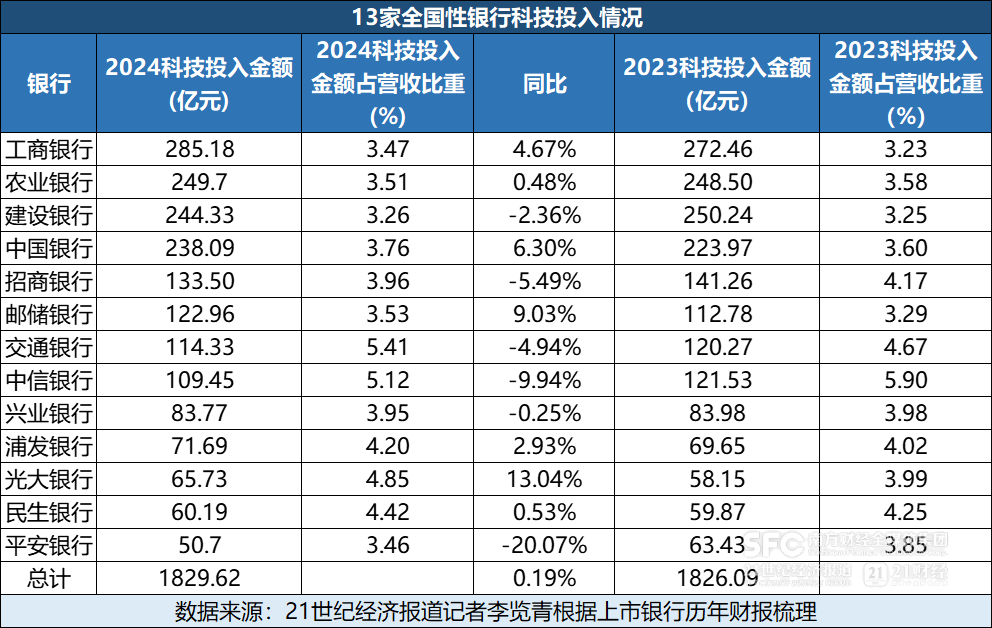
Core Viewpoint - The digital transformation of banks has entered a phase of "refinement," with a focus on optimizing technology investments and organizational structures amid a backdrop of cost reduction and efficiency improvement in the banking industry [2][3]. Technology Investment Overview - In 2024, 13 banks reported a total technology investment of approximately 182.96 billion yuan, a slight increase of 0.19% compared to 182.61 billion yuan in 2023, indicating a stabilization in technology spending [2][3]. - Only one bank, Everbright Bank, achieved double-digit growth in technology investment, increasing by 13.04% to 6.57 billion yuan, while other banks showed varying degrees of decline in their technology investments [3][4]. - Among the six major state-owned banks, total technology investment reached 125.46 billion yuan, a year-on-year increase of 2.1%, accounting for 68.57% of the total investment from the 13 banks [3]. Changes in Technology Investment - Six banks reported a decrease in technology investment, with Ping An Bank experiencing the largest decline of 20.07%, while others like China Construction Bank and China Merchants Bank also saw reductions of 2.36% and 5.49%, respectively [4][5]. - The focus on technology investment is shifting towards optimizing resource allocation rather than rapid growth, reflecting the initial establishment of digital infrastructure [6]. Technology Investment as a Percentage of Revenue - Eleven banks reported technology investment as a percentage of revenue exceeding 3.5%, with the highest being at 5.41% for the Bank of Communications, followed by CITIC Bank at 5.12% [6]. - The increase in technology investment ratios indicates a stronger emphasis on technology resources within the banks [6]. Human Resource Allocation in Technology - All banks, except for Ping An Bank, increased the proportion of technology personnel within their total workforce, reflecting a commitment to enhancing technological capabilities [7][8]. - The highest proportion of technology personnel is at Industrial Bank, with 13.51%, followed by Bank of Communications at 9.44% [9]. Organizational Structure Adjustments - Eight banks have made adjustments to their technology structures, focusing on enhancing governance and data management capabilities [11][12]. - The establishment of digital financial committees and data management departments is a common trend among banks to improve strategic planning and data governance [11][12][13]. - For instance, Industrial Bank has formed a digital financial committee to enhance decision-making processes, while China Bank has integrated its business development and software centers to boost digital capabilities [11][12]. Talent Development Initiatives - Banks are increasingly focusing on building a talent pool that combines technical and business skills, with initiatives aimed at fostering a culture of technological proficiency among all employees [10][11]. - For example, Postal Savings Bank is developing a team of agile, cross-functional professionals, while Industrial Bank is enhancing its talent acquisition and training programs to include high-level expertise in emerging technologies [10][11].



艾瑞咨询:2025年中国金融科技行业发展洞察报告
Sou Hu Cai Jing· 2025-03-31 11:03
Group 1 - The core viewpoint of the report is that the Chinese fintech industry is expected to grow significantly, with a market size projected to exceed 650 billion yuan by 2028, driven by technological innovation and policy support [1][13][11] - The report highlights the importance of digital transformation in financial institutions, emphasizing that strategic planning is becoming a core driver for this transformation [9][21] - The integration of advanced technologies such as artificial intelligence and big data is crucial, with a notable increase in cloud deployment acceptance among financial institutions [1][9][11] Group 2 - The report outlines the current state of the fintech industry, indicating that the market is transitioning from a focus on technology-driven solutions to a more business-driven approach [9][21] - It emphasizes the growing demand for comprehensive and systematic financial technology services, particularly in banking, insurance, and securities sectors [9][21] - The report identifies key trends in technology development, including the rapid growth of generative AI investments and the slow adoption of blockchain products [1][11][13] Group 3 - The report evaluates outstanding enterprises in the fintech sector, recognizing companies like Softcom Power and Chexiao Technology for their innovative services [1][11] - It discusses the need for technology service providers to enhance their product customization and scenario-based capabilities to meet the evolving demands of financial institutions [1][11] - Experts predict that the fintech industry will focus on the integration of large models, cloud-native and AI-native solutions, and compliance technology in the future [1][11][13]