大模型时代

Search documents
平庸的灭绝,大模型时代企业考89分依然可能会“死”?
混沌学园· 2026-03-18 12:06
Core Insights - The article emphasizes the transformative impact of AI on traditional business models, highlighting the shift from "software engineering" to "digital life" and the need for companies to adapt to this new reality [2][3]. Group 1: AI Industry Dynamics - The AI industry is characterized by a sense of "dizziness," where entrepreneurs are both excited about the potential value AI can bring and concerned about the disruption of core competencies due to rapid industry evolution [6]. - There is a significant disparity in the AI landscape, with 95% of AI projects failing to deliver returns, indicating a "fire and ice" scenario where some companies thrive while others struggle [6]. Group 2: Historical Context and Lessons - The development trajectory of electricity serves as a parallel to AI, moving from infrastructure battles and simple replacements to process reengineering and original innovation, suggesting a similar path for AI [9]. - The article outlines the historical pain points of the industrial era, where standardization was necessary to optimize physical labor, leading to a compromise on intelligence [10][11]. Group 3: AI's Revolutionary Changes - AI enables the unlimited expansion and affordability of cognitive capabilities, leading to a dual abundance of both physical and mental resources, thus liberating businesses from the constraints of standardization [12]. - The competitive landscape is shifting from macro-level product development to micro-level individual service, fundamentally altering business logic from group adaptation to individual customization [13][14]. Group 4: Disruptive Transformations - The article identifies three key transformative changes brought by AI: the extinction of mediocrity, the devaluation of process value, and the reversal of marginal effects [15][16]. - The market distribution is expected to shift from a normal distribution to a power-law distribution, where only the top 1% will thrive, while mediocre services will lose all value [17][18]. Group 5: Rethinking Competitive Moats - Companies must reassess their competitive moats in light of AI's ability to make intelligence as cheap and ubiquitous as utilities, questioning the effectiveness of traditional barriers built on information asymmetry and skill proficiency [30][31]. - The article warns that many companies are still focused on deepening their moats without recognizing the structural changes brought by AI, risking the creation of "negative assets" [34][35]. Group 6: AI Native Products - The article introduces the concept of "AI Native" products, which fundamentally differ from traditional software by allowing machines to adapt to human needs rather than the other way around [70][71]. - Four key criteria are proposed to evaluate whether a product is truly AI Native: survival testing, inclusivity testing, logical resilience testing, and responsibility transfer testing [75][76][77][78]. Group 7: Product Design Methodology - The core methodology for AI product design emphasizes embracing chaos, enhancing intent transfer, and ensuring transparency in AI operations [81][84]. - The design should focus on fluidity rather than rigidity, allowing for dynamic adaptation to user needs and minimizing cognitive load on users [84].


OpenClaw刷屏背后的冷思考:为什么95%的企业做AI都在亏钱?
混沌学园· 2026-03-12 11:55
Core Viewpoint - The article discusses the overwhelming anxiety and confusion in the business world due to the rapid advancements in AI technology, particularly highlighting the OpenClaw AI personal assistant as a symbol of this shift [1][2]. Group 1: AI Investment and Returns - A study by MIT reveals that 95% of corporate investments in AI have not resulted in tangible financial returns [3]. - The article emphasizes the need for a "future-oriented business cognitive navigation system" to cut through the noise of information overload and focus on essential structural variables [3]. Group 2: Misalignment in AI Implementation - Many companies attribute their failures in implementing large models to the models being "too dumb" or having "too many hallucinations," but the real issue is often a mismatch in business scenarios [9]. - The analogy of fitting an F1 engine into a delivery tricycle illustrates the folly of trying to apply high-powered AI to inefficient traditional business processes [9]. Group 3: Historical Context and Lessons - The article draws parallels between the current AI revolution and the early days of the electrical revolution, where companies failed to adapt their structures to leverage new technologies effectively [12][13]. - It highlights the importance of removing outdated processes (the "transmission shaft") to fully utilize the capabilities of new technologies [12][16]. Group 4: The New Business Landscape - In the AI era, services rated below 90 points are at risk of becoming obsolete, leading to a market split where only the top 1% will survive [20]. - The article discusses the shift from traditional hourly billing to results-based pricing, urging companies to find new competitive advantages [21]. Group 5: Product Development Evolution - The role of product managers is evolving from "architects" to "gardeners," focusing on creating adaptable products that meet human needs rather than rigidly following predefined paths [21]. - The article introduces the concept of "AI native" products and the need for a new framework to evaluate their authenticity [25]. Group 6: Future Insights - The article suggests that understanding the underlying principles of AI and its impact on business will enable companies to seize opportunities in the changing landscape [28][29]. - It emphasizes the importance of mastering future judgment methods and actionable frameworks to navigate the evolving market [29].
毛航升任新网银行首席信息官
2 1 Shi Ji Jing Ji Bao Dao· 2026-02-27 12:08
Core Viewpoint - The appointment of Mao Hang as the Chief Information Officer of Sichuan Xinwang Bank marks a significant step in enhancing the bank's digital and intelligent transformation efforts, leveraging his extensive experience in financial technology [1][3]. Company Overview - Sichuan Xinwang Bank, one of the three internet banks in China, was officially established on December 28, 2016, with a registered capital of 3 billion yuan. It was initiated by shareholders including New Hope Group, Xiaomi, and Hongqi Chain, and is recognized as the seventh private bank approved by the former China Banking Regulatory Commission [4]. - As of June 30, 2025, the total asset scale of Xinwang Bank reached 105.696 billion yuan, with operating income of 3.412 billion yuan in the first half of 2025, reflecting a year-on-year growth of 14.17%. The net profit attributable to shareholders was 486 million yuan, showing a year-on-year increase of 21.59% [4]. Leadership and Strategy - Mao Hang, with a background in computer science and technology, has held various positions in the China Industrial and Commercial Bank and has been the Information Technology Director and General Manager of the Technology Department at Xinwang Bank [3]. - During the "China International Financial Forum" on December 19-20, 2025, Mao emphasized that "business-technology integration" is fundamental for successful digital transformation, advocating for a deeper integration in the future [3]. - Mao noted that currently, 20% of the bank's telemarketing and 60% of debt collection calls are handled by AI, indicating significant improvements in customer experience through AI empowerment. However, he acknowledged the need for further restructuring of processes to fully realize the potential of AI [4].

大学无用?奥特曼辍学当了CEO,但名校生撑起了整个OpenAI
Sou Hu Cai Jing· 2026-01-26 10:50
Core Insights - The article highlights the importance of educational background in the AI industry, countering the narrative that degrees are irrelevant by showcasing the concentration of talent from prestigious universities at OpenAI [1][4][7] - OpenAI's employee distribution reveals that top universities like Stanford, UC Berkeley, and MIT contribute significantly to its workforce, indicating a strong correlation between educational pedigree and career opportunities in AI [7][9] - The competition for AI talent has escalated, with companies offering unprecedented salaries and benefits to attract top researchers, emphasizing that talent is the true competitive advantage in the AI sector [18][21][24] Educational Background - OpenAI employs 230 individuals from Stanford, 151 from UC Berkeley, and 100 from MIT, with these three institutions accounting for over 13% of the total workforce [7] - The presence of international institutions like the University of Waterloo, Tsinghua University, and Peking University in the top 20 further illustrates the global nature of AI talent [7][12] - The article suggests that while the educational background is significant, practical experience and project outcomes are ultimately more valuable in the AI field [14] Talent Competition - The AI talent war has entered a new phase, with companies like Google DeepMind reportedly offering compensation packages up to $20 million, including substantial signing bonuses [21][24] - The demand for AI talent has led to explosive salary growth for entry-level positions, making it competitive with senior roles in other industries [22] - OpenAI's resident researcher program offers competitive salaries and opportunities for formal positions, reflecting the industry's shift towards securing top talent through attractive compensation and resources [25] Industry Dynamics - The article emphasizes that the AI industry's evolution is driven by the aggregation of top talent, which creates a feedback loop that enhances innovation and application of research [26] - The narrative suggests that the competition for AI talent transcends salary, focusing on infrastructure, resource access, and visionary goals as key factors in attracting talent [24] - The findings from OpenAI's employee alma mater rankings reinforce the notion that the company's true strength lies in its ability to attract and retain top-tier AI talent rather than just its technological capabilities [24]
硅谷换血: 大模型时代为何华人取代了印度工程师?
3 6 Ke· 2025-08-13 10:40
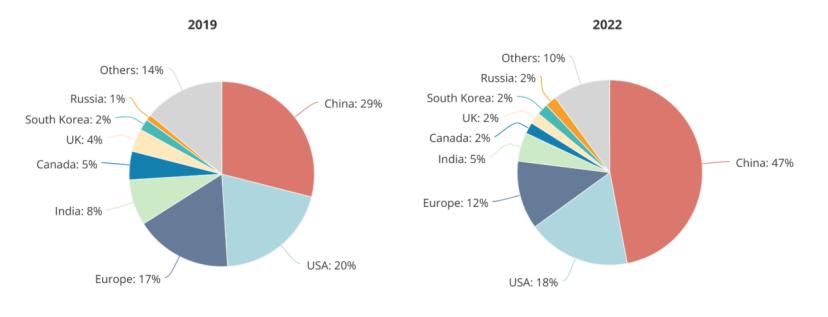
Core Insights - The talent landscape in Silicon Valley is shifting from Indian engineers to Chinese researchers due to the rise of large language models (LLMs) and generative AI, which require different skill sets [1][24][25] Group 1: Talent Demographics - In 2019, Chinese nationals made up 29% of top AI researchers in the U.S., which increased to 47% by 2022, with projections to exceed 50% by 2025 [2][4] - The shift indicates a growing dominance of Chinese talent in cutting-edge AI research, contrasting with the previous era where Indian engineers were more prevalent [4][24] Group 2: Educational Foundations - Chinese education emphasizes foundational sciences and mathematics, producing a large pool of talent well-suited for AI research [12][14] - In 2021, 33% of science and engineering PhDs awarded to international students in the U.S. were to Chinese students, compared to 15% for Indian students [13][24] Group 3: Cultural and Structural Factors - The Indian education system focuses on engineering and management, leading to a talent pool that is less inclined towards long-term research careers [15][17] - Cultural factors, such as the caste system and religious practices, create barriers for Indian professionals in Silicon Valley, affecting workplace dynamics and integration [18][20][23] Group 4: Industry Implications - The demand for research-oriented talent in AI has led to a re-evaluation of talent sourcing in Silicon Valley, with Chinese researchers filling the gap left by Indian engineers [24][25] - The contrasting educational and cultural approaches between India and China highlight the evolving needs of the tech industry, particularly in AI [24][25]
助力企业出海,科大讯飞发布L4级智能营销解决方案
Jing Ji Wang· 2025-04-10 08:08
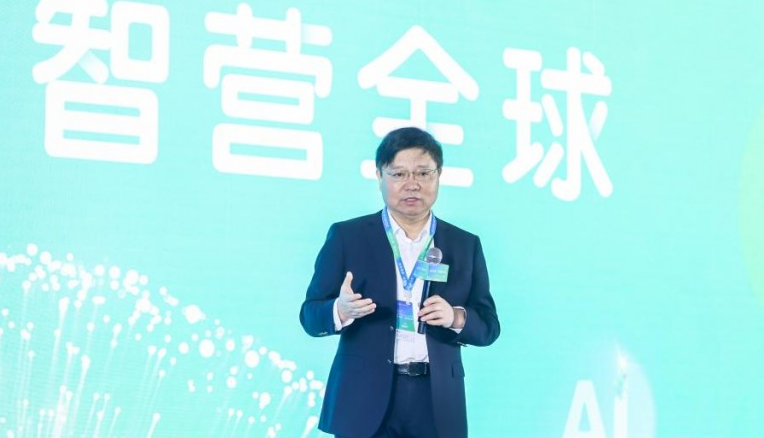
Core Insights - The 2025 iFLYTEK Global Intelligent Marketing Product Launch Conference was held with the theme "AI Without Boundaries, Smartly Operating Globally," gathering over 400 marketing experts to witness the era of large models [1] - The conference highlighted that the era of large models presents new opportunities for Chinese enterprises, enhancing brand marketing through upgraded AI capabilities, enabling brands to seize opportunities in international markets [2] Company Developments - iFLYTEK's Senior Vice President Yu Jidong announced an upcoming upgrade for the iFLYTEK Spark X1 [3] - The AI marketing business president Li Ping shared that AI technology has evolved from single capabilities (L1) to dynamic planning (L4), driving marketing transformation [3] - iFLYTEK officially launched the L4-level intelligent marketing solution, iFLYTEK AIMarX, covering influencer marketing, precise advertising, and independent e-commerce, facilitating a complete process from influencer engagement to in-site operations [3] Product Launches - iFLYTEK introduced the first AI-driven programmatic influencer trading platform, iFLYTalent, which addresses the full chain of influencer marketing needs through six core functions [4] - The company launched an independent e-commerce marketing platform powered by AI, offering three solutions: EchoMind market insight system, SeedingCraft creative generation, and UserPulse user operation hub, aimed at solving challenges in international expansion [4] Industry Impact - The advancements in AI marketing are expected to revolutionize the entire marketing chain, transitioning from experience-driven to data intelligence, and from manual trial-and-error to dynamic decision-making [3] - iFLYTEK's AI marketing initiatives are positioned to better serve global partners with a more global perspective and creative thinking [6]