
中式快餐资本化

Search documents
“中式小面第一股”上市首日暴跌,是面凉了,还是估值太“烫嘴”?
Sou Hu Cai Jing· 2025-12-17 06:01
Core Viewpoint - The IPO of "Yujian Xiaomian" (02408.HK), a Chinese noodle chain, faced significant market challenges, with its stock price dropping substantially on the first trading day, reflecting a disconnect between high valuations and actual market performance [1][3][19] Group 1: IPO Performance - Yujian Xiaomian's IPO was priced at HKD 7.04 per share, but it opened at HKD 5.00, a decline of 28.98%, and closed at HKD 5.08, down 27.84% on its first day [1][3][4] - The company had a strong IPO backing, with cornerstone investors subscribing to USD 22 million (approximately HKD 171 million), representing 25% of the total fundraising [3][4] Group 2: Industry Trends - The noodle restaurant industry is experiencing a cooling period, with leading brands reducing their expansion efforts and facing a decline in financing activity [5][6] - The overall market for Chinese noodle restaurants is projected to grow from RMB 1,833 billion in 2020 to RMB 2,962 billion by 2024, with a compound annual growth rate of 12.7% [10] Group 3: Company Performance - Yujian Xiaomian expanded its store count from approximately 170 at the end of 2022 to 451 by mid-2025, achieving a compound annual growth rate of nearly 50% [6][10] - Despite rapid expansion, the company faced declining performance metrics, with average customer spending dropping from RMB 36.2 to RMB 31.8, a decrease of 12.1% [6][10] Group 4: Valuation Concerns - The company's pre-IPO valuation was significantly high, with a price-to-earnings ratio around 70, which is well above the typical range of 10-25 for the restaurant industry [7][10] - The aggressive expansion strategy raised concerns about sustainability and profitability, leading to skepticism among investors [8][9] Group 5: Market Dynamics - The competitive landscape is characterized by a fragmented market with over 99% of noodle restaurants having registered capital below RMB 1 million, indicating a lack of strong brand presence [10] - Yujian Xiaomian's market share is projected to be only 0.5% by 2024, highlighting the intense competition from numerous small and independent noodle shops [10] Group 6: Strategic Insights - The company needs to focus on optimizing its single-store profitability rather than merely expanding the number of locations, which has led to a dilution of quality and customer experience [11][12] - Enhancing customer experience and service quality is crucial for improving market acceptance and brand value, as consumer satisfaction directly impacts store performance [12][14]

广州小店港股上市,遇见小面,如何用一碗面敲开国际资本大门?
Sou Hu Cai Jing· 2025-12-09 09:58
Core Viewpoint - Guangzhou Yujian Xiaomian Restaurant Co., Ltd. has officially listed on the Hong Kong Stock Exchange, becoming the first noodle restaurant to go public, marking a significant milestone for the Chinese dining industry [2][15]. Company Overview - The company issued 97.36 million H-shares at an offering price of HKD 7.04, raising a total of HKD 685 million [4]. - The public offering was oversubscribed by 426 times, with over 60,000 valid applications, indicating strong interest from both local and international investors [4][6]. - Notable cornerstone investors include Hillhouse Capital and Haidilao, which collectively invested USD 22 million, accounting for 25% of the total fundraising [4][6]. Business Performance - Yujian Xiaomian has expanded rapidly from 133 stores in 2022 to 465 stores across 22 cities [8]. - The company’s revenue increased from HKD 418 million to HKD 1.154 billion over three years, nearly doubling [10]. - Adjusted net profit for the first half of the year reached HKD 52.175 million, a 131% increase year-on-year, showcasing strong growth in the restaurant sector [10]. Expansion Strategy - The company plans to open 520 to 610 new stores between 2026 and 2028, focusing on lower-tier cities and international markets [12]. - Investment in the upstream supply chain is crucial, as food costs represent a significant portion of expenses, allowing the company to control quality and costs [12][14]. Industry Context - The listing of Yujian Xiaomian is part of a broader trend in the Hong Kong market, where several Chinese food brands have gone public, indicating a growing interest in the sector [6][15]. - The company’s approach of combining regional flavors with standardized operations serves as a model for other local dining brands aiming for expansion [14][15]. - The successful listing is seen as a milestone for the standardization and capitalization of Chinese fast food, potentially paving the way for more regional brands to enter the market [18][20].
“中式面馆第一股”上市遇冷:遇见小面首日破发近30% 高速扩张难掩模式隐忧
Xin Lang Cai Jing· 2025-12-08 10:38
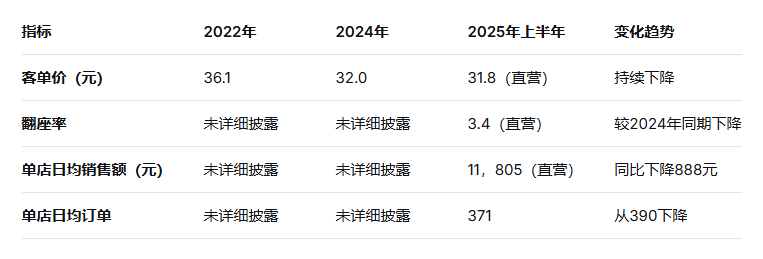
Core Viewpoint - The debut of "Yujian Xiaomian," known as the first Chinese noodle restaurant stock, on the Hong Kong Stock Exchange was marked by a significant drop in share price, reflecting market skepticism about the company's fundamentals and industry prospects [1][7]. Financial Performance - On its first trading day, Yujian Xiaomian opened at 5 HKD per share, down 28.98% from the issue price of 7.04 HKD, closing at 5.08 HKD, a total decline of 27.84%, resulting in a market capitalization of 3.61 billion HKD [1][7]. - The company reported a decrease in average daily sales per store for both direct-operated and franchised restaurants, with declines of 888 HKD and 1,035 HKD respectively in the first half of 2025 [1][8]. - The turnover rate for direct-operated and franchised restaurants fell from 3.8 and 3.6 in the first half of 2024 to 3.4 and 3.1 in the first half of 2025 [1][8]. Pricing Strategy - The company's strategy of "exchanging price for volume" has failed, as the average order value has consistently declined from 36.1 HKD in 2022 to 32.0 HKD in 2024, and further to 31.8 HKD (direct-operated) and 30.9 HKD (franchised) in the first half of 2025 [2][8]. - The market questions the sustainability of the company's approach to lowering menu prices to attract customers [2][8]. Industry Context - The Chinese noodle restaurant sector is experiencing a capital retreat, with many previously successful brands now facing growth challenges. In the past year, 241,600 new noodle restaurants opened, but the net increase was only 12,100, indicating a high industry elimination rate [2][8]. Business Model - Yujian Xiaomian's business model heavily relies on franchising, with 74.3% of its 374 stores being franchised, contrasting sharply with competitors like Xiangcunji, which operates over 99% of its stores as direct-operated [3][9]. - While franchising allows for rapid expansion, it also presents risks, including quality control issues, as evidenced by three franchised stores being penalized for quality problems in 2024 [4][10]. Expansion Plans - The company plans to aggressively expand, aiming to open approximately 150 to 180 new restaurants in 2026, 170 to 200 in 2027, and 200 to 230 in 2028, which could effectively double its current store count [5][10]. - However, the ongoing decline in same-store sales poses a significant challenge to this expansion strategy, with direct-operated and franchised same-store sales dropping by 3.1% and 2.9% respectively in the first half of 2025 [5][10]. Conclusion - The case of Yujian Xiaomian illustrates the difficulty of balancing traditional brand values with the demands of capital efficiency, providing valuable insights for the broader Chinese fast-food industry's path to capitalization [11].
“中式面馆第一股”遇冷:遇见小面上市即破发,资本为何不买单?
Guan Cha Zhe Wang· 2025-12-08 08:27
Core Viewpoint - The stock of "Yujian Xiaomian," known as the first Chinese noodle restaurant listed, fell 27.84% on its debut, indicating a lack of sustained investor enthusiasm despite a record oversubscription during its IPO phase [1] Financial Performance - Revenue is projected to grow from 418 million yuan in 2022 to 1.154 billion yuan in 2024, with a compound annual growth rate (CAGR) of 66.2% [2] - The company transitioned from a net loss of 35.97 million yuan in 2022 to a profit of 60.7 million yuan in 2023, with further growth expected to 41.83 million yuan in the first half of 2025, reflecting a year-on-year increase of 95.77% [2] Operational Challenges - The average daily sales per store decreased from 13,997 yuan in 2023 to 11,805 yuan in the first half of 2025, a decline of 15.66% [4] - The turnover rate for direct-operated restaurants fell from 3.9 times per day to 3.4 times, while franchise restaurants saw a drop from 3.6 to 3.1 times [4] - The average order value has decreased from 36.2 yuan in 2022 to 31.8 yuan in the first half of 2025, indicating a strategy to attract customers through lower prices [4] Expansion Plans - Approximately 60% of the net proceeds from the IPO will be used to expand the restaurant network, with plans to increase the number of stores to 1,000 over the next three years [3] - The company aims to open 150 to 180 new restaurants in 2026, 170 to 200 in 2027, and 200 to 230 in 2028 [3] Market Position - Despite the growth in store numbers, the market share of Yujian Xiaomian is only 0.5%, with the top five Chinese noodle brands holding less than 3% of the market [4] - The company has faced closures of franchise restaurants, with three and four closures reported in 2024 and the first half of this year, respectively [5] Investor Sentiment - The initial enthusiasm from institutional investors did not translate into long-term confidence from retail investors, leading to a significant drop in stock price post-IPO [2][5] - The market is shifting focus from mere store count and revenue growth to sustainable profit models and healthy store economics [5]

遇见小面的“加盟泡沫”要破了吗?
Sou Hu Cai Jing· 2025-11-28 06:15
Core Viewpoint - Guangzhou Yujian Xiaomian Catering Co., Ltd. has officially launched its IPO process, marking its second attempt to list on the Hong Kong Stock Exchange after an initial rejection due to declining average spending per customer and fluctuating turnover rates [1] Company Growth and Expansion - The company has expanded from a single store in 2014 to 374 stores by mid-2025, primarily through a franchise model, with 74.3% of its stores being franchises [2][3] - Revenue growth has been significant, with figures of 4.18 billion, 8.01 billion, and 11.54 billion yuan for 2022, 2023, and 2024 respectively, and a 91.6% year-on-year growth in 2023 [3][4] Profitability and Financial Performance - The company has transitioned from a net loss of 35.97 million yuan in 2022 to a net profit of 45.91 million yuan in 2023 and 60.7 million yuan in 2024, with a net profit of 41.83 million yuan in the first half of 2025 [3][15] - The average order value has decreased from 36.2 yuan in 2022 to 31.8 yuan in the first half of 2025, indicating a strategy of "price for volume" that has not resulted in expected customer growth [4][15] Market Position and Competition - The company holds a 0.5% market share, ranking fourth in the Chinese noodle restaurant sector, which is characterized by a large industry with many small players [1][6] - The competitive landscape is intense, with over 2,000 noodle shops in Guangzhou alone, leading to price wars that compress profit margins [8][20] Supply Chain and Operational Efficiency - The company has established a supply chain model that balances cost control and ingredient freshness, with procurement costs accounting for 32% of total revenue in 2024, down from 38% in 2022 [11][12] - The company has built a digital supply chain system that has reduced food waste from 8% in 2022 to 4.5% in 2024, enhancing profitability [10] Brand and Marketing Strategy - The company has focused on young consumers, with 72% of its customer base aged 18-35, and has engaged in various marketing activities to enhance brand awareness [14] - Despite strong marketing efforts, the brand has struggled to translate recognition into pricing power, as evidenced by declining average spending [14][20] Future Growth Potential - The company is exploring three major consumer trends: health-oriented products, scenario-based extensions, and digital operations to enhance efficiency [9][10] - The market for noodle restaurants is projected to grow, with the top five brands' market share expected to increase from 3.0% to 8.0% between 2025 and 2030, presenting growth opportunities for the company [21]
