
主权货币信用三支柱理论

Search documents
招商策略:美元的黄昏 黄金影子锚归来与A股地缘新框架
Xin Lang Cai Jing· 2026-02-26 13:42
Core Viewpoint - The article reveals a fundamental paradigm shift in the global monetary order since 2022, marked by the historical decoupling of gold from the US dollar pricing system. This change is rooted in a structural fracture of the credit foundation of the dollar as the dominant global currency, signaling the end of the old order and the emergence of a new one [2][4]. Group 1: Historical Context and Theoretical Framework - The article discusses the historical evolution of the global monetary system, highlighting the transition from silver coins to gold coins and eventually to fiat currencies, which has significantly influenced the international economic order [22][27]. - The "Three Pillars of Sovereign Currency Credit Theory" is introduced, explaining that the value of sovereign currency is supported by economic productivity, military and geopolitical power, and institutional credit and legal systems [2][20]. Group 2: Structural Crisis of the Dollar - The article identifies a systemic crisis in the dollar's credit structure, where all three pillars are under severe pressure. Economic productivity is declining due to deindustrialization, military power is perceived as weakened, and institutional credit has been undermined by actions such as the freezing of Russian foreign reserves [2][20][21]. - The article emphasizes that the decoupling of gold from the dollar's value reflects a broader market response to the simultaneous pressure on these three pillars, leading to a negative spiral of the dollar's intrinsic value [20][21]. Group 3: Gold's Resurgence and New Investment Framework - Gold is re-emerging as a "shadow anchor" and ultimate measure of value, with central banks significantly increasing their gold purchases, indicating a strategic shift towards non-sovereign, anti-sanction assets [3][18]. - The article proposes a new investment framework for the A-share market, moving from a traditional "growth-profit-valuation" model to one focused on "security-resilience-control," reflecting the new geopolitical realities [3][4][21]. Group 4: Investment Opportunities - Three core investment themes are suggested: 1. Resources and hard currency assets, including gold and strategic minerals essential for AI and renewable energy [3]. 2. Core technology assets, such as AI, semiconductors, and commercial space, which are seen as engines of productivity revolution [3]. 3. Security assets, driven by national subscription systems, covering defense, cybersecurity, and critical infrastructure [3].

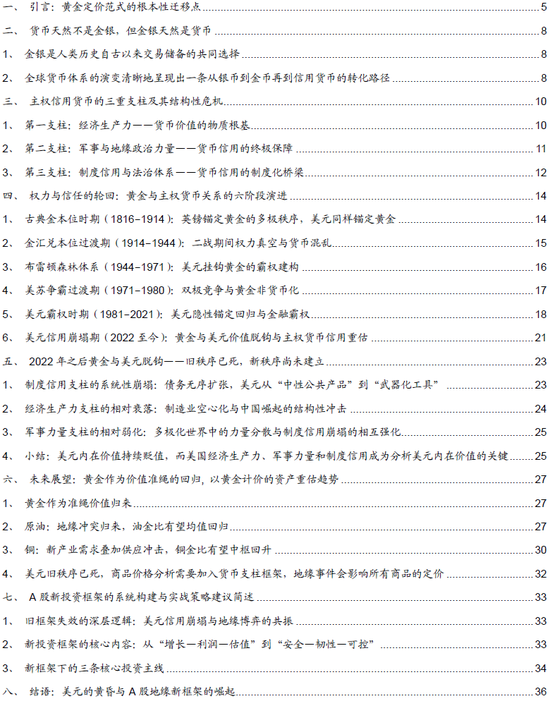
A股投资启示录(三十一):美元的黄昏:黄金影子锚归来与A股地缘新框架
CMS· 2026-02-26 08:33
Group 1 - The report highlights a fundamental shift in the gold pricing paradigm, emphasizing the historical decoupling of gold from the US dollar since 2022, marking the end of the old monetary order and the emergence of a new one [1][2][24] - The report identifies three pillars of sovereign currency credit: economic productivity, military and geopolitical power, and institutional credit and legal systems, all of which are currently facing significant challenges, leading to a negative spiral of the dollar's intrinsic value [2][24][39] - The return of gold as a "shadow anchor" and ultimate measure of value is underscored, with central banks purchasing gold at record levels, indicating a strategic shift towards gold as a non-sovereign, anti-sanction asset [2][23][24] Group 2 - The report proposes a new investment framework for the A-share market, moving from a traditional "growth-profit-valuation" model to a focus on "security-resilience-control," reflecting the need to adapt to geopolitical risks and institutional changes [2][24][25] - Three core investment themes are suggested: resource and hard currency assets, core technology assets, and security assets, which are essential for navigating the new geopolitical landscape [2][24][25] - The analysis emphasizes that the old investment paradigms are being eroded by geopolitical dynamics and institutional shifts, necessitating a strategic re-evaluation of investment approaches in the A-share market [2][24][25]