
主观CTA策略

Search documents
宏观对冲与主观略:资产配置新纪元
Guo Tai Jun An Qi Huo· 2025-12-26 13:30
Report Industry Investment Rating - No investment rating provided in the report. Core Viewpoints - In 2026, the scale of macro - hedge strategies is expected to increase further as their allocation value is increasingly recognized in the market. Risk - parity strategies will play a stronger role as the base position in the portfolio, and the returns of risk - parity managers will experience a certain degree of mean reversion. [36][37] - The performance of subjective CTA strategies in 2026 will be better than that in 2025. The decrease in Sino - US macro uncertainties and the increase in commodity volatility in a low - interest - rate environment will benefit subjective CTA managers. [58] Summary by Directory 01 Macro - Hedge Strategy Research and Outlook Manager Classification and Characteristics - Macro - hedge managers are classified into three types: risk - parity, asset - rotation, and multi - asset multi - strategy. This report focuses on the first two types. Risk - parity managers use the risk - parity model as the basis and enhance it, with relatively consistent performance; asset - rotation managers are based on asset - rotation frameworks like the Merrill Lynch Clock, emphasizing asset timing allocation and having less consistent performance. [6] Domestic Manager Performance in 2025 - As of November 28, 2025, the net value of the "risk - parity" macro - hedge index was 1.172, and that of the "asset - rotation" index was 1.101. In the 46 weeks from January 3 to November 28, 2025, risk - parity managers had positive weekly returns in 30 weeks and negative returns in 16 weeks, with the largest single - week drawdown occurring after the Tomb - Sweeping Festival on April 11. Asset - rotation managers had positive weekly returns in 25 weeks and negative returns in 20 weeks, with the largest single - week drawdown occurring in the week of November 21. In the context of global supply - chain reshaping, risk - parity managers outperformed asset - rotation managers in 2025. [10] Asset Correlation Analysis - In 2025, the negative correlation between treasury bonds and equity indices weakened compared to the end of last year. The China Securities Commodity Index was positively correlated with stock indices and negatively correlated with treasury bonds and gold. Gold, as a safe - haven asset, had a stronger correlation with treasury bonds. There were significant differences in the performance correlations of risk - parity and asset - rotation managers with equity, treasury bonds, and gold. [13] - In terms of equity assets, the correlation between the risk - parity strategy and the CSI 300 was 0.230, and that with the CSI 1000 was 0.186. The correlations of the asset - rotation strategy with the CSI 300 and CSI 1000 were 0.628 and 0.641 respectively. The asset - rotation strategy's returns were more dependent on stocks, and the large drawdown in the week of November 21 was related to the stock decline. [19] - After a five - fold leverage treatment of 10 - year treasury bonds, the correlation between the risk - parity strategy and 10 - year treasury bond futures was 0.221, while that of the asset - rotation strategy was - 0.068. Many managers believed that the treasury bond market was in a bear market, so asset - rotation managers mostly reduced or shorted treasury bonds, while risk - parity managers still held bond positions. [23] - In 2025, gold was one of the strongest - performing assets, with a cumulative net value of the Gold ETF of 1.588 from January 3 to November 28. The correlation between the risk - parity strategy and the Gold ETF was 0.453, while that of the asset - rotation strategy was 0.110. Gold had a greater impact on risk - parity strategies. [26] Overseas Manager Performance in 2025 - As of October 2025, the net value of the "unidentified" macro - hedge index was 1.088, the "subjective" macro - hedge index was 1.129, and the "quantitative" macro - hedge index was 1.159. Quantitative macro - hedge strategies performed the best, followed by subjective strategies, similar to the domestic situation. The maximum drawdowns of the unidentified and quantitative macro - hedge strategies occurred in April, indicating that domestic risk - parity managers may use similar underlying models to overseas ones. [29] - The unidentified macro - hedge strategy index had a more balanced correlation with various asset classes, with a near - zero correlation with New York gold. The subjective macro - hedge index had a high correlation of 0.792 with the S&P 500 and a negative correlation with New York gold, indicating that its returns were more dependent on the US stock market. The quantitative macro - hedge strategy also had a high correlation of 0.627 with the S&P 500 and a relatively high correlation of 0.300 with the S&P GSCI, but a negative correlation with US treasury bonds and gold. [33] Outlook for 2026 - The scale of macro - hedge strategies will increase as their allocation value is recognized. Some investors may replace part of their stock - neutral strategy allocation with low - volatility macro - hedge strategies. The role of risk - parity strategies as the base position in the portfolio will be enhanced, and their return attribution is relatively clear. [36] - The returns of risk - parity managers will experience mean reversion in 2026. Since the probability of bonds and gold replicating their price increases since 2024 is significantly reduced, the returns of these managers will decline. Historically, the long - term return of the basic risk - parity model is around 6 - 8%. [37] 02 Discretionary CTA Strategy Research and Outlook Performance in 2025 - The net value performance of managers in the observation pool in 2025 was weaker than in the same period of 2024. Uncertainties in Sino - US trade friction reduced the trading certainty of discretionary CTA managers based on industrial supply - demand research, weakening their position - holding confidence and return - generating ability. After June, although market sentiment improved, the lack of improvement in the industrial sector led to significant drawdowns for many managers, lowering the annual return. [40] Sector - Specific Performance - Black - sector managers showed some resilience in returns in 2025. In the first half of the year, the collapse of coal costs led to a downward trend in the black - sector prices, with good persistence and low volatility. The concerns about external demand due to Sino - US trade friction coincided with the seasonal decline in coal prices, providing trading opportunities with industrial and macro resonance. In the second half of the year, differences in the implementation of anti - involution policies led to a negative view among industrial - based managers, resulting in significant drawdowns. [45] - Agricultural - product managers were greatly affected by trade frictions between China and the US, Canada, etc. The unpredictable changes in agricultural - product imports and price fluctuations made it difficult for them to generate returns. [45] Industry Changes - Leading managers are iterating towards multi - asset and multi - strategy models. The limited capital capacity of single - asset futures trading, the need to understand the trading behavior of other market participants, and the benefits of multi - asset diversification are the main reasons. [50] - Start - up private - equity funds have shown strong drawdown - control ability since their establishment. Compared with the past, current start - up discretionary CTA private - equity funds have a clearer understanding of investors' risk preferences and a more explicit performance - oriented approach, enabling them to enter institutional investors' asset - allocation pools more quickly. [52] - In a diversified market structure, single - industry logic is insufficient for trading. Managers need to have comprehensive capabilities in macro - judgment, trading, and risk - control. Research determines the winning rate, trading and risk - control determine the profit - loss ratio, and an excellent trader may not be an excellent asset - management manager. [55] Outlook for 2026 - The performance of discretionary CTA strategies in 2026 will be better than in 2025. The decrease in Sino - US macro uncertainties will make commodity supply - demand the dominant factor in trading, and the increase in commodity volatility in a low - interest - rate environment will be beneficial for managers to generate returns. The increase in the scale of discretionary CTA managers based on industrial research will also contribute to the strength of industrial logic in the market. [58]
2026年主观CTA 策略年报:2026年主观CTA策略展望
Guo Tai Jun An Qi Huo· 2025-12-16 13:28
Report Industry Investment Rating No relevant content provided. Core View of the Report - The performance of the subjective CTA strategy line in 2026 will be better than that in 2025. The decline in Sino-US macro uncertainty and the rise in commodity volatility in a low-interest rate environment are favorable for subjective CTA managers in the commodity sector [1][37]. Summary by Relevant Catalogs 1. 2025 Subjective CTA Review 1.1 Subjective CTA Strategy Net Value Performance - In 2025, the net value performance of managers in the observation pool was weaker than that in the same period of 2024. Due to the interference of Sino-US trade friction uncertainty, the trading certainty of managers based on industrial supply and demand research declined significantly, resulting in weakened position-holding confidence and reduced income [7]. - In terms of sectors, black sector managers were relatively prominent in 2025. In the first half of the year, the cost collapse of coal drove the downward trend of black sector prices, and some black managers obtained trading opportunities with industrial and macro resonance. In the second half of the year, the divergence between the futures market sentiment and the spot market led to a significant decline in the net value of black sector managers. Agricultural product managers were greatly affected by foreign trade frictions, and the predictability of agricultural product imports was extremely poor, which affected their income acquisition [9][10]. - In terms of scale, there was little difference in the income performance of managers of different scales in 2025. The large-scale multi-sector managers did not show more obvious investment research advantages, and the small-scale managers did not show more income acquisition ability [14]. 1.2 2025 Subjective CTA Strategy Income Attribution - In 2025, the Nanhua Commodity Index fluctuated throughout the year, and some varieties showed structural differentiation, but the overall commodity index did not show a trending market. In the first half of the year, affected by Sino-US trade friction, the commodity index was under pressure to decline. After June, with the stalemate of Sino-US trade friction, "anti-involution" became a new theme, driving the commodity index to stabilize and rebound [17][18]. - The annual commodity index fluctuation and subjective CTA income acquisition in 2025 were mainly divided into two stages: - From January to May 2025, driven by the uncertainty brought by Sino-US trade friction, precious metals continued the upward trend at the end of 2024, with the London Spot Gold Index rising by 25.5% from January to May. At the same time, domestic industrial products, mainly domestic demand, weakened, with the CSI Steel Index falling by 13% from January to May. Managers mainly trading precious metals and black sector managers who shorted coal and coke or held positions such as buying ore and shorting coal obtained good income [20]. - From June to December 2025, Sino-US trade friction entered a stalemate stage, and the market generally expected that there would be no more negative news. "Anti-involution" became the core driving force in domestic industrial policies. There was a great divergence between subjective CTA private equity managers and industrial participants on whether "anti-involution" could be compared with the supply-side reform in 2016 - 2021. The net value of black sector managers declined significantly after June. In the agricultural product sector, the income of some managers was damaged due to the decline in palm oil prices. In the non-ferrous sector, managers using unilateral trading strategies performed better than those using arbitrage trading strategies [24][25]. 2. Subjective CTA Strategy Industry Ecological Changes 2.1 Head Managers Iterate towards Multi-Asset and Multi-Strategy - Head managers are rapidly iterating towards multi-asset and multi-strategy. The reasons may include limited capital capacity of single-asset futures trading, quarterly income convergence of single-commodity assets, increasing linkage between the equity market and the commodity market, and the need to reduce the impact of single-asset judgment errors on the net value and obtain beta opportunities of other assets [30]. - Expanding the ability circle does not necessarily lead to a significant decline in income. For commodity managers aiming at the asset management path, expanding the trading ability of other sectors can form a positive iteration between asset management scale and investment research [31]. 2.2 Start-up Private Equity Shows Strong Drawdown Control Ability in the Early Stage - In 2025, start-up private equity showed strong drawdown control ability in the early stage. Small-scale managers' weekly drawdown control ability was not weaker than that of large-scale managers. Domestic subjective futures private equity asset management has an obvious sample effect, and small-scale managers are clear about the subsequent asset management path and pay attention to controlling drawdown to improve investors' holding experience [33]. 2.3 In the Market with a Diverse Structure, Single-Industry Logic is Slightly Weak in Trading, Requiring Managers to Have More Comprehensive Abilities - The pricing ability of industrial logic in commodity futures has been weakened, and non-industrial logic forces such as macro strategies and multi-asset strategies have entered the market, making it difficult for teams relying solely on industrial logic to trade [35]. - From the perspective of capital allocation, industry is still the basis for studying subjective CTA managers, but managers should not have obvious shortcomings in macro judgment, trading, and risk control. Research determines the winning rate, trading and risk control determine the profit-loss ratio, and excellent traders are not necessarily excellent asset management managers [35][36]. 3. 2026 Subjective CTA Outlook - The decline in Sino-US macro uncertainty will make the commodity's own supply and demand the dominant factor, which is beneficial to subjective CTA managers based on industrial supply and demand research. There may be industrial contradictions in coking coal, iron ore in the black sector, and lithium carbonate in the new energy sector [37]. - In a low-interest rate environment, the rise in commodity volatility is conducive to managers to create better income. In 2026, the domestic low-interest rate environment will continue, and the main line of commodity trading may shift from precious metals in 2025 to basic bulk commodities [38]. - Subjective CTA managers are extending towards multi-asset and multi-strategy to provide better holding experience for investors. This change also makes the scale of subjective CTA managers further included in the capital allocation options [39].
杭州期货圈波动后,62%主观CTA产品单月回暖,业绩分化明显
Sou Hu Cai Jing· 2025-08-30 04:46
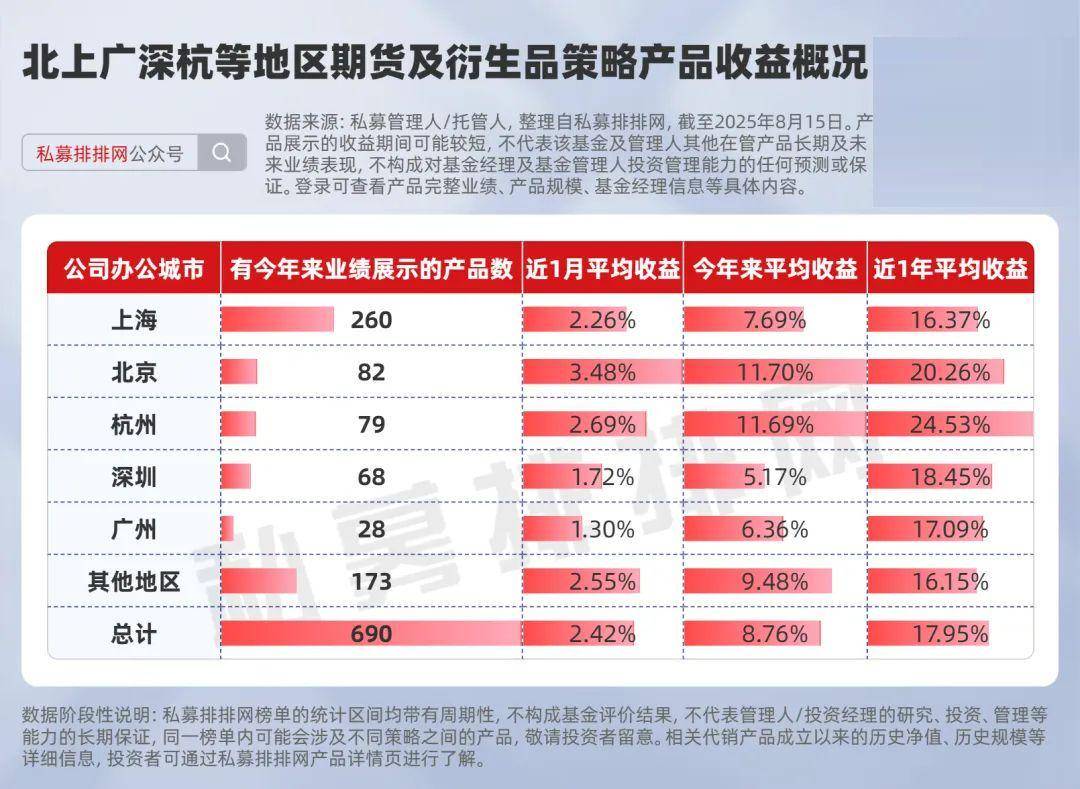
Core Viewpoint - The recent "anti-involution" trend in the Hangzhou futures market has led to significant drawdowns in the net value of several subjective CTA products from private equity institutions, highlighting the need for improved responsiveness to market changes despite a strong foundation in industrial fundamental analysis [1] Group 1: Market Dynamics - The Hangzhou futures market is characterized by a unique ecosystem formed since 2015, integrating "industrial capital + private equity funds + futures asset management" [1] - Major private equity firms such as Donghe Asset Management and Qiantang Yongli Asset Management have deep ties with Yong'an Futures, leveraging frontline intelligence in "warehousing-logistics-production line" [1] - The recent market changes have challenged traditional advantages, with losses attributed to a lag in responding to policy rhythms, emotional capital, and quantitative fund behaviors [1] Group 2: Performance Data - As of August 15, there are 690 futures and derivatives strategy products with performance data this year, with 79 from Hangzhou, ranking third in quantity [2] - The average return for Hangzhou products this year is 11.69%, placing them second overall, while they have shown resilience in the past month [2] - Among the 79 products in Hangzhou, the number of quantitative CTA and subjective CTA products is roughly equal, with subjective CTA strategies yielding higher average returns [2] Group 3: Strategy Breakdown - In Hangzhou, the top ten performing futures and derivatives strategy products have a high entry threshold, with subjective CTA products dominating the rankings [3] - The proportion of products achieving positive returns in the past month among subjective CTA products is 62.07%, indicating the agility of smaller private equity firms [4] - Qiantang Yongli Asset Management stands out as the only private equity firm in the 20-50 billion scale category, showcasing strong investment capabilities [4] Group 4: Institutional Insights - Eight private equity institutions in Hangzhou meet the ranking criteria, with the top three being mixed-type (subjective + quantitative) firms, reflecting the advantages of mixed strategies [4] - Junfu Investment and Qiantang Yongli Asset Management rank second and fifth respectively among 20-50 billion scale private equity firms, demonstrating robust investment styles [4] - Win Private Equity has emerged as a standout institution over the past year, advocating for counter-cyclical investments and showcasing exceptional performance in strategy and risk management [4]

2025年下半年主观CTA策略展望
Guo Tai Jun An Qi Huo· 2025-06-22 12:07
Group 1: Investment Rating - No investment rating is mentioned in the report. Group 2: Core Viewpoints - The performance of the subjective CTA strategy line in the second half of 2025 will continue the trend of the first half. The consistency between macro and industrial directions benefits subjective CTA managers, and the source of income will not decline significantly. Also, the probability of position limits is low, which is conducive to the recovery of market liquidity [2][32][35] Group 3: Summary by Directory 1. 2025 H1 Subjective CTA Review 1.1 Subjective CTA Strategy Net Value Performance - In H1 2025, the net value performance of managers in the observation pool was basically the same as that in H1 2024, and the maximum weekly drawdown was smaller. By sector, black and multi - sector managers had prominent returns. By scale, larger - scale managers had more obvious returns [8][11][14] 1.2 2025 H1 Subjective CTA Strategy Income Attribution - In H1 2025, the Nanhua Commodity Index weakened. The decline of coal drove the cost collapse of domestic industrial products. The income acquisition of subjective CTA was divided into two stages. In the first stage (Jan - Mar 2025), precious and non - ferrous metals rose, while domestic industrial products weakened. In the second stage (Apr - May 2025), after the Tomb - sweeping Festival, the market volatility increased, and subjective CTA managers performed well. The cost collapse of industrial products also promoted the performance of quantitative CTA factors [17][19][22] 2. Subjective CTA Strategy Industry Ecological Changes 2.1 Managers' Positions are Generally Low, Paying More Attention to Net Value Drawdown Management - Managers' positions are generally low, focusing on net value drawdown management. The income in H1 2025 came from the smooth trend of some varieties and the improvement of trading win - rate. Changes in trading habits are related to past commodity price fluctuations and capital requirements [26] 2.2 The Proportion of Industrial Hedging has Increased, Possibly Increasing Industrial Discourse Power - As the prices of industrial products such as coal decline, the industrial demand for hedging against price decline risks has increased. The reduction of the inventory transfer ability of factories through traders makes futures hedging a choice, which may increase industrial discourse power in subsequent pricing [30] 3. 2025 H2 Subjective CTA Outlook - The performance of the subjective CTA strategy line in H2 2025 will continue the trend of H1. The consistency between macro and industrial directions remains, and the decline trend of domestic industrial products has not changed. The probability of position limits is low, which is conducive to the recovery of market liquidity [32][33][35]