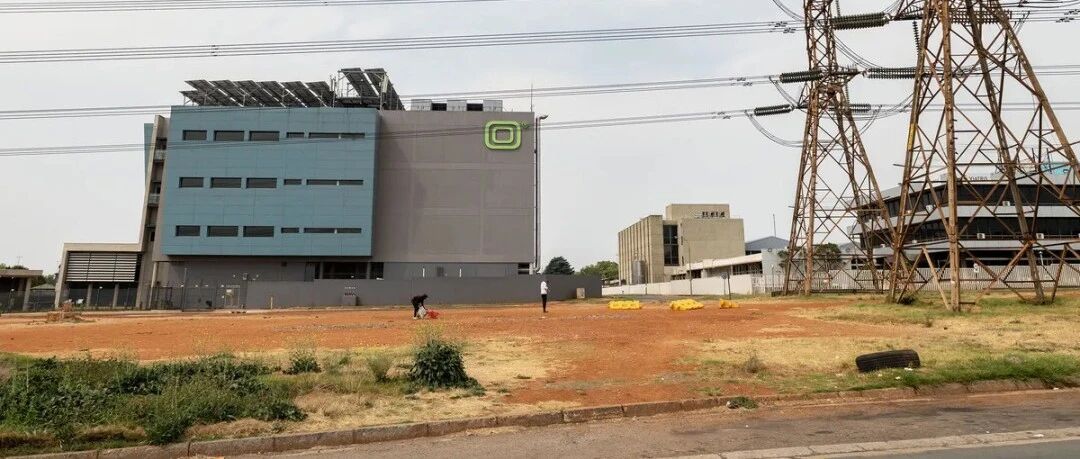
人工智能民主化

Search documents
雄心勃勃办AI峰会,第一天就差评如潮…印度致歉
Guan Cha Zhe Wang· 2026-02-17 14:53
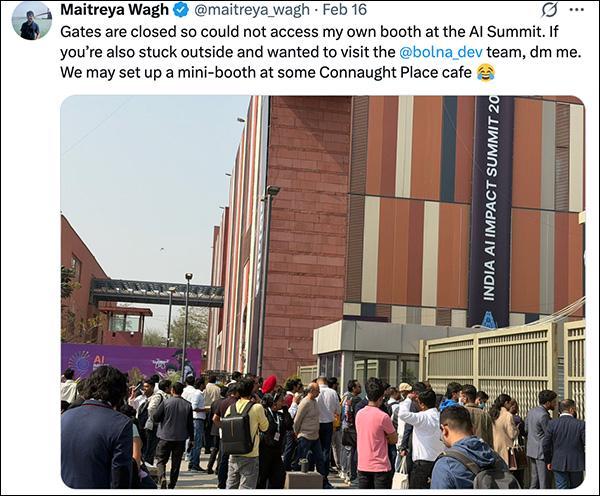
Core Insights - The AI Impact Summit in India faced significant organizational issues on its first day, leading to widespread criticism from attendees and participants [1][2][4][5] Group 1: Event Overview - The summit, themed "People, Progress, Planet," is touted as the largest AI summit ever held in the Global South, with participation from over 100 countries [1] - High-profile attendees included CEOs from major tech companies, although some, like NVIDIA's CEO, were unable to attend due to unforeseen circumstances [1] - The event was marred by logistical challenges, including overcrowding and inadequate security measures, which resulted in attendees being trapped outside the venue [1][2] Group 2: Attendee Experiences - Attendees reported difficulties accessing their own booths, with some being unable to enter due to security measures [2][4] - Complaints also arose regarding payment methods at food stalls, which only accepted cash, complicating transactions for international visitors [5] - The lack of clear signage and limited seating exacerbated the confusion, with some speakers still awaiting confirmation of their participation in discussions [5] Group 3: Government Response and Future Plans - India's Minister of Electronics and IT acknowledged the organizational shortcomings and promised improvements, stating that around 70,000 people attended the summit [6] - The Indian government aims to invest $200 billion in building data centers to bolster the AI industry, with backing from major companies like Google and Microsoft [10] - Despite ambitious plans, analysts note that India still has a long way to go in AI development, with R&D spending significantly lower than that of the US and China [10][11] Group 4: Broader Implications - The summit's messaging emphasized the need for democratizing AI resources, positioning India as a leader among developing nations [7][9] - Critics argue that the push for AI democratization may be more about branding than actual policy changes, highlighting a gap between rhetoric and action [9] - The paradox of the summit lies in India's ability to gather global leaders while still lagging in competitive AI capabilities [12]

第1个获得数学奥赛金牌的开源模型!DeepSeek新模型获网友盛赞:公开技术文件,了不起!
华尔街见闻· 2025-11-28 04:35
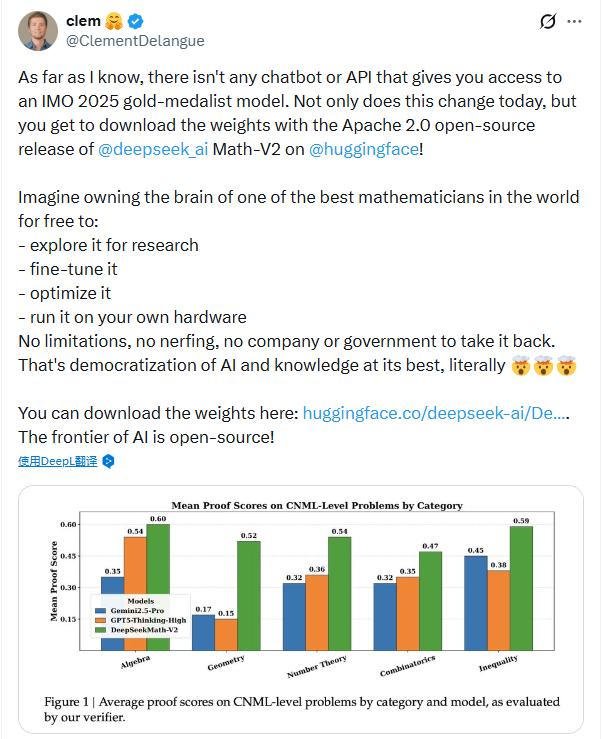
Core Insights - DeepSeek has launched its latest mathematical reasoning model, DeepSeekMath-V2, which has achieved gold medal status in the simulated 2025 International Mathematical Olympiad (IMO), marking a significant breakthrough in open-source AI's complex reasoning capabilities [1][2] - This achievement positions DeepSeekMath-V2 as the first open-source model to win a gold medal at the IMO level, drawing attention from the AI research and developer community [2] - Unlike closed-source models from Google and OpenAI, DeepSeekMath-V2's model weights are publicly available under the Apache 2.0 license, allowing for unrestricted access and exploration by users [3][5] Performance Highlights - DeepSeekMath-V2 solved 5 out of 6 problems in the IMO 2025 simulation, achieving gold medal status, which is a notable accomplishment given that only 72 out of 630 human participants received gold medals [4] - The model also demonstrated top-tier performance in other prestigious competitions, including achieving gold medal status in the Chinese Mathematical Olympiad (CMO) and scoring 118 out of 120 in the Putnam Mathematics Competition [4] Open-Source Advantage - The core appeal of DeepSeekMath-V2 lies in its complete openness, allowing users to freely download, fine-tune, and optimize the model without restrictions [5] - The release has been praised as a significant milestone for the open-source community, emphasizing the potential for open-source models to challenge the commercial strongholds of closed-source products [3][5] Innovative Training Framework - DeepSeekMath-V2 employs an innovative self-verification training framework, which includes a specialized verifier that assesses the quality of the proof process rather than just the final answer [10][11] - This mechanism encourages the model to identify and rectify issues in its reasoning chain before finalizing answers, enhancing the rigor of its mathematical reasoning [12] Dynamic Evolution Strategy - To prevent overfitting to its own verification mechanism, DeepSeek has implemented a dynamic evolution strategy that increases computational demands and automatically labels difficult proofs, ensuring the verifier and generator evolve in tandem [13] - This approach allows for the continuous optimization of performance and the creation of new training data, validating the feasibility of self-driven learning systems in tackling complex mathematical reasoning tasks [13]

第1个获得数学奥赛金牌的开源模型!DeepSeek新模型获网友盛赞:公开技术文件,了不起!
Hua Er Jie Jian Wen· 2025-11-28 00:46
Core Insights - DeepSeek has launched its latest open-source mathematical reasoning model, DeepSeekMath-V2, which has achieved gold medal status in the highly competitive International Mathematical Olympiad (IMO) 2025, marking a significant breakthrough in open-source AI capabilities in complex reasoning [1][3]. Group 1: Model Performance - DeepSeekMath-V2 solved 5 out of 6 problems in the simulated IMO 2025, becoming the first open-source model to achieve gold medal status in such a prestigious competition [1]. - The model also demonstrated top-tier performance in other challenging mathematics competitions, including achieving gold medal status in the Chinese Mathematical Olympiad (CMO) and scoring 118 out of 120 in the Putnam Mathematics Competition 2024, surpassing the highest human score of 90 [3]. Group 2: Innovation in Training Framework - The model employs an innovative self-verification training framework, which includes a dedicated verifier that assesses the quality of the proof process rather than just the correctness of the final answer [2][11]. - To prevent overfitting, DeepSeek has implemented a dynamic evolution strategy that increases computational demands and automatically labels difficult proofs, ensuring that the verifier and generator evolve in sync [12]. Group 3: Open Source and Community Impact - DeepSeekMath-V2's weights are publicly available under the Apache 2.0 license, allowing researchers and developers to download and utilize the model freely, which is seen as a significant step towards the democratization of AI [2][4]. - The release has sparked discussions about the potential impact of open-source models on the commercial viability of closed-source products, particularly concerning major players like NVIDIA [2].

DeepSeek深耕非洲:中国AI版图加速扩张
阿尔法工场研究院· 2025-10-24 00:04
Core Viewpoint - DeepSeek is emerging as a competitive force in the AI landscape, particularly in Africa, by offering cost-effective and energy-efficient solutions that cater to local needs, contrasting with Western proprietary models [1][5][12]. Group 1: DeepSeek's Market Position - DeepSeek, developed by High-Flyer, is positioned as a viable alternative to Western AI models like OpenAI, with significantly lower operational costs and the ability to run on less expensive hardware [1][5]. - The pricing structure of DeepSeek is highly competitive, with costs for processing and generating tokens being substantially lower than those of OpenAI's GPT-4o model, making it accessible for African startups [13][12]. - The model's open-source nature allows African companies to modify and develop applications without incurring high licensing fees, which is a significant advantage over proprietary models [5][9]. Group 2: Adoption and Impact in Africa - African startups, such as Qhala and EqualyzAI, are increasingly adopting DeepSeek for their AI applications, citing its affordability and suitability for local contexts [2][11]. - The AI landscape in Africa is shifting towards models that are tailored to local languages and cultural nuances, with DeepSeek being favored for its flexibility and lower costs [11][19]. - The digital economy in Africa is valued at approximately $1.8 trillion, and the adoption of cost-effective AI solutions like DeepSeek is seen as a way to enhance local innovation and product development [5][8]. Group 3: Strategic Implications - Chinese companies, including Huawei, are leveraging their established infrastructure and open-source models to gain a foothold in the African market, contrasting with the focus of Western firms on proprietary solutions [5][8]. - The strategy of providing open-source AI models aligns with China's broader initiatives in Africa, such as the Belt and Road Initiative, aiming for long-term engagement rather than immediate profits [5][8]. - Concerns about data privacy and reliance on foreign technology are prevalent, with some African leaders advocating for a balanced approach that incorporates both Chinese and Western technologies [19][20].