
人才供需对接

Search documents
两部门联合开展"冰雪+文旅"产业系列人才供需对接活动
Xin Hua She· 2026-02-21 16:33
Core Viewpoint - The Ministry of Education and the Ministry of Culture and Tourism are collaborating to enhance the matching of talent in the ice and snow economy with the cultural and tourism industry, aiming to support high-quality employment for college graduates in 2026 [1] Group 1: Talent Supply and Demand Activities - A series of talent supply and demand matching activities for the "Ice and Snow + Cultural Tourism" industry are being organized across various regions [1] - The first event, a recruitment fair in Xinjiang, attracted over 20,000 graduates and offered positions in areas such as scenic area operations, ice and snow sports, cultural design, and digital cultural tourism [1] Group 2: Regional Initiatives - During the winter break, similar activities are being conducted in Heilongjiang and Jilin provinces [1] - Heilongjiang's theme is "Promoting Ice and Snow, Integrating Industry and Education, and Promoting Employment," featuring policy promotion in scenic areas, job recruitment, and employment guidance lectures [1] - Jilin province has launched the "Ice and Snow Dream Building, Cultural Tourism Talent Gathering, and Cloud Employment" initiative, which includes creating a cloud recruitment platform and organizing enterprise visits and employment guidance sessions [1]
在人才供需对接方面,国家有哪些政策措施?
Ren Min Ri Bao· 2025-09-23 00:03
Core Insights - The article discusses the measures taken by the Chinese government to align talent cultivation with societal needs, emphasizing the importance of adapting education to meet the demands of the economy and society [1][4]. Group 1: Policy Initiatives - The "Education Strong Nation Construction Plan Outline (2024-2035)" was issued by the Central Committee of the Communist Party of China and the State Council, focusing on improving the mechanisms for talent cultivation to match economic and social development needs [1]. - The Central Political Bureau meeting on July 30 highlighted the priority of employment policies, particularly for key groups such as college graduates, veterans, and migrant workers [1]. Group 2: Data and Analysis - A national talent supply and demand big data platform has been initiated by the Ministry of Education, gathering 4.07 billion data resources to create a unified national talent supply and demand "data base" [2]. - The platform is designed to perform statistical analysis and compare the relevance of academic disciplines to industries, with pilot uses already underway in certain fields [2]. Group 3: Educational Reform - The "Higher Education Discipline and Major Adjustment and Optimization Action Plan (2025-2027)" has been issued, outlining six major actions to optimize urgently needed disciplines and adjust existing ones to align with national strategic needs [2]. - The Ministry of Education is implementing a comprehensive reform pilot for discipline and major adjustment mechanisms, with initial proposals focusing on urgent national and regional development areas [3]. Group 4: Monitoring and Adaptation - There is a need for dynamic monitoring of talent supply and demand relationships, with the Ministry of Education conducting talent supply and demand analysis reports at provincial and institutional levels [3]. - Employment status tracking surveys will be conducted to strengthen the link between employment conditions and educational programs, enhancing the quality of employment monitoring and feedback [3]. Group 5: Future Directions - The Ministry of Education aims to deepen the implementation of the talent cultivation supply and demand adaptation mechanism reform pilot, accelerating platform development to support the optimization of disciplines and talent cultivation models driven by technological development and national strategic needs [4].
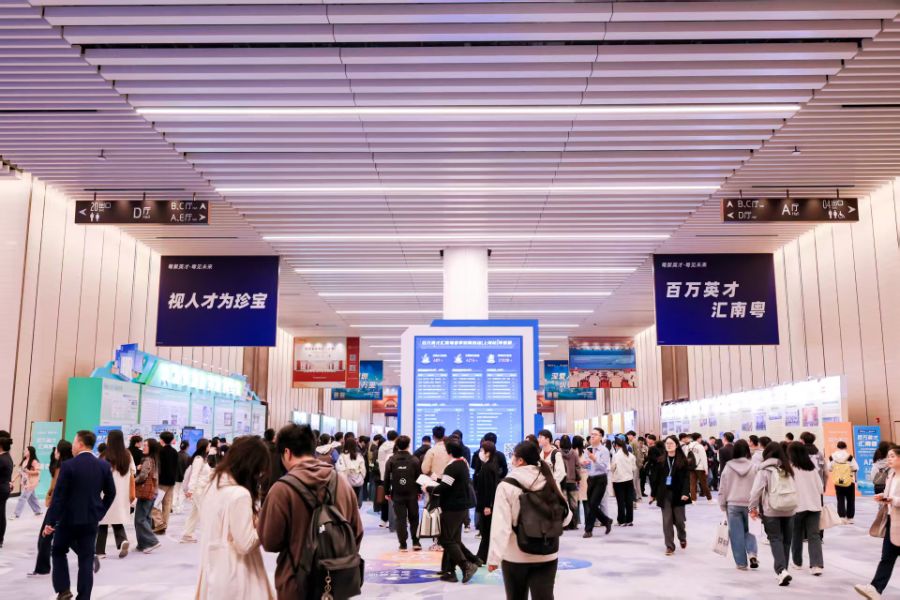
粤半年揽才超百万 人才供需“零时差”
2 1 Shi Ji Jing Ji Bao Dao· 2025-07-28 03:56
Group 1 - The "Million Talents Gathering in Guangdong" initiative aims to attract 1 million college graduates and various talents to Guangdong for employment and entrepreneurship, with a focus on matching talent supply and demand in real-time [1][9][12] - As of mid-July, Guangdong has successfully recruited over 1 million graduates, achieving its annual target ahead of schedule [2][9] - The Greater Bay Area's job market shows a significant demand for talent, with Shenzhen providing over 35.2% of job openings in the region [2][4] Group 2 - Major companies in Guangdong, such as Tencent and Xinwangda, are significantly increasing their recruitment efforts, with Tencent planning to add 28,000 internship positions over three years [4][5] - The demand for technical talent in emerging fields like AI and robotics is rising, with companies offering competitive salaries and incentives to attract skilled professionals [6][9] - The "Million Talents Gathering in Guangdong" initiative has facilitated efficient recruitment processes, allowing companies to receive hundreds of resumes during recruitment events [9][12] Group 3 - Guangdong's government has introduced supportive policies for graduates, including employment subsidies and housing assistance, to encourage talent retention and attraction [12][13] - Shenzhen has implemented measures to streamline the process for graduates to settle in the city, including online applications for residency and extended free accommodation for job seekers [12][13] - The initiative has led to a new paradigm of talent supply and demand matching, showcasing Guangdong's economic strength and commitment to fostering a skilled workforce [9][12]




百校联百园 千企促就业
Guang Xi Ri Bao· 2025-06-13 02:06
Group 1 - The event "2025 Guangxi 'Hundred Schools Link Hundred Parks, Thousand Enterprises Promote Employment'" aims to facilitate talent supply and demand matching, involving 85 universities, 20 parks, and 128 enterprises [1] - The conference focused on key areas such as school-enterprise cooperation and talent cultivation, with representatives sharing experiences and establishing multiple cooperation intentions [1] - The talent supply and demand negotiation meeting serves as a crucial platform for communication between universities and enterprises, leading to preliminary cooperation agreements [1][2] Group 2 - The job fair provided 1,500 employment positions across various sectors, including manufacturing, internet, computer, machinery, electronics, and new energy, with over 2,300 resumes submitted [2] - Local employment policies were presented, offering talent subsidies exceeding 80,000 yuan, housing guarantees, and entrepreneurial support [2] - An online job fair was introduced, running until July 7, with 1,105 companies registered and over 7,800 job openings available, creating a 24/7 employment service platform for graduates [2][3] Group 3 - The Education Department emphasized the importance of aligning academic strengths with job market demands to stabilize and expand employment, thereby contributing to high-quality development in Guangxi [3]