人民币定价

Search documents
显微镜下的中国经济(2026年第9期):大国博弈对人民币定价的新挑战
CMS· 2026-03-24 10:32
Exchange Rate Trends - The RMB has been on an appreciation trend this year, with the USD/RMB exchange rate increasing by 1.5% and the EUR/RMB by 1.4% in the first two months[4] - The nominal effective exchange rate of the RMB has surpassed 108, indicating a broad-based appreciation against a basket of currencies[4] Trade Surplus and Economic Implications - China's goods trade surplus reached approximately $1.2 trillion last year, a record-breaking figure, indicating a significant trade imbalance with partners[4] - The strong trade surplus may lead to increased trade friction amid rising global protectionism, prompting a policy shift towards expanding imports to narrow the surplus[4] Oil Prices and Cost Pressures - Global oil prices have surged, with Brent crude stabilizing around $100, reflecting an increase of over 30% compared to the same period last year[4] - The appreciation of the RMB can help alleviate cost pressures from rising commodity prices, enhancing the competitiveness of RMB-denominated trade[4] Export Outlook - Despite the RMB's appreciation, the impact on exports is expected to be limited due to the high bargaining power of China's exports, primarily in machinery and high-tech products[4] - China's share in global trade remains substantial, making it difficult for other countries to fully replace Chinese manufactured goods[4] Risk Factors - Geopolitical risks, domestic policy implementation challenges, and potential global recession driven by oil price increases are highlighted as significant risks to the economic outlook[4]
刚暂停购买澳洲矿石,西芒杜铁矿就出事暂停运行,巧合还是意外?
Sou Hu Cai Jing· 2025-10-07 05:30
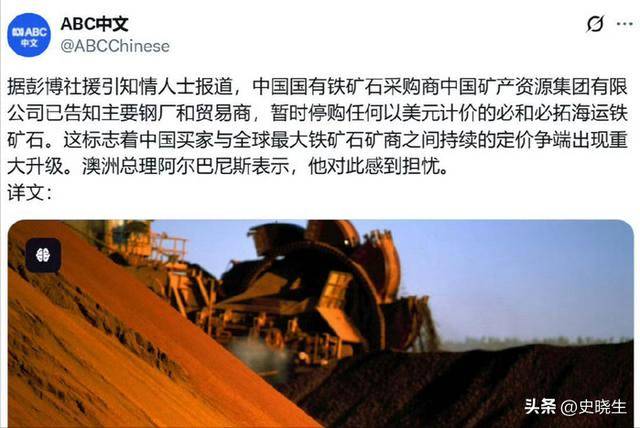
Core Viewpoint - The Chinese Mineral Resources Group (CMRC) has requested domestic buyers to suspend purchases of BHP's iron ore priced in USD, indicating a strategic shift in China's approach to iron ore supply chains and pricing [1][3]. Group 1: Strategic Decisions - The decision to suspend purchases follows unsuccessful negotiations between China and Australia, signaling China's intent to reshape the iron ore supply chain and assert pricing power [3][5]. - By pricing iron ore in RMB, China aims to reduce costs, increase profits, and facilitate the internationalization of the RMB [4][12]. Group 2: Impact of the Guinea Mine Incident - A safety accident at the Simandou iron ore mine in Guinea, involving the death of three workers, has led to the suspension of operations and safety inspections [4][13]. - The timing of this incident is critical, as it coincides with China's negotiations with BHP, potentially affecting China's bargaining position [13]. Group 3: Market Dynamics - China's demand for iron ore constitutes over 70% of Australia's iron ore exports, making it a crucial customer for Australian suppliers [8][11]. - The emergence of the Simandou mine as a viable alternative source of high-quality iron ore (with a total resource of 5 billion tons and over 66% grade) strengthens China's negotiating position against BHP [11][12]. Group 4: Future Considerations - The ongoing negotiations and market dynamics surrounding iron ore pricing will continue, with China determined to maintain its stance regardless of external factors [15].