
人民币汇率超调

Search documents
国联民生宏观:人民币交易指南2026
Xin Lang Cai Jing· 2026-01-04 09:37
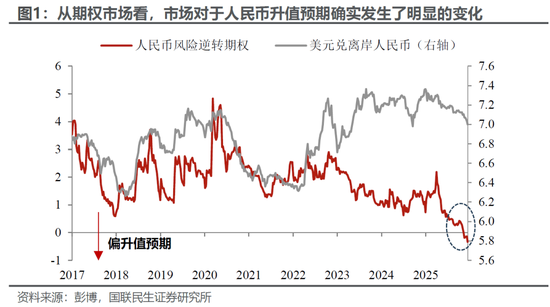
Core Viewpoint - The RMB exchange rate is expected to trend back to the "6" range in 2026, which could significantly impact the economy, policies, and market logic, marking a shift from 2025 when the exchange rate expectations began to change [1][44]. Group 1: RMB Exchange Rate Assessment - Evaluating whether the RMB is overvalued or undervalued is complex and can yield different conclusions based on various dimensions [3][46]. - The financial market and asset price dimensions suggest that the current appreciation of the RMB may be reasonable, as the US dollar index has dropped over 10% since its peak in January 2025 [3][46]. - The narrowing of the 2-year China-US interest rate differential by approximately 110 basis points since the beginning of the year indicates a decrease in the attractiveness of the RMB as a financing currency [4][47]. Group 2: Trade Dimension - The trade perspective supports the argument for RMB undervaluation, especially given China's strong export performance in recent years [7][51]. - The RMB exchange rate index remains at a relatively low level compared to recent years, despite its appreciation against the US dollar [7][51]. - There is a positive correlation between RMB depreciation and the expansion of bilateral surplus shares, indicating that trade dynamics are closely linked to exchange rate movements [7][51]. Group 3: Inflation Impact - The significant gap between the nominal effective exchange rate and the real effective exchange rate since 2022 reflects lower domestic inflation compared to global levels [11][54]. - The real exchange rate is a crucial indicator of a country's export price competitiveness, with lower real exchange rates generally favoring exports [15][58]. - Maintaining a stable real effective exchange rate while allowing for slight nominal depreciation could help avoid unnecessary trade frictions and manage surpluses effectively [15][58]. Group 4: Central Bank's Role in Exchange Rate Management - Historical patterns suggest that the RMB may experience significant appreciation during periods of US dollar depreciation, with the central bank likely to intervene to maintain stability [17][25]. - The central bank's approach to managing the exchange rate involves a balance of maintaining stability while allowing for necessary adjustments based on market conditions [17][27]. - The central bank has been gradually increasing its efforts to manage the RMB's appreciation, particularly in response to rapid increases in the exchange rate [25][27]. Group 5: Market Impact of Exchange Rate Changes - The market has adapted to the constraints imposed by RMB depreciation on monetary policy and liquidity, with expectations of a shift in sentiment during periods of appreciation [31][33]. - Generally, a normal appreciation of the RMB is associated with economic growth, positively impacting the stock market while potentially putting pressure on the bond market [35][36]. - In contrast, during periods of excessive appreciation, the stock market may underperform due to negative economic impacts, while the bond market could benefit [36][37].


国泰君安期货商品研究晨报-贵金属及基本金属-20251229
Guo Tai Jun An Qi Huo· 2025-12-29 02:14
Report Industry Investment Ratings No relevant information provided. Core Views of the Report - Gold: Inflation is moderately declining [2]. - Silver: Undergoing high - level adjustment [2]. - Copper: Strong overseas spot prices support price increases [2]. - Zinc: Showing a moderately strong oscillation [2]. - Lead: Weak demand restricts price increases [2]. - Tin: Supply is facing new disruptions [2]. - Aluminum: Following the upward trend of copper [2]. - Alumina: Under the policy orientation of "internal competition" [2]. - Cast aluminum alloy: Following the trend of electrolytic aluminum [2]. - Platinum: Bullish sentiment remains strong [2]. - Palladium: Oscillating upwards [2]. - Nickel: There is a game between capital and industrial forces, and attention should be paid to the emergence of structural opportunities [2]. - Stainless steel: Fundamental factors limit its flexibility, and attention should be paid to policy risks in Indonesia [2]. Summaries Based on Relevant Catalogs Gold - **Price and Trading Volume**: Yesterday, the closing price of Shanghai Gold 2602 was 1,016.30, with a daily increase of 0.75%, and the night - session closing price was 1018.10, with a night - session increase of 0.17%. The trading volume of ETF SPDR Gold ETF increased by 3 to 1,071.13 [4]. - **Macro and Industry News**: In 2026, the Two Sessions will be held on March 4 for the Chinese People's Political Consultative Conference and March 5 for the National People's Congress. China will continue to implement a more proactive fiscal policy in 2026. China's industrial enterprise profits in November 2026 decreased by 13.1% year - on - year. The central bank emphasized preventing the "overshoot" of the RMB exchange rate. Trump stated that Russia and Ukraine were "close to reaching an agreement" [4][6]. - **Trend Intensity**: Gold trend intensity is 0 [6]. Copper - **Price and Trading Volume**: The closing price of the Shanghai Copper main contract was 98,720, with a daily increase of 2.61%, and the night - session closing price was 101380, with a night - session increase of 2.69%. The LME 3M electronic copper board had a closing price of 12,133, with an increase of 0.65% [7]. - **Macro and Industry News**: China will continue to implement a more proactive fiscal policy in 2026. Peru extended the temporary licenses of small - scale miners until the end of 2026. Kazakhstan's refined copper production from January to November 2025 increased by 2.5% year - on - year. China's imports of copper ore and concentrates in November 2025 increased by 3.05% month - on - month and 13.13% year - on - year. Chile initiated the preliminary mediation procedure for the labor - capital contract negotiation of the Mantoverde copper - gold mine [7][9]. - **Trend Intensity**: Copper trend intensity is 1 [9]. Zinc - **Price and Trading Volume**: The closing price of the Shanghai Zinc main contract was 23170, with an increase of 0.46%. The LME 3M electronic zinc board had a closing price of 3086.5, with a decrease of 0.32%. The Shanghai Zinc main contract's trading volume increased by 20495 to 145708, and the position increased by 4103 to 97425 [10]. - **News**: China's industrial enterprise profits in November 2026 decreased by 13.1% year - on - year, but the profits of high - tech manufacturing increased by 10.0% year - on - year from January to November. China will continue to implement a more proactive fiscal policy in 2026 [11]. - **Trend Intensity**: Zinc trend intensity is 0 [12]. Lead - **Price and Trading Volume**: The closing price of the Shanghai Lead main contract was 17555, with an increase of 1.39%. The LME 3M electronic lead board had a closing price of 1999.5, with an increase of 0.83%. The Shanghai Lead main contract's trading volume increased by 3669 to 58769, and the position decreased by 770 to 55558 [13]. - **News**: China will continue to implement a more proactive fiscal policy in 2026. China's industrial enterprise profits in November 2026 decreased by 13.1% year - on - year [14]. - **Trend Intensity**: Lead trend intensity is 0 [14]. Tin - **Price and Trading Volume**: The closing price of the Shanghai Tin main contract was 338,550, with an increase of 0.79%, and the night - session closing price was 346,280, with an increase of 2.46%. The LME 3M electronic tin board had a closing price of 42,490, with a decrease of 0.81%. The Shanghai Tin main contract's trading volume increased by 70,845 to 369,071, and the position decreased by 968 to 52,276 [17]. - **Macro and Industry News**: Similar to gold, including the time of the Two Sessions, fiscal policy, industrial enterprise profits, exchange - rate prevention, and the Russia - Ukraine situation [18]. - **Trend Intensity**: Tin trend intensity is 1 [19]. Aluminum, Alumina, and Cast Aluminum Alloy - **Price and Trading Volume**: The closing price of the Shanghai Aluminum main contract was 22405, with an increase of 130 compared to T - 1. The closing price of the Shanghai Alumina main contract was 2793, with an increase of 147 compared to T - 1. The closing price of the cast aluminum alloy main contract was 21390, with an increase of 45 compared to T - 1 [20]. - **Comprehensive News**: Trump plans to take over the US power grid regulatory power for AI data centers. NVIDIA is leading the data center to a 800V DC architecture [21]. - **Trend Intensity**: Aluminum, alumina, and cast aluminum alloy trend intensities are all 1 [21]. Platinum and Palladium - **Price and Trading Volume**: The closing price of platinum futures 2606 was 705.30, with an increase of 2.67%. The closing price of palladium futures 2606 was 515.65, with a decrease of 2.53%. The trading volume and position of Shanghai Platinum and NYMEX Platinum, as well as Shanghai Palladium and NYMEX Palladium, all had corresponding changes [22]. - **Macro and Industry News**: China's ETF scale reached 6.03 trillion yuan as of December 27. The National Fiscal Work Conference was held from December 27 to 28. Cambodia and Thailand reached a consensus on the draft joint statement of the Cambodia - Thailand Border General Committee meeting [24]. - **Trend Intensity**: Platinum and palladium trend intensities are both 1 [24]. Nickel and Stainless Steel - **Price and Trading Volume**: The closing price of the Shanghai Nickel main contract was 126,750, with an increase of 1,340 compared to T - 1. The closing price of the stainless - steel main contract was 12,955, with a decrease of 35 compared to T - 1. The trading volume and position of both also had corresponding changes [26]. - **Macro and Industry News**: An Indonesian nickel - mining area was taken over, China suspended a non - official subsidy for Russian copper and nickel imports, Indonesia imposed sanctions on mining companies, adjusted RKAB regulations, and there were tariff threats from the US, suspension of new smelting licenses in Indonesia, production impacts in Indonesian nickel - wet projects, and Fed's dovish remarks, as well as export license management for some steel products in China [26][29]. - **Trend Intensity**: Nickel and stainless - steel trend intensities are both 0 [30].