
低增长高债务

Search documents
金价重返5000美元!有色开盘大幅异动,有色ETF汇添富(159652)开盘20分钟吸金超2000万!精铜矿或纳入储备范围!紫金矿业、洛阳钼业冲高
Sou Hu Cai Jing· 2026-02-04 02:09
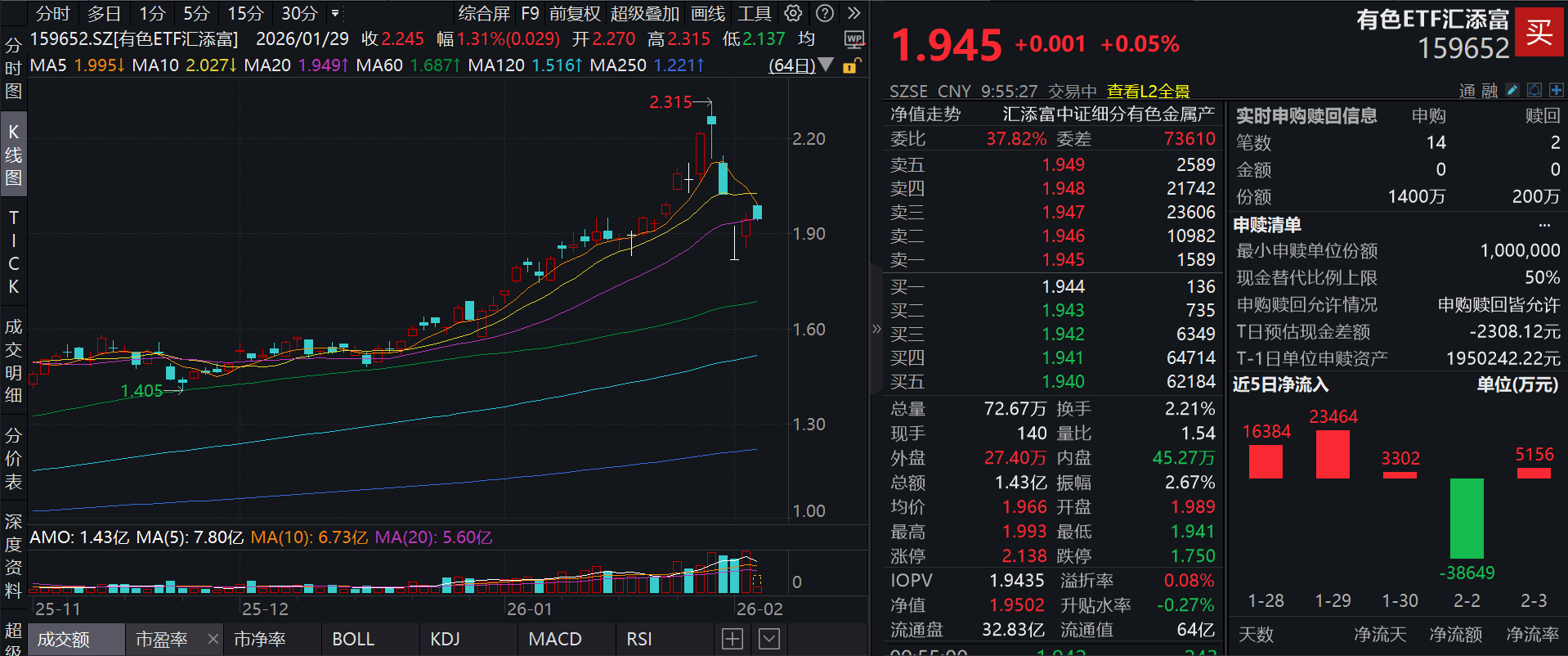
Core Viewpoint - The news highlights the performance and outlook of the non-ferrous metals sector, particularly focusing on the performance of the Huatai ETF and the broader market dynamics affecting metal prices and investments. Group 1: Market Performance - As of February 4, 2026, the China Securities Non-ferrous Metals Industry Theme Index (000811) decreased by 0.32%, with mixed performance among constituent stocks [1] - Notable gainers included Shenhuo Co., Ltd. up 1.73%, China Aluminum Corporation up 1.60%, and Luoyang Molybdenum up 1.51%, while Western Gold fell by 6.55% [1] - The Huatai Non-ferrous ETF (159652) saw a slight increase of 0.05%, with a recent price of 1.95 yuan, and a two-week cumulative increase of 2.59% [1] Group 2: Fund Flows and Liquidity - The Huatai Non-ferrous ETF's latest scale reached 6.403 billion yuan, with a net inflow of 51.56 million yuan recently [3] - Over the past five trading days, there were net inflows on four days, totaling 96.57 million yuan, averaging 19.31 million yuan per day [3] - The ETF recorded a turnover rate of 2.21% with a transaction volume of 143 million yuan [1] Group 3: Investment Sentiment and Outlook - The sentiment in the precious metals sector improved significantly as spot gold prices surpassed $5,000 per ounce, with a daily increase exceeding 2% [3] - The China Nonferrous Metals Industry Association has included copper concentrate in its reserve scope, indicating potential upward pressure on copper prices due to supply disruptions and capital expenditure shortages [3] - Institutions are optimistic about the non-ferrous sector, with expectations of high profitability sustained for 3-5 years due to supply-demand mismatches and macroeconomic easing [3] Group 4: ETF Characteristics and Advantages - The Huatai Non-ferrous ETF (159652) covers a wide range of metal sectors, including gold, copper, aluminum, lithium, and rare earths, positioning it to benefit from a super cycle in non-ferrous metals [5] - The ETF has a leading "gold-copper content" with 34% copper and 12% gold, totaling 46%, which is superior to its peers [7] - The ETF's index has shown a cumulative return leading its peers since 2022, with a maximum drawdown lower than that of similar funds, indicating a better investment experience [9]



未知机构:长江宏观于博团队十字路口的黄金谁来定价还能涨吗宏观周脉博系列4-20260203
未知机构· 2026-02-03 01:55
Summary of Key Points from the Conference Call Industry Overview - The discussion revolves around the gold market, particularly focusing on the recent price movements and underlying factors influencing these changes [1][2]. Core Insights and Arguments 1. **Gold Price Trends**: Since the beginning of the year, gold prices have consistently risen, surpassing $5,000 per ounce, but have recently experienced a correction due to geopolitical events and the "Walsh Shock" [1]. 2. **Demand Structure**: The price movements of gold are primarily driven by futures positions, ETF increases, and central bank purchases. Notably, the actual delivery volume from futures investors is very low, while gold ETFs tend to passively reflect price trends. Central bank purchases are more strategic in nature [1]. 3. **Short-term Outlook**: The "Walsh Shock" may be nearing its end, as balance sheet reductions could elevate term premiums, making it difficult for medium to long-term interest rates to decline. This situation does not align with political interests, particularly those of Trump. Geopolitical tensions and expectations of interest rate cuts are expected to support gold prices throughout the year [2]. 4. **Long-term Perspective**: The global economy is characterized by a "restructuring of order" and a "low growth, high debt" environment, positioning gold as the optimal asset for countering uncertainty [2]. Additional Important Points - The interplay between geopolitical events and market reactions is crucial in understanding gold price fluctuations, indicating a complex relationship between external factors and investor behavior [1][2]. - The strategic role of central banks in gold purchasing highlights the asset's importance in financial stability and risk management [1].
宏观周脉博系列4:十字路口的黄金:谁来定价,还能涨吗?
Changjiang Securities· 2026-02-01 23:30
Group 1: Gold Price Trends - Since the beginning of the year, gold prices have risen significantly, surpassing $5,000 per ounce, driven by geopolitical events and the "Wosh Shock" adjustment[2] - As of January 28, the London gold spot price increased from $4,318 per ounce at the end of last year to $5,414 per ounce[6] - The "Wosh Shock" is nearing its end, as the expectation of balance sheet reduction may raise term premiums, making it difficult for mid to long-term interest rates to decline[9] Group 2: Demand Structure and Influences - Gold demand is primarily driven by jewelry, central bank purchases, and ETFs, with central bank purchases and ETF increases playing a significant role in price changes[7] - The actual delivery volume from futures investors is very low, indicating that gold pricing is more reflective of financial behavior rather than physical demand[8] - Central banks, particularly from Brazil, Indonesia, and Iraq, have been significant buyers of gold in January, contributing to the price increase[8] Group 3: Future Outlook - The upcoming midterm elections are a major factor, with expectations of a 50 basis point rate cut by the end of the year supporting gold prices[9] - The global economic landscape remains characterized by "order restructuring" and "low growth with high debt," making gold a preferred asset against uncertainty[9] - Historical patterns suggest that gold will continue to be a key asset as geopolitical tensions and economic uncertainties persist[9]