
保险业转型

Search documents
收百万罚单、股权流拍,北部湾保险多重压力悬顶
Bei Jing Shang Bao· 2026-02-10 13:24
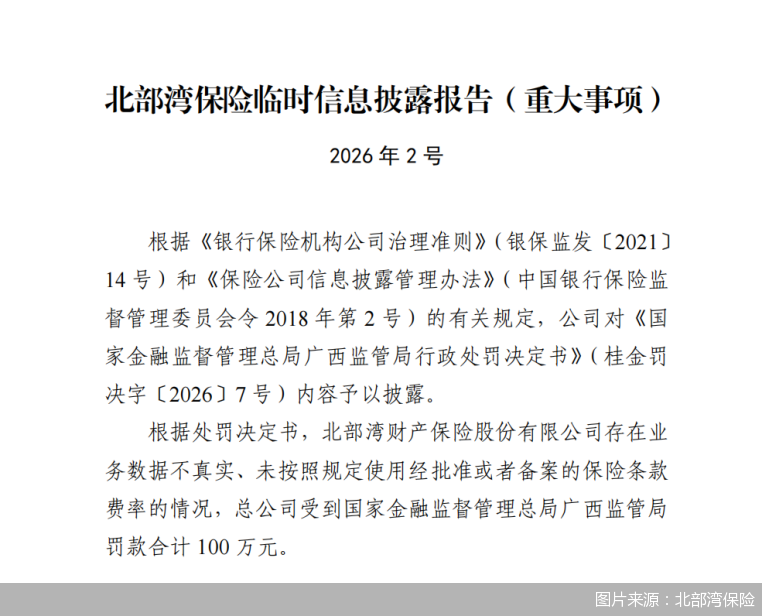
Core Viewpoint - The survival pressure on small and medium-sized insurance companies is intensifying, as evidenced by the recent penalties and challenges faced by Beibu Gulf Insurance, highlighting issues of compliance, capital, and governance [1][3][5] Compliance Issues - Beibu Gulf Insurance was fined a total of 1 million yuan for violations including false business data and improper use of approved insurance terms and rates [3][4] - Multiple branches of Beibu Gulf Insurance have also faced penalties for similar violations, indicating systemic governance flaws within the company [4][6] - Legal experts suggest that the company's compliance system is inadequate, reflecting a lack of effective internal controls and oversight mechanisms [4][6] Shareholding Challenges - The shareholding market for Beibu Gulf Insurance is experiencing a downturn, with significant portions of its stock failing to attract bids during auctions, indicating a cautious market sentiment [5][6] - The company has seen multiple instances of share pledges, which raises concerns about the stability of its governance structure and the potential for shareholder rights to be compromised [6][7] - High levels of share pledges among major shareholders could lead to uncertainties regarding the company's future and governance [6][7] Business Development and Strategy - Beibu Gulf Insurance, established in 2013, has undergone significant market reforms and is focusing on differentiated business development [7][8] - The company reported an insurance business revenue of 3.99 billion yuan and a net profit of 87 million yuan in 2025, indicating a stabilization in profitability [7] - The company aims to leverage local resources and align with regional economic development strategies, particularly in agriculture and infrastructure [8]

前11月保费超5.76万亿元,寿险单月降幅收窄释放啥信号
Nan Fang Du Shi Bao· 2025-12-29 08:33
Core Viewpoint - The insurance industry in China is undergoing a significant transformation from scale expansion to value creation, as indicated by the recent data showing a 7.56% year-on-year growth in original insurance premium income for the first 11 months of the year, reaching 5.76 trillion yuan [2][5]. Group 1: Industry Performance - The original insurance premium income for life insurance reached 4.42 trillion yuan, with a year-on-year growth of 9.2% [2]. - In November, the life insurance premium income was 154.8 billion yuan, showing a year-on-year decline of 2.4%, but the decline was significantly narrowed compared to October [2][3]. - The industry is signaling a gradual stabilization after a short-term adjustment, attributed to the recent adjustments in preset interest rates [3][4]. Group 2: Market Dynamics - The decline in life insurance premiums is primarily due to the adjustment of preset interest rates, which has led to a shift in product offerings towards lower preset interest rate products [3][4]. - The insurance sector is currently in a critical period for "opening red," and the narrowing decline in premiums indicates a positive trend towards adapting to these adjustments [4]. - The market demand is expected to remain strong through 2026, with the attractiveness of insurance products still higher than bank deposits, supporting new premium and new business value growth [4]. Group 3: Industry Challenges - The insurance industry is experiencing a prolonged period of slowing growth, with a compound annual growth rate of only 3.4% from 2019 to 2023, significantly down from 12.2% in December 2019 [5]. - The persistent low-interest-rate environment has compressed the profit margins of traditional savings-type insurance products, leading to increased competition and a decline in new business value rates for some listed insurance companies [5]. Group 4: Regulatory Environment - The recent regulatory policies aim to guide the insurance industry towards a focus on value rather than scale, emphasizing the importance of serving the economy and social stability [6]. - A series of policy measures have been implemented to promote risk protection and encourage the development of commercial health insurance and long-term care insurance [6]. Group 5: Product Strategy Evolution - The design logic of life insurance products is rapidly evolving, with a shift from pure savings to a combination of savings, protection, and service [7]. - The main products are now incorporating health and medical coverage, reflecting a broader understanding of long-term growth needs beyond just savings attributes [7][8]. - The insurance industry is expected to explore new growth areas in health and technology, enhancing its role as a core supporter of the social security system and economic risk management [8].
中国财险藏大招!三条道路暗中突围,碾压全球行业寒冬
Sou Hu Cai Jing· 2025-12-13 14:07
Core Viewpoint - The insurance industry is experiencing a stark contrast between life insurance companies, which are thriving, and non-life insurance companies, which are struggling due to various economic factors [1][3]. Group 1: Overall Market Trends - The global total premium growth rate is expected to decline from 3.1% in 2025 to 2.3% in 2026-2027, indicating a slowdown in growth [3]. - The life insurance sector is projected to grow at 2.5%, outperforming the overall industry [3]. - Non-life insurance growth is expected to drop to 2.1%, primarily due to stagnant premium increases, especially in the competitive non-auto insurance sector [5]. Group 2: Economic Environment Impact - The insurance industry's challenges stem from significant changes in the global economy, described as a "quicksand era," where stability is deceptive and can lead to pitfalls [6]. - Major economies in Europe and the U.S. have government debt-to-GDP ratios exceeding 100%, limiting central banks' ability to manage monetary policy independently [8]. - The current economic turmoil negatively impacts insurance companies that rely on long-term investment returns to cover claims, as asset yields decrease while liability costs rise [10]. Group 3: China's Insurance Market Dynamics - Despite global economic challenges, China's property insurance market is transitioning from scale to quality, with premium growth expected to maintain 5% to 6% from 2025 to 2030, outpacing GDP growth [11]. - The transition is driven by three key strategies that align with China's economic trends [11]. Group 4: Key Strategies for Transformation - The first strategy involves profitability breakthroughs in new energy vehicle insurance, which is expected to achieve overall profitability by 2027 after years of losses [13]. - The second strategy focuses on "index-based" agricultural insurance, which reduces operational costs and increases efficiency by using objective indicators for claims [16]. - The third strategy is to enhance insurance coverage for Chinese companies expanding overseas, addressing various risks associated with international operations [18]. Group 5: Conclusion on Industry Adaptation - The insurance industry must abandon outdated practices and accurately assess risks to adapt to the current economic landscape, with China's property insurance sector's strategies providing a potential pathway to navigate through economic cycles [20].

保险业首季实现保费收入约2.17万亿元 财险公司保费收入同比上涨,人身险公司保费收入同比下降
Zheng Quan Ri Bao· 2025-04-29 18:54
Core Insights - The insurance industry achieved a premium income of 2.17 trillion yuan in Q1, showing a slight year-on-year increase of 0.93% [1][2] - There is a divergence in premium income growth between property insurance companies, which saw a 5.10% increase, and life insurance companies, which experienced a 0.29% decline [2][3] - The growth disparity is attributed to the industry's transition phase and adjustments in the sales structure of life insurance products [1][2] Property Insurance Performance - Property insurance companies reported a premium income of 515.5 billion yuan, with significant growth in accident insurance (8.91%), health insurance (7.65%), and auto insurance (4.30%) [3] - The decline in claims expenditure for property insurance companies, which fell by 2.2% to 249.7 billion yuan, is linked to a decrease in major natural disaster losses [4] Life Insurance Performance - Life insurance companies generated a premium income of 1.659 trillion yuan, with only health insurance and investment-linked insurance showing positive growth [2][3] - Health insurance premiums reached 264.1 billion yuan, reflecting a year-on-year increase of 3.69%, driven by regulatory support, increased consumer health awareness, and product innovation [3] Claims Expenditure Trends - Life insurance companies faced a 20.4% increase in claims expenditure, totaling 577.6 billion yuan, primarily due to the maturity of popular life insurance products [4] - The rising claims expenditure poses profitability challenges for life insurance companies, necessitating strategies to optimize product structures and enhance operational efficiency [4] Future Outlook - The insurance industry is expected to maintain stable growth in premium income, with potential fluctuations in growth rates as market demand gradually releases and reforms deepen [4]