保险资金权益配置

Search documents
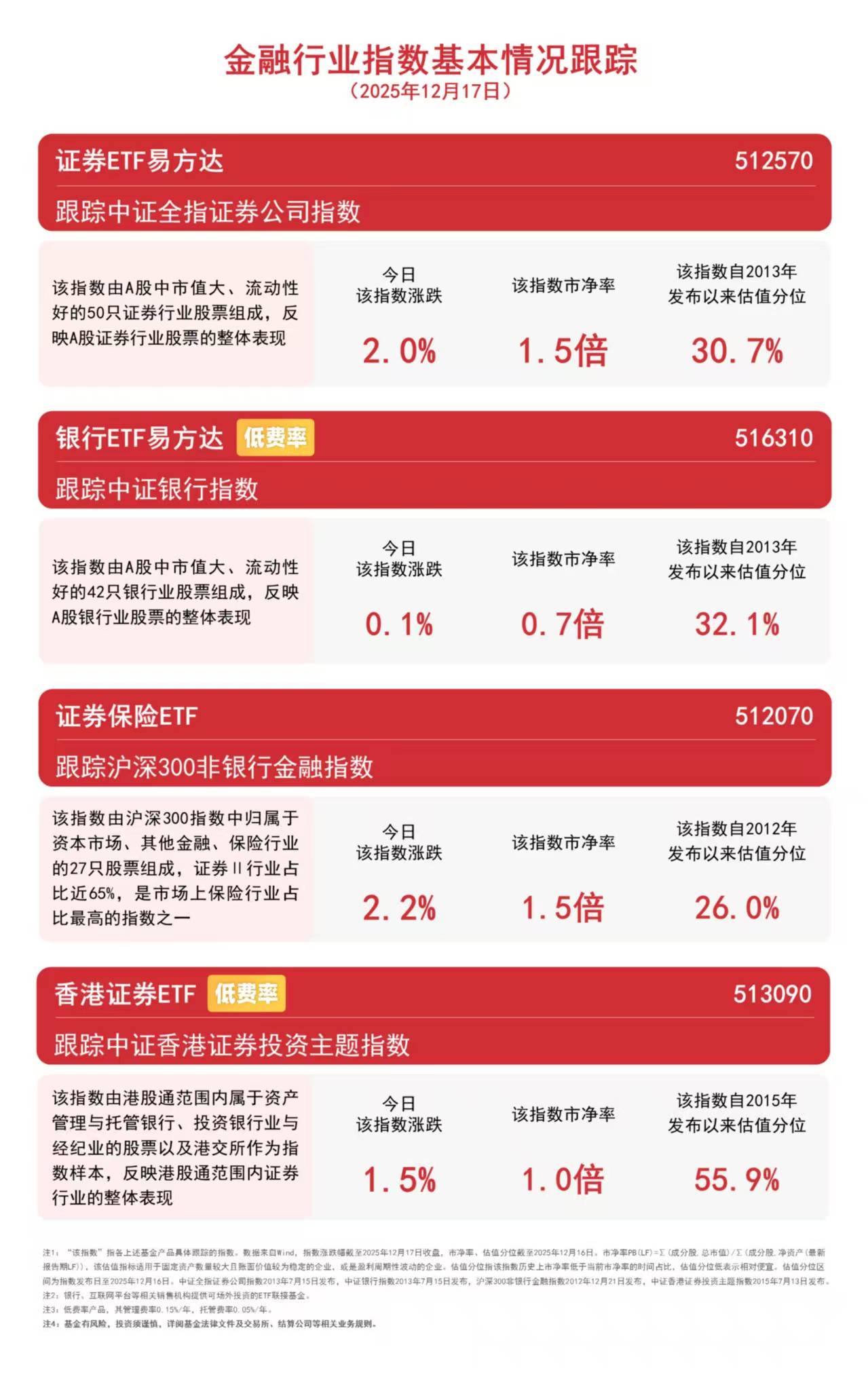
大盘午后拉升,关注证券保险ETF(512070)、证券ETF易方达(512570)等产品布局机会
Sou Hu Cai Jing· 2025-12-17 11:28
Group 1 - The core viewpoint of the article highlights a significant rally in the non-bank financial sector, particularly in securities and insurance, with the CSI 300 non-bank financial index rising by 2.2% and the CSI All Share Securities Companies Index increasing by 2.0% [1] - The recent policy adjustment by the National Financial Regulatory Administration, which lowers risk factors for long-term holdings in various indices, is expected to foster patient capital and support technological innovation [1] - The implementation of this policy is anticipated to continuously drive medium to long-term capital into the market, enhancing the equity allocation capacity of insurance funds [1] Group 2 - The securities insurance ETF (512070) has attracted over 500 million yuan in the past week, indicating strong investor interest [1] - The CSI 300 index reflects the overall performance of the top 50 securities industry stocks in A-shares, with a current price-to-book ratio of 1.5 times [3] - The CSI Bank Index, which represents the performance of the top 42 banking stocks in A-shares, has a price-to-book ratio of 0.7 times [4]

20cm速递|关注科创板100ETF(588120)投资机会,保险资金配置比例存提升空间
Mei Ri Jing Ji Xin Wen· 2025-12-10 12:08
Group 1 - The core viewpoint is that the proportion of stocks held by insurance companies in the Sci-Tech Innovation Board is on a long-term upward trend, supported by policy encouragement for insurance holdings in Sci-Tech stocks [1] - The risk factor for holdings exceeding two years has been adjusted from 0.4 to 0.36, which facilitates a normalized high proportion of equity allocation while maintaining tactical maneuvering space [1] - The increase in equity allocation by insurance funds is a major source of incremental growth, with potential additional investment space reaching trillions if the stock and fund investment ratio is raised to a 30% cap [1] Group 2 - The Sci-Tech 100 ETF (588120) tracks the Sci-Tech 100 Index (000698), which has a daily fluctuation limit of 20%, reflecting the overall performance of 100 larger and more liquid securities selected from the Sci-Tech Innovation Board [1] - The index components cover multiple high-tech industries, including information technology and healthcare, showcasing strong innovation and growth potential [1]
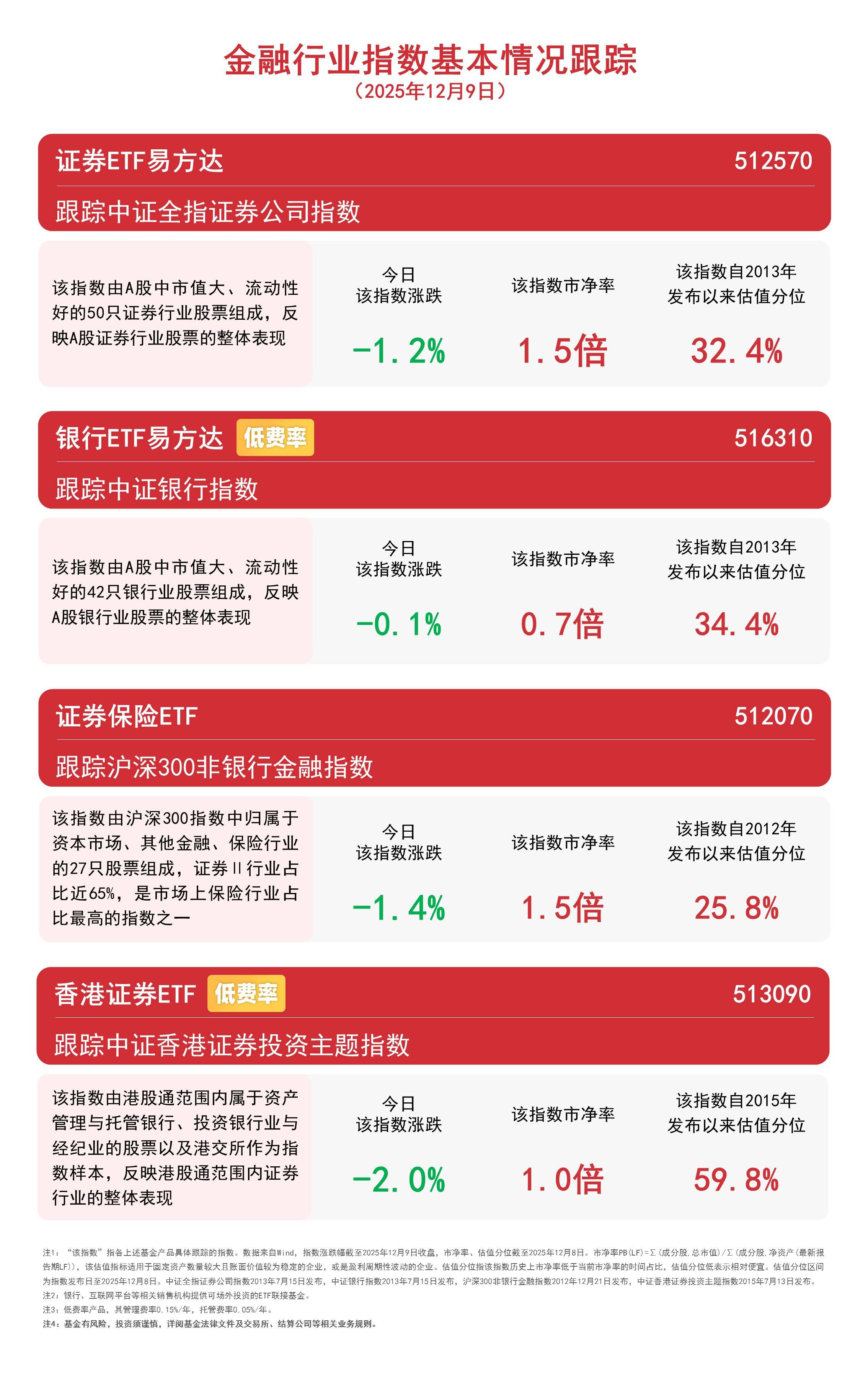
非银板块震荡调整,关注证券保险ETF(512070)、证券ETF易方达(512570)等产品布局机会
Sou Hu Cai Jing· 2025-12-09 10:31
Group 1 - The non-bank sector experienced a pullback after three consecutive days of gains, while the banking sector continued to fluctuate within a narrow range. The China Securities Bank Index fell by 0.1%, the China Securities Company Index dropped by 1.2%, the CSI 300 Non-Bank Financial Index decreased by 1.4%, and the Hong Kong Securities Index declined by 2.0% [1] - Ping An Securities noted that the National Financial Regulatory Administration issued a notice adjusting the risk factors for insurance companies' related business, which lowered the risk factors for long-term holding assets such as the CSI 300, dividend low volatility, and STAR Market. This adjustment is expected to cultivate patient capital and support technological innovation [1] - The implementation of this policy is anticipated to continuously promote the entry of medium to long-term funds into the market, enhancing the equity allocation capability of insurance funds [1] Group 2 - The CSI 300 Non-Bank Financial Index consists of 27 stocks from the CSI 300 Index that belong to the capital market, other financial sectors, and the insurance industry, with the securities industry accounting for nearly 65%, making it one of the indices with the highest proportion of the insurance industry in the market [4] - The Hong Kong Securities ETF tracks the China Securities Hong Kong Securities Investment Theme Index, which reflects the performance of stocks within the asset management, custody banks, investment banking, and brokerage industries in Hong Kong [5][6]
保险行业研究:风险因子下调引导长钱长投,险资权益配置限制再放开
SINOLINK SECURITIES· 2025-12-07 13:37
Investment Rating - The industry is rated as "Buy" with an expectation of an increase exceeding 15% in the next 3-6 months [8]. Core Insights - The adjustment of risk factors for long-term stock investments is expected to ease the constraints on insurance capital allocation to equities. Specifically, the risk factor for stocks held over three years in the CSI 300 and the CSI Low Volatility 100 Index has been reduced from 0.3 to 0.27, and for stocks held over two years on the STAR Market, it has been lowered from 0.4 to 0.36 [2][3]. - The policy aims to guide long-term investments and stabilize the capital market, although the immediate impact on insurance capital's willingness and scale to increase equity assets is expected to be limited [4]. - It is estimated that there will be an influx of 550-600 billion yuan in new capital into the market next year, with varying levels of stock accumulation among companies [5]. Summary by Sections Risk Factor Adjustment - The adjustment of risk factors is a direct implementation of measures announced earlier to support the capital market, which includes a 10% reduction in stock investment risk factors [2][3]. - The overall impact on the solvency ratio of insurance companies is expected to be minimal, with a projected increase in solvency ratios for major life insurance companies being less than 3% [3]. Market Outlook - The insurance sector is anticipated to see double-digit growth in new premium sales, driven by the maturity of fixed deposits and the appeal of insurance products for long-term wealth preservation [6]. - The valuation of insurance companies remains low, presenting a favorable cost-performance ratio for investment [6]. Capital Influx - Major state-owned enterprises are expected to allocate 30% of new premiums to A-shares, translating to approximately 250 billion yuan entering the market [5]. - Some companies may exceed this allocation, with estimates suggesting that companies like China Life and Taiping may invest up to 40% of new premiums into the stock market [5].
——申万宏源策略《关于调整保险公司相关业务风险因子的通知》点评:鼓励长期资金入市的方向延续
Shenwan Hongyuan Securities· 2025-12-07 02:38
Core Insights - The report discusses the adjustment of risk factors for insurance companies' investments, specifically the reduction of risk factors for stocks held for over three years in the CSI 300 and the low-volatility dividend index from 0.3 to 0.27, and for stocks held for over two years in the Sci-Tech Innovation Board from 0.4 to 0.36 [3][4][17] - The adjustment is seen as a marginal impact, with the potential for a significant increase in equity allocation by insurance funds in the long term [17][21] Quantitative Assessment of Risk Factor Adjustment - The report provides three scenarios for the proportion of stocks held for over three years in the CSI 300 and low-volatility dividend index: current situation at 13.0%, mid-term neutral at 42.1%, and optimistic at 50.3% [7][15] - For stocks held for over two years in the Sci-Tech Innovation Board, the current situation is at 0.6%, mid-term neutral at 1.9%, and optimistic at 2.9% [7][15] - The minimum capital released from the risk factor adjustment is estimated at 141 billion, 457 billion, and 554 billion under the three scenarios, respectively, with potential increases in stock investment of 514 billion, 1669 billion, and 2015 billion [15][17] Encouragement of Long-term Capital Market Entry - The adjustment is viewed as a supportive policy for encouraging long-term capital entry into the market, particularly for state-owned insurance companies that have already increased their equity investment ratios [17][21] - The report emphasizes the importance of increasing the equity allocation ratio of insurance funds as the main source of potential market entry space, estimating a potential increase of 32,431 billion if the equity and fund investment ratio reaches the regulatory cap of 30% [17][20] Market Dynamics and Future Outlook - The report notes that the spring market's economic and industrial catalysts are yet to be clarified, with supply-demand logic becoming a primary concern [21] - The adjustment of risk factors may lead to a favorable environment for insurance companies to engage in high-dividend stock investments while maintaining a focus on cost-effectiveness [21]
上半年狂买 险资重仓板块曝光
经济观察报· 2025-09-06 09:07
Core Viewpoint - Insurance funds are increasingly becoming a significant presence in the A-share market, with substantial investments in various sectors and a notable shift towards equity assets as traditional fixed-income returns decline [2][4][11]. Group 1: Insurance Fund Presence and Investment Trends - As of June 2025, insurance funds are listed among the top ten shareholders in nearly 800 A-share companies, with over 280 stocks increased and more than 300 new positions established in Q2 [2][4]. - The total investment balance of insurance companies in stocks reached 3.07 trillion yuan, an increase of approximately 640 billion yuan from Q4 2024 [4]. - The seven major A+H listed insurance companies hold a combined investment total of 21.85 trillion yuan, accounting for 60.30% of the industry total [4]. Group 2: Investment Strategies and Asset Allocation - Insurance companies are focusing on balancing returns, duration, and cash flow due to the long-term nature of their liabilities, leading to a cautious approach towards risk [4][11]. - In a low-risk return environment, insurance funds are gradually increasing their allocation to equities, with varying strategies among different companies [4][5]. - The average dividend yield of stocks held by insurance funds is 2.30%, slightly down from previous periods due to rising stock prices [8]. Group 3: Specific Company Actions and Sector Preferences - China Ping An has seen the largest increase in stock investment, with a net increase of 211.9 billion yuan, while China Life and New China Life also reported significant increases [5]. - The top five sectors for insurance fund holdings include banking, transportation, telecommunications, real estate, and utilities, with media, telecommunications, and utilities showing the highest quarterly increases [8]. - Insurance funds have engaged in notable stock purchases, with China Life increasing positions in CITIC Bank and China Telecom, while reducing holdings in Sinopec [9][10]. Group 4: Regulatory Environment and Future Outlook - Recent regulatory changes have encouraged insurance companies to allocate more funds to the A-share market, with a target of 30% of new premiums to be invested annually [12]. - The overall market valuation is considered reasonable, with expectations for continued investment in technology, consumer manufacturing, and emerging markets [12].