债券抛售潮

Search documents
ATFX:格陵兰岛事件加剧全球债券抛售潮 黄金稳居高点有望继续破位
Xin Lang Cai Jing· 2026-01-20 15:01
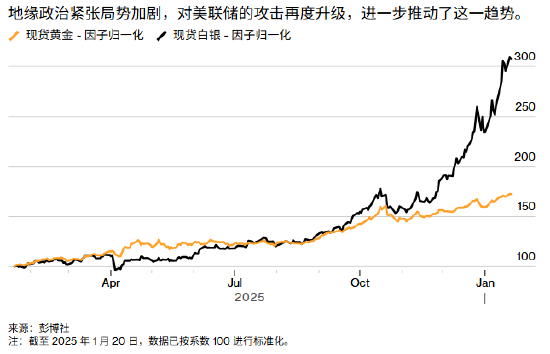
Group 1: Precious Metals Market - Gold prices reached a historical high of $4,694 per ounce, while silver peaked at $94.7295 per ounce due to geopolitical tensions [1][5] - The situation surrounding President Trump's attempt to acquire Greenland has raised concerns about a potential trade war between the US and Europe, driving demand for safe-haven assets [1][8] - The ongoing macroeconomic and geopolitical instability has made investors reliant on financial assets uneasy, further supporting the upward trend in precious metal prices [8] Group 2: Oil Market Dynamics - Oil prices are under pressure due to signs of oversupply, with some Middle Eastern crude spot prices declining as OPEC+ countries increase production [9] - The International Energy Agency is set to release a market analysis report, which may indicate severe oversupply in the oil market this year, potentially leading to further declines in oil prices [9] - Despite the general oversupply, certain regions are experiencing supply tightness, particularly in the Mediterranean due to issues with the Black Sea and Kazakhstan's giant Tengiz oil field, which may provide some support against downward price pressure [9]

【环球财经】日元急剧贬值刺激东京股市反弹 日经225指数涨1.81%
Xin Hua Cai Jing· 2025-12-22 09:13
Group 1 - The core viewpoint of the articles highlights the impact of the Bank of Japan's interest rate hike on the financial markets, particularly the rebound in the Tokyo stock market due to the sharp depreciation of the yen [1][2] - The Nikkei 225 index rose by 1.81%, closing at 50,402.39 points, while the Tokyo Stock Exchange index increased by 0.64%, closing at 3,405.17 points [2] - The market reaction included a sell-off in the Tokyo bond market, with the yield on new 10-year government bonds reaching 2.1%, the highest in nearly 27 years, indicating ongoing concerns about Japan's fiscal deterioration [1] Group 2 - Various sectors within the Tokyo Stock Exchange showed mixed performance, with notable gains in sectors such as non-ferrous metals, electrical products, and machinery, while sectors like land transportation, air transportation, and other products experienced declines [2]
日债危机进入新阶段:10年期收益率升破警戒线,创2008年来新高
华尔街见闻· 2025-07-15 10:16
Core Viewpoint - The Japanese bond market is experiencing significant turmoil due to political uncertainty and fiscal concerns, with the 10-year bond yield surpassing critical levels, indicating heightened market anxiety [1][3]. Group 1: Bond Yield Trends - On July 15, the 10-year Japanese government bond yield rose by 2.5 basis points to 1.595%, the highest level since 2008. The 20-year yield increased by 3.5 basis points to 2.64%, and the 30-year yield rose by 4 basis points to 3.195%, both reaching levels not seen since 1999. Bonds with maturities of 20 years or more have seen yields rise by at least 20 basis points this month [1][3]. - The rise in the 10-year yield is particularly concerning as it directly impacts the economy, being a benchmark for fixed mortgage rates, which will increase financing costs for businesses and households [3][5]. Group 2: Political Context and Market Reactions - The upcoming July 20 Senate elections are a key factor driving the rise in bond yields, with concerns that the ruling coalition may lose, leading to a significant shift in fiscal policy and increased selling pressure in the bond market [5][6]. - Polls indicate a declining trend in expected seats for the ruling Liberal Democratic Party, raising fears of a potential shift to more populist policies that could exacerbate fiscal deficits and undermine investor confidence in bonds [5][7]. - Analysts warn that if the ruling coalition loses, it could trigger a sell-off of long-term bonds by foreign investors, particularly due to fears of potential consumption tax cuts [5][7]. Group 3: Global Context - The rise in Japanese bond yields is part of a broader global trend, with long-term government bond yields falling worldwide as investors express concerns over government spending exceeding sustainable levels [7][8]. - The Bank of Japan's governor has indicated that while the impact of long-term yields on the economy is limited compared to short-term debt, the situation will be closely monitored [8].