
光伏产业供需

Search documents
南华期货光伏产业周报:供需双弱,宽幅震荡-20260208
Nan Hua Qi Huo· 2026-02-08 14:36
1. Report Industry Investment Rating The document does not provide the industry investment rating. 2. Core Viewpoints of the Report - The polysilicon futures price fluctuated widely this week. The core logic driving the price trend focuses on factors such as supply - side production suspension and resumption, downstream demand - side production scheduling, photovoltaic export rush, and anti - involution. The industry presents a "weak supply and weak demand" characteristic, with supply expansion slowing and downstream production under pressure. Due to the export tax - refund window in April, there may be an export rush for photovoltaic modules, but the overall market is mainly focused on inventory consumption [3]. - The polysilicon futures price is expected to be in a wide - range oscillation. The current 20 - day rolling volatility is 28.63%, and the historical percentile of the current volatility in the past 3 years is 83.6% [9]. 3. Summary According to Relevant Catalogs 3.1 Core Contradictions and Strategy Recommendations 3.1.1 Core Contradictions - The current polysilicon market is affected by supply - side production changes, downstream demand, export rush, and anti - involution. The industry shows a "weak supply and weak demand" situation, with supply - side production declining and downstream production also under pressure. The market is mainly consuming inventory, and attention should be paid to the anti - involution progress [3]. 3.1.2 Industry Operation Suggestions - **Polysilicon Futures Price Range**: The polysilicon futures price is expected to have a wide - range oscillation, with a 20 - day rolling volatility of 28.63% and a historical percentile of 83.6% in the past 3 years [9]. - **Photovoltaic Industry Risk Management Strategy Suggestions**: Different hedging strategies are provided for polysilicon sales, procurement, and inventory management, including using futures contracts and option combinations, with recommended hedging ratios [9]. 3.2 Market Information - On January 31 (Saturday), some leading polysilicon companies held a meeting to discuss polysilicon market - related matters. On February 5, a photovoltaic industry - related meeting was held to focus on capacity optimization and price order rectification [11]. 3.3 Market Analysis 3.3.1 Price, Volume, and Capital Interpretation - **Market Review and Technical Analysis**: The polysilicon weighted index closed at 49,536 yuan/ton this week, with a week - on - week increase of 5.06%. The trading volume was 12,451 lots, a week - on - week decrease of 47.72%, and the open interest was 65,885 lots, a week - on - week decrease of 10,229 lots. The PS2605 - PS2606 spread was in a contango structure, with a week - on - week decrease of 470 yuan/ton. The number of warehouse receipts was 8,610 lots, a week - on - week increase of 190 lots. The futures price is expected to face resistance at 52,000 yuan/ton [15]. - **Option Situation**: The 20 - day historical volatility and the implied volatility of at - the - money options of polysilicon fluctuated widely in the past week. The option open - interest PCR showed a weakening trend [17][18]. - **Capital Trends**: The long - position scale of key profitable seats in polysilicon showed a stable trend in the past week [20]. - **Spread Structure**: The polysilicon futures term structure is in a contango structure [22]. - **Basis Structure**: The basis of the main contract showed a slightly stronger oscillation this week, and it is recommended to pay attention to the opportunity of taking goods from the futures market periodically [26]. 3.3.2 Futures and Price Data - The prices of various types of polysilicon, silicon wafers, battery cells, and photovoltaic modules are provided, showing different price changes [29]. 3.4 Valuation and Profit Analysis - The overall profit margin of polysilicon enterprises is weakening. From the spot market, the spot profit of polysilicon is declining. In terms of production technology, the profit of the silane method is higher than that of the improved Siemens method. The gross profit margin of polysilicon futures is about 26.99% [30]. 3.5 Fundamental Data 3.5.1 Polysilicon Supply - **Domestic Production**: The domestic polysilicon weekly production decreased, with the SMM - weekly production at 20,100 tons, a week - on - week decrease of 0.50% and a month - on - week decrease of 15.55%. The Baichuan - weekly production was 19,220 tons, a week - on - week decrease of 5.78% and a month - on - week decrease of 27.14%. The Baichuan - weekly utilization rate was 31%, a week - on - week decrease of 0.0313 and a month - on - week decrease of 26.19% [38]. - **Overseas Production**: The overseas polysilicon monthly production and utilization rate data are provided [40]. - **Inventory**: The domestic polysilicon weekly inventory increased. The total weekly inventory was 589,000 tons, a week - on - week increase of 1.63% and a month - on - week increase of 10.22% [43]. 3.5.2 Silicon Wafer Supply - **Production**: The weekly silicon wafer production was 10.38 GW, a week - on - week decrease of 11.66% and a month - on - week decrease of 1.33% [46]. - **Inventory**: The weekly silicon wafer inventory was 28.32 GW, a week - on - week increase of 3.77% and a month - on - week increase of 7.97% [46]. 3.5.3 Battery Cell Supply - **Production**: The monthly production and utilization rate data of battery cells are provided, including different types of battery cells such as Topcon, BC, and HJT [53]. - **Inventory**: The weekly battery cell inventory was 9.17 GW, a week - on - week increase of 2.80% and a month - on - week increase of 2.80% [56]. 3.5.4 Photovoltaic Module Supply - **Production**: The monthly production and utilization rate data of photovoltaic modules are provided, including N - type and P - type modules [59]. - **Inventory**: The weekly photovoltaic module inventory was 24.7 GW, a week - on - week decrease of 5.36% and a month - on - week decrease of 17.67% [62]. 3.5.5 Bidding - The weekly data of photovoltaic module winning bids show that the winning bid capacity was 137.33 MW, a week - on - week decrease of 46.84% and a month - on - week decrease of 95.83%. The average winning bid price was 0.78 yuan/watt, a week - on - week increase of 1.30% and a month - on - week increase of 6.85% [64]. 3.5.6 Installation and Application - The monthly new - installed capacity of Chinese photovoltaics and the data of green power generation (including wind and solar power) are provided [68][70].

集邦咨询:硅料短期弱稳 中下游环节价格重心下移
智通财经网· 2025-11-20 05:52
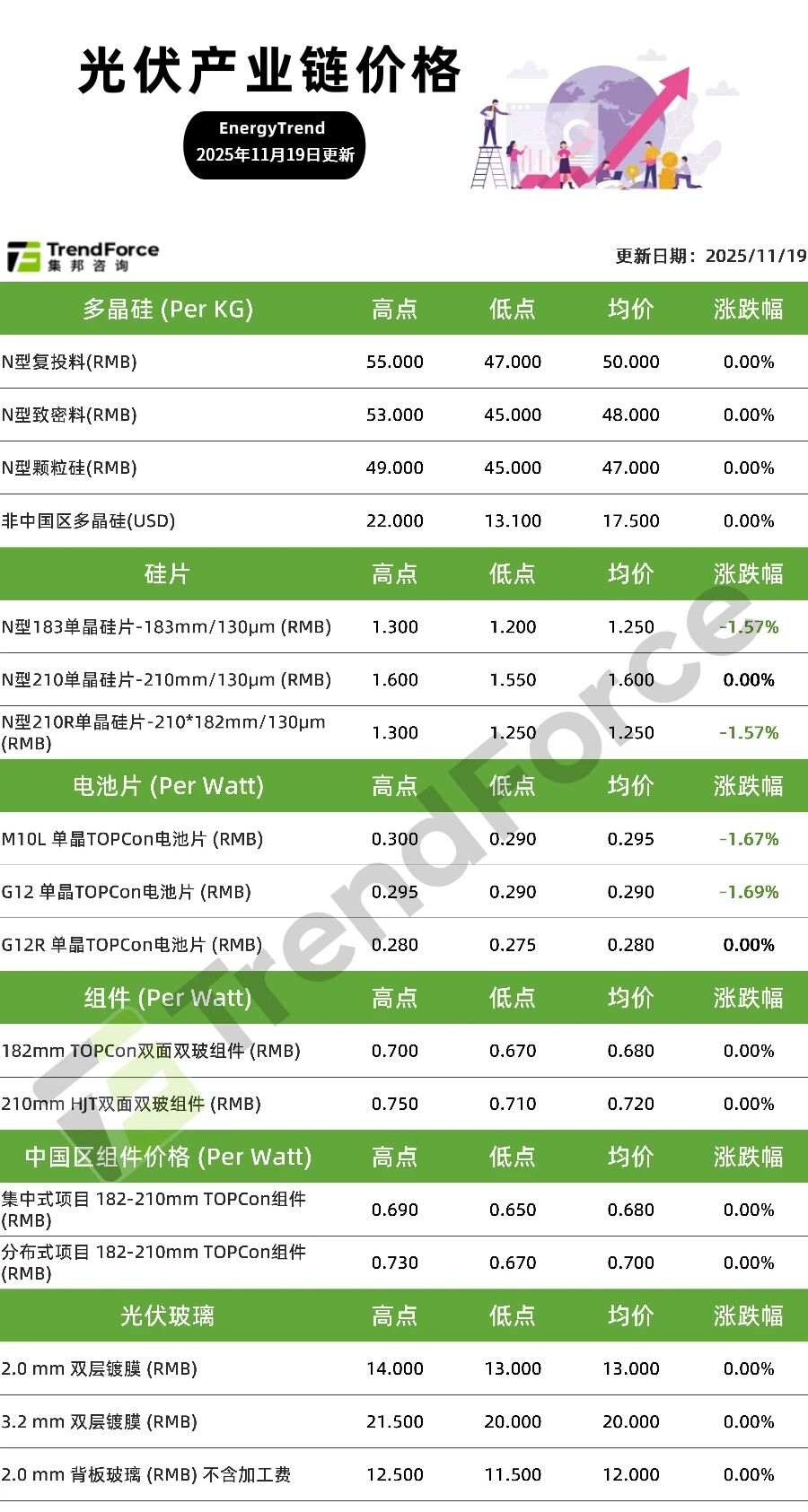
Core Viewpoint - The photovoltaic industry is experiencing a weak and stable price trend for polysilicon due to supply-side reductions and a consensus against internal competition, despite high inventory and low demand [1][2]. Supply and Demand Analysis - **Polysilicon**: Supply has contracted significantly, with leading manufacturers halting production, which has mitigated some negative impacts from weakened demand. However, demand remains weak, with downstream prices falling and inventory levels exceeding 430,000 tons, suppressing market confidence [2]. - **Silicon Wafers**: The overall inventory remains high at over 23 GW, leading to significant shipping challenges. While some leading manufacturers are attempting to maintain prices, others are resorting to lower pricing to alleviate inventory pressure. Demand for even previously strong products like the 210N has decreased, resulting in a drop in transaction volumes [3]. - **Battery Cells**: There is a dual decline in demand both domestically and internationally, with significant drops in orders for 210N batteries. Current inventory levels are manageable but face structural pressures, particularly as major markets like India reduce purchasing [4]. - **Photovoltaic Modules**: Seasonal demand is declining, with manufacturers under pressure to meet annual targets. The pricing strategy is diverging, with larger manufacturers pushing for sales while smaller ones face operational challenges. Prices have dropped to a range of 0.65-0.68 RMB/W, with further declines expected if demand does not improve [5]. Price Trends - **Polysilicon Prices**: Prices are currently stable, supported by supply-side reductions [2]. - **Silicon Wafer Prices**: The average price for N-type 183mm wafers has decreased by 1.57% to 1.25 RMB, while 210N wafers remain stable at 1.60 RMB [7]. - **Battery Prices**: Prices for 183N and 210N batteries have fallen to approximately 0.29 RMB/W, indicating a downward trend [4][7]. - **Module Prices**: The price for modules has decreased, with the current range at 0.65-0.68 RMB/W, reflecting the impact of seasonal demand and market pressures [5][7].

多晶硅月报:上方基本面压制,下方政策托底等待区间突破确定性机会-20251101
Jian Xin Qi Huo· 2025-11-01 14:59
Report Summary Report Title Multi-silicon Monthly Report Report Date November 01, 2025 Industry Investment Rating Not provided Core Viewpoint The multi-silicon market is suppressed by fundamentals above and supported by policies below. Wait for a definite opportunity for range breakthrough [4]. Summary by Directory 1. Multi-silicon Market Review and Outlook - **Market Review**: In October, multi-silicon futures contracts continued to oscillate at high levels. The Ps2511 contract closed at 54,350 yuan/ton, up 5.82% monthly, with a trading volume of 2.321 million lots and an open interest of 2,748 lots. The Ps2601 contract closed at 56,410 yuan/ton, up 5.29% monthly, with a trading volume of 2.392 million lots and an open interest of 142,000 lots, a net increase of 109,000 lots. The spot price of multi-silicon remained stable, with the n-type re-feeding material trading in the range of 49,000 - 55,000 yuan/ton, and the average transaction price at 53,200 yuan/ton [9]. - **Market Outlook**: The spot price range of multi-silicon is 49,000 - 55,000 yuan/ton, and the average transaction price is 53,200 yuan/ton. The price range of the multi-silicon futures 2601 contract is 50,000 - 59,000 yuan/ton. The closing price at the end of October has a premium over the spot price, and the upward resistance is increasing. The endogenous driving force for the improvement of multi-silicon supply and demand is limited. The profit of multi-silicon has been significantly repaired, and the monthly output has continued to exceed expectations. In October, the output of multi-silicon was 137,000 tons, which can meet the terminal demand of 68.50GW. The terminal demand is still in the weak stage after the "rush installation", with the monthly demand expected to be about 10GW, the export demand between 20 - 30GW, and the total demand about 40GW. The policy-driven logic takes precedence over the fundamentals. The support policy is that the selling price of silicon materials should not be lower than the comprehensive production cost of enterprises. The effective support provided by the fundamentals is expected to be between 45,000 - 47,000 yuan/ton. The stimulus policy comes from the "state reserve" rumor in the past two months, which has not been realized and should not be priced. Overall, the unilateral driving force is not strong. It is advisable to bet on a rebound at the lower edge of the range or wait for the policy to be realized for a range breakthrough. Do not chase up or sell down within the range [10][11]. 2. Limited Endogenous Driving Force for the Improvement of the Photovoltaic Industry's Supply and Demand - **Price Stability**: The spot prices in the photovoltaic industry generally remained stable. The spot price of industrial silicon was stable, the multi-silicon spot price was stable with low market activity, the prices of silicon wafers showed no obvious changes, and the prices of downstream batteries and components were relatively stable [13]. - **High Profits and Production Will**: In October, the average production cost of multi-silicon was 41,443 yuan/ton, and the theoretical net profit per ton was as high as 9,157 yuan/ton. The high profits and industry self-discipline may weaken the actual effect of anti-involution production cuts. The production willingness of multi-silicon enterprises was high in October, and the actual production cut was less than expected, with the pressure of supply-demand mismatch remaining [14][15]. - **Production and Demand Situation**: The production of silicon wafers and batteries remained stable, and the pressure of terminal demand had not been significantly transmitted to the upstream. The anti-involution price increase in the industry chain stimulated the production of silicon wafers and batteries to continue to rise. From January to September, the silicon wafer production was 488.70GW, with a cumulative year-on-year decrease of 4.59%. In October, the expected production of silicon wafers was between 58 - 60GW, with little monthly change. From January to September, the battery production was 481.48GW, with a cumulative year-on-year increase of 0.51%. In October, the expected production of batteries was about 55GW, with little monthly change. The terminal demand was still in the weak stage after the "rush installation" in the first half of the year. From January to September 2025, the new photovoltaic installed capacity was 240.27GW, with a cumulative year-on-year increase of 49.35%. However, the installed capacities in June, July, August, and September were 14.36GW, 11.04GW, 7.36GW, and 9.65GW respectively, and the installed capacity in September decreased by 54% year-on-year. In terms of external demand, from January to September 2025, the total export volume of photovoltaic modules was 204.27GW, a year-on-year increase of 4.6%. In September, the export volume of Chinese photovoltaic modules was 25.63GW, a month-on-month decrease of 6.0% and a year-on-year increase of 46.8%. The supply-demand mismatch pressure remained, and the multi-silicon spot market continued to accumulate inventory. As of October 30, the multi-silicon spot inventory was 273,040 tons, a 13.33% increase from the same period last month, a 1.2% increase from the end of June, and a 7.50% increase from the same period last year. The futures inventory was 27,360 tons, a 14.72% increase from the same period last month [15][16][17]. 3. The Macro and Industrial Policies Were in a Vacuum Period in October - **Policy Frequent in September**: In September, the multi-silicon industry policies were frequently issued, fulfilling the policy expectations of anti-"involution" competition set by the high-level since the end of June. On September 4, the Ministry of Industry and Information Technology and the State Administration for Market Regulation issued the "Stable Growth Action Plan for the Electronic Information Manufacturing Industry from 2025 - 2026". On September 16, the article "Deeply Promote the Construction of a Unified National Market" was published in the official media, emphasizing the governance of various chaotic phenomena. On the same day, the Standardization Administration of China solicited opinions on 3 mandatory national standards such as "Energy Consumption Quotas per Unit Product of Silicon Polysilicon and Germanium". After the adjustment of the existing production capacity structure, the effective production capacity of domestic multi-silicon will drop to about 2.4 million tons/year, a decrease of 16.4% compared with the end of 2024 and a 31.4% decrease compared with the installed production capacity [32]. - **Policy Evaluation**: Currently, the total production capacity of the multi-silicon industry is significantly excessive. It is expected that the policy logic is not to clear the photovoltaic production capacity but to promote the healthy and orderly development of the industry through policy guidance and market-based operations, with the overall goal of meeting the "dual carbon" target. The multi-silicon industry needs more policies from the policy side and the industry to get out of the bottom cycle of supply-demand imbalance [33].
建信期货多晶硅日报-20250806
Jian Xin Qi Huo· 2025-08-06 01:41
Report Date - The report date is August 6, 2025 [2] Market Performance - Multiple contracts of polysilicon declined significantly. The closing price of PS2509 was 50,330 yuan/ton, with a gain of 3.88%. The trading volume was 433,130 lots, and the open interest was 127,587 lots, a net increase of 20,838 lots [4] Future Outlook - Polysilicon is supported by comprehensive costs and spot prices. It has ended its previous adjustment and returned to range - bound trading. The price increase in the photovoltaic industry has not been smoothly transmitted to the component end. In August, polysilicon production is expected to increase to 125,000 tons, which can meet the downstream demand of 56.82GW. Since June, the pressure of a sharp decline in terminal demand has gradually spread upstream, and the monthly output of silicon wafers and battery cells has dropped to about 52GW. The supply - demand relationship remains loose. Currently, the supply - demand situation has not improved significantly, and the policy implementation has cooled market sentiment. Prices are expected to remain in a wide - range oscillation, with 47,000 yuan as a short - term support level [4] Market News - On August 5, the number of polysilicon warehouse receipts was 3,120 lots, a net increase of 250 from the previous trading day. From January to June, the cumulative photovoltaic installed capacity was 212.21GW, a year - on - year increase of 107.07%. In June, the domestic installed capacity was only 14GW, showing a significant decline. On August 1, the Ministry of Industry and Information Technology issued a notice on the special energy - saving supervision task list for the polysilicon industry in 2025. According to customs data, in June 2025, China exported about 21.7GW of photovoltaic components, a 3% month - on - month decrease and a 2% decrease compared with June 2024. From January to June, the cumulative export of photovoltaic components was about 127.3GW, a 3% decrease compared with the same period last year [5]
工业硅、多晶硅日评:供给端扰动,价格低位反弹-20250701
Hong Yuan Qi Huo· 2025-07-01 02:30
Report Industry Investment Rating No relevant content provided. Core View - The silicon market is experiencing weak supply and demand, with high inventory pressure. Recently, due to sudden production cuts by Xinjiang silicon enterprises on the supply side, the futures and spot prices have rebounded, providing short - term support for silicon prices. In the medium - to - long term, the oversupply situation persists [1]. - The polysilicon price has rebounded at a low level driven by the rising sentiment of industrial silicon. However, from a fundamental perspective, the adjustment of industrial overcapacity takes time to transmit, and the rebound space may be limited [1]. Summary by Related Content Price Changes - **Industrial Silicon**: The average price of non - oxygen - blown 553 (East China) increased by 1.23% to 8,200 yuan/ton, and the average price of 421 (East China) increased by 1.15% to 8,800 yuan/ton. The closing price of the futures main contract rose by 0.37% to 8,060 yuan/ton [1]. - **Polysilicon**: The price of N - type dense material remained flat at 33.5 yuan/kg, the price of polysilicon re - feeding material remained flat at 31.5 yuan/kg, the price of polysilicon dense material remained flat at 30.0 yuan/kg, and the price of polysilicon cauliflower material remained flat at 28.5 yuan/kg. The closing price of the futures main contract rose by 0.66% to 33,535 yuan/ton [1]. - **Silicon Wafer**: The price of N - type 210mm decreased by 0.81% to 1.22 yuan/piece, and the price of N - type 210R decreased by 0.98% to 1.01 yuan/piece. The price of N - type 183mm remained flat at 0.87 yuan/piece [1]. - **Cell**: The price of single - crystal PERC cell M10 - 182mm remained flat at 0.27 yuan/watt [1]. - **Component**: The price of single - crystal PERC component single - sided - 182mm remained flat at 0.70 yuan/watt, and the price of single - crystal PERC component single - sided - 210mm remained flat at 0.72 yuan/watt [1]. - **Organic Silicon**: The price of DMC remained flat at 10,450 yuan/ton, the price of 107 glue decreased by 0.43% to 11,550 yuan/ton, and the price of silicone oil decreased by 0.37% to 13,300 yuan/ton [1]. Market Information - **Silicon Wafer Market**: In July, the overall production schedule of the silicon wafer market is expected to decrease by about 4 - 5GW, with significant production cuts by several leading enterprises, especially for N - type 183mm silicon wafers [1]. - **Electronic Silane Gas Project**: The first - phase 2000 - ton production line of Shaanxi Tianhong Ruike Silicon Materials Co., Ltd.'s annual 5000 - ton electronic silane gas project will be put into production at the end of this month, and the second - phase 3000 - ton project will be launched as planned [1]. - **Photovoltaic Glass Market**: Domestic leading photovoltaic glass enterprises plan to collectively cut production by 30% starting from July, and it is expected that the domestic glass production in July will drop to about 45GW [1]. Supply and Demand Analysis - **Industrial Silicon**: On the supply side, the operation of silicon enterprises in the north has changed little, and the operation of enterprises in the southwest is steadily recovering. On the demand side, polysilicon enterprises continue to cut production, and the demand from the organic silicon and silicon - aluminum alloy industries is weak [1]. - **Polysilicon**: On the supply side, silicon material enterprises continue to cut production, but some may have new production capacity, with a slight increase in expected output. On the demand side, the photovoltaic market is weak, with rising inventory and slow - growing demand [1].
工业硅、多晶硅日评:工业硅上方压力较强,多晶硅波动加剧-20250509
Hong Yuan Qi Huo· 2025-05-09 02:09
Report Industry Investment Rating - Not provided Core Viewpoints of the Report - The industrial silicon market is characterized by strong supply and weak demand, with high inventory pressure, and is expected to remain weak in the short - term, trading in the range of 8,000 - 10,000 yuan/ton [1] - The polysilicon price fluctuates sharply in the short - term due to the conflict between weak fundamentals and delivery factors. If the contradiction of "high positions and low warehouse receipts" remains unresolved, long positions in the 06 contract can be considered [1] Summary by Related Catalogs Industrial Silicon Price Changes - The average price of non - oxygenated 553 (East China) industrial silicon decreased by 0.55% to 9,050 yuan/ton, and the average price of 421 (East China) industrial silicon decreased by 0.50% to 10,050 yuan/ton. The closing price of the futures main contract increased by 0.30% to 8,315 yuan/ton [1] Supply and Demand - In April, the industrial silicon production decreased to about 300,000 tons due to production cuts in some Xinjiang silicon enterprises. In May, production is expected to increase steadily but incrementally limited. On the demand side, polysilicon enterprises maintain production cuts, organic silicon enterprises have strong intentions to cut production to support prices but face weak demand, and silicon - aluminum alloy enterprises purchase as needed [1] Investment Strategy - The industrial silicon market has strong supply and weak demand, high inventory pressure, and is expected to remain weak in the short - term, with a trading range of 8,000 - 10,000 yuan/ton [1] Polysilicon Price Changes - N - type dense material, polysilicon re - feeding material, polysilicon dense material, and polysilicon cauliflower material prices remained unchanged. The closing price of the futures main contract increased by 4.03% to 36,950 yuan/ton [1] Supply and Demand - Supply: Silicon material enterprises maintain production cuts, and some new production capacities may be put into operation, with expected output within 100,000 tons. Demand: The photovoltaic market is weak, with rising inventories of silicon wafers and materials, falling prices, and weak market transactions [1] Investment Strategy - Due to delivery factors and production cut news, the polysilicon price rebounded at a low level. In the short - term, price fluctuations intensify. If the "high positions and low warehouse receipts" contradiction is not resolved, long positions in the 06 contract can be considered [1] Other Information - Jinyang New Energy's subsidiary has entered into a joint - venture agreement for a 4GW HBC upgrade project [1] - The price of 2.0mm single - layer coated glass of two domestic second - tier photovoltaic glass enterprises has been lowered to 13 yuan/square meter, and the mainstream market quotation has dropped to 13.5 yuan/square meter [1] - Yidao New Energy's Quzhou and Jingshan bases have obtained ISO 14067 product carbon footprint certification [1]