
全球多元化配置

Search documents
美股不再独美!从“抛售美国”到横扫全球,华尔街资金疯狂外迁
Jin Shi Shu Ju· 2026-02-10 03:49
Core Viewpoint - Investors are shifting their focus from U.S. equities to international markets, betting that the U.S. advantage will narrow, marking a significant change in investment strategy [1][2]. Group 1: Market Trends - The MSCI All-Country World Ex-U.S. Index surged 29% last year, outperforming the S&P 500's 16% increase, indicating a strong performance in international markets [2]. - Global indices, including the European Stoxx 600, South Korea's Composite Index, and MSCI Emerging Markets Index, have outperformed major U.S. benchmarks since 2026 [1]. - Investors are increasingly allocating funds to international markets, with a net inflow of $51.6 billion into international equity ETFs in January, reflecting a significant shift in investment behavior [2]. Group 2: Investor Sentiment - Fund managers express optimism about global markets, citing fiscal stimulus in Japan and increased military spending in Europe as positive developments [1]. - There is a growing belief among investors that diversification into international equities is becoming essential, as evidenced by inquiries from clients about increasing overseas stock allocations [6]. - Despite the shift, many still believe that U.S. equities will continue to lead the global market, albeit with a reduced advantage compared to previous years [5][6]. Group 3: Economic Indicators - The depreciation of the U.S. dollar by approximately 10% since its peak in 2022 has enhanced the relative value of overseas companies, making international stocks more attractive [5]. - Concerns about the expanding national debt and political volatility in the U.S. are prompting investors to consider reducing their exposure to U.S. equities and rebalancing their portfolios [6].
PIMCO:债券资产展现长期投资价值 适当增加相关多元化配置比重
Xin Hua Cai Jing· 2026-01-27 16:20
Group 1 - The core viewpoint is that global economic growth is expected to remain strong in 2026, with potential short-term increases in equity markets. However, investors should consider combining stock and bond portfolios or increasing bond holdings for global diversification [1] - The impact of technological advancements, particularly artificial intelligence, will lead to significant differentiation among industries and companies, benefiting those that adopt new technologies while others may fall behind [1] - Global monetary and fiscal policies are anticipated to diverge, with the influence of fiscal policy increasing as monetary easing reaches its limits. Bonds are highlighted as having solid and lasting investment value, with higher initial yields providing a strong foundation for active investors [1] Group 2 - Investors are encouraged to utilize global diversification to mitigate risks and seize opportunities for attractive returns across different markets. In a late-cycle credit environment, a focus on high-quality selection strategies, liquidity, and credit quality is essential [1]
“多元化配置+增长韧性”不惧地缘风浪! 高盛与汇丰押注欧洲股市长牛
智通财经网· 2026-01-23 11:45
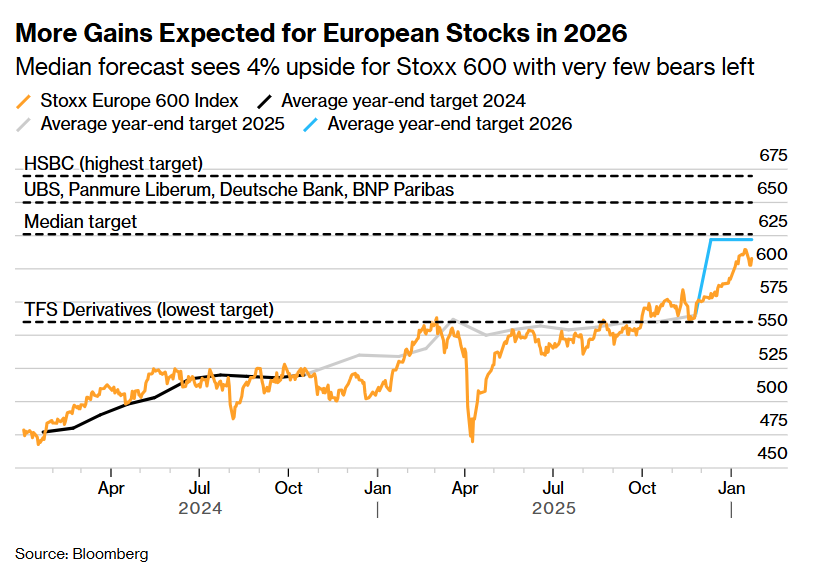
Core Viewpoint - European stock markets are expected to overcome challenges posed by the US-EU trade war and geopolitical tensions, provided that the economic outlook supports strong performance and increased US capital flows into European equities [1][2]. Group 1: Market Predictions - Wall Street strategists predict that the Stoxx Europe 600 Index will rise approximately 4% by the end of 2026, reaching around 626 points from its recent closing level [1]. - HSBC has raised its target for the Stoxx 600 Index from 640 to 670 points, indicating a potential upside of about 11% for the remainder of the year [2]. - UBS anticipates that the Stoxx 600 Index could reach 650 points, driven by profit growth and strong economic performance in Europe [6]. Group 2: Economic and Policy Factors - The bullish outlook from Goldman Sachs and HSBC is based on European economic resilience, profit growth, loose monetary policy, and accelerated fiscal spending [2]. - Significant fiscal support is expected, including over €2 trillion (approximately $2.3 trillion) for AI and clean energy investments, along with a €500 billion infrastructure fund from the German government [9]. - The European stock market is currently trading at a forward P/E ratio of around 15, suggesting double-digit earnings growth for the year [10]. Group 3: Sector Performance and Investor Sentiment - The Stoxx 600 Index has risen nearly 3% this year, following a 17% increase in 2025, with semiconductor, defense, and mining stocks leading the gains [9]. - A survey indicates that 95% of European fund managers expect the stock market to rise in the next 12 months, marking a record high [14]. - Investors are increasingly interested in diversifying their portfolios away from the US market, particularly favoring European value stocks [15].



亚洲多国经济数据亮眼,新兴亚洲市场配置或正当时
Jin Rong Jie· 2025-12-01 07:57
Group 1 - Emerging Asian markets mostly rose, with India's Sensex index increasing by 0.3% and reaching a new historical high, while Thailand's SET index and Malaysia's FTSE index both rose by over 1% [1] - India's economy showed an annualized growth rate of 8.2% in Q3, exceeding market expectations and marking the fastest growth in six quarters [1] - InCred Asset Management noted that the correction in Indian stock indices over the past 14-15 months has bridged the gap between corporate earnings and stock valuations, creating attractive entry points [1] Group 2 - Malaysia's trade volume for January to September 2025 grew by 4.4% to 2.235 trillion ringgit, setting a historical record [1] - The trade volume accounted for 134% of Malaysia's GDP, highlighting its deep integration into the global economy [1] - Key growth drivers included electronics (especially semiconductors), machinery, palm oil, and processed foods, with a surge in electronics exports attributed to companies preemptively shipping to avoid U.S. tariffs and a global tech cycle recovery [1] Group 3 - The Emerging Asia ETF (520580) tracks the Singapore Exchange's Emerging Asia Select 50 Index, primarily investing in India, Indonesia, Malaysia, and Thailand, with India accounting for approximately 48% of its weight [2] - The index has a high correlation with the Indian market, with a correlation coefficient of 0.69 with the Sensex 30 index over the past three years [2] - This correlation provides a new benchmark for global diversification, with lower correlations to other major indices such as the Hang Seng Index and the Dow Jones Industrial Average [2]
新兴亚洲ETF(520580)创上市以来最高收盘价,高“印度含量”助力全球化配置
Sou Hu Cai Jing· 2025-11-20 13:40
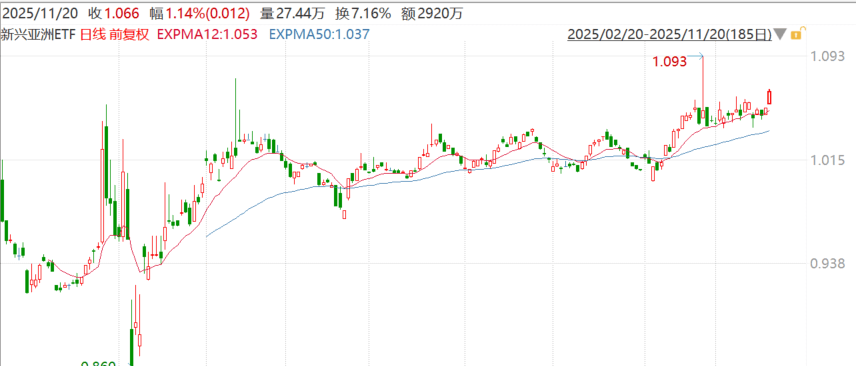
Core Insights - The Indian SENSEX30 index rose by 0.33% on November 20, reaching a new high since September 2024, and is close to its historical peak [1] - Moody's has indicated that consumer demand and infrastructure spending will drive India's economic growth, with an expected growth rate of 7% for this year [3] - Morgan Stanley forecasts strong performance for the Indian stock market over the next 12 months, driven by robust domestic growth and stable oil prices, with a projected 13% increase in the BSE Sensex index by December 2026 [3] Market Performance - The SENSEX30 index saw significant gains from major companies such as Reliance Industries, Mahindra & Mahindra, and the State Grid of India, each rising over 1% [1] - The Emerging Asia ETF (520580) closed up 1.14% at 1.066 yuan, marking its highest closing price since its listing on February 20 of this year [1] Investment Insights - The Emerging Asia ETF (520580) tracks the Singapore Exchange Emerging Asia Select 50 Index, with approximately 48% of its investments in the Indian market, making it the highest "India content" ETF listed in the A-share market [3] - The correlation coefficient between the Emerging Asia Select 50 Index and the Indian SENSEX30 index is 0.69 over the past three years, indicating a strong relationship, compared to lower correlations with other major indices [4]
下半年投资策略出炉:多家投行仍“挺”中国科技股
Xin Jing Bao· 2025-06-16 03:22
Group 1 - The core viewpoint of the article emphasizes the increasing attractiveness of non-US assets and the importance of diversification in investment strategies as global investors reassess risk-return profiles of dollar assets [2][3][4] - Multiple institutions highlight that the appeal of markets outside the US, particularly in Asia and Europe, is expected to strengthen, with emerging markets and Asian profit growth leading globally [3][4][5] - There is a notable shift in investment focus from India to China, particularly in the context of passive and partially active funds, indicating a growing confidence in China's market stability and institutional credibility [4][5][6] Group 2 - The article mentions that international long-term capital is increasingly interested in Chinese assets, particularly in the consumer and technology sectors, driven by favorable pricing and strong corporate performance [5][6] - The Hong Kong market is experiencing a significant influx of international capital, with daily trading volumes projected to rise from approximately 100 billion HKD in 2024 to between 200 billion and 300 billion HKD in 2025, with 70% attributed to international funds [5] - The positive outlook for China's technology sector is reinforced by recent policy support and innovations such as DeepSeek, which are expected to boost market confidence and consumer spending [5][6]
瑞银:“美国例外论”被削弱,投资者转向全球多元化配置
Zhong Guo Xin Wen Wang· 2025-06-11 14:53
Group 1 - The concept of "American exceptionalism" is becoming less applicable as investors shift towards global diversification in their asset allocation [1][2] - Historically, during market turmoil, significant capital flowed into the US due to the perception of the dollar and US Treasury bonds as safe havens, but this trend is changing [1] - Moody's downgraded the US sovereign credit rating from "Aaa" to "Aa1" for the first time in 108 years, primarily due to rising government debt and interest payment ratios [1] Group 2 - The US Treasury bonds, once considered the most reliable investment, are losing their appeal, with the 20-year Treasury yield rising to approximately 5% and the 10-year yield reaching about 4.5% [1] - The dollar is weakening amid market volatility, and predictions suggest that the Federal Reserve is likely to lower interest rates, further contributing to the dollar's decline [2] - Global investors are actively pursuing diversified investment strategies in response to the uncertainty surrounding US debt and tariffs imposed on foreign goods [2]