
全球石油供需

Search documents
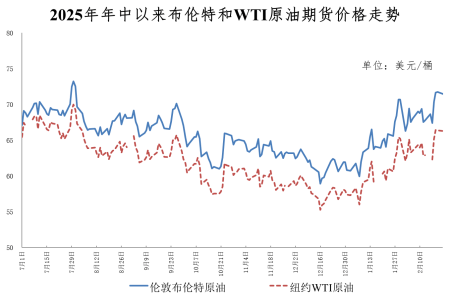
国际能源署发布报告显示:全球市场石油供应短期承压
Jing Ji Ri Bao· 2026-02-25 01:45
Core Insights - The International Energy Agency's February report indicates a significant decline in global oil supply due to geopolitical tensions, extreme weather, and reduced exports from Kazakhstan, Russia, and Venezuela, with January supply dropping by 1.2 million barrels per day to 106.6 million barrels per day [1] - Brent crude oil prices have recently surpassed $70 per barrel, reaching the highest level since September 2025, driven by escalating geopolitical tensions between Iran and the U.S. [1] Group 1: Supply Disruptions - Multiple supply disruptions from oil-producing countries have tightened the spot oil market, further driving up prices [2] - Russian oil supply fell by 350,000 barrels per day in January, with Indian imports dropping to 1.1 million barrels per day, the lowest since November 2022 [2] - Venezuela's oil production decreased by 210,000 barrels per day to 780,000 barrels per day, but is expected to rebound following U.S. authorization for exports [2] - Extreme cold weather in North America led to over 1 million barrels per day of production capacity being shut down [2] Group 2: Refining and Inventory Trends - Global refinery crude processing declined from a record 86.3 million barrels per day in December to 85.7 million barrels per day in January due to seasonal maintenance and declining refining margins [3] - Global oil inventories increased by 37 million barrels in December, reaching a total of 477 million barrels, with OECD inventories also rising above the five-year average for the first time since 2021 [3] Group 3: Future Projections - The report forecasts a strong rebound in global oil supply in 2026, with demand expected to grow by 850,000 barrels per day, primarily driven by non-OECD economies [4] - Global oil production is projected to increase by 2.4 million barrels per day in 2026, reaching 108.6 million barrels per day, with contributions from both OPEC and non-OPEC countries [4] - Global crude processing is expected to average an increase of 790,000 barrels per day, driven mainly by non-OECD member countries [4] Group 4: Demand Adjustments - Due to economic uncertainties and rising oil prices, the demand growth forecast for 2026 has been slightly adjusted down to 850,000 barrels per day, with China remaining the largest contributor [5] - Global oil inventories reached a historical high of 477 million barrels by December 2025, as supply continues to exceed demand [5]
国际能源署发布报告显示——全球市场石油供应短期承压
Jing Ji Ri Bao· 2026-02-24 22:11
Core Viewpoint - The International Energy Agency's February report indicates a significant decline in global oil supply due to geopolitical tensions, extreme weather, and reduced exports from Kazakhstan, Russia, and Venezuela, leading to a rise in oil prices, with Brent crude surpassing $70 per barrel for the first time since September 2025 [1][2]. Group 1: Oil Supply and Price Dynamics - In January, global oil supply decreased by 1.2 million barrels per day (bpd) to 106.6 million bpd, influenced by geopolitical tensions and extreme weather conditions [1]. - The report highlights that Russian oil supply fell by 350,000 bpd in January, primarily due to increased sanctions from the US and EU, resulting in India's imports of Russian oil dropping to 1.1 million bpd, the lowest since November 2022 [2]. - Venezuela's oil production decreased by 210,000 bpd to 780,000 bpd in January, but is expected to rebound following US authorization for exports [2]. Group 2: Refining and Inventory Trends - Global refinery crude processing fell from a record 86.3 million bpd in December to 85.7 million bpd in January due to seasonal maintenance and declining refining margins [3]. - Global oil inventories increased by 37 million barrels in December, reaching a total of 477 million barrels, with OECD oil inventories also rising for the first time since 2021 [3][5]. - An expected increase of 49 million barrels in global oil inventories in January indicates ongoing supply exceeding demand [3]. Group 3: Future Projections - The report forecasts a strong rebound in global oil supply in 2026, with an expected demand growth of 850,000 bpd, primarily driven by non-OECD economies [4]. - Global oil production is projected to increase by 2.4 million bpd in 2026, reaching 108.6 million bpd, with contributions evenly split between OPEC and non-OPEC producers [4]. - The average global crude processing volume is anticipated to rise by 790,000 bpd to 84.6 million bpd in 2026, mainly driven by non-OECD countries [4].
油价上调,就在今晚!
Sou Hu Cai Jing· 2026-02-24 13:35
Core Viewpoint - The domestic retail price of refined oil in China will increase starting from February 24, with gasoline and diesel prices rising by 175 yuan and 170 yuan per ton respectively, reflecting the upward trend in international oil prices during the current pricing cycle [1][3]. Group 1: Price Adjustments - The retail prices for 92 octane gasoline, 95 octane gasoline, and 0 diesel will increase by 0.14 yuan, 0.15 yuan, and 0.14 yuan per liter respectively [1]. - Filling a 50-liter tank with 92 octane gasoline will cost an additional 7 yuan due to the price increase [2]. Group 2: International Oil Price Trends - The international oil prices have been fluctuating upwards during the current pricing cycle, influenced by geopolitical tensions, particularly between the U.S. and Iran [3]. - The International Energy Agency has revised its forecast for global oil demand growth for 2026 down from 930,000 barrels per day to 850,000 barrels per day, indicating a persistent oversupply in the market [3]. - The new round of tariff increases in the U.S. is expected to exert pressure on global economic growth and oil demand [3].

原油及聚酯产业链月报:PEC+持续增产,原油或将承压-20250606
Donghai Securities· 2025-06-06 07:54
Report Industry Investment Rating No information provided in the given content. Core Viewpoints of the Report - Interest rates and exchange rates: Despite the unexpected month - on - month decline in US PPI data in April and the relatively high US Treasury yields in May, economic data on June 4 showed signs of slowdown in the US job market and service industry, increasing the uncertainty of interest rate cuts. China's fiscal policy has been significantly front - loaded, and banks have entered a "low - interest - rate era". The implementation of the policy of significantly reducing tariffs between China and the US has short - term boosted domestic risk appetite and increased the demand for RMB financial asset allocation [81]. - Commodities: In the short term, commodities are bearish under the impact of the trade war. However, considering the improvement in the cost side, China's petrochemical industry chain is complete and still has a cost - competitive advantage [81]. - Equities: Bullish on China's consumption recovery (towards cost - effectiveness) and self - controllable industrial chains [81]. - Trade and oil demand: It is expected that after the oil price reaches the bottom in the off - season of the second quarter, it is expected to recover, which is beneficial to targets with upstream resources, such as PetroChina and CNOOC [81]. - Offshore oil and gas exploration: It is expected that the offshore oilfield service industry will maintain stable capital expenditure, and China will continue to increase oil and gas reserves and production. Bullish on listed oilfield service companies with low valuations, large overseas market potential, and internationally advanced technology, such as Offshore Oil Engineering, China Oilfield Services, and Bohai Machinery Equipment [81]. - Refining and chemical integration: Bullish on targets with strong hydrocracking capabilities and integrated refining - PX - PTA industrial chains, such as Hengli Petrochemical, Rongsheng Petrochemical, and Tongkun Group [81]. - Cost - competitive advantage: The negative impact of ethane imports is expected to be repaired, which is beneficial to previously oversold domestic targets, such as Satellite Chemical and Wanhua Chemical, as well as natural - gas - related targets, such as ENN Energy and Jiufeng Energy [81]. Summary by Directory 1. Oil Price Review and Outlook - **Price judgment**: In May 2025, Brent crude oil was weakly traded, closing at around $63.9 per barrel at the end of the month. OPEC+ countries will increase production by an additional 411,000 barrels per day in June and July. The Fed continued to pause interest rate cuts in June 2025 as expected. The oil price has entered a short - term downward channel, and Brent crude oil may touch a low of $55 per barrel in the second quarter. In the long term, oil prices are greatly affected by the demand side. With the Fed resuming interest rate cuts later, the risk of oil price correction increases. It is expected that Brent crude oil will fluctuate between $55 - $80 per barrel in 2025 [3]. - **Supply and demand factors**: OPEC+ will increase production by 411,000 barrels per day in June and July, and the production cut of 3.6 million barrels per day will be maintained until the end of 2026. US refinery processing volume improved in May compared with the previous month but was lower than the same period last year. China's crude oil consumption was sluggish, but imports improved. In April 2025, China's industrial crude oil processing decreased by 1.3% year - on - year, and imports increased by 7.5% year - on - year [3]. - **Other factors**: As of May 30, 2025, the US 10 - year Treasury yield was about 4.41%. Economic data on June 4 showed signs of slowdown in the US job market and service industry, and the market increased bets on interest rate cuts. The US dollar was relatively weak in May. In April, the US CPI increased by 2.3% year - on - year, lower than market expectations. Geopolitical situations in the Middle East are expected to continue to deteriorate, and global trade frictions may escalate. The Yellowtail - grade crude oil in Guyana is expected to be launched in the third quarter [3]. 2. Commodities, Interest Rates, and Exchange Rates - **Interest rates**: The Fed has gone through 13 complete interest - rate hike cycles since 1954. As of May 30, 2025, the US 10 - year Treasury yield was about 4.41%. The inversion of the yield curve between 2 - year and 10 - year US Treasuries, which lasted from early July 2022 to the end of August 2024, has basically ended, but there was an inversion with 3 - month US Treasuries as of June 4, indicating a low market expectation of interest rate cuts [32][37]. - **Exchange rates**: In May, the US dollar index was volatile and remained weak, closing at 99.44, up 0.23% from the end of the previous month and down 5.07% from the same period last year. The offshore RMB appreciated slightly against the US dollar, closing at 7.20, up 1.01% from the end of the previous month and up 0.79% from the same period last year [38]. - **Inflation**: In April, the US CPI increased by 2.3% year - on - year, lower than market expectations. The US PPI increased by 0.7% year - on - year and unexpectedly decreased month - on - month. The Fed is still very cautious about inflation risks [44]. 3. Polyester Industry Chain - **Profit margins**: In May, the international crude oil price declined, driving down the prices of industrial chain products and weakening the spreads. The spread of ethylene cracking from naphtha was $151 per ton, down $12 per ton month - on - month. The prices of raw materials PTA and ethylene glycol increased month - on - month, and the average price of polyester filament increased month - on - month. The profit of the entire PX - PTA - polyester filament industrial chain was about $28 per ton, a significant month - on - month improvement [54]. - **Supply and demand**: As of the end of May, the average inventory of polyester filament sample enterprises was around 20 days, basically the same as at the end of the previous month. In May, the total supply of polyester filament was 3.25 million tons, up 0.7% month - on - month and 3.6% year - on - year. The average monthly capacity utilization rate was 90.6%, down 3.5 percentage points month - on - month and up 2.8 percentage points from the same period last year [64]. - **Exports**: In April 2025, China's polyester filament exports were 349,800 tons, up 5.59% from the previous month. From January to April 2025, the cumulative exports were 1.3405 million tons, up 6.99% from the same period last year. From January to April 2025, China's textile and clothing exports were generally stable, with textile exports continuing to grow and clothing exports still under pressure [69]. 4. Conclusions and Investment Recommendations - **Overall view**: OPEC+ continues to increase production, and crude oil may face pressure. - **Investment recommendations**: Bullish on companies with upstream resources, offshore oilfield service companies, refining and chemical integration companies, and companies with cost - competitive advantages [81].