全球资产布局

Search documents
10年投资年化收益近7% 中投公司是如何布局全球资产的?
Di Yi Cai Jing· 2025-12-10 04:55
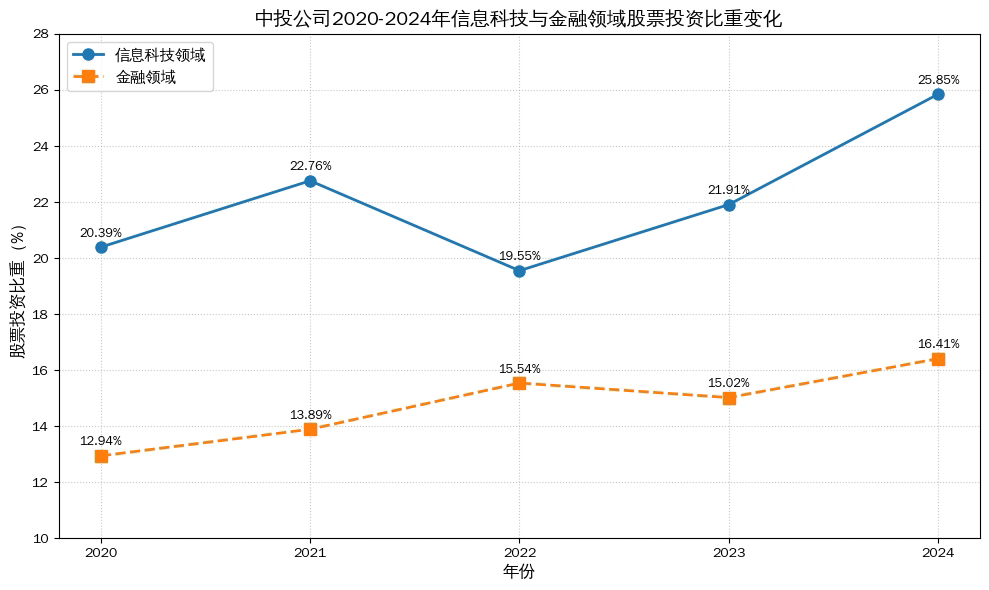
Core Insights - The China Investment Corporation (CIC) has maintained a stable annualized return on foreign investments despite significant changes in the external investment environment, achieving an annualized net return of 6.92% over the past decade as of December 31, 2024, exceeding performance targets by 61 basis points [1] - The CIC's investment strategy focuses on long-term performance, with a rolling annualized return rate being a key metric for evaluating investment performance [1] Investment Performance - The annualized net return rates for the CIC from 2020 to 2024 were 6.82%, 8.73%, 6.43%, 6.57%, and 6.92%, respectively, consistently surpassing ten-year performance targets by varying margins [1] Asset Allocation - The CIC's asset allocation includes alternative assets, public market equities, fixed income, and cash products, with alternative assets making up the largest portion of the portfolio, accounting for 48.49% in the most recent five-year period [3] - The investment proportions in public market equities over the last five years were 38%, 35.4%, 28.60%, 33.13%, and 34.65% [4] Sector Focus - The CIC has prioritized investments in sectors such as Information Technology, Financials, Consumer Discretionary, Healthcare, Industrials, Communication Services, and Consumer Staples, with a notable shift towards Information Technology since 2020, where its investment proportion exceeded that of Financials [5] - The investment proportions in Information Technology from 2020 to 2024 were 20.39%, 22.76%, 19.55%, 21.91%, and 25.85%, while Financials were 12.94%, 13.89%, 15.54%, 15.02%, and 16.41% [5] Geographic Allocation - The CIC's stock investments are primarily directed towards developed economies, with a growing trend in allocations to emerging markets and other regions, where the investment proportions in U.S. stocks were 57%, 61.48%, 59.18%, and 60.29% from 2020 to 2023 [6] - The allocation to developed sovereign debt has also increased, with proportions of 55%, 51.63%, 52.75%, 66.02%, and 64.4% from 2020 to 2024 [6] Strategic Outlook - The CIC acknowledges the challenges posed by high interest rates, inflation, and geopolitical changes in the global macroeconomic environment, while also recognizing opportunities arising from technological and industrial transformations [8] - The company aims to enhance its management and professional capabilities, optimize asset allocation, and improve its investment management mechanisms in response to the evolving investment landscape [8]

10年投资年化收益近7%,中投公司是如何布局全球资产的?
Di Yi Cai Jing· 2025-12-10 04:33
Group 1 - The core viewpoint of the news is that China's sovereign wealth fund, the China Investment Corporation (CIC), is increasing its investment in global technology stocks while maintaining stable annualized returns despite changing external investment environments [2][3]. Group 2 - CIC's annualized net return on foreign investments over the past decade is 6.92% in USD, exceeding performance targets by 61 basis points [2]. - The annualized net return since its establishment is 6.39% in USD [2]. - The investment performance is evaluated over a 10-year cycle, with rolling annualized returns showing consistent outperformance against targets [2]. Group 3 - CIC's asset allocation includes alternative assets, public market equities, fixed income, and cash products, with alternative assets being the largest category [4]. - The allocation to alternative assets over the past five years has been 43%, 47%, 53.21%, 48.31%, and 48.49% respectively [4]. - The investment in public market equities has varied, with proportions of 38%, 35.4%, 28.60%, 33.13%, and 34.65% over the last five years [5]. Group 4 - The focus sectors for CIC's stock investments include information technology, finance, consumer discretionary, healthcare, industrials, communication services, and consumer staples, with notable shifts in investment proportions [7]. - Since 2020, the investment in information technology has consistently exceeded that in finance, maintaining over 20% in most years [7]. - The investment proportions in information technology from 2020 to 2024 are 20.39%, 22.76%, 19.55%, 21.91%, and 25.85%, while finance proportions are 12.94%, 13.89%, 15.54%, 15.02%, and 16.41% [7]. Group 5 - Geographically, developed economies are the primary focus for CIC's stock investments, although there has been a trend of increasing allocations to emerging markets [8]. - The investment proportions in U.S. stocks from 2020 to 2023 are 57%, 61.48%, 59.18%, and 60.29%, while non-U.S. developed regions are 31%, 25.39%, 26.81%, and 25.58% [8]. Group 6 - In fixed income assets, developed sovereign debt is a key focus, with increasing allocation trends compared to emerging sovereign debt [9]. - The allocation to developed sovereign debt from 2020 to 2024 is 55%, 51.63%, 52.75%, 66.02%, and 64.4% [9]. - The report highlights challenges in the global macroeconomic environment, including high interest rates and inflation, while also noting opportunities arising from technological and industrial transformations [9].
复星国际发布中期业绩 股东应占溢利6.61亿元 海外业务收入持续提升
Zhi Tong Cai Jing· 2025-08-27 11:00
Group 1 - The core revenue for Fosun International reached 87.283 billion RMB, with a net profit attributable to shareholders of 661 million RMB and basic earnings per share of 0.08 RMB [1] - The overseas business revenue increased to 46.67 billion RMB, accounting for 53% of total revenue, which is a 6.6 percentage point increase compared to the same period in 2024 [1] - The company invested 3.6 billion RMB in technology innovation during the reporting period, particularly in the healthcare sector, contributing to the revaluation of underlying asset values [1] Group 2 - The total revenue from the top four subsidiaries, including Fosun Pharma, Yuyuan, Fosun Portugal Insurance, and Fosun Tourism, amounted to 63.61 billion RMB, representing 73% of the group's total revenue [2] - The operating profit for the group was 3.15 billion RMB, reflecting a year-on-year decline of 9.3%, primarily due to the decrease in profits from the leisure business segment [2] - The insurance business, led by Fosun Portugal Insurance, showed strong revenue growth, which partially offset the decline in profits from other segments [1][2]