固定收益

Search documents
五矿信托:2026年宏观经济与大类资产配置展望
Jin Rong Jie· 2026-02-11 02:43
Core Viewpoint - The macroeconomic outlook for 2026 indicates a significant restructuring of macroeconomic policies, focusing on long-term stability and structural adjustments rather than merely smoothing short-term fluctuations. The year marks a transition towards quality-driven growth and a proactive transformation of the economy [1][4]. Group 1: Macroeconomic Policy - Fiscal policy will maintain a high intensity, with a deficit rate expected to remain between 4.0% and 4.2%, translating to approximately 5.9 trillion yuan in deficit. This aims to boost effective demand and facilitate the transition between old and new growth drivers [6][7]. - Monetary policy is set to shift towards "moderate easing," with expectations of a reserve requirement ratio cut in the first quarter and interest rate reductions in the second quarter, aimed at stimulating credit demand and supporting fiscal efforts [10][12]. Group 2: Investment Dynamics - Fixed asset investment is projected to recover, with growth rates expected to rise to 3.0%-3.5%. Infrastructure investment will be the main driver, anticipated to grow by around 5.5%, supported by fiscal measures [13][15]. - Manufacturing investment is expected to remain resilient, with a growth rate of about 5.0%, as companies shift focus from expansion to upgrading capabilities, aided by a structural shift towards high-value intermediate and capital goods [15]. Group 3: Consumption Trends - Consumer spending is expected to transition from stimulus-driven growth to normalized growth, with retail sales growth projected at 4.0%-4.5%. Durable goods consumption will stabilize, while service consumption is anticipated to become the largest incremental growth area, driven by policy support [17]. Group 4: External Trade and Balance - China's export structure is evolving from "end-product manufacturing" to "industrial base," enhancing export resilience. The export growth rate is expected to remain around 5.5%, supported by a shift towards high-value products [21][24]. - The focus on deepening cooperation with emerging markets will facilitate a transition from simple product exports to a model of "technology + capacity," which is expected to provide a solid foundation for maintaining export growth [24].

新交所集团报告2026财年上半年净利润为3.57亿新元
Jin Tou Wang· 2026-02-06 10:21
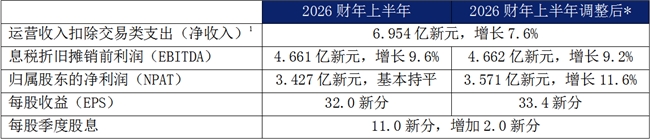
Core Insights - Singapore Exchange Group reported record half-year revenue and net profit for the first half of the fiscal year 2026, highlighting the strength of its diversified asset base in navigating global market uncertainties [2] Financial Performance - Net income (excluding treasury income) increased by 10.1% year-on-year to SGD 636.6 million (SGD 578 million) [2] - Adjusted net profit rose by 11.6% to SGD 357.1 million (SGD 320.1 million) [2] - Adjusted EBITDA grew by 9.2% to SGD 466.2 million (SGD 426.9 million) [2] - Adjusted earnings per share (EPS) was SGD 0.334 (SGD 0.299) [2] - The board proposed an interim dividend of SGD 0.110 per share, up from SGD 0.090, leading to a total half-year dividend of SGD 0.2175, a 20.8% increase year-on-year [2] Business Segments - Fixed Income, Currencies, and Commodities (FICC) net income grew by 12.5% to SGD 178.9 million (SGD 159.1 million), accounting for 25.7% of total net income [3] - FICC - Fixed Income net income increased by 30.1% to SGD 6.2 million (SGD 4.8 million) [4] - FICC - Currencies and Commodities net income rose by 11.9% to SGD 172.7 million (SGD 154.3 million) [6] - Equity - Spot revenue increased by 16.2% to SGD 223.9 million (SGD 192.6 million), representing 32.2% of total net income [9] - Equity - Derivatives net income decreased by 5.6% to SGD 167.4 million (SGD 177.4 million), accounting for 24.1% of total net income [13] Trading Activity - Daily average trading volume in the securities market increased by 20% year-on-year to SGD 1.51 billion, the highest level in five years [2] - The number of IPO projects in the pipeline continues to rise, with retail participation reaching a four-year high [2] - The average daily trading volume for the SGX FX subsidiary increased by 32.3% to USD 180 billion (USD 136 billion) [7] Cost Management - Total expenses grew by 2.9% to SGD 270.8 million (SGD 263.1 million) [20] - Fixed employee costs increased by 6.5% to SGD 99.9 million (SGD 93.8 million) [20] - Variable employee costs decreased by 4.1% to SGD 52.9 million (SGD 55.1 million) [20] Future Outlook - The company remains confident in achieving a mid-term revenue growth target of 6% to 8% [21] - The expected growth in expenses and capital expenditures for fiscal year 2026 is maintained at 4% to 6% and SGD 90 million to SGD 95 million, respectively [21]
摩通第四季度股票销售和交易业务营收达28.6亿美元 超预期
Ge Long Hui A P P· 2026-01-13 11:57
Group 1 - The core point of the article is that JPMorgan Chase reported strong earnings in its fourth quarter, exceeding market expectations in both equity sales and trading, as well as fixed income, foreign exchange, and commodities business revenues [1] Group 2 - JPMorgan's equity sales and trading revenue reached $2.86 billion, surpassing the market estimate of $2.7 billion [1] - The fixed income, foreign exchange, and commodities business generated $5.38 billion in revenue, exceeding the market forecast of $5.27 billion [1] - The earnings per share (EPS) for the quarter was reported at $4.63 [1]

中国头号基金的“十万亿投资底盘”
Sou Hu Cai Jing· 2025-12-11 01:20
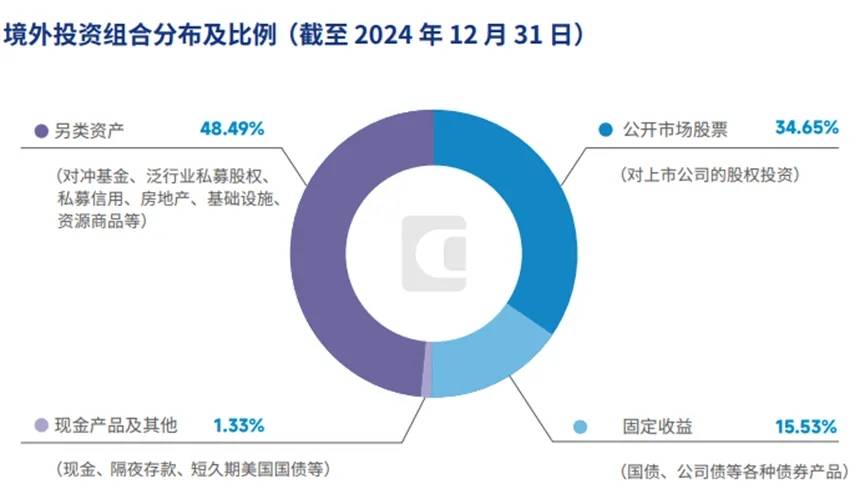
Core Insights - China Investment Corporation (CIC) is a unique and powerful entity within China's vast national asset system, not merely a fund manager or a "national team" [2][3] - The 2024 annual report reveals CIC's global asset scale, with net assets nearing 10 trillion RMB and a stable rolling annualized return of over 6% over the past decade [3][5][6] Investment Structure - As of December 31, 2024, CIC's overseas investment portfolio is structured into four main categories: alternative assets (48.49%), public market equities (34.65%), fixed income (15.53%), and cash/short-term products (1.33%) [8][11][12][13] - Alternative assets, which include hedge funds, private equity, real estate, and infrastructure, are prioritized, indicating a focus on long-term value rather than short-term market fluctuations [11][14] Sector Allocation - Within the public market equities, information technology is the largest sector, accounting for 25.85%, followed by financials (16.41%), consumer discretionary (11.85%), and healthcare (9.88%) [15][18] - The overall structure emphasizes technology leadership, financial stability, and a balanced approach to consumer and industrial sectors [18] Management Structure - CIC's investment management is divided between internal teams and external top-tier management institutions, with 37.47% of assets managed internally and 62.53% externally [19][22] - This dual-layer system allows CIC to maintain strategic direction while leveraging specialized expertise from external managers [24] Investment Strategy - The report outlines specific investment strategies, including a focus on performance-driven stock investments and optimizing bond portfolios [25][26] - CIC aims to enhance its real estate investments for inflation resistance and cyclical resilience, with a long-term investment assessment period of 10 years [26]
10年投资年化收益近7% 中投公司是如何布局全球资产的?
Di Yi Cai Jing· 2025-12-10 04:55
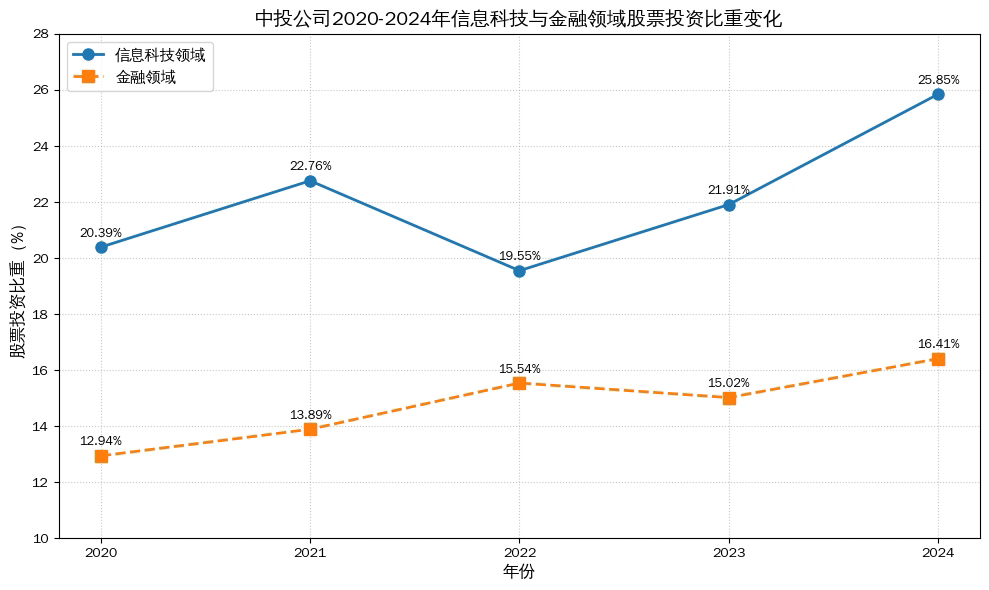
Core Insights - The China Investment Corporation (CIC) has maintained a stable annualized return on foreign investments despite significant changes in the external investment environment, achieving an annualized net return of 6.92% over the past decade as of December 31, 2024, exceeding performance targets by 61 basis points [1] - The CIC's investment strategy focuses on long-term performance, with a rolling annualized return rate being a key metric for evaluating investment performance [1] Investment Performance - The annualized net return rates for the CIC from 2020 to 2024 were 6.82%, 8.73%, 6.43%, 6.57%, and 6.92%, respectively, consistently surpassing ten-year performance targets by varying margins [1] Asset Allocation - The CIC's asset allocation includes alternative assets, public market equities, fixed income, and cash products, with alternative assets making up the largest portion of the portfolio, accounting for 48.49% in the most recent five-year period [3] - The investment proportions in public market equities over the last five years were 38%, 35.4%, 28.60%, 33.13%, and 34.65% [4] Sector Focus - The CIC has prioritized investments in sectors such as Information Technology, Financials, Consumer Discretionary, Healthcare, Industrials, Communication Services, and Consumer Staples, with a notable shift towards Information Technology since 2020, where its investment proportion exceeded that of Financials [5] - The investment proportions in Information Technology from 2020 to 2024 were 20.39%, 22.76%, 19.55%, 21.91%, and 25.85%, while Financials were 12.94%, 13.89%, 15.54%, 15.02%, and 16.41% [5] Geographic Allocation - The CIC's stock investments are primarily directed towards developed economies, with a growing trend in allocations to emerging markets and other regions, where the investment proportions in U.S. stocks were 57%, 61.48%, 59.18%, and 60.29% from 2020 to 2023 [6] - The allocation to developed sovereign debt has also increased, with proportions of 55%, 51.63%, 52.75%, 66.02%, and 64.4% from 2020 to 2024 [6] Strategic Outlook - The CIC acknowledges the challenges posed by high interest rates, inflation, and geopolitical changes in the global macroeconomic environment, while also recognizing opportunities arising from technological and industrial transformations [8] - The company aims to enhance its management and professional capabilities, optimize asset allocation, and improve its investment management mechanisms in response to the evolving investment landscape [8]
10年投资年化收益近7%,中投公司是如何布局全球资产的?
Di Yi Cai Jing· 2025-12-10 04:33
Group 1 - The core viewpoint of the news is that China's sovereign wealth fund, the China Investment Corporation (CIC), is increasing its investment in global technology stocks while maintaining stable annualized returns despite changing external investment environments [2][3]. Group 2 - CIC's annualized net return on foreign investments over the past decade is 6.92% in USD, exceeding performance targets by 61 basis points [2]. - The annualized net return since its establishment is 6.39% in USD [2]. - The investment performance is evaluated over a 10-year cycle, with rolling annualized returns showing consistent outperformance against targets [2]. Group 3 - CIC's asset allocation includes alternative assets, public market equities, fixed income, and cash products, with alternative assets being the largest category [4]. - The allocation to alternative assets over the past five years has been 43%, 47%, 53.21%, 48.31%, and 48.49% respectively [4]. - The investment in public market equities has varied, with proportions of 38%, 35.4%, 28.60%, 33.13%, and 34.65% over the last five years [5]. Group 4 - The focus sectors for CIC's stock investments include information technology, finance, consumer discretionary, healthcare, industrials, communication services, and consumer staples, with notable shifts in investment proportions [7]. - Since 2020, the investment in information technology has consistently exceeded that in finance, maintaining over 20% in most years [7]. - The investment proportions in information technology from 2020 to 2024 are 20.39%, 22.76%, 19.55%, 21.91%, and 25.85%, while finance proportions are 12.94%, 13.89%, 15.54%, 15.02%, and 16.41% [7]. Group 5 - Geographically, developed economies are the primary focus for CIC's stock investments, although there has been a trend of increasing allocations to emerging markets [8]. - The investment proportions in U.S. stocks from 2020 to 2023 are 57%, 61.48%, 59.18%, and 60.29%, while non-U.S. developed regions are 31%, 25.39%, 26.81%, and 25.58% [8]. Group 6 - In fixed income assets, developed sovereign debt is a key focus, with increasing allocation trends compared to emerging sovereign debt [9]. - The allocation to developed sovereign debt from 2020 to 2024 is 55%, 51.63%, 52.75%, 66.02%, and 64.4% [9]. - The report highlights challenges in the global macroeconomic environment, including high interest rates and inflation, while also noting opportunities arising from technological and industrial transformations [9].
The Goldman Sachs Group (NYSE:GS) Conference Transcript
2025-12-09 16:02
Summary of Goldman Sachs Conference Call - December 09, 2025 Company Overview - **Company**: The Goldman Sachs Group (NYSE: GS) - **CFO**: Dennis Coleman, with the firm since 1996 and CFO since 2022 Industry Insights - **Macroeconomic Outlook**: The U.S. economy is characterized as resilient and conducive to business, with expectations of a 25 basis points pause by the Federal Reserve in early 2026, followed by potential rate cuts [2][3] - **M&A Activity**: Goldman Sachs has maintained a leading position in M&A, advising on over $1.5 trillion of activity in 2025, potentially marking the second biggest year in history for M&A [7][9] - **Sponsor-led Transactions**: There has been a 40% increase in sponsor-led transactions, with sponsors holding $1 trillion in dry powder, indicating a significant opportunity for future M&A activity [12][10] Key Business Segments Global Banking and Markets - **Market Position**: Goldman Sachs holds the number one position in M&A for the past 20 years and has a leading equities and FICC franchise [3][4] - **Client Engagement**: High levels of client engagement have been noted, even amidst broader market uncertainties [6] Asset and Wealth Management - **Growth Focus**: The firm aims to grow durable revenue streams, with a top-five active asset management business and a leading alternatives platform [3][38] - **Recent Performance**: In the last quarter, Goldman Sachs raised $33 billion in alternatives, setting a record and raising full-year guidance to over $100 billion [38] Capital Solutions Group - **Strategic Importance**: The Capital Solutions Group has been successful in consolidating financing activities and is expected to drive growth through large strategic financing transactions [21][22] Financial Performance and Strategy - **Excess Capital**: Goldman Sachs has a significant amount of excess capital, which will be prioritized for client franchise deployment, dividend growth, and shareholder returns [31][32] - **Inorganic Growth**: Recent acquisitions, such as Innovator Capital Management, are aimed at enhancing the firm's position in the ETF and venture capital spaces [34][35] Risk Management - **Focus on Risk**: The firm emphasizes robust risk management practices across its financing activities, with a focus on stress testing and collateral management [26][27] Efficiency and Technology - **1GS 3.0 Initiative**: A comprehensive review of the operating model aimed at driving efficiency and growth, leveraging AI and technology to streamline processes [48][49] Talent Management - **Competitive Environment**: There is a strong demand for talent at Goldman Sachs, with a focus on retaining top performers through competitive compensation and development programs [53][54] Conclusion - **Investment Case**: Goldman Sachs is positioned for growth with a strong market share in key segments, a commitment to durable revenue growth, and favorable regulatory conditions. The firm is optimistic about its ability to drive returns for shareholders moving into 2026 [56][57]

华尔街宏观交易员有望斩获16年来最丰厚业务收入 但高额奖金梦恐落空
Sou Hu Cai Jing· 2025-11-25 18:01
Core Insights - Wall Street macro traders are set to achieve their best performance since 2009, driven by clients betting on changes in global central bank interest rate policies [1] Group 1: Revenue Projections - Goldman Sachs, JPMorgan, and Citigroup are expected to generate $165 billion in revenue from fixed income, credit, and commodity trading this year, representing a 10% increase compared to 2024 [1] - G-10 interest rate business revenue is projected to reach $40 billion, marking a five-year high [1] Group 2: Market Influences - Factors such as global central bank interest rate adjustments, uncertainty in tariff policies, concerns over expanding fiscal deficits, and steepening yield curves are contributing to the increase in revenue for rate traders [1] - A similar revenue surge is anticipated in 2026, with industry revenue expected to reach $162 billion [1]
东证融汇获“2025年度金牛券商集合资产管理人”等多项证券业金牛奖
Zhong Zheng Wang· 2025-11-11 08:40
Core Insights - The 2025 Securities Industry High-Quality Development Conference and the Jin Yuan Group Cup Securities Industry Golden Bull Award Ceremony were held in Xiamen, highlighting achievements in the securities industry [1] - Dongzheng Ronghui, a wholly-owned subsidiary of Northeast Securities, received awards for "2025 Annual Golden Bull Securities Asset Management" and "Three-Year Medium to Long-Term Pure Bond Golden Bull Asset Management Plan" [1] Company Overview - Dongzheng Ronghui was established on December 24, 2015, with a registered capital of 700 million yuan and is based in Shanghai [1] - Since officially starting its asset management business in February 2016, the company has developed a comprehensive management system covering investment research, capital markets, client services, operational management, and compliance risk management [1] - The company offers a full range of wealth management products, including fixed income, equity, mixed, cash management, and derivatives [1] Performance Metrics - As of September 2025, the company maintained a high proportion of actively managed business, serving over one million clients with high-quality asset management services [1] - In 2024, the company's asset management revenue reached a historical high, with a year-on-year growth of 21.84%, indicating strong client trust in the company's professional investment capabilities [2] Brand Philosophy - The company emphasizes a brand philosophy of "rational yet warm," focusing on providing extreme, professional, and personalized asset management services [2] - Deep insights into client needs and careful fulfillment are seen as key to establishing long-term trust and achieving value co-creation [2]

港交所行政总裁陈翊庭:将更多开拓固定收益和其他资产类别
Zheng Quan Shi Bao Wang· 2025-10-23 14:03
Core Insights - The CEO of Hong Kong Exchanges and Clearing (HKEX), Charles Li, emphasized the need for a more diversified multi-asset ecosystem to address current challenges [1] - In the context of global investors considering de-dollarization and seeking new balance points, HKEX aims to expand its offerings beyond IPOs and equities to include fixed income, commodities, and other asset classes [1] Group 1 - HKEX's primary challenge is to establish a more diverse ecosystem that includes various asset classes [1] - The focus on fixed income and other asset classes is seen as essential for meeting investor demands [1] - The current global trend of de-dollarization is influencing HKEX's strategic direction [1]