
公平与包容(DEI)

Search documents
特朗普政府又把哈佛告了
第一财经· 2026-02-14 02:28
Core Viewpoint - The article discusses the escalating conflict between Harvard University and the U.S. federal government, focusing on a new lawsuit filed by the Department of Justice seeking access to Harvard's admissions process documents, particularly regarding race considerations in admissions [3][5]. Group 1: Lawsuit Details - The U.S. Department of Justice has filed a lawsuit against Harvard University, accusing it of obstructing and delaying an investigation into its admissions process [3]. - The lawsuit aims to compel Harvard to provide documents related to admissions decisions, including data on individual applicants and communications regarding diversity, equity, and inclusion (DEI) initiatives [5]. - Harvard submitted over 2,000 pages of admissions-related documents in May 2025, but the DOJ claims these documents primarily consist of summary data and publicly available information [5]. Group 2: Harvard's Response - Harvard's spokesperson stated that the university has been in "good faith" communication with the federal government and views the lawsuit as a retaliatory action for its resistance to government overreach [5]. - The university has made changes to its admissions process following a 2023 Supreme Court ruling that found it violated laws by considering race in undergraduate admissions [5][6]. Group 3: Political Context - Former President Trump has previously indicated that the government was close to a settlement with Harvard, which would involve a $500 million investment in vocational training programs [8]. - Trump has criticized Harvard and other universities for alleged anti-Semitism and has threatened to cut federal funding if they do not comply with his demands [8]. - The Department of Defense has announced it will sever all academic ties with Harvard, citing concerns about the ideological training of military officers [8].


再次施压 特朗普政府又把哈佛告了
Di Yi Cai Jing· 2026-02-14 02:12
Core Viewpoint - The conflict between Harvard University and the U.S. federal government has escalated, with the government filing a new lawsuit seeking admissions-related documents from Harvard, accusing the university of obstructing the investigation [1][2]. Group 1: Lawsuit Details - The U.S. Department of Justice has accused Harvard of "obstructing" and "delaying" the investigation by refusing to provide necessary documents related to admissions decisions [1]. - Harvard submitted over 2,000 pages of admissions-related documents in May 2025, but the DOJ claims these were mainly summary data and public information [2]. - The DOJ's lawsuit aims to compel Harvard to provide documents related to the consideration of race in admissions, without alleging any discriminatory practices or seeking monetary damages [2]. Group 2: Harvard's Response - Harvard's spokesperson stated that the university has been communicating in "good faith" with the federal government and views the lawsuit as a retaliatory action for resisting government overreach [1][2]. - The university has made changes to its admissions process following a Supreme Court ruling in 2023, including restricting access to applicants' race and ethnicity information until after the admissions process is complete [2]. Group 3: Political Context - Former President Trump indicated that the government was close to a settlement with Harvard, which would involve a $500 million investment in vocational training, but later expressed skepticism about the project's success and sought $1 billion in compensation from Harvard [3]. - The U.S. Department of Defense announced it would sever all academic ties with Harvard, citing concerns about the ideological training of military officers, and is considering similar actions against other Ivy League schools [3].
再次施压,特朗普政府又把哈佛告了
Di Yi Cai Jing· 2026-02-14 01:57
Core Viewpoint - The conflict between Harvard University and the U.S. federal government has escalated, with the Department of Justice filing a new lawsuit against Harvard regarding its admissions process, which Harvard perceives as retaliation for its resistance to White House demands [1][3]. Group 1: Lawsuit Details - The U.S. Department of Justice has accused Harvard of "obstructing" and "delaying" its investigation by refusing to provide necessary documents related to admissions decisions, claiming that Harvard has "illegally" concealed essential information [1][3]. - Harvard submitted over 2,000 pages of admissions-related documents in May 2025, but the DOJ considers these to be primarily summary data and public information, not the specific applicant data and correspondence requested [3]. - The DOJ's lawsuit aims solely to compel Harvard to provide documents related to the use of race in its admissions process, without alleging any discriminatory practices or seeking monetary damages [3]. Group 2: Harvard's Response and Changes - Harvard has stated it will defend itself against what it describes as retaliatory actions, asserting its independence and constitutional rights in the face of government overreach [3]. - Following the Supreme Court's 2023 ruling that Harvard's consideration of race in undergraduate admissions violated relevant laws, the university has made changes to its admissions process, including restricting access to applicants' race and ethnicity information until after the admissions process is complete [3]. Group 3: Broader Context and Political Implications - Former President Trump previously indicated that the government was close to a settlement with Harvard, which would involve a $500 million investment in vocational training, but later expressed skepticism about the project's success and sought $1 billion in compensation from Harvard [5]. - The U.S. Department of Defense has announced it will sever all academic ties with Harvard, citing concerns about the ideological training of military officers, and is considering similar actions against other Ivy League schools [5]. - Trump has repeatedly criticized Harvard and similar institutions for alleged anti-Semitism and has threatened to cut federal funding unless they comply with his demands [5].

特朗普下令SEC审查代理咨询机构规则
Ge Long Hui A P P· 2025-12-12 00:55
Core Viewpoint - The article discusses President Trump's executive order aimed at limiting the influence of proxy advisory firms, which is part of a broader effort to weaken the impact of third-party entities on corporate decision-making [1] Group 1: Executive Order Details - The executive order was issued on Thursday and instructs the SEC chairman to review rules and regulations related to proxy advisory firms [1] - The order emphasizes the consideration of revising or rescinding rules, regulations, guidance documents, announcements, and memoranda that are inconsistent with the order's objectives [1] Group 2: Focus Areas - The review will particularly focus on aspects related to "Diversity, Equity, and Inclusion (DEI)" and "Environmental, Social, and Governance (ESG)" policies [1]
Python软件基金会拒绝政府150万美元拨款后,引发社区“捐赠潮”
程序员的那些事· 2025-11-12 10:56
Core Points - The Python Software Foundation (PSF) rejected a $1.5 million grant from the National Science Foundation (NSF) due to restrictions against promoting diversity, equity, and inclusion (DEI) initiatives [1][2] - The PSF board believes that such restrictions contradict the foundation's mission, leading to the decision to forgo what could have been its largest funding ever [2] - Following the announcement, the PSF received strong positive feedback from the community, resulting in a surge of donations from thousands of individual and corporate supporters [4] Financial Impact - In a matter of days, the PSF received thousands of new donations and increased its number of "supporting members" (annual fee of $99) [6] - As of last Friday, the foundation's executive director Deb Nicholson disclosed that they had received over $157,000 in donations, including 295 new supporting members [6] - Although these new donations have not yet compensated for the $1.5 million grant shortfall, the PSF emphasized the significance of the community's strong support [6] Mission and Values - The PSF reiterated its mission to "support and promote a diverse, international Python community," emphasizing the importance of maintaining its core values even at the cost of substantial funding [7]

从图书馆到出版业:特朗普削减预算引发“多米诺效应”
Xin Jing Bao· 2025-08-12 12:13
Core Viewpoint - The recent budget cuts by the U.S. government, particularly affecting the Institute of Museum and Library Services, are expected to significantly impact public libraries' purchasing power, which in turn will affect the revenue of small and independent publishers [1][2] Group 1: Impact on Libraries - The budget cuts prevent public libraries from relying on federal funding for their next fiscal year, forcing them to adjust their purchasing budgets, primarily affecting book acquisitions [1] - Libraries are crucial for the sales structure of small publishers, with library purchases accounting for 8%-12% of sales for some publishers [1] - The reduction in library funding could lead to a heavier workload for librarians, limiting their ability to promote lesser-known authors through reading programs [1] Group 2: Consequences for Publishers - Publishers are concerned that if libraries cannot afford to purchase books, readers may not buy them independently, particularly affecting new and marginalized authors [2] - The potential reduction in library collections could disrupt the channels through which new authors are discovered, impacting the entire publishing ecosystem [2] - The tightening of immigration policies may further complicate the situation for publishers, as overseas authors may be less willing to visit the U.S., affecting diversity in literature [2] Group 3: Long-term Effects - The cuts to library funding could lead to a collapse of the existing ecosystem that supports authors and publishers, with authors being the first to suffer from these changes [2]
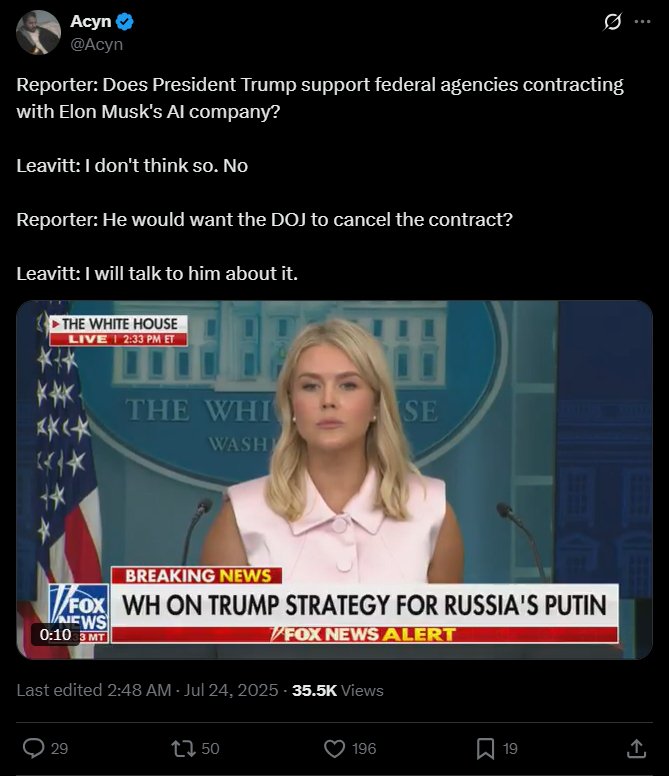
xAI也要被踢出局,白宫:不希望马斯克获得政府合同
Guan Cha Zhe Wang· 2025-07-24 12:55
Core Points - The White House has released an AI action plan outlining federal policy actions under the Trump administration, including promoting AI exports and addressing energy and licensing issues related to AI infrastructure [1][5] - Trump appears to be excluding Elon Musk's AI startup xAI from federal contracts, despite xAI recently being awarded contracts by the Department of Defense [2][3] - The relationship between Trump and Musk has soured, impacting potential collaborations, although Musk's SpaceX continues to hold significant government contracts [4] Group 1: AI Policy Actions - The AI action plan includes requirements for federal procurement of large language models to be neutral and unbiased [1] - Trump has signed an executive order prohibiting federal agencies from engaging with companies that exhibit partisan bias or ideological agendas [5] - The administration plans to eliminate regulatory measures seen as hindering innovation, particularly those from the Biden era related to diversity, equity, and climate change [5] Group 2: xAI and Federal Contracts - xAI has launched a suite of AI products for government clients, including the Grok 4 language model, which is now available for procurement by federal agencies [2][3] - If Trump directs the government to exclude xAI from contracts, the company could miss significant opportunities for collaboration [3] - The Department of Defense has awarded contracts to xAI and three other AI companies, each with a maximum value of $200 million, to develop agentic AI workflows [3] Group 3: SpaceX and Government Relations - SpaceX has received over $22 billion in non-classified contracts from the Department of Defense and NASA since 2000, indicating strong government reliance on the company [4] - Following the deterioration of relations between Trump and Musk, the Trump administration has reviewed SpaceX's government contracts but found most difficult to cancel due to SpaceX's dominant position in rocket launches and low Earth satellite services [4] - The Trump administration is seeking alternative partners for missile defense systems to reduce reliance on SpaceX, engaging with Amazon's Project Kuiper and other defense contractors [4]
前咖啡店老板募1.86亿,“颠覆”传统风投
3 6 Ke· 2025-07-21 10:21
Group 1 - Zeal Capital Partners successfully raised $82 million for its third fund, which aims to invest in 25 early-stage technology companies focused on enterprise AI software across education, finance, and healthcare sectors [4][6] - The maximum investment per company is set at $2.3 million, and Zeal will secure board seats in each of the invested companies [4][6] - Since its establishment in 2020, Zeal has raised a total of $186 million, with investors including Citigroup's Impact Fund, M&T Bank, MassMutual, and several historically Black colleges and universities [4][9] Group 2 - The founder and managing partner, Nasir Qadree, emphasizes the importance of liquidity in the current investment climate and the need for creative solutions [2][4] - Qadree's investment philosophy is influenced by a significant encounter with Vernon Jordan, who advised that true power and influence come from being in the boardroom [3][4] - Zeal has invested in several promising startups, including Esusu, a fintech company valued at $1 billion, and Humanly, an AI recruitment software company valued at $66 million [5][6] Group 3 - Zeal does not position itself strictly as an impact investment firm but incorporates diversity in its investment criteria, believing that diversity leads to superior returns [6] - The fundraising environment is challenging due to high interest rates, a cooling IPO market, and geopolitical tensions, with potential political changes affecting diversity and inclusion initiatives [6][12] - Qadree aims to uncover overlooked AI unicorn startups and promote economic equity through Zeal's investments, striving to create more inclusive opportunities [12]

美联储前理事沃什:多元、公平与包容(DEI)和全面包容性就业是美联储的关键错误。
news flash· 2025-07-17 12:17
Core Viewpoint - The former Federal Reserve governor, Kevin Warsh, criticizes the focus on diversity, equity, and inclusion (DEI) and comprehensive inclusive employment as a significant error of the Federal Reserve [1] Group 1 - Warsh argues that the Federal Reserve's emphasis on DEI initiatives detracts from its primary mission of maintaining economic stability and controlling inflation [1] - He suggests that the Federal Reserve should prioritize its traditional roles over social agendas, which he believes could lead to adverse economic consequences [1] - The critique highlights a growing debate on the role of central banks in addressing social issues versus focusing solely on monetary policy [1]
支持欧洲价值观就是支持ESG!欧洲650亿美元规模“老钱”警告美国资管机构
Hua Er Jie Jian Wen· 2025-05-27 00:28
Group 1 - European investors are warning the U.S. asset management industry about potential divestment if they yield to the Trump administration's policies, particularly regarding climate change and governance principles [1][2] - The Dutch pension fund PME is reassessing its €5 billion investment with BlackRock due to concerns over the firm's lack of condemnation of Trump's actions related to climate and judicial issues [2][3] - PME's senior strategist highlighted a clear divide between European and U.S. asset management firms in terms of engagement, active ownership, and climate initiatives [2][3] Group 2 - PME is implementing a new screening mechanism to ensure its investment portfolio aligns with European values and ESG standards, significantly reducing its investable stock universe by about two-thirds to around 1,000 stocks [4] - The new screening will exclude passive stock investments in emerging markets due to uncontrollable ESG risks [4] - PME is also reviewing the performance of its external managers, particularly U.S. asset management firms, in light of their alignment with current U.S. policies [4] Group 3 - The quality and transparency of ESG disclosures are becoming critical factors for institutional investors' decision-making processes [6][7] - PME has indicated that if U.S. firms cease to disclose diversity, equity, and climate-related data, it will reconsider its investment decisions [6] - The current situation may signify the beginning of a divergence in the global asset management industry, marking a new phase of competition between European investors and U.S. asset management giants [7]