
内存芯片短缺

Search documents
灾难级预警!IDC:内存芯片危机加剧,2026年手机市场将骤减13%
Zhi Tong Cai Jing· 2026-02-27 01:37
Core Insights - The global smartphone market is projected to shrink by 12.9% in 2026 due to an unprecedented memory chip shortage, marking a significant downward revision from previous forecasts [1] - The ongoing memory crisis is impacting various sectors of the electronics industry, with smartphone manufacturers adapting by tightening specifications and phasing out unprofitable entry-level models [1] - The crisis is expected to last until at least mid-2027, leading to substantial changes in market size, average selling prices, and competitive dynamics in the smartphone sector [1] Industry Impact - IDC forecasts that smartphone shipments will be approximately 1.1 billion units in 2026, down from 1.26 billion units the previous year, indicating a halt in years of slow growth [1] - The rising costs of chips, including DRAM and NAND, are severely affecting the already thin profit margins of many Android device brands [1] - Chinese manufacturers like Xiaomi and OPPO are heavily investing in high-end components to capture greater market share domestically and enhance their global brand image [1] Market Dynamics - High-end smartphones, such as Apple's iPhone, are expected to better withstand the memory crisis, while companies like Xiaomi and Lenovo have warned that consumer prices may need to rise [2] - The era of affordable smartphones priced below $100 is considered over, as the IDC believes this segment is no longer profitable and cannot be sustained [2] - Even after the crisis, memory prices are not expected to return to 2025 levels, indicating a long-term shift in pricing structures within the smartphone market [2]
三星S26发布会直击:隐私屏成亮点,AI深度融入,因芯片短缺推高成本逆势涨价100美元
Zhi Tong Cai Jing· 2026-02-26 02:57
Core Insights - Samsung Electronics has launched the Galaxy S26 series smartphones, with two models priced $100 higher than their predecessors, primarily due to ongoing memory chip shortages [1][2] - The new models emphasize AI functionality upgrades and privacy protection features rather than significant design changes [1][2] Pricing Strategy - The Galaxy S26 Ultra is priced at $1300, the S26 Plus at $1100, and the standard S26 at $900, directly competing with Apple's iPhone 17 series [1] - The price increase for the Plus and S26 models is attributed to the persistent memory chip shortage, which is expected to raise the average smartphone price by 6.9% by 2026 [2][3] Memory Chip Shortage - The global memory chip shortage is driven by the rapid expansion of AI infrastructure, affecting supply for smartphones, PCs, and other consumer electronics [2][3] - Analysts predict that the memory chip shortage will last until 2027 or early 2028, despite manufacturers investing in capacity expansion [3] AI Features - The S26 series is marketed as the third generation of "AI phones," featuring enhanced processing speeds and AI tools for photo editing and document scanning [2] - The standout feature of the S26 Ultra is a privacy screen that limits visibility from side angles, a first in the industry [2][6] Software and Integration - The Galaxy S26 includes support for Perplexity AI technology, allowing users to access AI assistance via voice commands [4] - Samsung's Bixby has been improved to assist users more effectively through natural conversation, integrating deeply with various applications [4] Product Specifications - The S26 Ultra features a 6.9-inch screen with a privacy mode, a 200MP main camera, and supports 65W wired fast charging [6][7] - The S26 Plus and S26 models include fun software features like a horizontal lock for video recording and natural language image editing capabilities [8] Audio Products - Samsung has introduced the Galaxy Buds 4 Pro and Galaxy Buds 4, targeting competition with Apple's AirPods Pro 3 and other brands [9] - The Buds 4 Pro offers up to 6 hours of playback with active noise cancellation, while the Buds 4 has slightly shorter battery life [10]
A Memory-Chip Shortage Is Squeezing Consumer Tech—and It's Set to Get Worse
WSJ· 2026-02-13 03:00
Core Viewpoint - The world's largest electronics companies are facing significant challenges due to soaring prices, leading to a range of difficult responses that may impact their operations and profitability [1] Group 1: Industry Challenges - Rising prices are creating pressure on electronics companies, forcing them to consider unpalatable responses to maintain margins [1] - The industry is experiencing a shift in consumer behavior as higher prices may lead to reduced demand for electronic products [1] Group 2: Company Responses - Companies are evaluating various strategies to cope with increased costs, which may include price hikes, cost-cutting measures, or changes in product offerings [1] - The potential responses from these companies could significantly alter their market positioning and competitive dynamics [1]


内存芯片短缺,全球多行业承压
Huan Qiu Shi Bao· 2026-02-10 22:47
Core Insights - The memory chip shortage is severely impacting the market, with prices continuing to rise and no signs of a downturn [1] - Companies like Nintendo and major PC brands are facing pressure on profit outlooks, leading to stock price declines, while memory chip manufacturers' stock prices have surged to unprecedented levels [1] - Fund managers and analysts are assessing which companies can better navigate the supply crisis through strategies like securing supply, raising prices, or redesigning products to reduce memory usage [1] Industry Impact - The Bloomberg Global Consumer Electronics Manufacturers Index has dropped by 12% since late September last year, while the index for memory chip manufacturers, including Samsung, has skyrocketed over 160% [1] - Concerns about the duration of the shortage are growing, with Fidelity International's fund manager suggesting that the current valuation is based on the assumption that supply disruptions will normalize within one to two quarters [1] - The shortage is also affecting the smartphone market, with companies like Apple facing tough decisions on whether to raise prices or sacrifice profits to attract new customers, which could have significant implications for the entire industry [1] Financial Market Reactions - The memory chip shortage and price increases have become frequent topics in corporate earnings reports and calls, signaling clear warnings to investors [2] - Qualcomm indicated that memory constraints would impact smartphone production, leading to an over 8% drop in its stock price, while Nintendo experienced its largest stock drop in 18 months due to profit margin warnings [2] - Logitech's stock has fallen about 30% from its peak last November due to concerns over demand for personal computers being affected by rising chip prices [2] Market Dynamics - There are dual concerns regarding demand and profitability in the corporate sector, exacerbated by significant investments from major cloud service providers in AI infrastructure, raising fears of worsening memory chip shortages [2] - The current memory chip cycle is noted to last 3 to 4 years, with the ongoing cycle surpassing previous ones in both duration and price increases, with no signs of demand momentum slowing down [2]
内存芯片短缺冲击智能手机市场 高通公司股价下滑
Xin Lang Cai Jing· 2026-02-05 00:11
Core Viewpoint - Qualcomm forecasts second-quarter revenue and profit below Wall Street expectations due to a global memory supply shortage impacting smartphone sales [1] Group 1: Financial Performance - Qualcomm's projected revenue for the second quarter is between $10.2 billion and $11 billion, while analysts' average expectation is $11.12 billion [1] - The company anticipates adjusted earnings per share for the quarter to be between $2.45 and $2.65, compared to an expected profit of $2.89 [1] Group 2: Market Impact - Following the earnings report, Qualcomm's stock fell by 9% in after-hours trading, contributing to a year-to-date decline of over 11% [1] - The decline in stock price is attributed to concerns over market share loss and soaring memory prices [1] Group 3: Supply Chain Issues - Qualcomm's CEO, Cristiano Amon, indicated that the forecast miss is due to smartphone customers facing memory chip shortages [1] - Amon noted that original equipment manufacturers, particularly in China, are reducing inventory levels to adapt to memory supply constraints [1]

英特尔官宣:大举进军GPU
半导体行业观察· 2026-02-04 01:38
Core Viewpoint - Intel plans to produce graphics processing units (GPUs) to compete with Nvidia, with a focus on data centers and has recently hired a top GPU architect from Qualcomm [2][3] Group 1: GPU Development - Intel's CEO, Pat Gelsinger, announced the hiring of a chief GPU architect, emphasizing the importance of this role for the company's GPU plans [2] - The GPU initiative will target the data center market, where Nvidia has established a significant presence [2] - Eric Demers, a former Qualcomm executive, will report to Intel's data center chip head, indicating a strategic move to enhance Intel's capabilities in this area [2] Group 2: Customer Engagement and Manufacturing - Intel is actively collaborating with several customers to understand their needs and is preparing to ramp up production based on customer orders [2] - The company is seeing interest in its 14A manufacturing technology, with expectations to begin mass production later this year [2] Group 3: Competitive Landscape - Gelsinger expressed concern over Huawei's recruitment of around 100 top designers, despite U.S. restrictions on Huawei's access to chip industry tools, indicating a potential competitive threat [3] - The semiconductor industry has seen Intel lag behind other major players, who have benefited from the growth in AI data centers [3] Group 4: Market Challenges - Intel's recent quarterly performance was overshadowed by production disruptions and supply issues, despite better-than-expected results [4] - The company has received significant investments from the U.S. government, SoftBank, and Nvidia, highlighting ongoing financial support [4] - Gelsinger identified the memory chip shortage as a major challenge, exacerbated by rising demand from AI data centers, with expectations that this issue will not ease until at least 2028 [4]

苹果Q4在中国手机销量猛增28%夺回榜首,但内存短缺危机恐吞噬利润
Zhi Tong Cai Jing· 2026-01-19 09:18
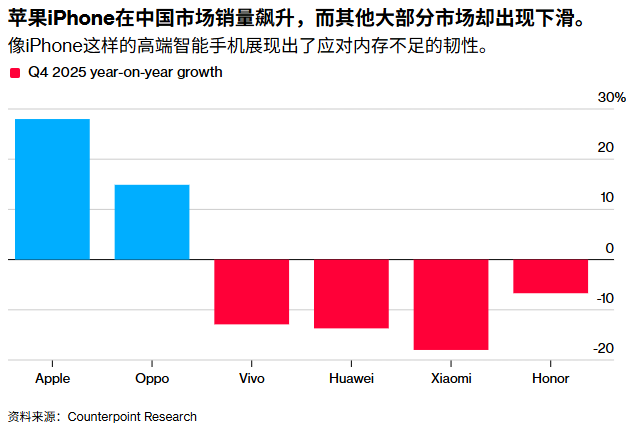
Core Viewpoint - Apple has regained its leading position in the Chinese smartphone market with a 28% increase in iPhone shipments during the holiday season, despite a worsening shortage of key memory chips [1][4]. Group 1: Apple’s Market Performance - In Q4, Apple's iPhone shipments accounted for one-fifth of global shipments, while domestic competitors like Huawei experienced double-digit percentage declines [1]. - For the full year, Apple ranked second in China, closely trailing Huawei, with both holding approximately 17% market share [4]. - Apple's iPhone 17 series has attracted many consumers, contributing to its strong performance [1]. Group 2: Challenges and Risks - The newly launched iPhone Air has underperformed due to its late release in China and compromises made between thinness and functionality [4]. - The rising prices of memory chips pose a significant financial challenge for Apple, as it needs to increase RAM capacity in future models to support advanced features [4][6]. - The semiconductor shortage, driven by manufacturers prioritizing high-end memory for AI chips, has led to increased prices and supply uncertainties for device manufacturers [5][6]. Group 3: Industry Dynamics - Companies like HP and others in the consumer hardware sector are facing pressure due to high memory component costs, which have become an investment risk [5]. - The memory chip shortage is described as a "crisis" by IDC, with expectations of further price increases of 40% to 50% in Q1 2026, followed by an additional 20% in Q2 2026 [6]. - Apple, with its strong market position and financial resources, has the highest bargaining power in negotiations with chip suppliers, allowing it to secure supply despite rising costs [7]. Group 4: Future Outlook - Apple's ability to maintain its leading position in 2026 will largely depend on how it manages the cost impacts from the memory chip shortage [7].

Counterpoint:苹果iPhone出货量飙升28%,领跑中国市场
Jin Rong Jie· 2026-01-19 06:48
Core Insights - Apple's iPhone shipments in the Chinese market grew by 28% during the holiday season, reclaiming the top market position despite increasing memory chip shortages [1] - The iPhone 17 series attracted a significant number of consumers, with Apple's phones accounting for one-fifth of total shipments in December [1] - Memory prices are expected to rise further, with an anticipated increase of 40% to 50% in Q1 2026, followed by an additional 20% rise in Q2 2026 [1] - Smartphone manufacturers are expected to optimize their product portfolios, focusing on reducing the scale of low-end models to maintain profit margins [1]
AI热潮催生“存储涨价潮”,三星电子Q4营业利润有望飙升160%创七年新高
智通财经网· 2026-01-06 03:46
Core Viewpoint - The semiconductor industry is experiencing a significant price surge due to a shortage of chips, driven by the increasing demand for artificial intelligence (AI) applications, which is expected to lead to a 160% increase in Samsung Electronics' operating profit for Q4 [1] Group 1: Samsung's Financial Performance - Analysts predict Samsung's operating profit for Q4 will reach 16.9 trillion KRW (approximately 11.7 billion USD), marking the highest quarterly profit since Q3 2018 [1] - This profit forecast represents a substantial increase from 6.49 trillion KRW in the same period last year, with some analysts raising expectations to over 20 trillion KRW due to stronger-than-expected traditional chip prices [1] - Samsung's stock price surged by 125% last year, achieving its largest annual gain in 26 years, reflecting a dramatic turnaround in the company's performance [3] Group 2: Market Dynamics and Chip Prices - According to TrendForce, the price of certain DDR5 DRAM chips has increased by 314% year-over-year, with traditional DRAM contract prices expected to rise by 55% to 60% in Q4 [2] - The ongoing price increase in traditional DRAM is expected to benefit Samsung significantly, as the company primarily focuses on this segment [2] - The demand for high-bandwidth memory (HBM) chips, particularly from clients like NVIDIA, is contributing to Samsung's competitive advantage in the market [3] Group 3: Challenges and Risks - Despite the positive outlook for Samsung's semiconductor business, there are concerns that rising chip prices may negatively impact demand for personal computers and smartphones, which are significant revenue sources for the company [4] - Samsung's mobile division is facing profit margin pressures due to the rising costs of chips, which could affect overall profitability [4][5] - The CEO of Samsung's mobile division acknowledged the unprecedented nature of the current market conditions, indicating that no company is immune to the impacts of the chip shortage [5]
三星电子2026战略:8亿台设备接入Gemini AI,折叠屏市场迎关键转折点
Zhi Tong Cai Jing· 2026-01-05 11:57
Core Insights - Samsung Electronics plans to double the number of mobile devices equipped with Google's Gemini AI features by the end of this year, aiming to expand from 400 million devices to 800 million by 2026 [1][2] - The company is enhancing its collaboration with Google to maintain its leadership in the Android ecosystem against competitors like Apple and Chinese brands [2] - Samsung is also integrating Gemini AI into its home appliances and televisions, showcasing advancements at CES 2026 [2] Group 1 - Samsung has successfully deployed Gemini AI features to approximately 400 million devices, including smartphones and tablets, by the end of last year [1] - The brand recognition of Galaxy AI has increased from 30% to 80% within a year, indicating growing consumer awareness [1] - The company anticipates a higher adoption rate of AI technologies within the next six months to a year [1] Group 2 - Roh acknowledged the unprecedented global shortage of memory chips affecting various consumer electronics, including smartphones and televisions [3] - There is a possibility of raising product prices due to the surge in memory chip prices, which is deemed unavoidable [3] - Samsung holds nearly two-thirds of the foldable smartphone market share as of Q3 2025, despite facing competition from Huawei and Apple [3]