军工发展

Search documents
2025亚洲通用航空展今天拉开帷幕,航空航天ETF天弘(159241)近20日“吸金”累超7600万元,机构:发展军工或为未来重中之重
2 1 Shi Ji Jing Ji Bao Dao· 2025-11-27 01:34
Group 1 - The three major indices showed mixed performance, with the aerospace and defense sector weakening, as indicated by the CN5082.SZ index, which fell by 2.56% [1] - The Tianhong Aerospace ETF (159241) had a trading volume of 79.287 million yuan, with a closing premium widening to a real-time premium rate of 0.07% [1] - As of November 25, the Tianhong Aerospace ETF (159241) saw a net inflow of over 76 million yuan in the past 20 days, with a latest circulation share of 455 million and a circulation scale of 529 million yuan [1] Group 2 - The National Space Administration issued an action plan for the high-quality and safe development of commercial aerospace from 2025 to 2027, aiming for significant growth in the industry scale and enhanced innovation and governance capabilities [1] - The 2025 Asian General Aviation Exhibition opened in Zhuhai, featuring 381 companies from 22 countries and regions, with Tianhong Fund planning a live event focused on military investment trends [1] - The Tianhong Aerospace ETF closely tracks the CN5082.SZ index, which covers various sectors including aerospace equipment and military electronics, with a defense and military weight of 98.2% [2] - Huafu Securities predicts significant growth in both domestic and foreign demand from 2026 to 2027, emphasizing the importance of military development as a key focus for the future [2]


市场能否重回4000点?这一板块获大幅看好!
Zheng Quan Shi Bao Wang· 2025-11-23 12:52
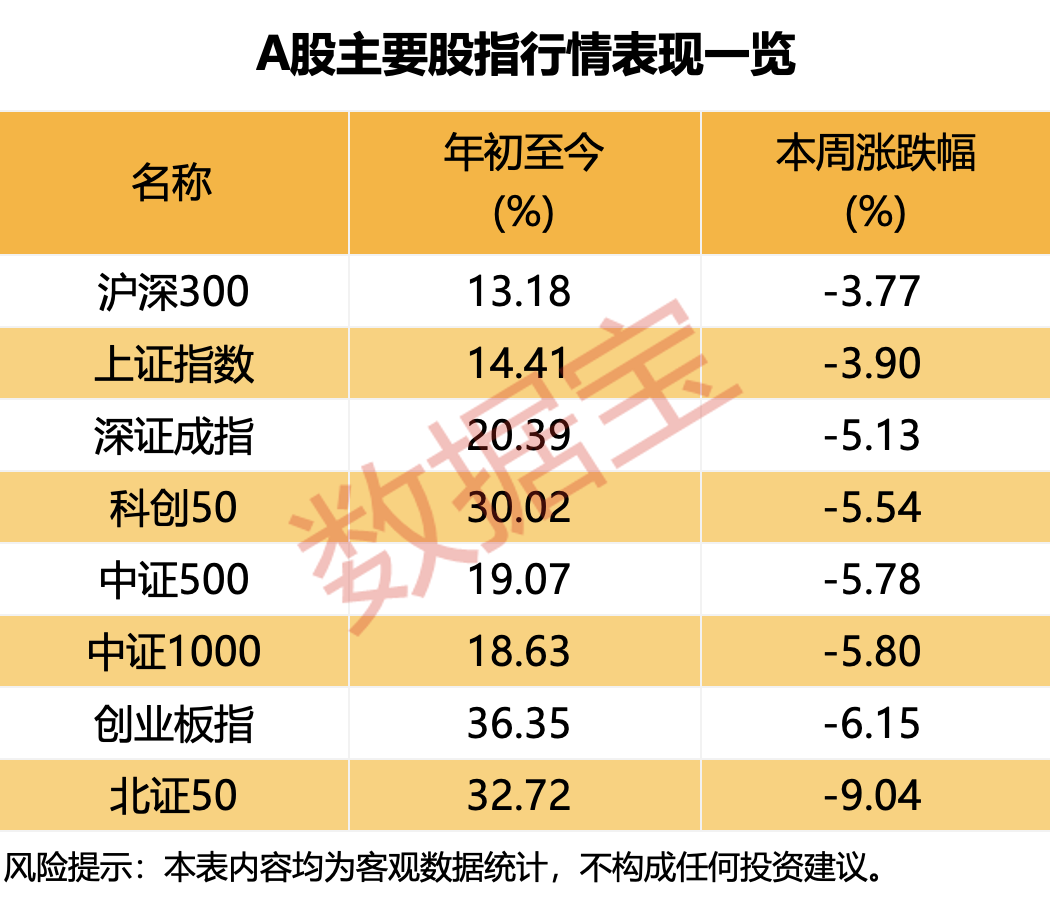
Market Performance - The A-share market has shown poor profitability this week, with only 11% of respondents reporting profits, while 89% reported losses [7] - Major indices such as the Shanghai Composite Index and the Shenzhen Component Index experienced declines, with the Shanghai Composite Index down 3.90% this week [2] - The overall market sentiment indicates a bearish outlook, with 38% of respondents expecting the market to trade sideways and unable to reach 4000 points [8] Sector Performance - All major industry indices saw declines, with the power equipment sector leading the losses at 10.54%, followed by comprehensive and basic chemical sectors [3] - The banking sector experienced the smallest decline at 0.89%, indicating relative stability compared to other sectors [3] Fund Flow - A total of 249.32 billion yuan in net outflow was recorded from A-share main funds this week, with all 31 major industry sectors experiencing net outflows [3] - The power equipment, electronics, and pharmaceutical sectors saw the highest net outflows, amounting to 50.52 billion yuan, 38.39 billion yuan, and 25.76 billion yuan respectively [3] Investor Sentiment - A survey indicated that 26% of investors increased their positions, while 18% reduced their holdings, reflecting a cautious approach to market conditions [4] - The proportion of investors holding less than 50% of their positions increased, indicating a shift towards more conservative investment strategies [4] Future Outlook - Respondents remain optimistic about the long-term trend of the A-share market, with 50% believing the Shanghai Composite Index could reach 4000 points [10] - The military industry sector has seen a significant increase in positive sentiment, rising by 9 percentage points to 12%, indicating growing interest in this area [12] Industry Trends - The military industry is expected to experience significant growth driven by domestic and international demand, with key factors including the "14th Five-Year Plan" and military trade developments [13] - Analysts predict a shift towards high-end demand and improved financial health within the military sector, with a focus on new combat capabilities and military-civilian integration [13]
中国稀土管制令打响“时间争夺战”,能否重塑全球格局?
Sou Hu Cai Jing· 2025-10-13 19:43
Core Insights - The recent announcement of China's strict rare earth regulations is viewed as a strategic move in a "race against time" that impacts global markets and technology sectors [1][3][8] - The competition between China and the U.S. in key areas such as AI, semiconductors, and military technology will shape the future global landscape [3][5] Industry Analysis - China's rare earth control is not merely a trade tactic but a strategic maneuver to secure a buffer period for industrial upgrades and technological breakthroughs [1][3] - The U.S. faces significant challenges in establishing a self-sufficient rare earth supply chain, with estimates suggesting it could take 5 to 10 years to reduce dependence on Chinese supplies [3][5] - China's rare earth regulations are creating opportunities in AI, where U.S. data center expansions are hindered by shortages, while Chinese AI chip performance is rapidly improving [3][5] - In the semiconductor sector, while U.S. companies struggle with supply issues, Chinese firms like SMIC and Yangtze Memory Technologies are making significant advancements in production capabilities [5] - The military sector is also affected, with U.S. defense production facing rare earth supply constraints, while China accelerates the development of advanced military technologies [5][7] Strategic Implications - The interplay between rare earth resources and advancements in AI, semiconductors, and military technology is creating a virtuous cycle that enhances China's competitive edge [5][7] - The strategic foresight of China's rare earth policy may lead to a significant shift in global industrial dynamics, positioning China as a leader in critical technology sectors [7][8]