农业综合生产能力提升

Search documents
国内农产品期货多数品种上涨!农业ETF天弘(512620)标的指数逆市涨超1%
Mei Ri Jing Ji Xin Wen· 2026-02-26 08:20
Group 1 - The agricultural sector is experiencing a slight upward trend, with the Tianhong Agricultural ETF (512620) seeing a 1.14% increase in its benchmark index during trading, with a transaction volume of 2.9565 million yuan and a turnover rate of 0.45% [1] - The Tianhong Agricultural ETF has recorded a net inflow of 210 million yuan over the past 30 trading days, reaching a new high of 645 million yuan as of February 25, 2026, making it the largest in its category on the Shanghai Stock Exchange [1] - The CSI Agricultural Index, which the Tianhong ETF closely tracks, has seen a 29.80% increase over the past year, with its current PE-TTM at 22.22 times, significantly lower than the historical average of 23.19%, indicating a high cost-performance ratio and investment value [1] Group 2 - Domestic agricultural futures have mostly risen, with main contracts for soybeans, soybean meal, and corn showing slight increases, supported by the resumption of operations in downstream processing enterprises and rising cotton yarn prices in the spot market [2] - The recent issuance of the Central No. 1 Document emphasizes enhancing agricultural production capacity and regulating pig production, creating positive market expectations [2] - The meat and dairy cycle is expected to reverse positively this year, with long-term support for pig prices due to industry dynamics, while the corn supply-demand balance is tightening, providing bottom support [2]

锐财经|推动乡村全面振兴取得新进展
Ren Min Ri Bao Hai Wai Ban· 2026-02-06 05:41
Core Viewpoint - The central government has released the 14th guiding document on "agriculture, rural areas, and farmers" since the 18th National Congress, focusing on modernizing agriculture and promoting comprehensive rural revitalization [1] Group 1: Agricultural Production Capacity - By 2025, agricultural production capacity is expected to reach new heights, with grain output stabilizing above 1.4 trillion jin, aiming for 1.43 trillion jin, achieving historical highs in both total output and yield [2] - The document emphasizes maintaining grain security and balancing production capacity, ecology, and income growth to enhance agricultural quality and efficiency [2][3] - It calls for a new round of actions to boost grain production capacity, focusing on land use, high-standard farmland construction, and integrating technology into agricultural practices [3] Group 2: Farmers' Income Stability - Increasing farmers' income remains a central task, with policies aimed at stabilizing agricultural earnings through minimum purchase prices and subsidies for key crops [4] - The document supports the development of local industries to enhance county-level economies and promote employment for migrant workers through skills training and job matching [4][5] Group 3: Ongoing Support for Poverty Alleviation - The document introduces a systematic approach to "regularized precise assistance" to consolidate poverty alleviation achievements, focusing on dynamic management of assistance targets and efficient support methods [6] - It highlights the importance of maintaining stable financial and resource support for poverty alleviation efforts, ensuring no abrupt changes in funding or policy direction [7]
农村居民人均可支配收入2.4万元,促进农民就业增收将有新举措
Di Yi Cai Jing· 2026-01-22 13:23
Group 1 - The core viewpoint emphasizes the importance of enhancing agricultural comprehensive production capacity and quality efficiency as a key task in the "14th Five-Year Plan" [1][3] - By 2025, China's grain output is projected to reach 14,298 billion jin, an increase of 168 billion jin, setting a new historical high [1] - The production of pork, beef, mutton, and poultry is expected to reach 10,072 million tons, reflecting a growth of 4.2% compared to the previous year [1] Group 2 - The transition period for consolidating and expanding poverty alleviation achievements has ended, moving into a new phase of normalized assistance [3] - Over 85% of poverty-stricken households have received at least one form of industrial support during the transition period [3] - The employment scale of the poverty alleviation population has remained stable at over 30 million for five consecutive years, securing more than two-thirds of the income for impoverished families [3] Group 3 - The Ministry of Agriculture and Rural Affairs aims to enhance agricultural production capacity and quality efficiency, focusing on high-quality agricultural development [4] - Key strategies include promoting diversified food supply systems, enhancing grain supply capabilities, and implementing high-standard farmland construction [4] - The development of rural industries and agricultural processing is prioritized, with an emphasis on strengthening supply chains and improving logistics [4] Group 4 - The central rural work conference proposed a second round of land contract extensions for 30 years, with pilot programs covering seven provinces and over 25 million farmers [5] - The Ministry of Agriculture and Rural Affairs will guide provinces in establishing work mechanisms and developing specific measures for land contract extensions [5] - The goal is to ensure steady progress in the pilot programs, providing solid support for agricultural modernization [5]

农业农村部:提高大豆油料产能和自给率,更大力度推进粮油作物大面积单产提升
Xin Lang Cai Jing· 2026-01-12 03:56
Core Viewpoint - The Ministry of Agriculture and Rural Affairs of China is focusing on enhancing soybean and oilseed production capacity and self-sufficiency, while promoting large-scale yield improvements in grain and oil crops [1] Group 1: Agricultural Production Capacity - The government aims to solidify rural revitalization efforts this year [1] - There will be a strong emphasis on improving agricultural comprehensive production capacity and quality efficiency [1] - High-standard farmland construction will be advanced to enhance agricultural disaster prevention and mitigation capabilities [1] Group 2: Soybean and Oilseed Initiatives - The implementation of the national soybean and oilseed production capacity enhancement project is a key focus [1] - Efforts will be made to increase soybean and oilseed production capacity and self-sufficiency rates [1] Group 3: Modern Agricultural Practices - The action plan for modernizing facility agriculture will be executed to expand food production space comprehensively [1]
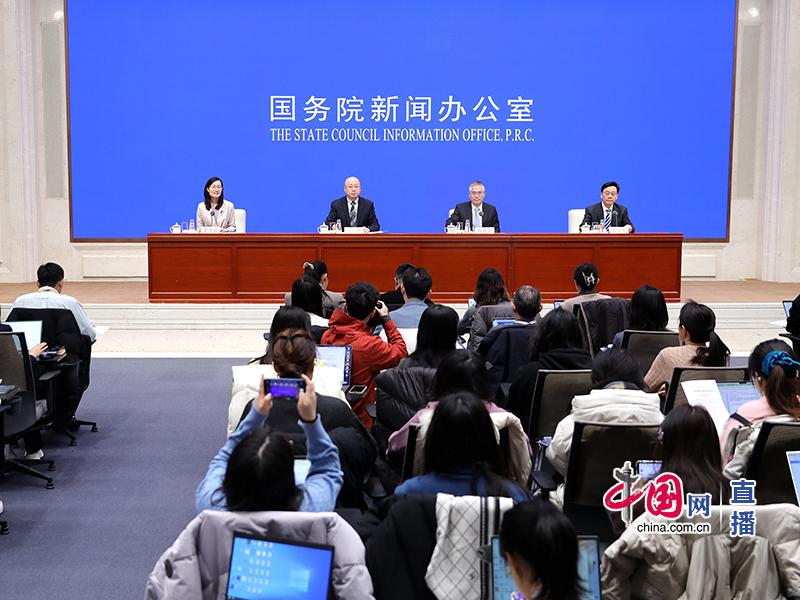
农业农村部:提高大豆油料产能和自给率 更大力度推进粮油作物大面积单产提升
Jing Ji Guan Cha Wang· 2026-01-12 02:43
Core Viewpoint - The article emphasizes China's commitment to advancing rural revitalization and enhancing agricultural production capacity and quality this year [1] Group 1: Agricultural Production Enhancement - China aims to significantly improve the yield of grain and oil crops through large-scale production initiatives [1] - The country will focus on high-quality construction of high-standard farmland to boost agricultural efficiency [1] - There will be an acceleration in enhancing disaster prevention and mitigation capabilities in agriculture [1] Group 2: Specific Agricultural Initiatives - The implementation of the national soybean and oilseed production capacity enhancement project is a priority to increase self-sufficiency [1] - Actions will be taken to modernize facility agriculture, expanding food production capabilities comprehensively [1]
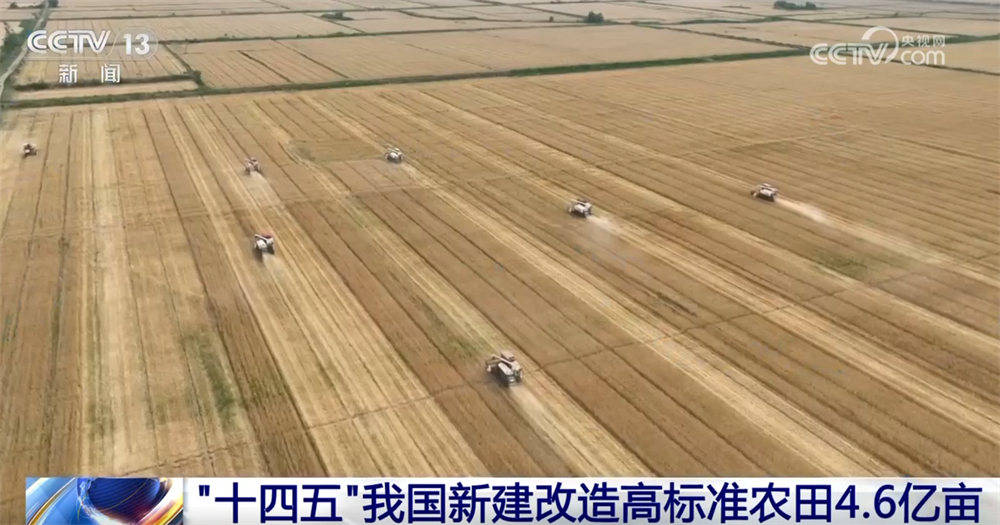
“十四五”新建改造高标准农田4.6亿亩 为端稳“中国饭碗”提供“硬支撑”
Yang Shi Wang· 2025-12-15 01:48
Core Viewpoint - During the "14th Five-Year Plan" period, China is advancing high-quality construction of high-standard farmland, with over 700 billion yuan allocated to support the establishment and enhancement of 4.6 million hectares of high-standard farmland, significantly contributing to national food security [1][4]. Group 1 - The Ministry of Agriculture and Rural Affairs is guiding localities to improve farmland through standards of leveling fields, ensuring water and road access, and enhancing soil productivity [4]. - There is a focus on optimizing the spatial layout and timing of high-standard farmland construction, prioritizing regions such as Northeast black soil areas, plains, and areas with irrigation conditions [1][4]. - The construction of high-standard farmland is aimed at transforming eligible permanent basic farmland into high-standard farmland [1]. Group 2 - Completed high-standard farmland has effectively improved agricultural production capacity and disaster resilience [6]. - Through concentrated construction and improved field facilities, previously low-yielding and unstable plots have achieved reliable irrigation and drainage, promoting efficient use of agricultural resources [6]. - Many farmlands have reached production levels of "1,000 kilograms per season, 2 tons per year," with more regions experiencing stable production during minor disasters and increased yields during favorable conditions [6].