
分布式网络

Search documents
微软第一座“AI超级工厂”投入运营:将两座数据中心连接,构建分布式网络
美股IPO· 2025-11-13 03:39
Core Viewpoint - Microsoft has officially launched its first "AI Super Factory," connecting data centers across states to create a distributed computing cluster, marking a shift towards a networked collaborative era in AI infrastructure [1][3]. Group 1: AI Super Factory Concept - The "AI Super Factory" integrates geographically dispersed data centers into a virtual supercomputer, differing from traditional data center designs [5]. - This distributed network connects multiple sites, consolidating advanced GPUs, EB-level storage, and millions of CPU cores to support future AI model training with trillions of parameters [5][6]. Group 2: Infrastructure and Technology - The new data center in Atlanta spans 85 acres with over 1 million square feet designed specifically for AI workloads [6]. - Key features include a high-density architecture, advanced chip systems with NVIDIA GPUs, an efficient liquid cooling system, and high-speed internal connectivity [7][8]. Group 3: Network and Power Distribution - Microsoft has deployed 120,000 miles of dedicated fiber optic cables to create a high-speed network for AI traffic, ensuring data transmission at near-light speed [9]. - The decision to build across states is driven by land and power supply considerations, allowing for distributed power demand and avoiding overloading any single grid [9]. Group 4: Competitive Landscape - Microsoft’s "AI Super Factory" is a strategic asset in the escalating competition for AI computing power, with plans to double its data center footprint in the next two years to meet surging demand [4][10]. - Competitors like Amazon, Meta Platforms, and Oracle are also ramping up their infrastructure investments, indicating a broader industry trend towards massive AI-related capital expenditures [10].


冲动、理性与多巴胺:你的每个决定,大脑早有安排?
3 6 Ke· 2025-11-10 12:42
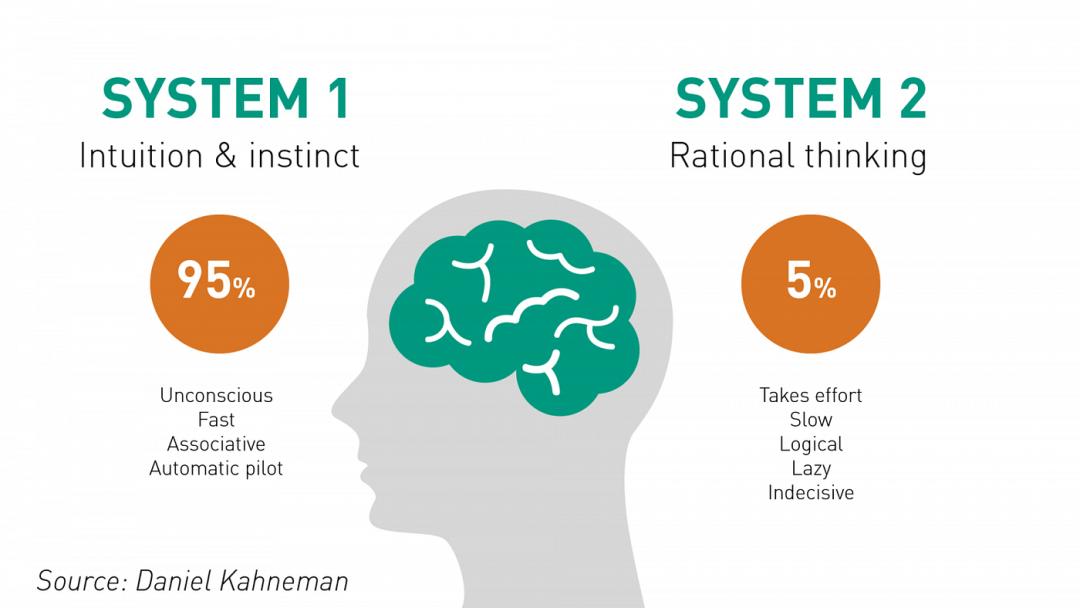
Core Insights - The article discusses the complexities of human decision-making and how it is influenced by various cognitive processes and neural mechanisms [1][2][9] Group 1: Decision-Making Mechanisms - Decision-making is a developing interdisciplinary science that combines neuroscience, psychology, mathematics, economics, and engineering [1] - Daniel Kahneman's concept of two thinking systems: System 1 is fast and automatic, while System 2 is slow and deliberate, allowing for corrections of errors made by System 1 [2] Group 2: Neural Activity in Decision-Making - Neuroscientific studies reveal multiple neural circuits in the brain that evaluate options from various perspectives, reflecting the complexity of decision-making [4] - Recent research published in "Nature" constructed a comprehensive decision-making map of the mouse brain, recording over 620,000 neurons across 279 brain regions [5][7] Group 3: Experimental Findings - The decision-making process in mice involves a complete cycle of visual input, choice, action, and reward feedback, demonstrating that even minor choices activate extensive brain regions [7] - The findings challenge the traditional linear pathway model of decision-making, suggesting a distributed network where signals emerge simultaneously across various brain areas [8]
互联网的起源:从“lo”到全球连接的革命
Sou Hu Cai Jing· 2025-10-29 14:21
Core Insights - The birth of the internet marked a significant milestone in technological history, fundamentally changing communication and impacting daily life [5] Group 1: Historical Context - The first computer-to-computer message was sent on October 29, 1969, from UCLA to SRI, which was intended to be "login" but only transmitted "lo" due to a system crash [1][2] - The failure of this initial transmission was caused by a speed mismatch, with ARPANET transmitting at 5000 characters per second, overwhelming the receiving system [2] Group 2: Technological Innovations - The concept of a "distributed network" was proposed in the 1960s to ensure communication could continue after a nuclear attack, leading to the development of ARPANET [3] - The innovation of "packet switching" allowed information to be broken into smaller parts and sent through various paths, enhancing communication reliability [3] Group 3: Vision for the Future - Scientists involved in the ARPANET project foresaw that computer networks would become essential infrastructure, similar to electricity and telephones [4] - The evolution of the internet has permeated various aspects of life, from online shopping to social media, reflecting rapid technological advancement [4]

国际商业结算(00147)上涨25.62%,报0.255元/股
Jin Rong Jie· 2025-08-07 01:46
Group 1 - The core viewpoint of the article highlights the significant increase in the stock price of International Commercial Settlement, which rose by 25.62% to 0.255 yuan per share, with a trading volume of 1.5539 million yuan [1] - The company focuses on building a global multi-currency real-time clearing and settlement platform based on blockchain and distributed networks, connecting national central bank systems to facilitate efficient cross-border fund flow 24/7 [1] - The company's services target countries along the "Belt and Road" initiative, covering approximately 4.4 billion people and a combined economy of 21 trillion dollars, aiming to reshape the global clearing and settlement landscape [1] Group 2 - As of the 2024 annual report, International Commercial Settlement reported total operating revenue of 172 million yuan and a net loss of 211 million yuan [2]
正链科技(零极数字集团)拟美股上市 中国证监会要求补充说明主营业务内容等情况
Zhi Tong Cai Jing· 2025-08-01 13:48
Group 1 - The China Securities Regulatory Commission (CSRC) has requested additional information from Zhenglian Technology (Zero Limit Digital Group) regarding its main business operations and client details as part of its listing application on NASDAQ [1][2] - Zhenglian Technology plans to issue 2 million ordinary shares at a price of $4 per share, aiming to raise $8 million with an expected market capitalization of $200 million [1][3] - The company was established in August 2017 and is headquartered in Nanshan District, Shenzhen, focusing on providing comprehensive digital solutions for various industries during the transition to a new generation of the internet [3] Group 2 - The company’s distributed network infrastructure software products enable users to efficiently build distributed networks or migrate existing centralized applications to distributed networks, with applications in digital governance, online education, search engines, e-commerce, digital asset platforms, food traceability, IoT, and smart manufacturing [3] - For the fiscal years 2023 and 2024, the company reported revenues of $5.68 million and $5.90 million, with corresponding net profits of $2.52 million and $2.71 million [3]