
利益分配机制

Search documents
年薪435万上市公司董事长“因对岗位薪酬不满”投票反对自己连任?本人最新回应
Sou Hu Cai Jing· 2025-12-03 14:31
Core Viewpoint - The article discusses the dissatisfaction of Ding Yanhui, the chairman of Aibisen, regarding the company's governance structure and compensation mechanisms, leading him to vote against the chairman election due to concentrated shareholding issues and ineffective incentive systems [1][3]. Group 1: Governance Structure - Ding Yanhui expressed concerns about the serious issues within the company's governance structure, highlighting the concentrated shareholding that hinders optimization through negotiation [1]. - He has communicated repeatedly with the company regarding the concentrated shareholding problem but has not seen any results, which prompted his dissenting vote during the chairman election [1]. Group 2: Compensation Mechanism - Ding criticized the company's profit distribution mechanism as being inadequate and the compensation distribution mechanism as unscientific and unreasonable [1]. - In 2024, Ding Yanhui received a total pre-tax compensation of 4.3556 million yuan, which includes 1.7399 million yuan from the employee stock ownership plan, marking a 51% increase from his 2.8845 million yuan salary in 2023 [3]. Group 3: Personal Philosophy - Ding Yanhui stated his commitment to reform, emphasizing his motto of contributing more taxes to the state and providing better compensation to employees [1].



因不满意岗位薪酬,投票反对自己当董事长?本人回应
Sou Hu Cai Jing· 2025-12-03 02:04
Core Viewpoint - The chairman of Aibisen, Ding Yanhui, cast the only dissenting vote against the election of the new board chairman due to dissatisfaction with the chairman's compensation and the company's incentive mechanism [1][3]. Group 1: Board Meeting and Voting Results - On November 28, Aibisen announced the resolution of the first meeting of the sixth board of directors, where the proposal to elect the new chairman received 8 votes in favor, 1 against, and no abstentions or recusal [1]. - Ding Yanhui, as the chairman, voted against the proposal, citing dissatisfaction with the chairman's compensation as the reason for his dissent [1]. Group 2: Chairman's Concerns - Ding Yanhui later clarified that his dissent was due to dissatisfaction with the company's incentive mechanism rather than the salary itself, attributing the issue to a concentrated shareholding structure that hinders governance optimization [3]. - He emphasized that the company's governance structure has serious issues, the profit distribution mechanism is inadequate, and the compensation distribution mechanism is unscientific and unreasonable [3]. Group 3: Chairman's Background and Compensation - Ding Yanhui, born in 1973, is the actual controller of Aibisen, holding 124,671,149 shares, which accounts for 33.78% of the total share capital [5]. - In 2024, Ding received a pre-tax compensation of 4.3556 million yuan, which includes 1.7399 million yuan from the employee stock ownership plan, marking a 51% increase from his 2.8845 million yuan salary in 2023 [5].
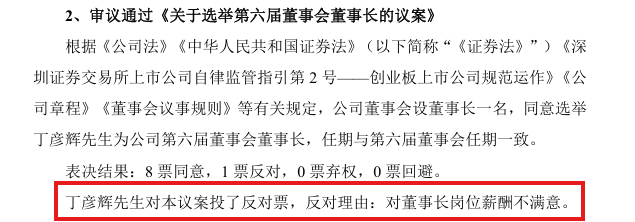
因对“薪酬不满意”拒当艾比森董事长?公司回应:非嫌薪酬低 实为不满激励机制
Xin Lang Cai Jing· 2025-12-02 12:56
Core Viewpoint - The announcement from A-share listed company Abison regarding the resolution of the first meeting of the sixth board of directors has attracted significant attention, particularly due to a dissenting vote from Ding Yanhui concerning the chairman's remuneration [1] Group 1: Board Decisions - The board approved the proposal regarding the chairman of the sixth board of directors [1] - Ding Yanhui cast one vote against the proposal, citing dissatisfaction with the chairman's remuneration [1] Group 2: Company Response - Abison clarified that the dissenting vote was a clerical error and that the chairman is actually dissatisfied with the company's incentive mechanisms [1] - The chairman aims to implement reforms and innovations, including optimizing the company's governance structure and addressing issues with the profit distribution mechanism and remuneration incentive system [1]
AI提效导致裁员?得了吧,背后是老板在做利益分配
Hu Xiu· 2025-07-04 01:53
Core Viewpoint - The article discusses the challenges and strategies related to resource allocation and efficiency optimization in large organizations, emphasizing the importance of a well-defined governance framework and top-level design to address redundancy and improve operational efficiency [1][60][62]. Group 1: Organizational Structure and Efficiency - As business complexity increases, efficiency issues become prominent, and a common solution is to break down operations into smaller units such as subsidiaries or project teams [2][3]. - While this approach can lead to focused goals and manageable team sizes, it also creates overlapping responsibilities and areas of neglect, which can grow significantly as team sizes increase [5][6]. - The emergence of a governance framework that combines human and legal aspects is essential to address these efficiency challenges [6][8]. Group 2: Maintenance Costs and Resource Allocation - As companies grow, maintenance costs from redundant resources and outdated projects become a significant concern, leading to regular cost optimization efforts [14][19]. - Companies may not lack funds but still impose restrictions on headcount and costs to address perceived inefficiencies [20][21]. - Identifying and managing redundant resources is crucial, as excessive maintenance costs can lead to systemic issues that hinder overall performance [22][23]. Group 3: Top-Level Design and Resource Distribution - Effective resource distribution requires a macro perspective to understand where resources should be allocated, especially during restructuring or layoffs [36][38]. - Adjusting resource allocation ratios, such as shifting from maintaining old businesses to investing in new initiatives, is vital for long-term sustainability [41][42]. - A structured approach to identifying redundancies and prioritizing key business areas can lead to a dynamic balance and improved operational efficiency [42][64]. Group 4: Implementation Challenges - Implementing new mechanisms and processes often faces resistance, necessitating a strategic approach to promote acceptance and effectiveness [50][56]. - Creating successful pilot cases within influential departments can facilitate broader adoption of new systems across the organization [51][54]. - Continuous monitoring and adjustment of resource allocation and operational strategies are essential to maintain alignment with organizational goals and address emerging challenges [63][64].

胖东来也没有奇迹
投资界· 2025-02-11 07:38
以下文章来源于远川研究所 ,作者黎铮 远川研究所 . 刻画这个时代 一个冬天的童话。 作者 | 黎铮 编辑 | 李墨天 来源 | 远川研究所 (ID:YuanChuanInstitution) 把胖东来当作榜样的永辉超市,曾经也是前者的老师。 早年于东来去福州进货,永辉创始人张松轩兄弟俩带于东来参观门店,毫无保留地分享 生鲜供应链的整套流程——那是永辉赖以生存的身家性命。 2022年一次讲课,于东来感慨当年峥嵘岁月:"你看,原来永辉多好[1]。" 巅峰时期,永辉的门店数量是胖东来的75倍。命运用又一个十年将两者的身份对调,时 过境迁,胖东来飞升零售教父,永辉成了教父的门徒,步步高、中百等商超上市公司, 于东来近日公布的2024年营收数据 胖东来是一本被零售行业长时间忽略,短时间翻烂的教材,但它的内核其实不复杂, 只 是反常识: 一不靠低价,二不做巨头,三不要增长。 不靠低价 线下消费至暗的2022年,想破脑袋的零售同行和深感赚钱毫无乐趣的于东来把酒言欢, 一场全国巡回帮扶之旅就此展开。 最先尝到甜头的是头戴ST帽子的步步高,梅溪湖店调改三天后,日均客流与销售额就分 别比改造前翻了6.5倍和6.7倍[3]。永辉 ...
