
薪酬激励机制

Search documents
435万年薪仍不满?艾比森董事长反对自己当选董事长,公司回应:系笔误
Xin Lang Cai Jing· 2025-12-03 12:47
Core Viewpoint - The recent board resolution announcement from A-share listed company Absen has sparked market discussions, particularly due to the unique situation where the founder and chairman Ding Yanhui cast the only dissenting vote against his own election, citing dissatisfaction with the chairman's salary of 4.35 million yuan [1][11]. Group 1: Voting and Reactions - During the first meeting of the sixth board of directors on November 28, 2025, all 9 directors attended, and the election of the chairman resulted in 8 votes in favor and 1 vote against, which was from Ding Yanhui himself [3][13]. - The announcement of Ding's dissent quickly gained traction on social media, with mixed reactions from netizens questioning why he was dissatisfied with a salary of 4.35 million yuan [3][13]. Group 2: Salary Data - Ding Yanhui's pre-tax remuneration for 2024 was 4.3556 million yuan, which includes 1.7399 million yuan from the employee stock ownership plan, marking a 51% increase from 2.8845 million yuan in 2023 [5][15]. - Over five years, his salary has increased nearly fivefold from 730,000 yuan in 2020 to 4.3556 million yuan in 2024 [5][15]. - Compared to peers, Ding's salary is significantly higher, with the chairman of Leyard earning 1.051 million yuan, and others earning even less, indicating that Ding's compensation is more than double the average salary of 2.0971 million yuan for other executives at Absen [5][16]. Group 3: Company Performance - In 2024, Absen reported a revenue of 3.663 billion yuan, a year-on-year decline of 8.58%, and a net profit attributable to shareholders of 117 million yuan, down 62.98% [6][16]. - However, in the first three quarters of 2025, the company showed signs of recovery with a revenue of 2.872 billion yuan, up 5.66%, and a net profit of 185 million yuan, up 57.33% [6][16]. Group 4: Company Response and Governance Issues - In response to the public outcry regarding Ding's salary dissatisfaction, Absen clarified that the statement was a clerical error, and Ding's actual concern was about the overall incentive mechanism of the company [7][17]. - Ding aims to push for reforms in the company's governance structure, focusing on optimizing governance, improving the distribution of benefits, and adjusting the incentive mechanisms [7][17]. Group 5: Shareholder Dynamics and Market Reaction - As the founder and actual controller of Absen, Ding holds approximately 12.5 million shares, accounting for 33.78% of the total share capital, with a market value of around 2 billion yuan [8][18]. - Ding's limited influence over his own salary is highlighted by his absence from the compensation and assessment committee, which is led by another individual [9][21]. - Following the "self-opposition" incident, Absen's stock price fell by 1.36% to 16.01 yuan per share, with a total market capitalization of approximately 5.9 billion yuan [10][22]. - The incident has drawn attention to potential adjustments in the executive compensation system, with the board also passing a proposal to revise the senior management compensation management system [10][23].


因对“薪酬不满意”拒当艾比森董事长?公司回应:非嫌薪酬低 实为不满激励机制
Xin Lang Cai Jing· 2025-12-02 12:56
Core Viewpoint - The announcement from A-share listed company Abison regarding the resolution of the first meeting of the sixth board of directors has attracted significant attention, particularly due to a dissenting vote from Ding Yanhui concerning the chairman's remuneration [1] Group 1: Board Decisions - The board approved the proposal regarding the chairman of the sixth board of directors [1] - Ding Yanhui cast one vote against the proposal, citing dissatisfaction with the chairman's remuneration [1] Group 2: Company Response - Abison clarified that the dissenting vote was a clerical error and that the chairman is actually dissatisfied with the company's incentive mechanisms [1] - The chairman aims to implement reforms and innovations, including optimizing the company's governance structure and addressing issues with the profit distribution mechanism and remuneration incentive system [1]
马斯克十年OKR曝光:12大魔鬼关卡,活该他万亿美元薪酬
3 6 Ke· 2025-11-12 10:44
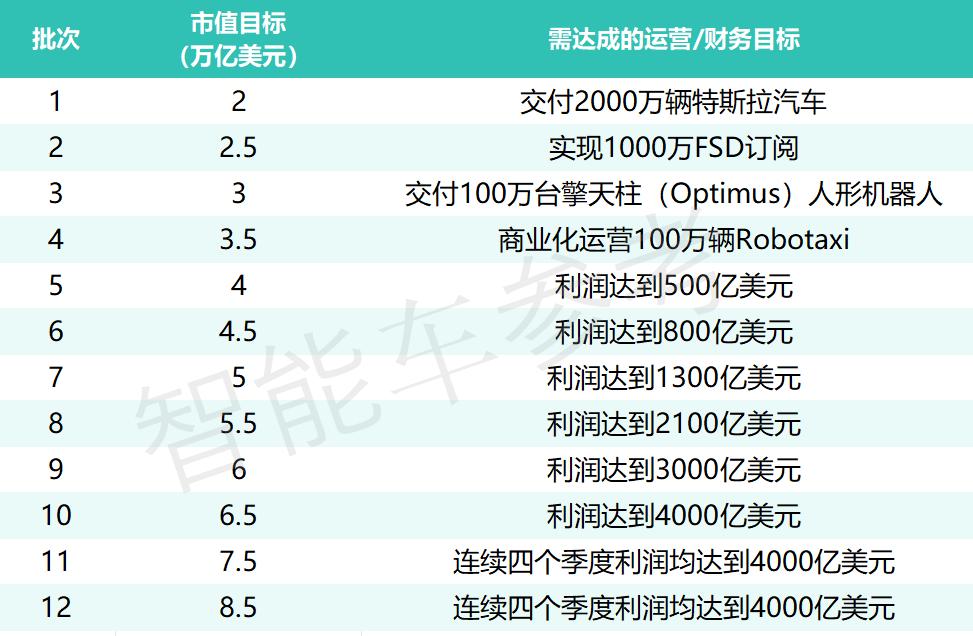
Core Viewpoint - Tesla's new compensation plan for Elon Musk, approved with 75% support at the shareholder meeting, requires him to meet 12 performance targets to unlock his potential $1 trillion compensation, raising questions about the feasibility of achieving these goals [1][2][3]. Group 1: Compensation Structure - The compensation plan is structured around 12 levels, each with specific market capitalization and operational/financial targets that Musk must achieve to earn his compensation [2][5]. - The first batch requires Tesla to reach a market cap of $2 trillion and deliver 20 million vehicles, while the final batch demands a market cap of $8.5 trillion and consistent profits of $400 billion over four quarters [2][5][7]. Group 2: Performance Targets - Initial targets focus on product delivery, including vehicle deliveries, Full Self-Driving (FSD) subscriptions, and the deployment of humanoid robots and Robotaxi fleets, which are crucial for Tesla's growth trajectory [3][5]. - Later targets shift to profitability, requiring adjusted EBITDA to reach $800 billion initially, increasing to $4 trillion, which is significantly higher than current industry leaders [5][7]. Group 3: Historical Context - Musk's previous compensation plan from 2018, which was based on performance metrics, has yet to be fully realized despite achieving all targets, highlighting the challenges in executing such ambitious plans [9][11][15]. - The current plan's ambitious nature is underscored by the comparison to Saudi Aramco's profits, with Musk needing to increase Tesla's profits by 223 times within ten years [7][9]. Group 4: Industry Implications - The unique compensation structure has drawn attention within the automotive industry, with other companies beginning to adopt similar performance-based incentives for their executives [17][19]. - Domestic competitors like Li Auto and Xpeng are implementing their own performance-based compensation plans, focusing on sales and market capitalization, reflecting a trend in the industry towards aligning executive incentives with company performance [19][27].

上海莱士:公司董事会薪酬与考核委员会一直密切关注公司高管薪酬体系的合理性与有效性
Zheng Quan Ri Bao Zhi Sheng· 2025-09-18 11:41
Group 1 - The company is focused on the rationality and effectiveness of its executive compensation system, as stated by the board's compensation and assessment committee [1] - The company plans to continuously optimize its compensation assessment system to establish a more scientific and long-term development strategy-aligned incentive mechanism [1]

中证协发文督促券商建立起科学合理的薪酬激励机制
news flash· 2025-07-11 09:17
Core Viewpoint - The China Securities Association (CSA) has issued guidelines to encourage securities firms to establish a scientific and reasonable compensation incentive mechanism and a clean operation management system to enhance the overall integrity management capabilities of the industry and prevent moral risks and conflicts of interest, thereby providing a solid guarantee for the healthy development of the industry [1] Group 1 - The new regulations emphasize the need for securities companies to develop effective compensation incentive mechanisms [1] - The guidelines aim to improve the integrity management capabilities of the industry [1] - The CSA seeks to prevent moral risks and conflicts of interest within the securities sector [1] Group 2 - The implementation of self-regulatory rules for industry personnel management will be further refined [1] - The guidelines will detail requirements regarding professional ethics, integrity, and compliance for industry personnel [1] - The CSA aims to guide industry personnel to enhance their awareness of compliance and integrity, and to value their professional reputation [1]