制度性红利

Search documents
中泰证券:居民资金会否缺席明春行情?
Xin Lang Cai Jing· 2025-12-26 05:22
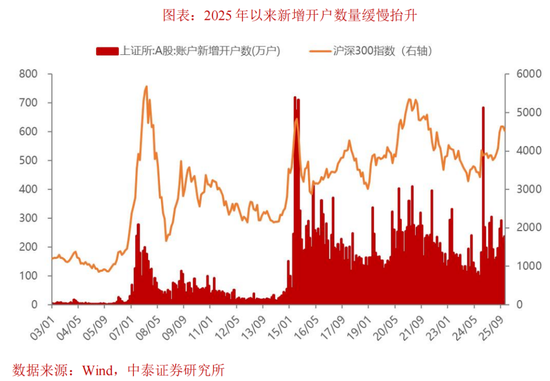
Core Viewpoint - The current investment behavior of residents in the stock market is characterized by a "de-leveraging" trend, reflecting a cautious approach to asset allocation amid macroeconomic changes, contrasting sharply with previous market exuberance periods [1][41]. Group 1: Resident Investment Behavior - The number of new account openings in November 2025 was 2.38 million, showing a recovery from the July low but still significantly lower than previous bull market levels, indicating a slow entry of retail investors [2][41]. - The current market activity is primarily driven by the activation of dormant accounts rather than new retail investors entering the market, with a focus on systematic investment rather than speculative trading [4][44]. - The financing net buying ratio has returned to positive territory, indicating a slight recovery in leveraged funds, but the intensity remains weaker compared to the strong net buying phases of 2019-2020 [5][47]. Group 2: Changes in Fund Flows - The structure of resident fund flows is changing, with a significant shift towards passive investment products like ETFs, which accounted for approximately 72% of new fund issuance in 2025, reflecting a preference for lower-cost investment options [7][49]. - The total issuance of new funds from January to November 2025 was about 530.8 billion yuan, with a monthly average of 48.3 billion yuan, indicating a lack of enthusiasm in the fund issuance market [7][47]. - The net subscription of stock ETFs remained strong, with a single-month net subscription reaching 177.2 billion yuan in April, highlighting the attractiveness of low-cost investment tools for residents [9][49]. Group 3: Economic Context and Implications - The slow entry of resident funds is primarily due to the negative feedback from the wealth effect caused by declining real estate prices, which has led to a cautious outlook on future income and increased preference for savings [10][52]. - As of November 2025, cumulative new resident savings deposits reached 12.06 trillion yuan, continuing a trend of high savings since 2022, with a significant portion in fixed-term deposits reflecting risk aversion [12][52]. - The decline in real estate values has resulted in a substantial reduction in household wealth, leading to a defensive accumulation of cash and deposits among residents [13][53]. Group 4: Future Capital Inflows - Insurance funds saw a significant increase in stock and securities investments, with a quarterly growth of 863.9 billion yuan in Q3 2025, indicating a strong entry of institutional capital into the market [22][61]. - The projected incremental capital from insurance funds for 2026 is estimated to be around 620 billion yuan, driven by regulatory changes and the need for higher returns in a low-interest-rate environment [24][63]. - The upcoming maturity of high-yield deposits from 2025 to 2026 is expected to create a significant shift in capital flows, potentially leading to increased investment in equity markets as residents seek better returns [25][68]. Group 5: Seasonal Market Trends - The spring season historically shows a significant increase in market activity, with a notable rise in retail investor participation and liquidity, driven by seasonal effects and credit expansion [30][69]. - The financing net buying ratio typically peaks in January, indicating a period of heightened activity and potential for thematic investments during the spring [32][71].


居民资金会否缺席明春行情?
李迅雷金融与投资· 2025-12-26 05:06
Core Viewpoint - The article discusses the current state of resident capital entering the market, highlighting a trend of "de-leveraging" and cautious investment behavior among residents, contrasting it with previous market cycles where there was more aggressive entry of funds [1][12][16]. Group 1: Resident Capital Behavior - The pace of new account openings has slowed, with November 2025 seeing 2.38 million new accounts, which is significantly lower than the 4.05 million during the 2020 fund craze and the 2.02 million in March 2019 at the start of the last bull market [2]. - The current market activity indicates that the majority of new capital is coming from the activation of dormant accounts rather than new investors entering the market in a panic [6]. - The financing net buying ratio has returned to positive territory, indicating a slight recovery in leveraged funds, but the intensity remains weaker compared to the aggressive net buying seen in 2019-2020 [7]. Group 2: Structural Changes in Investment Preferences - There is a notable shift towards passive investment products, with 72% of new funds issued in 2025 being passive index funds, reflecting a growing preference for lower-cost investment options among residents [11]. - The high management fees associated with actively managed funds have led to a "scar tissue effect" among residents, making them more cautious about investing in equities [12]. - The trend of residents moving towards fixed-term deposits indicates a risk-averse mindset, driven by the negative wealth effect from declining real estate prices [15][16]. Group 3: Insurance Capital and Market Dynamics - Insurance capital has seen a significant increase, with a quarterly growth of 863.99 billion yuan in Q3 2025, indicating a strong entry into the market [26]. - Regulatory changes have facilitated insurance capital's ability to invest in equities, with a projected annual increment of 620 billion yuan in 2026 [28]. - The pressure on the liability side of insurance companies is driving them to seek higher dividend-paying assets to cover the gap between their costs and returns [28]. Group 4: Market Outlook and Seasonal Trends - The upcoming spring season is expected to see a "spring rally," characterized by a structural loosening of funds and increased participation from retail investors, albeit at a more cautious pace compared to previous years [35]. - Historical data shows that the spring season typically favors small-cap and growth stocks, with an average rally of around 15% [38]. - The article suggests that the current market dynamics will likely lead to a more gradual and sustained rally, with specific sectors such as technology and consumer goods expected to perform well [42][43].

“A+H”上市风潮驱动港股强劲复苏 上半年40只股票首发上市,筹资额1087亿港元超去年全年
Mei Ri Jing Ji Xin Wen· 2025-06-16 12:50
Core Insights - The report by Ernst & Young highlights the robust performance of the IPO market in mainland China and Hong Kong amidst a global downturn in IPO activities, with a significant increase in their market share [1][7]. A-Share Market - In the first half of 2025, approximately 50 companies are expected to go public in the A-share market, raising over 37.1 billion RMB, marking a 14% increase in both the number of IPOs and the total funds raised year-on-year [4]. - The industrial, technology, and materials sectors lead in both the number of IPOs and the amount raised, with the automotive industry playing a crucial role, accounting for over 30% of the listed companies [4][5]. - The "technology" attribute of the A-share market is becoming increasingly prominent, with regulatory support for high-quality, unprofitable tech companies to go public [4][6]. Hong Kong Market - The Hong Kong IPO market is experiencing a strong recovery, with an estimated 40 companies expected to go public in the first half of 2025, raising around 108.7 billion HKD, representing a 33% increase in the number of IPOs and a 711% increase in funds raised year-on-year [7][8]. - The introduction of the "Tech Company Special Line" in May 2025 is aimed at facilitating the listing of technology and biotech companies, thereby enhancing the market's focus on innovation [3][7]. - The "new consumption + hard technology" sectors are emerging as key drivers for the Hong Kong IPO market, with biotech and health, as well as retail and consumption, leading in the number of IPOs [7][8]. Future Outlook - The A-share IPO market is expected to adopt a more rhythmic issuance pattern that aligns with market capacity, focusing on high-quality tech companies that meet listing criteria [6]. - The North Exchange is becoming a primary platform for IPO applications, indicating a shift towards supporting specialized and innovative small and medium enterprises [6]. - The Hong Kong IPO market is anticipated to maintain its momentum due to the enthusiasm for A-share companies listing in Hong Kong, the implementation of the "Tech Company Special Line," and the return of Chinese companies listed in the U.S. [8].