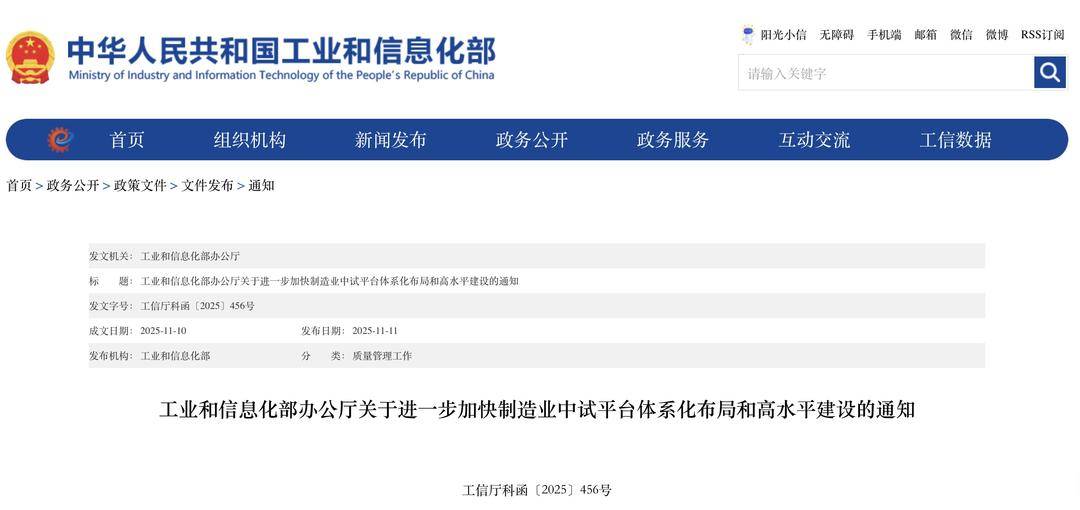
制造业中试平台

Search documents
首批24家省级制造业中试平台名单发布
Xin Hua Ri Bao· 2026-01-10 21:14
Core Viewpoint - The establishment of 24 provincial-level manufacturing pilot platforms marks a significant advancement in the systematic construction of pilot platforms in the province, covering key industries such as semiconductors, biomedicine, new materials, high-end equipment, and new energy vehicles [1] Group 1: Manufacturing Pilot Platforms - The manufacturing pilot platforms focus on the provincial "1650" industrial system, providing services and solutions for new products in the trial production stage, acting as a crucial link between laboratory innovations and industrialization [1] - Starting in 2024, the Ministry of Industry and Information Technology and Jiangsu Province will initiate the cultivation and application process for manufacturing pilot platforms [1] - A guideline for the construction of manufacturing pilot platforms has been established, with over 400 platforms currently in cultivation, and 21 of them receiving key support from the Ministry of Industry and Information Technology [1] Group 2: Distribution of Platforms - The first batch of provincial-level manufacturing pilot platforms includes 6 cities, with Suzhou having the highest number at 8, followed by Changzhou with 5, Wuxi with 4, Nanjing with 3, Zhenjiang with 3, and Huai'an with 1 [1] - During the official operation of the provincial manufacturing pilot platforms, any significant changes such as name changes or structural adjustments must be reported to the local municipal industry and information bureau [1]
聚焦6个关键领域 加快制造业中试平台高水平建设
Ren Min Ri Bao· 2025-12-24 03:22
Core Viewpoint - The article emphasizes the importance of high-level construction of manufacturing pilot platforms to accelerate the transformation and application of major scientific and technological achievements in China. Group 1: Manufacturing Pilot Platforms - The Chengdu High-tech Zone's pilot base has successfully assisted over 300 products in reaching mass production by providing a full-chain service for product finalization, process optimization, and reliability verification [3] - The Ministry of Industry and Information Technology (MIIT) aims to establish a modern pilot platform system by the end of 2027, with a focus on multi-entity participation and multi-level service networks [3][4] - Currently, over 2,400 pilot platforms have been established in China, with 241 selected as key cultivation platforms by MIIT, which have undertaken 25,000 pilot service projects [5] Group 2: Importance of Pilot Testing - Pilot testing is identified as a critical link connecting the innovation chain, technology chain, and industrial chain, with an 80% success rate for industrialization when pilot testing is conducted, compared to only 30% without it [4] - The MIIT has released guidelines to address key issues in pilot platform construction, focusing on strategic positioning, basic capabilities, and future potential [6] Group 3: Development Strategies - The MIIT's strategy includes strengthening, activating, and supplementing pilot platforms to enhance their development and competitiveness, with a focus on key industries such as artificial intelligence, quantum technology, and biomedicine [6][7] - To avoid redundant construction and competition, the guidelines emphasize the need for complementary functions, resource sharing, and business promotion based on actual industrial development conditions [7]


加快制造业中试平台高水平建设(政策速递)
Ren Min Ri Bao· 2025-12-23 22:31
Core Viewpoint - The establishment and enhancement of manufacturing pilot testing platforms are crucial for accelerating the transformation and application of major scientific and technological achievements in China, with a focus on improving the success rate of industrialization through systematic support and development strategies [1][2][3]. Group 1: Manufacturing Pilot Testing Platforms - The Chengdu High-tech Zone's pilot testing base has successfully assisted over 300 products in reaching mass production by providing comprehensive services for product finalization, process optimization, and reliability verification [1]. - As of now, more than 2,400 pilot testing platforms have been established in China, with 241 selected as key cultivation platforms by the Ministry of Industry and Information Technology (MIIT), which have undertaken 25,000 pilot service projects [2]. - The success rate of industrialization for technologies that undergo pilot testing is 80%, compared to only 30% for those that do not [1]. Group 2: Guidelines for High-level Construction - The MIIT has released guidelines addressing key issues in the construction of pilot testing platforms, focusing on what to build, who will build it, and how to build it [3]. - The guidelines emphasize a systematic approach to strengthen, activate, and supplement pilot testing platforms, targeting strategic positioning, basic capabilities, and future potential [3]. - Specific sectors and industries have been identified for the development of pilot testing platforms, including raw materials, equipment manufacturing, consumer goods, information technology, and emerging industries [3]. Group 3: Avoiding Redundant Construction - To prevent redundant construction and "involution" competition, the guidelines advocate for a resource-based approach that considers local conditions and industry foundations [4]. - The aim is to achieve functional complementarity, resource sharing, and business promotion among pilot testing platforms, avoiding blind and hasty advancements [4].
山东一平台入选首批国家级制造业中试平台
Da Zhong Ri Bao· 2025-12-21 01:13
Core Viewpoint - The Ministry of Industry and Information Technology has released the first batch of national-level manufacturing pilot platforms, with 21 platforms selected nationwide, including the green chemical and new materials pilot platform of Shandong Kingboard Petrochemical Co., Ltd [1] Group 1: National-Level Manufacturing Pilot Platforms - The national-level manufacturing pilot platforms are established to address the "last mile" challenge in the industrialization of scientific and technological achievements [1] - By 2027, a modern pilot platform system is expected to be basically established, with the first batch of selections initiated this year [1] - The selected platforms span various fields, including petrochemical, integrated circuits, advanced materials, instruments, and industrial mother machines [1] Group 2: Collaborative Development - The construction of manufacturing pilot platforms will be integrated with existing pilot functions of scientific and technological innovation platforms [1] - The initiative will also align with the development of national high-tech development zones, industrial parks, advanced manufacturing clusters, and characteristic industrial clusters of small and medium-sized enterprises [1] - This integrated approach aims to create cumulative effects, aggregation effects, and multiplication effects [1]
广州获批首个国家级制造业中试平台 加速新技术新产品迭代升级
Guang Zhou Ri Bao· 2025-12-17 02:08
Group 1 - The "Electronic Information Product Pilot Platform" in Guangzhou has been selected as one of the first 21 national-level manufacturing pilot platforms by the Ministry of Industry and Information Technology [1] - The platform focuses on four key product categories: integrated circuits, basic electronics, electronic systems, and consumer electronics, and includes five pilot sub-platforms and two support platforms, forming a "4+5+2" systematic platform architecture [1] - The platform covers an area of over 110,000 square meters and has nearly 200 advanced pilot equipment, providing over 5,000 high-level pilot public services annually for more than 1,200 enterprises [1] Group 2 - Guangzhou has previously promoted 12 manufacturing pilot platforms to be included in the first batch of key cultivation lists by the Ministry of Industry and Information Technology, ranking first among provincial capital cities [2] - To further accelerate the systematic layout and high-level construction of manufacturing pilot platforms, Guangzhou has supported 32 additional platforms to apply for the Ministry of Industry and Information Technology's 2025 pilot platform reserve [2] - This initiative aims to continuously enhance the public service capacity and level of manufacturing pilot platforms in Guangzhou [2]
工信部发文!建设无机非金属行业中试平台,聚焦高纯石英等领域
中国有色金属工业协会硅业分会· 2025-11-18 07:34
Core Viewpoint - The Ministry of Industry and Information Technology has issued a notice to accelerate the systematic layout and high-level construction of manufacturing pilot platforms, emphasizing the importance of these platforms in connecting the innovation chain, technology chain, and industrial chain to support the integration of technological and industrial innovation [1] Group 1: Key Directions for Manufacturing Pilot Platforms - Key focus areas for raw materials industry pilot platforms include petrochemical, steel, non-ferrous metals, inorganic non-metallic materials, and advanced materials [2] - Information technology pilot platforms will concentrate on integrated circuits, basic electronics, energy electronics, industrial control equipment and systems, information display, communication devices, basic software, industrial software, servers, and new industrial networks [2] Group 2: Inorganic Non-Metallic Industry Pilot Platform - The construction of pilot platforms in the inorganic non-metallic sector will focus on high-performance artificial crystal growth and processing technology, advanced synthesis technology for high-purity quartz products, key technologies for high-performance ceramic powder preparation and sintering, and the design and preparation of green low-carbon cementing materials [2] - The aim is to establish several pilot platforms to enhance basic conditions, technical support capabilities, and public service capabilities, facilitating the industrialization of key materials such as solid-state battery electrolyte materials and high-performance fibers [2] Group 3: New Display Technology Pilot Platform - The new display pilot platform will focus on 8.5 generation and above LCD, AMOLED mainstream display technologies, and emerging technologies like MicroLED, silicon-based OLED, electronic paper, laser display, and 3D display [3] - The platform aims to validate and optimize display materials, key processes, core components, and accessories, enhancing product performance and accelerating technological iteration [3] - It will also establish a standard system for pilot verification in the new display field, promoting the transformation of technological innovations and sharing industry technical information [3]
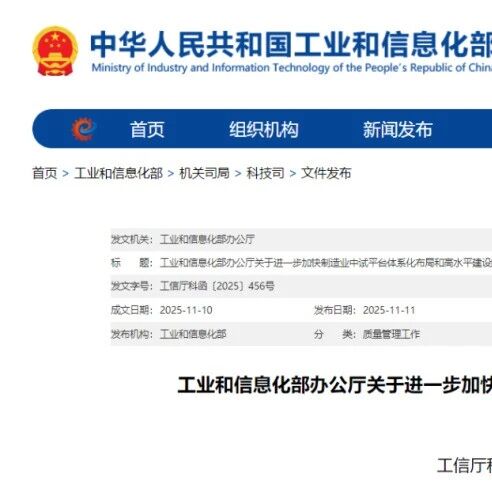
制造业中试平台“建什么、谁来建、怎么建”?
Zhong Guo Jing Ji Wang· 2025-11-13 05:52
Core Viewpoint - The Ministry of Industry and Information Technology has issued a notice to accelerate the systematic layout and high-level construction of manufacturing pilot test platforms, outlining what to build, who will build it, and how to build it [1] Group 1: Definition and Purpose - The pilot test platform serves as a carrier to provide pilot test services for samples transitioning from the trial production stage to the production process [1] Group 2: Key Areas of Construction - The manufacturing pilot test platform will focus on six key areas: raw materials industry, equipment manufacturing, consumer goods industry, information technology, emerging and future industries, and common needs, covering 37 industry key directions [2] Group 3: Stakeholders in Construction - The pilot test platforms can be constructed by various entities including government, universities, research institutions, and enterprises, with a tailored approach based on local conditions to enhance high-quality pilot test supply [3] Group 4: Construction Methodology - The development of pilot test platforms relies on the collaborative support of funding, technology, and talent. A systematic guarantee mechanism will be established from three aspects: investment, operation, and support, with increased policy supply and resource support for funding, land, and talent [4]
城市24小时 | 抢占又一万亿级市场 旅游大省“盯”上过客
Mei Ri Jing Ji Xin Wen· 2025-11-12 16:31
Core Insights - Yunnan province is actively promoting the "Travel to Yunnan" initiative, aiming to enhance the quality of life and develop a new growth blueprint for the travel industry [1][2] - The province has released a special development plan for "Travel to Yunnan" from 2025 to 2030, which includes the establishment of 26 pilot projects across 16 prefectures [1][3] - The travel industry in Yunnan is expected to significantly contribute to the local economy, with a projected 7 billion visitors and a total tourism expenditure of 1.14 trillion yuan in 2024 [3] Group 1: Development Plans and Initiatives - The "Travel to Yunnan" initiative focuses on nine key areas, including increasing farmers' income, promoting employment, and integrating industries [1] - The development plan proposes a comprehensive travel development framework consisting of "two axes, three belts, and six zones" to enhance regional tourism [1] - Yunnan aims to cultivate over 3,000 key rural travel villages by 2027 as part of its three-year action plan [2] Group 2: Economic Impact and Market Potential - In 2024, Yunnan is expected to receive 7 billion tourists, with tourism-related industries contributing over 7% to the regional GDP [3] - The local tourism consumption structure indicates that transportation and accommodation costs account for 70% of total spending, with a significant portion not remaining in the local economy [3] - The number of travelers in Yunnan reached 3.898 million in 2024, with a consumption scale exceeding 42.56 billion yuan, where over 60% of spending is on local services [3] Group 3: Competitive Landscape - Other provinces, such as Guizhou and Hainan, are also developing their own travel brands and initiatives to attract tourists, indicating increasing competition in the travel market [4] - The national travel market has a potential demand of 600 million visitors, with an overall market size expected to approach 3 trillion yuan [4]
城市24小时 | 抢占又一万亿级市场,旅游大省“盯”上过客
Mei Ri Jing Ji Xin Wen· 2025-11-12 16:11
Core Insights - Yunnan is promoting the "Travel to Yunnan" initiative to enhance the quality of life and develop the travel industry, with a focus on creating a replicable development model [1][2][3] - The province aims to attract 3,000 key rural travel villages by 2027, emphasizing the integration of culture and tourism [2][3] - Yunnan's tourism sector is projected to receive 700 million visitors in 2024, generating a total expenditure of 1.14 trillion yuan, with tourism-related industries contributing over 7% to the regional GDP [3] Summary by Sections Development Plans - The "Travel to Yunnan" high-quality development conference introduced the "Travel to Yunnan Development Special Plan (2025-2030)" and announced the first batch of 26 pilot projects across 16 prefectures [1] - The plan outlines a comprehensive travel development framework consisting of "two axes, three belts, and six zones" to promote differentiated and characteristic development [1] Market Potential - Yunnan's travel consumption structure indicates that traditional tourism models are insufficient to meet the diverse needs of visitors, with transportation costs historically accounting for about 40% of total spending [3] - In 2024, the number of travelers in Yunnan is expected to reach 3.898 million, with a consumption scale exceeding 42.56 billion yuan, where local spending on dining, accommodation, and entertainment exceeds 60% [3] Competitive Landscape - Other provinces, such as Guizhou and Hainan, are also developing their travel brands, indicating increasing competition in the travel market [4] - The national travel market has a potential demand of 600 million visitors, with an overall scale estimated to approach 3 trillion yuan, highlighting the competitive nature of retaining visitors [4]
中试平台迎利好!工信部发文,打通科技转化 “最后一公里”
Yang Zi Wan Bao Wang· 2025-11-12 12:34
Core Viewpoint - The Ministry of Industry and Information Technology (MIIT) has issued a notification aimed at accelerating the systematic layout and high-level construction of pilot test platforms in the manufacturing industry, facilitating the transformation of technology into practical applications, referred to as bridging the "last mile" of technology transfer [1][3]. Group 1: Notification Objectives - The notification focuses on advancing key tasks of new industrialization, with a goal to strengthen pilot test platforms by the end of 2027, establishing a modern pilot test platform system and forming a national manufacturing pilot test service network with multi-entity participation, multi-field layout, and multi-level services [3]. - Pilot testing is identified as a critical link between laboratory innovation and industrial production, with a reported success rate of over 80% for technology commercialization after pilot testing, compared to only 30% for those that do not undergo this process [3]. Group 2: Key Tasks - The notification outlines three main tasks: "strengthening a batch," "activating a batch," and "filling gaps in a batch." The approach emphasizes a tiered advancement strategy to guide pilot test platforms towards higher levels of development [3][4]. - In the "strengthening" aspect, the notification encourages the development of pilot test platforms through a structured path from reserve platforms to key cultivated platforms and ultimately to national-level pilot test platforms, aiming to build foundational, core, and backbone forces for the national manufacturing pilot test service network [3]. - The "activating" strategy focuses on targeted support and quality enhancement for pilot test platforms that possess public service attributes but require improvement in capabilities and effectiveness [4]. Group 3: Focus Areas for Development - The notification emphasizes the need to address key industry sectors such as artificial intelligence, humanoid robots, quantum technology, clean low-carbon hydrogen, biomedicine, major technical equipment, new materials, and information technology, which are crucial for future development and industrial security [4]. - Local industrial and information authorities are encouraged to select specific areas for development based on regional strengths, with priority given to pilot test platforms in these critical sectors for inclusion in the MIIT's key cultivation management [4]. - Additionally, the notification includes guidelines for the construction of manufacturing pilot test platforms and key direction points for 2025, aimed at assisting localities in establishing urgently needed pilot test platforms across six key areas and 37 industry focus directions [4].