
加息与降息

Search documents
多资产年度复盘:“贵金属狂欢”与“AI质疑”交织的宏观大年(下)
Xin Lang Cai Jing· 2026-01-13 14:00
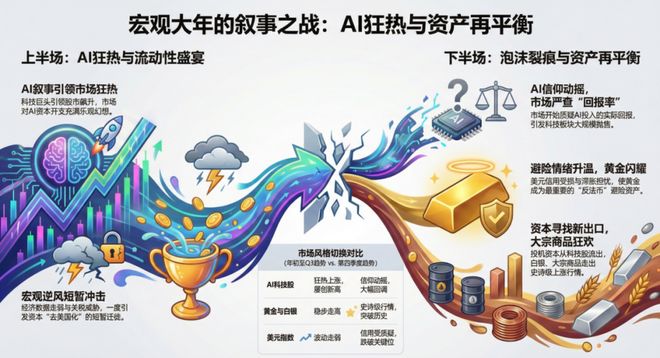
Group 1 - The global capital markets experienced significant narrative shifts throughout the year, moving from blind bets on "Trump economics" to skepticism about AI capital returns, reflecting a journey from the disillusionment of "American exceptionalism" to the turbulence of "asset rebalancing" [1] - The third quarter showcased market volatility, with a divergence between speculative enthusiasm for tech stocks and a flight to safety in gold and bonds, indicating a dual-track economy [1] - In July, despite strong non-farm payroll data, the stock market rebounded led by AI leaders, as investor sensitivity to tariff risks diminished following trade agreements between Trump and the EU and Japan [3] Group 2 - In August, a significant downward revision of U.S. non-farm data unexpectedly catalyzed a new market rally, as it suggested the Federal Reserve might accelerate rate cuts [4][5] - Powell's speech at the Jackson Hole meeting opened the door for more monetary stimulus, leading to a surge in risk assets, particularly in the AI sector, with major tech stocks seeing substantial price increases [5] - By September, the Federal Reserve initiated a rate-cutting cycle, which was characterized as "preventive" rather than typical "recessionary," aimed at stimulating growth amid rapid AI development [6] Group 3 - The fourth quarter revealed cracks in the AI bubble, with investors shifting focus from tech hype to actual earnings, as the performance of major tech companies faced reevaluation [7] - In October, discussions about potential AI bubbles intensified, compounded by government shutdown fears and trade tensions, leading to increased market volatility [9] - November marked a significant downturn for tech stocks, particularly for Nvidia and Meta, as investor scrutiny of AI profitability intensified, revealing concerns over high valuations and competitive pressures [11] Group 4 - By December, the market landscape shifted again, with silver prices experiencing a historic surge amid ongoing monetary policy easing, reflecting heightened investor concerns over global inflation [12] - The yield curve steepened as inflation expectations rose, with the 30-year U.S. Treasury yield returning to early-year highs, indicating significant market volatility driven by inflation and Fed policy tightening expectations [12]


澳洲联储主席Bullock:仍预计核心通胀率将缓慢降至2.5%。全球经济仍面临不确定性和不可预测性。月度数据表明核心CPI可能没有达到预期。寻求数据支持核心通胀预期。鉴于CPI大幅回落,失业率仅小幅上升的情形令人震惊。委员会寻求审慎、渐进的宽松路径。澳洲联储加息幅度小于其他央行,可能不需要那么多降息。劳动力市场仍然吃紧,到年底可能会有所缓解。领先指标并未表明失业率大幅上升。
news flash· 2025-07-24 03:13
Core Viewpoint - The Reserve Bank of Australia (RBA) Chairman Bullock expects core inflation to gradually decline to 2.5% despite ongoing global economic uncertainties and unpredictability [1] Economic Indicators - Monthly data suggests that core Consumer Price Index (CPI) may not meet expectations [1] - A significant drop in CPI alongside only a slight increase in unemployment rate is surprising [1] Monetary Policy - The committee is seeking a cautious and gradual path for monetary easing [1] - The RBA's rate hikes have been smaller compared to other central banks, indicating that extensive rate cuts may not be necessary [1] Labor Market - The labor market remains tight, with expectations of some easing by the end of the year [1] - Leading indicators do not suggest a significant rise in the unemployment rate [1]