
核心通胀率

Search documents
欧元区1月通胀率降至1.7%,创16个月新低
Shang Wu Bu Wang Zhan· 2026-02-27 16:11
Core Insights - The Eurozone's annual inflation rate decreased from 2.0% in December to 1.7% in January, marking the lowest level in nearly 16 months [1] - The Euro strengthened significantly, with the exchange rate against the US dollar surpassing 1.2, reaching a four-year high [1] Inflation Breakdown - The annual inflation rate for services slowed from 3.4% to 3.2% [1] - Prices for processed food, alcohol, and tobacco decreased slightly from 2.1% to 2.0% [1] - Energy prices fell by 4.0%, a larger decline compared to the 1.9% drop in December [1] - In contrast, the price increase for unprocessed food rose to 4.2%, while non-energy industrial goods saw a slight increase of 0.4% [1] Core Inflation - The core inflation rate, excluding volatile items like energy and food, dropped to 2.2%, the lowest level since October 2021 [1] Country-Specific Data - France's harmonized consumer price index decreased from 0.7% to 0.4% [1] - Spain's inflation rate fell from 3.0% to 2.4% [1] - Italy's inflation rate decreased from 1.2% to 1.0% [1] - Germany's inflation rate slightly increased from 2.0% to 2.1% [1] Highest and Lowest Inflation Rates - Romania recorded the highest annual inflation rate at 8.5% [1] - Slovakia and Estonia had inflation rates of 4.3% and 3.8%, respectively [1] - France had the lowest inflation rate at 0.4%, followed by Denmark at 0.6%, and both Finland and Italy at 1.0% [1]
荷兰国际:本周一系列日本经济数据料展现积极信号 3月会议得以维持利率不变
Jin Rong Jie· 2026-02-23 01:01
Core Viewpoint - The recent economic activity data from Japan is expected to signal positive momentum for the economy in the early months of 2026, despite the fourth quarter GDP growth falling short of expectations [1] Group 1: Economic Activity - The Dutch International Group anticipates a strong rebound in monthly economic activity data, driven by fiscal spending and substantial winter bonuses [1] - Industrial production and retail sales are predicted to show significant growth in January [1] Group 2: Inflation Trends - Tokyo's consumer inflation, a leading indicator of national trends, is likely to slow further due to declining energy, utility, and food prices [1] - The core inflation rate, excluding fresh food, is expected to drop below 2%, which may allow the Bank of Japan to maintain the current interest rate of 0.75% in the March meeting [1]
路透调查:日本1月核心通胀率可能连续第二个月放缓
Sou Hu Cai Jing· 2026-02-13 05:40
Core Insights - Japan's core consumer inflation rate is expected to slow for the second consecutive month in January due to declining gasoline costs and a slowdown in food price increases [1] - The nationwide core consumer price index (CPI), which includes energy but excludes fresh food prices, is projected to rise by 2.0% year-on-year in January, matching the increase expected in January 2024 [1] - In December, the core CPI rose by 2.4% year-on-year, indicating a persistent inflation trend [1] - Core consumer inflation has remained above the central bank's 2% target for nearly four years as companies continue to pass rising raw material costs onto consumers [1]
通胀连续十月告负 泰国1月CPI下降0.66%
Sou Hu Cai Jing· 2026-02-05 04:55
Core Viewpoint - Thailand's inflation rate has remained in negative territory for the tenth consecutive month due to declining global oil prices and government cost-of-living subsidies, marking the longest period of price decline since the pandemic [1] Inflation Data - In January, the Consumer Price Index (CPI) decreased by 0.66% year-on-year, surpassing economists' average forecast [1] - Month-on-month, prices fell by 0.28%, also below market expectations [1] - The core inflation rate, excluding volatile energy and fresh food prices, rose by 0.6% year-on-year, aligning with previous predictions [1] Future Outlook - The Deputy Director of the Department of Trade Policy and Strategy, Natiya Suchinda, indicated that consumer prices are expected to continue easing in the first quarter due to low global oil prices and government subsidies on electricity and fuel [1] - It is anticipated that inflation will shift to "slight positive growth" in the second quarter [1] - The Ministry of Commerce maintains its overall inflation forecast for the year at between 0% and 1% [1]
2026年贵金属相对价值前景展望
Qi Huo Ri Bao· 2026-02-04 03:48
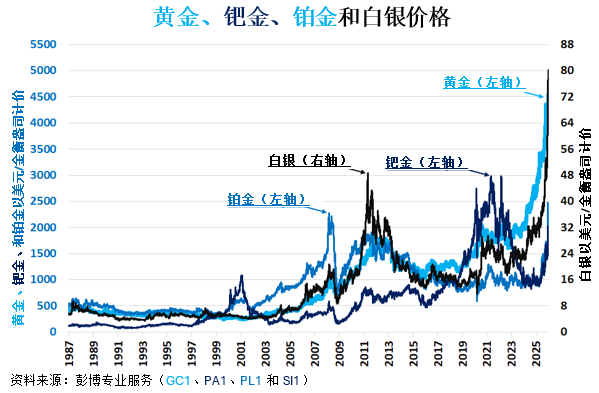
Core Insights - Precious metal prices have seen a significant upward trend from the end of 2025 into early 2026, with gold surpassing $4,500 per ounce, silver exceeding $80 per ounce, and platinum reaching its highest level since 2007 [1] - The performance of these metals from the end of 2024 to January 6 shows gold up 65%, palladium up 95%, platinum up 150%, and silver up 170%, indicating a strong recovery for metals that had previously lagged behind gold [4] - The silver-to-gold ratio has dropped to its lowest level since 2013, suggesting a shift in relative value between these two metals [4] Precious Metals Performance - Gold's performance has been relatively weaker compared to other metals, likely due to its prior significant gains from 2000 to the end of 2024, where it rose 73% [4] - Silver's recent surge may reflect its higher beta attribute, leading to more pronounced price movements in response to gold's fluctuations [6] - The decline in silver's traditional uses, such as photography, has been offset by new demand from batteries and solar panels, contributing to its price increase [9] Platinum and Palladium Analysis - Despite recent rebounds, platinum prices remain at historical lows compared to gold and silver, with gold now nearly twice the price of platinum [13] - Palladium has seen two historical price surges due to supply constraints, but its current price is also at a historical low relative to gold and silver [15] - The demand for palladium is declining as electric vehicle market share increases, which may impact its future pricing [13] Market Size and Economic Value - In 2025, global mining output was 818 million ounces of silver, 95 million ounces of gold, 6.4 million ounces of palladium, and 5.5 million ounces of platinum, indicating a significant disparity in market size [17] - The economic value of gold mining output is approximately 6.5 times that of silver and 35 times that of platinum and palladium, suggesting that even a small shift in investment from gold to other metals could significantly impact their prices [20] Macroeconomic Outlook for 2026 - Several macroeconomic factors are driving gold prices higher, including core inflation rates exceeding central bank targets, large budget deficits in major economies, and ongoing geopolitical tensions [23][25][26] - Investors should monitor core inflation rates closely, as sustained high rates without corresponding tightening from central banks could lead to increased demand for precious metals [26] - The global fiscal landscape is expected to remain supportive of precious metals, with many countries maintaining large budget deficits and implementing expansionary fiscal policies [27]

澳大利亚核心通胀率居高不下,加息可能性依然存在
Jin Rong Jie· 2026-01-28 01:12
Core Insights - Australia's core inflation rate remains high, indicating that price pressures are not cooling as expected, which may lead the Reserve Bank of Australia to consider raising interest rates this year [1] Inflation Data - In the fourth quarter, the Consumer Price Index (CPI) excluding volatile items increased by 0.9% on a quarter-on-quarter basis, aligning with economists' expectations [1] - Year-on-year, this CPI measure rose by 3.4%, surpassing the previous forecast of a 3.3% increase and exceeding the Reserve Bank of Australia's target range of 2-3% [1]
新加坡元兑美元汇率升至逾11年来最高水平
Xin Lang Cai Jing· 2026-01-26 02:41
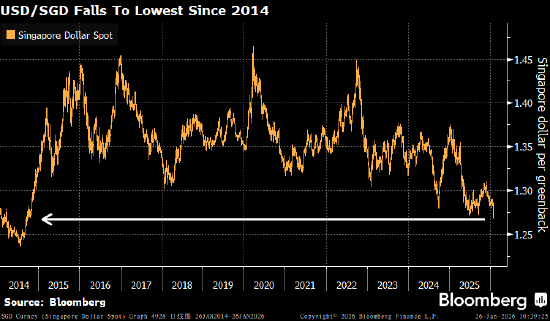
Group 1 - The Singapore dollar has risen to its highest level against the US dollar since October 2014, driven by safe-haven inflows [1][3] - The Singapore dollar increased by over 0.4% to 1.2680, as market speculation suggests potential US intervention in the Japanese foreign exchange market, putting pressure on the dollar [1][3] - The Monetary Authority of Singapore (MAS) is expected to maintain its policy unchanged during the upcoming meeting, as core inflation remains stable [1][3] Group 2 - MAS focuses on the nominal effective exchange rate (S$NEER) rather than interest rates as its primary policy tool, allowing it to fluctuate within a policy band [1][3] - Singapore has attracted numerous investors due to its high-dividend stock market, AAA-rated bonds, and relatively stable government policies [1][3] - The Straits Times Index is currently at a historical high, and the Singapore dollar has appreciated approximately 6% over the past 12 months [1][3]
希腊通胀率升至2.9%
Shang Wu Bu Wang Zhan· 2026-01-20 17:21
Group 1 - Greece's inflation rate rose to 2.9% in December, up from 2.8% in November, marking a rebound after two consecutive months of decline [1] - The Eurozone consumer price index (CPI) decreased slightly to 2% from 2.1% [1] - The core inflation rate in the Eurozone, excluding volatile items such as energy, food, alcohol, and tobacco, fell to 2.3%, while Greece's core inflation rate stood at 3.2% [1]
美12月通胀率维持在2.7%,高物价持续给多数美国人带来压力
Xin Lang Cai Jing· 2026-01-13 14:53
Core Insights - The December Consumer Price Index (CPI) in the U.S. showed a year-on-year increase of 2.7%, indicating slight improvement in inflation levels, but high prices continue to burden consumers [3][9] - The month-on-month inflation rate accelerated from an estimated 0.1% in November to 0.3% in December, although November's data was affected by a government shutdown that distorted the CPI report [10][12] Summary by Category Overall Inflation - The overall inflation rate for December remained steady compared to November, with a year-on-year increase of 2.7% [3][9] - The month-on-month increase in December was 0.3%, up from the previously estimated 0.1% for November [10] Core Inflation - Economists had anticipated a month-on-month increase of 0.3% for the core CPI, with a slight year-on-year rise to 2.6% [12] - The actual report indicated that the core CPI rose by only 0.2% month-on-month, while the year-on-year increase reached 2.7% [6][12] Future Outlook - Projections suggest that by the end of 2025, the U.S. inflation rate will still be above normal levels, but the overall CPI data indicates some progress in inflation control, with December's rates lower than those in January [6][12]

欧元区2025年12月通胀率初步降至2%
Shang Wu Bu Wang Zhan· 2026-01-12 16:54
Core Insights - The Eurozone's annual inflation rate for December 2025 decreased from 2.1% in November to 2% [1] - Service prices increased by 3.4% year-on-year, while energy prices saw a decline of 1.9% [1] - Food, alcoholic beverages, and tobacco prices rose by 2.6%, and non-energy industrial goods prices increased by 0.4% [1] Inflation Trends - The core inflation rate, excluding energy and food prices, fell from 2.4% in November to 2.3% in December 2025 [2] - Among major Eurozone economies, Germany's annual inflation rate decreased from 2.6% to 2%, while France's rate slightly increased from 0.7% to 0.8% [2] - Italy's annual inflation rate rose from 1.1% to 1.2%, and Spain's rate decreased from 3.2% to 3.0% [2] Country-Specific Data - Slovakia and Estonia recorded the highest annual inflation rates in the Eurozone at 4.1% each, while Cyprus had the lowest at 0.1% [2]