区域经济均衡

Search documents
离职率连续三年下滑,职场人的跳槽热情降温了?
第一财经· 2026-01-13 09:54
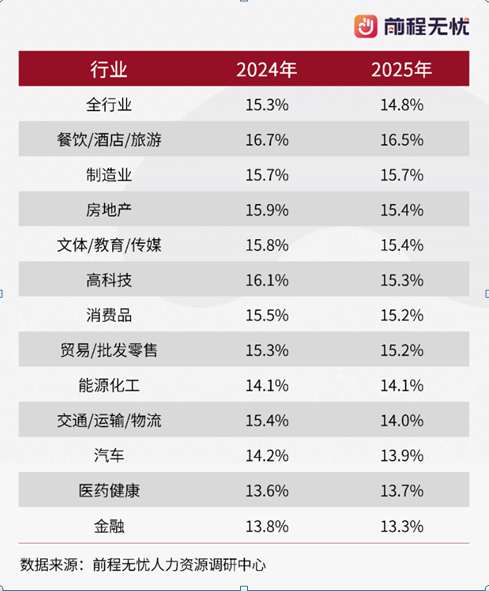
Core Viewpoint - The overall employee turnover rate in China decreased to 14.8% in 2025, reflecting a trend of job stability influenced by macroeconomic conditions, industry adjustments, and changing employment attitudes [3][4]. Group 1: Employee Turnover Rates - The turnover rate in the restaurant/hotel/tourism industry remains the highest at 16.5%, despite a slight decrease of 0.2 percentage points from 2024 [4][6]. - The manufacturing industry also has a turnover rate of 15.7%, which is linked to pressures from carbon neutrality goals and digital transformation, leading to adjustments in frontline worker positions [4][6]. - The real estate sector's turnover rate decreased to 15.4% from 15.9% in 2024, indicating ongoing personnel optimization amid deep industry adjustments [5][6]. Group 2: Industry Comparisons - The transportation/logistics sector saw the most significant decline in turnover rate, dropping 1.4 percentage points to 14.0%, suggesting a more stable employment ecosystem due to mature logistics systems and flexible labor models [5][6]. - Other industries such as high-tech and consumer goods also experienced slight decreases in turnover rates, with high-tech dropping to 15.3% and consumer goods to 15.2% [6]. Group 3: Regional Talent Mobility - The gap in turnover rates between first-tier cities and new first-tier cities is narrowing, with new first-tier cities becoming attractive destinations for talent due to industrial upgrades and lower living costs [7]. - The trend indicates a shift in employment choices among younger individuals, who are increasingly valuing work-life balance and sustainable career development over traditional aspirations of moving to first-tier cities [7]. Group 4: Implications for Employers - The trend towards lower turnover rates suggests a need for companies to optimize HR strategies, focusing on internal talent development rather than external recruitment [7]. - Employers are encouraged to balance efficiency with employee well-being to foster a more engaged workforce during this period of stability [7].


离职率连续三年下滑 职场人的跳槽热情降温了?
Di Yi Cai Jing· 2026-01-13 08:28
Core Insights - The overall employee turnover rate in China decreased to 14.8% in 2025, marking a 0.5 percentage point decline from 2024, continuing a three-year trend of gradual decrease [1] Industry Analysis - The hospitality and tourism sector has the highest turnover rate at 16.5%, despite a slight decrease of 0.2 percentage points from 2024, indicating persistent issues with employee turnover [1] - The manufacturing sector follows with a turnover rate of 15.7%, influenced by pressures from dual carbon goals and digital transformation, leading to adjustments in frontline worker positions [2] - The real estate sector's turnover rate decreased to 15.4% from 15.9% in 2024, reflecting ongoing personnel optimization amid deep industry adjustments [2] - In contrast, the transportation and logistics sector saw a significant decline in turnover rate by 1.4 percentage points to 14.0%, suggesting a more stable employment ecosystem due to mature logistics systems and flexible employment models [2] Regional Trends - The turnover rate gap between first-tier cities and new first-tier cities is narrowing, indicating a shift in talent flow dynamics, with new first-tier cities becoming attractive destinations due to industrial upgrades and lower living costs [2] - Cities like Chengdu are emerging as talent hubs, particularly in the electronic information industry, attracting a significant influx of skilled workers [2] Labor Market Dynamics - The labor market in China is transitioning towards a "stability-oriented" model, prompting companies to optimize HR strategies to address potential challenges [3] - The decrease in turnover rates, while positive, highlights the need for employers to balance efficiency with employee well-being for long-term success [3]
离职率连续三年下滑,职场人的跳槽热情降温了?
Di Yi Cai Jing· 2026-01-13 08:18
Core Insights - The "risk aversion" mentality is leading employees to prefer staying in their current positions rather than seeking new opportunities, as evidenced by a decline in the overall employee turnover rate to 14.8% in 2025, down 0.5 percentage points from 2024, marking a three-year trend of gradual decrease [1][2]. Industry Analysis - The hospitality and tourism sector has the highest turnover rate at 16.5%, despite a slight decrease of 0.2 percentage points from 2024, indicating persistent issues with employee turnover [1][3]. - The manufacturing sector maintains a turnover rate of 15.7%, influenced by pressures from dual carbon goals and digital transformation, which are causing adjustments in frontline worker positions [2][3]. - The real estate sector's turnover rate has decreased to 15.4% from 15.9% in 2024, reflecting ongoing personnel optimization amid industry adjustments [2][3]. - In contrast, the transportation and logistics sector has seen a significant decline in turnover rate to 14.0%, down 1.4 percentage points from 2024, suggesting a more stable employment ecosystem due to the maturation of logistics systems and flexible employment models [2][3]. Regional Trends - The turnover rate gap between first-tier cities and new first-tier cities is narrowing, indicating a shift in talent flow dynamics, with new first-tier cities becoming attractive destinations for talent due to industrial upgrades and lower living costs [3][4]. - The balance between salary competitiveness, industrial foundation, and quality of life in new first-tier cities is changing employment choices, as more young people prioritize work-life balance and sustainable career development over solely targeting first-tier cities [4]. Labor Market Dynamics - The labor market in China is transitioning towards a "stability-oriented" model, prompting companies to optimize HR strategies to address potential challenges, emphasizing the need for a balance between efficiency and employee well-being [4].