
医保新政

Search documents
帮主郑重收评:三万亿成交撑场,光伏航天领涨,下周走势这样看
Sou Hu Cai Jing· 2026-01-23 08:13
Core Viewpoint - The A-share market is experiencing a "stable index, crazy individual stocks" pattern, with nearly 3,900 stocks rising, indicating a strong underlying logic behind the market movements [1] Group 1: Market Performance - The opening of the market showed clear signals with the photovoltaic and commercial aerospace sectors igniting the rally, leading to over 20 stocks hitting the daily limit up [3] - The main reason for the surge in the photovoltaic sector is the continuous increase in component prices, with mainstream transaction prices rising significantly over the past two weeks [3] - In the commercial aerospace sector, nearly 30 stocks surged following the announcement of a ten-year industrial plan for a national commercial aerospace launch base in Jiuquan [3] Group 2: Sector Analysis - The photovoltaic sector is supported by rising prices and guidance from leading companies, while commercial aerospace benefits from strong policy support and industrial upgrades [3] - Concerns about declines in insurance and oil & gas sectors are deemed unnecessary, as the market's trading volume exceeded 30 trillion, indicating sufficient liquidity to support the market [3] Group 3: Future Outlook - The market is expected to remain in a high-level oscillation pattern, with the Shanghai Composite Index likely fluctuating between 4,080 and 4,200 points [4] - Short-term corrections in the photovoltaic and commercial aerospace sectors may occur, but the long-term logic remains intact, providing buying opportunities for long-term investors [4] - Other sectors to watch include silicon photonics and CPO related to AI computing power, as well as medical devices benefiting from new healthcare policies, all supported by policy and technological backing [4]


淋巴瘤创新药“医保新政”落地,全病程保障为患者生命续航
Qi Lu Wan Bao· 2026-01-16 09:30
Core Insights - The implementation of the 2025 National Basic Medical Insurance Drug List on January 1, 2026, includes innovative drugs for lymphoma, particularly bispecific antibody drugs, marking a significant advancement in the treatment landscape for lymphoma patients [1][3]. Group 1: Lymphoma Treatment Landscape - The incidence of lymphoma is rising due to improved diagnostic capabilities and an aging population, with approximately 100,000 new cases reported annually in China [3]. - The five-year survival rate for lymphoma patients in China is about 40%, which lags behind that of Western countries, partly due to limited access to innovative drugs [3]. - The establishment of specialized lymphoma centers is being promoted nationwide to enhance diagnostic precision and treatment outcomes [3]. Group 2: Innovative Drug Developments - Recent advancements in lymphoma treatment include the emergence of monoclonal antibodies, bispecific antibodies, antibody-drug conjugates (ADCs), and small molecule targeted therapies [3]. - The introduction of the new medical insurance policy is expected to accelerate the integration of innovative drugs into clinical practice, aligning China's treatment standards more closely with international benchmarks [3]. Group 3: Specific Drug Insights - Among various lymphoma subtypes, diffuse large B-cell lymphoma (DLBCL) is the most prevalent, accounting for about 50% of hospitalized patients in specialized centers [4]. - Approximately 30%-40% of DLBCL patients may progress to relapsed or refractory disease, which poses significant treatment challenges and increases healthcare costs [4]. - The bispecific antibody drug, Gefitinib, is now included in the National Basic Medical Insurance Drug List, providing new treatment options for patients with relapsed/refractory DLBCL [4][5]. Group 4: Financial Impact of Insurance Coverage - The inclusion of innovative drugs in the insurance list significantly reduces treatment costs; for instance, the ADC drug, Vebotuzumab, saw an 80% reduction in treatment expenses after being added to the insurance list [8]. - Patients previously deterred by high costs can now access innovative treatments, improving their chances of survival [8]. Group 5: Regional Healthcare Initiatives - The establishment of regional medical alliances aims to ensure that advanced treatments are accessible locally, promoting the goal of providing high-quality care without the need for patients to travel far [9]. - The 2025 National Medical Insurance Drug List added 114 new drugs, with 50 being innovative drugs, particularly benefiting the oncology sector [9].

贵州推出医保新政支持生育
Xin Lang Cai Jing· 2026-01-09 19:44
Core Viewpoint - The new policy aims to enhance maternity insurance coverage and standardize benefits for both employed and unemployed spouses of male workers in Guizhou Province, effective from January 1, 2026 [1] Group 1: Policy Enhancements - The policy specifies that male workers participating in urban and rural resident basic medical insurance will have their unemployed spouses' maternity medical expenses covered at the same rate as insured female workers [1] - For male workers not participating in basic medical insurance, their unemployed spouses will receive maternity medical expenses at 50% of the insured female workers' rate [1] Group 2: Maternity Benefits Standardization - The unified conditions for maternity benefits state that insured employees must have paid employee medical insurance for a continuous period of 12 months before childbirth or termination of pregnancy [1] - The policy establishes a standard for unemployed individuals receiving the same maternity insurance benefits as employed workers, including maternity medical and maternity allowance [1] Group 3: Management and Service Optimization - The policy mandates direct payment of maternity allowances to individuals, ensuring that maternity allowances are distributed directly to employees across the province [1] - It clarifies the time limits for claiming maternity allowances, allowing female employees to receive monthly payments during maternity leave or a lump sum after the leave ends [1] - The policy promotes the inclusion of maternity medical expenses in payment method reforms [1] Group 4: Transitional Periods - Areas with existing continuous payment durations that differ from the new policy will have a transitional period, with specific durations set for various cities, such as a maximum of 6 months for Guiyang, Zunyi, Liupanshui, and Tongren, and up to 11 months for Bijie, Qiannan, and Anshun [2]
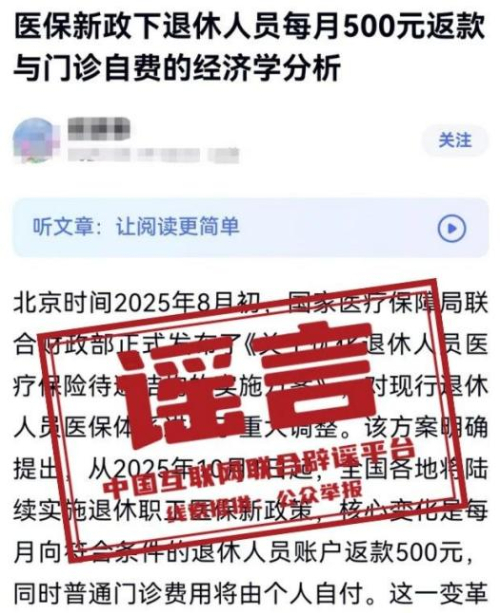
“医保新政下退休人员每月500元返款”?官方:谣言!
Qi Lu Wan Bao Wang· 2025-08-27 00:02
Core Points - A recent article claimed that a new medical insurance policy for retirees would be implemented in China, providing a monthly refund of 500 yuan and requiring individuals to cover outpatient expenses [1] - The National Healthcare Security Administration and the Ministry of Finance have confirmed that no such document or policy has been released, labeling the claims as rumors [1] Summary by Category - **Policy Announcement** - The article suggested that a significant adjustment to the current medical insurance system for retirees would take place starting October 1, 2025, with a monthly refund of 500 yuan for eligible retirees [1] - **Verification and Response** - Relevant authorities conducted a verification process and found that the claims regarding the new policy were unfounded, emphasizing that no official announcement had been made [1]
医保局明确下半年重点:创新药、长护险新政来了
Di Yi Cai Jing· 2025-08-19 08:43
Group 1: Healthcare Policy Focus - The core focus of healthcare policy in the second half of the year includes the development of medical institutions, innovation in the pharmaceutical industry, comprehensive implementation of long-term care insurance, and expansion of maternity insurance [1] - The meeting emphasized a shift in the healthcare system from "passive payment" to "active empowerment" and from "disease compensation" to "health investment" [1] - A series of new healthcare policies will be initiated or implemented, including the establishment of a commercial insurance innovative drug directory and the launch of the 3.0 version of the disease-based payment grouping scheme [1] Group 2: Drug Pricing and Innovation - The National Healthcare Security Administration announced a list of 534 drugs that passed the basic medical insurance directory review and 121 drugs that passed the commercial insurance innovative drug directory review [2] - The establishment of the commercial insurance innovative drug directory allows for the inclusion of high-innovation drugs that meet unmet needs and have confirmed clinical value, facilitating their entry into hospitals [2] - The policy aims to improve drug accessibility by not including these drugs in the basic medical insurance self-payment rate indicators and the monitoring scope of alternative drugs in centralized procurement [2] Group 3: Payment and Care Models - The meeting called for the initiation of the 3.0 version of the disease-based payment grouping scheme to enhance the quality and efficiency of medical institutions [3] - As of June, over 90% of coordinated areas in the country achieved instant settlement for medical insurance, with payment timelines reduced to within 20 working days after application [3] - The long-term care insurance, referred to as the "sixth insurance," will be fully implemented in the second half of the year, with a focus on planning and supporting long-term care service institutions [3] Group 4: Maternity Insurance Expansion - The maternity insurance system will undergo upgrades and expansions, encouraging the inclusion of flexible employment personnel, migrant workers, and new employment forms into the coverage [4] - As of now, the number of people covered by maternity insurance has reached 253 million, with maternity insurance benefit expenditures amounting to 67.832 billion yuan in the first half of the year [4] - Five provinces have achieved full coverage of hospitalization costs for childbirth within the policy scope, and 18 provinces have fully implemented direct payment of maternity allowances to insured individuals [4]