千亿县

Search documents
广东的“县域短板”,博罗之后如何再造“千亿县”?
经济观察报· 2026-02-03 12:15
Core Viewpoint - The emergence of Bo Luo County as Guangdong's first "billion county" signifies a shift in the province's development model, placing greater emphasis on county-level economic growth alongside urban development [2][3]. Economic Milestones - Bo Luo County's GDP is projected to exceed 100 billion yuan by 2025, marking a significant milestone for Guangdong, which has historically lacked representation in the "billion county club" [2]. - The number of "billion counties" in China has increased to 62 by 2024, with notable examples from Jiangsu Province, where some counties have GDPs exceeding 500 billion yuan [2]. County Economic Dynamics - The lack of "billion counties" in Guangdong has been attributed to a focus on urban centers like Shenzhen and Guangzhou, leading to a disparity in county-level economic development [2][6]. - The administrative evolution in the Pearl River Delta has resulted in the transformation of many economically strong counties into districts, impacting the county economic landscape [5][6]. Development Strategies - Bo Luo County has shifted from a fragmented industrial approach to a systematic development strategy, focusing on key industries and establishing industrial parks to enhance competitiveness [10][13]. - The county has successfully developed eight industrial clusters, including new-generation electronic information and intelligent equipment manufacturing, aligning with national strategic directions [10][13]. Regional Collaboration - Bo Luo County's integration with Huizhou's urban area has facilitated infrastructure connectivity and collaborative development, enhancing its economic dynamism [10][13]. - The "Hundred Counties, Thousand Towns, and Ten Thousand Villages High-Quality Development Project" aims to address urban-rural disparities and promote balanced regional development [6][12]. Future Prospects - Other counties in Guangdong, such as Hui Dong and Zhaoqing, are on track to achieve "billion county" status, indicating a potential trend in county-level economic growth [7][14]. - The experiences of Jiangsu and Zhejiang provinces in county economic development may provide valuable insights for Guangdong in cultivating more competitive counties [14][15].


广东的“县域短板”,博罗之后如何再造“千亿县”?
Jing Ji Guan Cha Wang· 2026-02-02 09:38
Core Insights - Huizhou's Boro County is set to become Guangdong's first "trillion county" by 2025, marking a significant milestone for the province and ending its absence from the "trillion county club" [1][2] - The emergence of "trillion counties" reflects a shift in economic focus towards county-level development, which is increasingly recognized as vital for regional economic dynamics [2] Economic Landscape - As of 2024, there are 62 "trillion counties" in China, with Jiangsu's Kunshan and Jiangyin exceeding 500 billion in GDP, showcasing their role as economic engines [1] - Guangdong has historically concentrated economic growth in cities like Shenzhen and Guangzhou, lacking strong county-level economies [1][3] Administrative and Geographical Factors - Guangdong's unique administrative evolution, particularly in the Pearl River Delta, has led to a scarcity of "trillion counties" as many economically strong counties have been restructured into districts [3][4] - The economic disparity between the Pearl River Delta and other regions in Guangdong is evident, with the former accounting for over 80% of the province's economic output [4] Development Initiatives - The "Hundred Counties, Thousand Towns, and Ten Thousand Villages High-Quality Development Project" was launched to address urban-rural imbalances and promote county-level economic growth [4] - From 2023 to 2025, 57 counties in Guangdong are expected to see GDP growth rates surpassing the provincial average, indicating a positive trend in county-level economic development [4] Boro County's Economic Growth - Boro County's GDP has seen significant growth, surpassing 700 million in 2021, 800 million in 2022, and projected to exceed 1 billion by 2025 [6] - The county has shifted from a fragmented industrial approach to a more systematic layout, focusing on developing a trillion-level smart equipment industry park [6][7] Industrial Strategy - Boro County has implemented an "eight ones" industrial chain mechanism to enhance the precision of its investment strategies and has established a "four ones" park development model to improve efficiency [7] - The county has successfully developed eight hundred billion-level industrial clusters, focusing on modern industries such as electronic information and new energy [7][8] Lessons for Other Counties - Boro's experience serves as a model for other counties in Guangdong, emphasizing the importance of concentrated industrial development and collaboration within the regional economic framework [8][9] - The county's integration into the Guangdong-Hong Kong-Macao Greater Bay Area has facilitated industrial transfer and collaboration, enhancing its economic capabilities [8] Comparative Insights - The development paths of Jiangsu and Zhejiang provinces, which have the highest number of "trillion counties," offer valuable lessons for Guangdong, particularly in terms of administrative efficiency and fostering local industries [10] - The emphasis on private and small enterprises in Jiangsu and Zhejiang highlights the potential for Guangdong to enhance its economic vitality through similar support mechanisms [10]
最新百强县出炉,昆山、江阴、张家港位列前三
21世纪经济报道· 2025-07-26 09:18
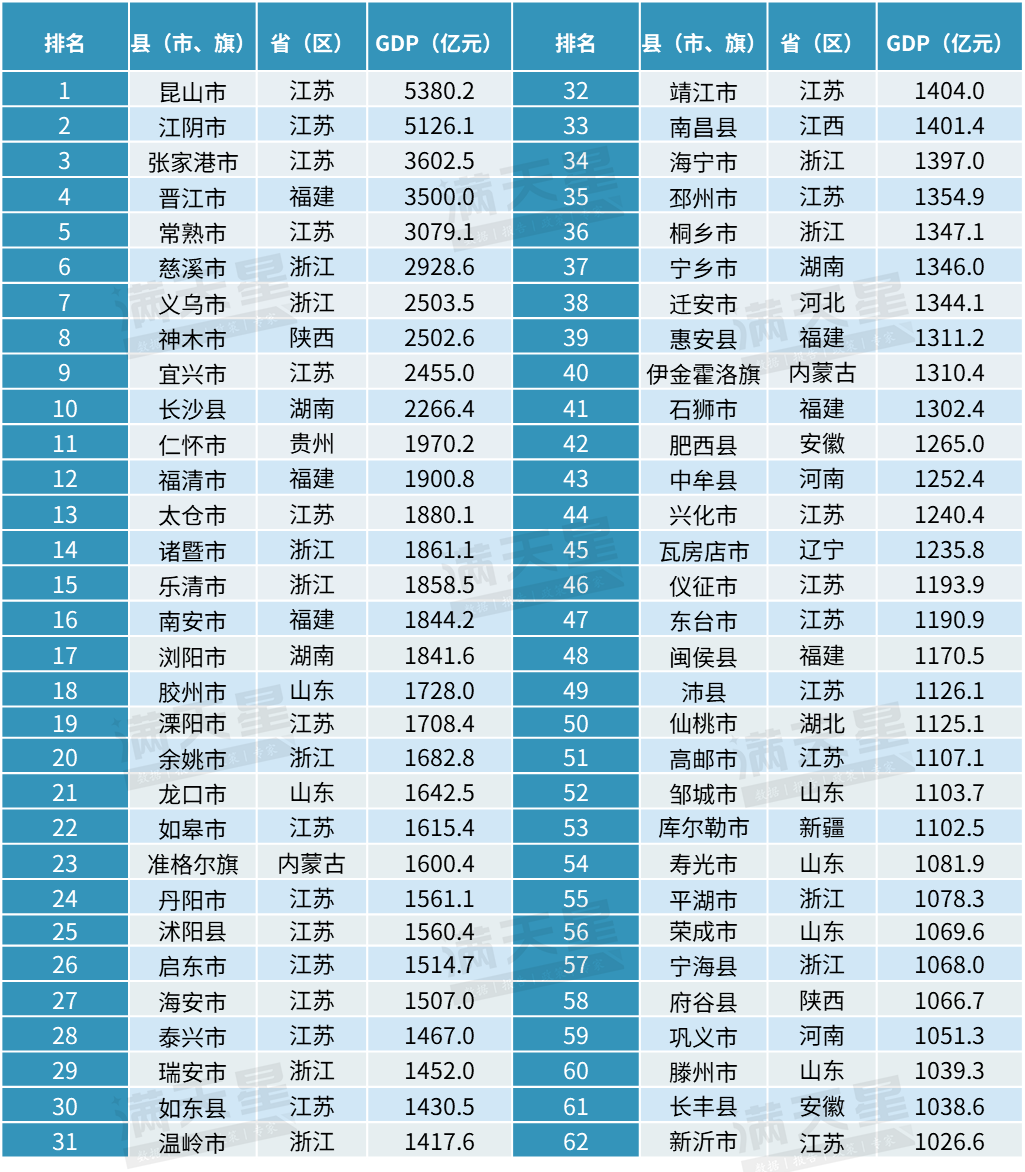
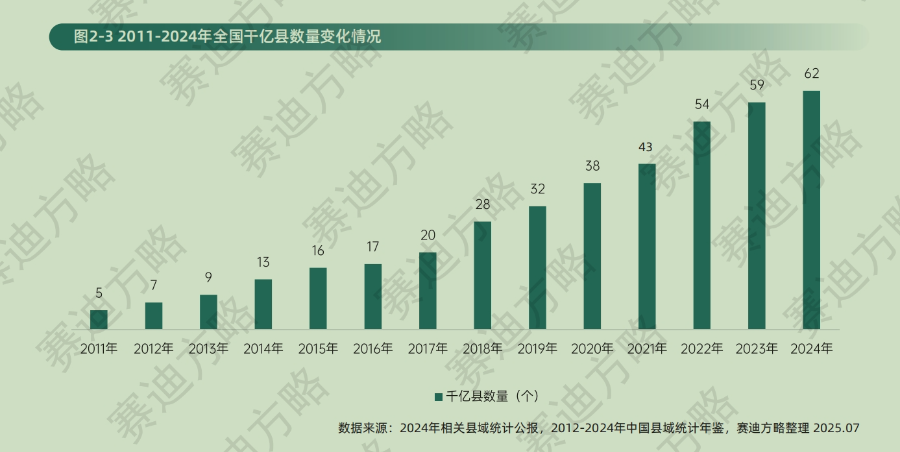
Core Viewpoint - The "Thousand Billion Counties" in China are expected to increase to 62 by 2024, with a total GDP of 10.6 trillion yuan, indicating a significant growth in county-level economies [1][6]. Group 1: Economic Growth and Performance - By 2024, the total number of "Thousand Billion Counties" will reach 62, up from 59 in 2023 and 54 in 2022, showcasing a consistent growth trend [6][10]. - Among the 62 "Thousand Billion Counties," Kunshan and Jiangyin have GDPs exceeding 500 billion yuan, while Zhangjiagang, Jinjiang, and Changshu have GDPs over 300 billion yuan [8][10]. - Over 70% of "Thousand Billion Counties" are projected to have GDP growth rates surpassing the national average, with 12 counties achieving nominal growth rates over 10% [10]. Group 2: Distribution of Strong Counties - The "2025 Saidi Top 100 Counties" report highlights that Jiangsu, Zhejiang, and Shandong provinces excel, occupying 25, 15, and 12 seats respectively [10][12]. - Jiangsu province dominates the top 10 rankings, holding 6 positions and securing the top 3 spots [10][12]. Group 3: Characteristics of "Super Strong Counties" - As of 2024, there are 7 "Super Strong Counties" in China, each with an economic total exceeding 200 billion yuan, including Kunshan (538.02 billion yuan) and Jiangyin (512.61 billion yuan) [3][16]. - These "Super Strong Counties" contribute significantly to the national economy, accounting for 1.9% of GDP and 1.6% of general public budget revenue, despite representing only 0.08% of the land area and 0.9% of the population [17].

“超级县”崛起:昆山、江阴GDP破5000亿,义乌增速夺冠
2 1 Shi Ji Jing Ji Bao Dao· 2025-07-25 14:46
Core Insights - The number of "billion counties" in China is projected to increase to 62 by 2024, with a total GDP of 10.6 trillion yuan [1][2] - Jiangsu, Zhejiang, and Shandong provinces are leading in the "2025 Top 100 Counties" list, occupying 25, 15, and 12 seats respectively [1][3] - Seven "super strong counties" have emerged, each with an economic output exceeding 200 billion yuan, surpassing several provincial capitals [1][5][7] Group 1: "Billion Counties" Growth - The total number of "billion counties" reached 62 in 2024, up from 59 in 2023 and 54 in 2022 [2] - Among these, Kunshan and Jiangyin have GDPs exceeding 500 billion yuan, while ten counties have GDPs over 200 billion yuan [2] - Over 70% of "billion counties" are expected to have GDP growth rates surpassing the national average, with 12 counties showing nominal growth rates above 10% [2] Group 2: Economic Contributions - "Billion counties" contribute significantly to the national economy, accounting for 7.8% of GDP, 6.3% of general public budget revenue, and 10.3% of large-scale industrial enterprises [2] - In 2024, the combined GDP of the seven "super strong counties" is projected to reach 2.5 trillion yuan, contributing 1.9% to the national GDP [8] Group 3: "Super Strong Counties" Characteristics - The seven "super strong counties" include Kunshan, Jiangyin, Zhangjiagang, Jinjiang, Cixi, Changsha County, and Yiwu, all with significant economic and population metrics [5][8] - These counties have a combined permanent population of 12.727 million, with urban populations exceeding one million in several cases [8] - Fiscal revenues in these counties are generally above 10 billion yuan, with some exceeding 20 billion yuan, indicating a strong economic standing comparable to medium-sized cities [8]
2025年全国百强县名单出炉,四川有7地上榜 优化存量调整结构 冲刺千亿县
Si Chuan Ri Bao· 2025-07-24 00:16
Core Insights - The article discusses the ranking of counties in Sichuan province in the 2025 National Top 100 Counties list, highlighting that only Jianyang improved its position while the others declined [1][2] - The competition among counties is intense, with only one new entry from Guangdong, indicating a challenging environment for counties aiming for higher rankings [3] Group 1: Rankings and Performance - Sichuan has seven counties listed in the top 100, maintaining the highest number in the western region, but only Jianyang improved its rank from 80th to 79th [1][2] - The other six counties experienced varying degrees of decline, with the largest drop being three positions [2] - The distribution of top counties shows that eastern regions dominate with 67 counties, while western regions have only 12 [3] Group 2: Economic Development and Goals - Several counties in Sichuan, including Deyang's Guanghan, Shifang, and others, are targeting entry into the top 100, with GDP thresholds of 600 billion yuan being a key benchmark [4] - Currently, Guanghan has surpassed 600 billion yuan, while others are approaching the 500 billion yuan mark [4] - The article emphasizes the need for traditional industries to upgrade and innovate to enhance county economic performance [6] Group 3: Future Aspirations - Jianyang aims to leverage its industrial land and manufacturing capabilities to boost its economic standing [6] - Xichang is also targeting a GDP of over 1 trillion yuan by 2027, focusing on commercial aerospace as a key industry [6] - The article highlights the importance of strategic planning and investment in emerging industries to achieve these ambitious goals [6]
2024年中国“千亿县”增加到62个
Zhong Guo Xin Wen Wang· 2025-07-23 12:33
Core Insights - The number of "billion counties" in China is projected to increase from 59 to 62 by 2024, indicating a trend towards high-quality economic development in county regions [1][2] - The report highlights the growing competition among counties, with 21 counties nearing the "billion" mark and over 100 counties exceeding 800 million in GDP [1] - The evaluation of the top 100 counties shows a significant concentration in the eastern region, with Jiangsu, Zhejiang, and Shandong provinces leading the rankings [1] Summary by Sections - **Economic Growth**: The total economic output of county regions is steadily increasing, with fiscal strength stabilizing, although regional disparities are widening [2] - **County Classification**: The county tier system is characterized by "leading head counties" and "expanding mid-tier counties," with billion counties leading the way and near-billion counties following [2] - **Regional Distribution**: The top 100 counties are predominantly located in the eastern region, which holds 67 seats, while the northeastern region has only 3 [1] - **Provincial Performance**: Jiangsu province dominates the top rankings with 25 seats, followed by Zhejiang with 15 and Shandong with 12, showcasing the strong economic performance of these provinces [1]
苏浙两省包揽半数,中国“千亿县”增至62席
Jing Ji Guan Cha Wang· 2025-04-29 09:41
Core Insights - The latest "billion-county" list by CCID Consulting shows an increase in the number of counties with GDP exceeding 100 billion yuan, now totaling 62, with new additions from Shandong, Anhui, and Jiangsu [2][4] - These counties contribute 10.5 trillion yuan to the national GDP, accounting for 7.8% of the total, reflecting a 0.2 percentage point increase year-on-year [2][4] - The emergence of new billion-counties is supported by new industries, indicating a trend of strong economic growth in these regions [2][4] Economic Characteristics - The three main characteristics of "billion-counties" are high industrial output, advanced urban construction levels, and strong market consumption capabilities [4] - In 2024, the total industrial output value of these counties is expected to approach 15 trillion yuan, with an average industrial output value of around 2.4 billion yuan [4] - Retail sales of consumer goods in these counties are projected to reach 3.2 trillion yuan, with an average exceeding 500 million yuan [4] Regional Distribution - The 62 "billion-counties" are primarily concentrated in 15 provinces, with Jiangsu leading with over one-third of the total, having 22 counties on the list [4][7] - Zhejiang ranks second with 11 counties, while Shandong and Fujian each have 6 counties [4][7] - The distribution of "billion-counties" is more balanced in the eastern regions, while central and western regions are gradually increasing their numbers [7][8] Industry Support - The strong performance of "billion-counties" in Jiangsu is attributed to their robust industrial support, particularly through park economies and high-tech platforms [8][10] - For instance, Kunshan's economic development zone contributes about 50% of its GDP, showcasing the importance of industrial parks [10] - New emerging industries are crucial for the growth of newly recognized "billion-counties" like Tengzhou and Changfeng, with a focus on high-end equipment and new energy vehicles [11][10] Future Prospects - The number of counties nearing the "billion" mark is increasing, with 21 counties projected to reach GDPs between 900 million and 1 billion yuan in 2024 [15] - Provinces like Hubei and Zhejiang are showing strong growth potential, with several counties expected to achieve "billion-county" status soon [15][16] - The government is emphasizing the development of county economies, aiming to enhance infrastructure and public services to support this growth [16]
62个千亿县,谁在领跑?
Hu Xiu· 2025-04-21 09:54
Group 1 - The core viewpoint is that cities with GDP exceeding one trillion and counties with GDP exceeding one hundred billion are essential for regional economic development [2][4] - There are 62 counties in China with GDP exceeding one hundred billion, contributing 7.8% of the national GDP with only 1.3% of the land area [4][6] - The top ten counties by GDP are primarily located in the eastern coastal regions, with eight in this area and two in the central and western regions [8][9] Group 2 - The leading counties in GDP are dominated by Jiangsu and Zhejiang, which together account for about 80% of the total [9][12] - The emergence of new hundred billion counties is expected to continue, with 24 new counties added since 2020 [4][17] - The counties are categorized into three types: manufacturing strong counties, resource-rich counties, and counties surrounding major cities [22][30] Group 3 - The manufacturing strong counties are primarily found in developed coastal provinces like Jiangsu, Zhejiang, and Fujian [23][24] - Resource-rich counties are mainly located in the central and western regions, relying on natural resources for economic strength [30][32] - Counties surrounding major cities benefit from urban spillover effects and have strong economic ties to their respective metropolitan areas [27][35] Group 4 - The article highlights the challenges faced by smaller counties, with many experiencing population decline and economic difficulties [40][45] - It discusses the need for administrative reforms in small counties to address fiscal sustainability and population retention [46][48] - The potential for merging smaller counties is suggested as a solution to reduce administrative costs and improve efficiency [52][54]