半导体供应链危机

Search documents
安世半导体风波再起!荷兰“逆行”做法毫无道理
Ke Ji Ri Bao· 2026-02-14 05:14
Core Viewpoint - The Dutch court's decision to maintain the investigation into ASML Semiconductor's operations and the suspension of the Chinese chairman's position reflects ongoing geopolitical tensions and has significant implications for the semiconductor supply chain, particularly in the automotive sector [1][3]. Group 1: Company Operations and Impact - ASML Semiconductor plays a crucial role in the global chip supply chain, especially for automotive chips, and the Dutch government's intervention has led to a split between its Dutch headquarters and Chinese branches, causing severe operational disruptions [3][6]. - The company's revenue significantly declined in October and November last year, leading to cash flow issues and local banks suspending loans, which exacerbated the chip shortage crisis faced by European automakers [3][6]. - The Dutch court's ruling to continue the investigation may prolong the operational chaos and supply chain crisis, with the investigation potentially lasting over six months [3][6]. Group 2: Legal and Regulatory Context - The court cited that ASML Semiconductor did not comply with the Dutch Ministry of Economic Affairs' requirements in light of U.S. sanctions, indicating a preference for reducing ties with U.S. suppliers rather than complying with demands [4][6]. - The court's assertion that the split between the Dutch and Chinese operations was unclear in terms of responsibility is seen as a misrepresentation, as the disruptions are attributed to the Dutch government's intervention [6][7]. - Allegations of a conflict of interest regarding ASML's procurement of wafers from a Chinese company are viewed as unfounded, as these transactions were part of normal operations to mitigate U.S. sanctions [6][7]. Group 3: Recommendations and Future Outlook - It is suggested that the Dutch government and judiciary should cease their interventions to restore the legitimate control of ASML Semiconductor to its parent company, thereby stabilizing operations and the global semiconductor supply chain [7].



正听丨荷兰法庭裁决调查安世半导体毫无道理
Ke Ji Ri Bao· 2026-02-14 03:06
Core Viewpoint - The Dutch court's decision to maintain the suspension of the Chinese chairman's position and the investigation into ASML Semiconductor's operations reflects ongoing geopolitical tensions and has significant implications for the semiconductor supply chain, particularly in the automotive sector. Group 1: Court Ruling and Investigations - The Amsterdam appellate court upheld a ruling from October 2025, ordering an investigation into ASML Semiconductor's policies and operations, while continuing the suspension of the Chinese chairman's position and the legal control of the shareholder, Wingtech Technology [1]. - The Dutch government had previously invoked the Cold War-era "Goods Availability Act" to forcibly take control of ASML Semiconductor, citing "economic security" concerns [1]. - The court's decision indicates that the investigation could last for an extended period, potentially exceeding six months [2]. Group 2: Impact on ASML Semiconductor and the Automotive Industry - ASML Semiconductor plays a crucial role in the global chip supply chain, especially for automotive chips, and the intervention has led to a split between its Dutch headquarters and Chinese branches, causing significant operational disruptions [1]. - Reports indicate that ASML Semiconductor experienced a substantial decline in revenue in October and November of the previous year, with cash flow issues leading to local banks suspending loans [1]. - The automotive industry in Europe is facing a chip shortage crisis, with some companies planning to purchase wafers directly and transport them to China for processing, while Japanese automakers like Honda and Nissan have had to reduce or halt production [1]. Group 3: Reasons Behind the Court's Decision - The court cited that ASML Semiconductor did not comply with the Dutch Ministry of Economic Affairs' requirements in response to U.S. sanctions, suggesting that the Chinese management's strategy of reducing reliance on U.S. suppliers was inadequate [2]. - The court's assertion that the split between the Chinese and Dutch operations was unclear in terms of responsibility is seen as a misrepresentation of the situation, as the Dutch intervention is viewed as the primary cause of the crisis [3]. - The court raised concerns about a large order of wafers from a Chinese company, implying a conflict of interest, despite the order being part of ASML's normal operations to mitigate U.S. sanctions [3]. Group 4: Call for Resolution - There is a strong call for the Dutch government and the court to cease their interventions, restore Wingtech Technology's legal control over ASML Semiconductor, and avoid further disruptions to the global semiconductor supply chain [4].
事关安世,商务部呼吁
半导体芯闻· 2025-12-31 08:56
Group 1 - The core viewpoint of the article emphasizes the necessity of strong measures against ASML by the Dutch government, as stated by Dutch Economic Minister Karremans [1] - The Chinese side has repeatedly highlighted that inappropriate administrative intervention by the Dutch side in ASML's internal affairs has led to a global semiconductor supply chain crisis, and the Dutch side must bear full responsibility for this [1] - The article expresses confusion over the Dutch government's indifference to global industry anxiety and its lack of responsible actions to ensure the stability and security of the global semiconductor supply chain [1]

商务部:荷方切勿一意孤行 应立即纠正错误
Zhong Guo Xin Wen Wang· 2025-12-31 03:34
Core Viewpoint - The Chinese Ministry of Commerce urges the Netherlands to correct its erroneous stance regarding ASML and emphasizes the need for responsible actions to stabilize the global semiconductor supply chain [1] Group 1: China's Position - The Chinese government has repeatedly highlighted that the Netherlands' inappropriate administrative intervention in ASML's internal affairs has contributed to a global semiconductor supply chain crisis [1] - The Ministry of Commerce criticizes the Netherlands for being unresponsive to global industry concerns and for not demonstrating a responsible attitude towards the security of the semiconductor supply chain [1] Group 2: Call to Action - The Chinese Ministry of Commerce calls on the Netherlands to avoid unilateral actions and to immediately rectify its mistakes to clear obstacles for restoring stability and security in the global semiconductor supply chain [1]
刚刚宣布!荷兰暂停针对安世半导体行政令
Zhong Guo Ji Jin Bao· 2025-11-19 12:04
Core Viewpoint - The Dutch government has announced the suspension of an administrative order against ASML, indicating a shift towards constructive measures in light of recent developments [1][2]. Group 1: Government Actions - Dutch Economic Minister Karremans stated that it is the right time to take constructive measures regarding ASML [2]. - The Dutch government previously issued an administrative order on September 30, which was criticized by the Chinese Ministry of Commerce for interfering in ASML's internal affairs [3]. - The Dutch court's decision to strip Chinese companies of their equity in ASML was deemed erroneous and harmful to Chinese enterprises' legitimate rights [3]. Group 2: Impact on Semiconductor Supply Chain - ASML (Netherlands) announced on October 26 that it would stop supplying wafers to ASML (China), disrupting normal production and causing turmoil in the global semiconductor supply chain [3]. - The Chinese government has taken steps to stabilize the global semiconductor supply chain, including announcing exemptions for compliant exports on November 1 [3]. - Despite China's efforts, the global semiconductor supply chain remains fragile due to the Dutch government's actions, which have exacerbated the situation [4]. Group 3: Diplomatic Relations - The Chinese Ministry of Commerce has expressed a willingness to engage in discussions with the Dutch side to resolve the crisis, emphasizing the need for constructive proposals rather than superficial actions [4]. - The Chinese government has consistently maintained a responsible attitude and has taken practical measures to restore stability in the semiconductor supply chain [4]. - There is a call for the Dutch government to demonstrate genuine cooperation and propose substantial solutions to the ongoing issues [4].
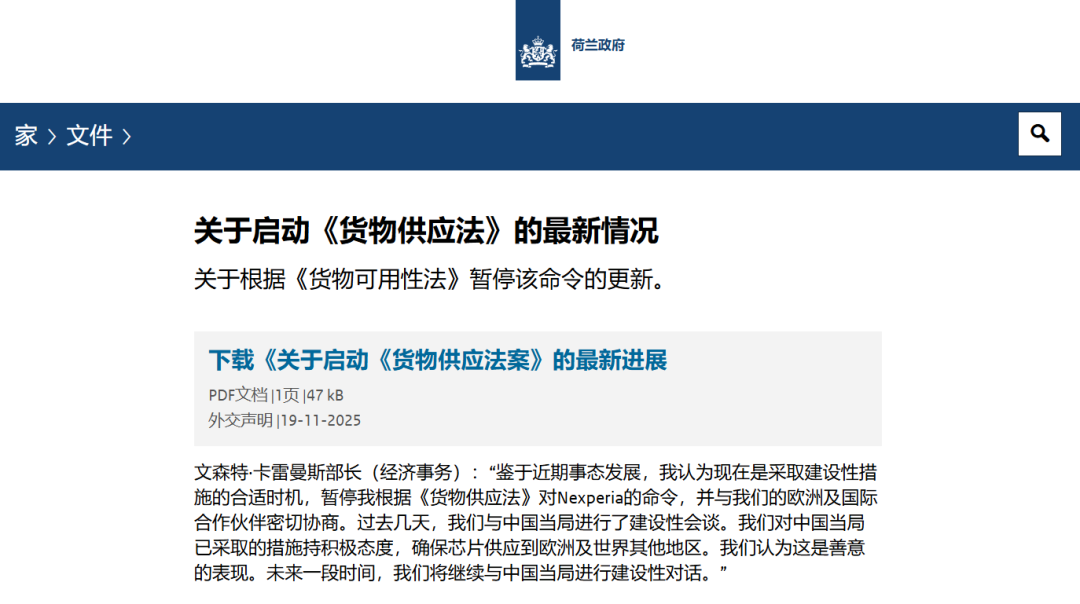
突传大消息!荷兰:暂停对安世半导体干预
Zheng Quan Shi Bao· 2025-11-19 11:48
Core Viewpoint - The Dutch Minister of Economic Affairs, Karremans, announced on November 19 that intervention against ASML has been suspended, indicating a return of control to the Chinese owners of the company [2]. Group 1: Company Control and Intervention - The suspension of intervention means that ASML's control is handed back to its Chinese owners, which is seen as a constructive step amid recent developments [2]. - The Chinese Ministry of Commerce expressed disappointment over the Dutch government's previous actions, which included an administrative order and a court ruling that led to the forced management of a private enterprise's shares [2][3]. Group 2: Semiconductor Supply Chain Impact - The Chinese Ministry of Commerce highlighted that the semiconductor supply chain crisis has taught the world that administrative interference in business operations can lead to instability [2][3]. - The Dutch government's actions have been criticized for damaging the business environment and government credibility in the Netherlands, as they did not follow legal procedures or protect foreign investment rights [3]. Group 3: Future Cooperation and Negotiations - The Chinese side has expressed a willingness to engage in discussions with the Dutch government to resolve the current crisis, emphasizing the need for constructive proposals rather than superficial gestures [4]. - There is a call for the Dutch government to demonstrate genuine cooperation and to present substantial solutions to the ongoing issues in the semiconductor supply chain [4].
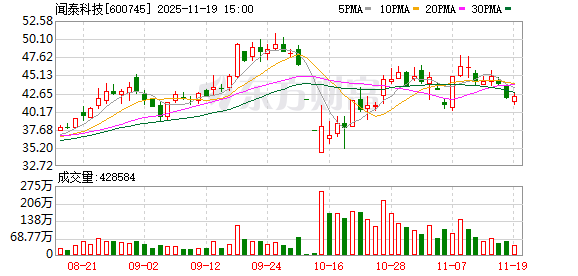
突传大消息!荷兰:暂停对安世半导体干预
证券时报· 2025-11-19 11:00
Core Viewpoint - The article discusses the recent developments regarding ASML and the Dutch government's decision to suspend its intervention, which has implications for the global semiconductor supply chain [2][3]. Group 1: Government Intervention - The Dutch Minister of Economic Affairs, Karremans, announced the suspension of intervention in ASML, indicating a return of control to the Chinese owners [2][3]. - The Chinese Ministry of Commerce expressed disappointment over the Dutch government's previous actions, which they believe disrupted the stability of the global semiconductor supply chain [3][4]. Group 2: Supply Chain Implications - The article highlights that the Dutch government's intervention led to significant disruptions in the semiconductor supply chain, which was previously stable before the intervention [3][4]. - The Chinese Ministry of Commerce noted that the actions taken by the Dutch government have resulted in ongoing vulnerabilities in the semiconductor supply chain, affecting various industries, including automotive [4]. Group 3: Future Cooperation - The Chinese side has expressed willingness to engage in constructive discussions with the Dutch government to resolve the current crisis, emphasizing the need for a genuine collaborative approach [5]. - The Chinese Ministry of Commerce hopes that the Dutch government will come forward with substantive and constructive solutions rather than repeating past mistakes [5].

阿斯麦CEO就安世半导体事件表态:此事凸显供应链脆弱性,对话可防止争端升级
Guan Cha Zhe Wang· 2025-11-17 00:01
Core Viewpoint - The recent tensions between the Netherlands and China regarding ASML and the acquisition of Nexperia highlight the fragility of the semiconductor supply chain and the importance of dialogue to prevent escalation [1][2]. Group 1: ASML's Position - ASML's CEO Christophe Fouquet emphasized the critical nature of the semiconductor industry and its ecosystem's vulnerability, stating that communication is essential before tensions escalate [1]. - He believes that the immediate impact of the tensions on ASML will be minimal and that the worst of the crisis has passed [1]. Group 2: Nexperia's Background - The Dutch government took control of Nexperia, a subsidiary of the Chinese company Wingtech Technology, citing national security concerns, with the action being made public on October 12 [2]. - Nexperia, headquartered in Nijmegen, focuses on discrete and logic devices, and is projected to generate approximately 14.7 billion yuan in revenue in 2024, accounting for one-sixth of Wingtech's total revenue [2]. Group 3: Global Supply Chain Impact - The takeover has caused significant disruptions in the global automotive supply chain, affecting major car manufacturers in the US, Europe, and Japan [3]. - Following the tensions, the US decided to suspend the implementation of stringent export controls for a year, while China agreed to resume chip supplies to the European automotive sector under certain conditions [3]. Group 4: Ongoing Challenges - Despite China's efforts to restore chip exports, European manufacturers continue to face severe chip shortages, which could lead to production line shutdowns [7]. - Automotive executives have expressed concerns about the depletion of chip inventories and the need for ASML to quickly resume supplies to avoid catastrophic impacts on various industries [7]. Group 5: Diplomatic Efforts - The Dutch government announced plans to send a delegation to China to seek a mutually acceptable resolution to the ongoing tensions [5]. - China has expressed disappointment with the Dutch government's actions and emphasized the need for constructive dialogue to resolve the semiconductor supply chain crisis [9].


事关安世半导体,商务部发声
Zheng Quan Shi Bao· 2025-11-14 15:27
Core Viewpoint - The Chinese Ministry of Commerce expresses strong dissatisfaction with the Dutch government's actions regarding Nexperia, emphasizing that such administrative interventions disrupt the global semiconductor supply chain and violate contractual principles [1][2][5]. Group 1: Dutch Government Actions - Dutch Economic Minister Kaagmans stated that he would make the same decision regarding Nexperia, indicating a firm stance despite international criticism [1]. - The Dutch government issued an administrative order on September 30, followed by a court ruling on October 8, which led to significant disruptions in the semiconductor supply chain [1][2]. - The Dutch authorities have been accused of hastily implementing the Cold War-era "Goods Availability Act" without following proper legal procedures, damaging the business environment and credibility of the Dutch government [2]. Group 2: Impact on Semiconductor Supply Chain - The crisis in the semiconductor supply chain has been exacerbated by the Dutch government's actions, which have led to a fragile and severe situation globally [2][5]. - Nexperia, a key semiconductor asset of Wingtech Technology, faced a one-year freeze on its assets and operations due to the Dutch government's intervention [4]. - The Chinese side has taken measures to restore the stability of the semiconductor supply chain, including exemptions for compliant exports, but the situation remains precarious due to the Dutch actions [2][5]. Group 3: Chinese Response and Future Cooperation - The Chinese Ministry of Commerce has expressed a willingness to engage in discussions with the Dutch side to resolve the crisis, provided that constructive proposals are brought to the table [3]. - The Chinese side has emphasized the need for the Dutch government to take substantial actions rather than merely verbal commitments to restore the semiconductor supply chain [5]. - Nexperia China has assured its employees that despite the challenges posed by the Dutch government, it remains capable of providing full salaries and benefits [5].
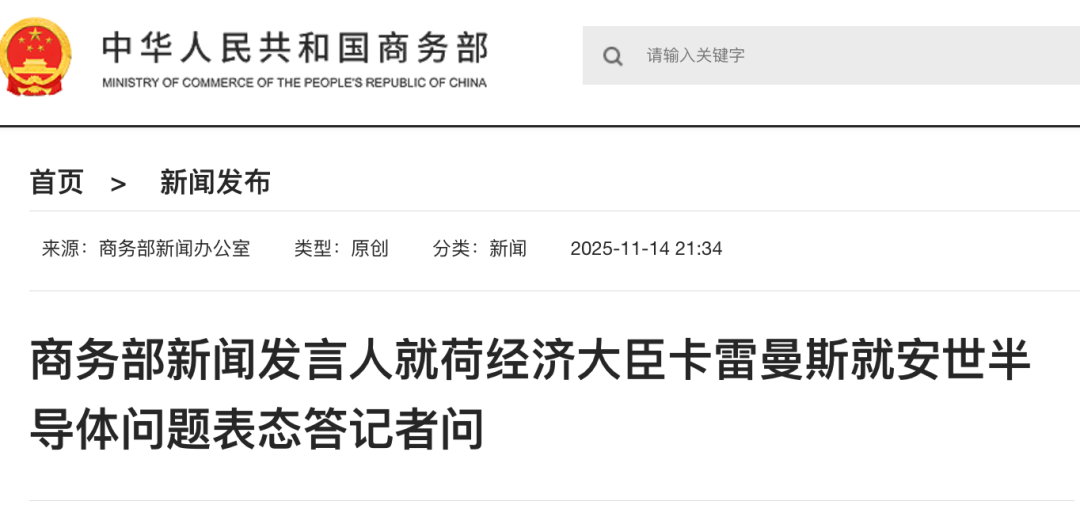
事关安世半导体,商务部发声
证券时报· 2025-11-14 15:19
Core Viewpoint - The article discusses the recent statements made by Dutch Economic Minister Karremans regarding Nexperia, a semiconductor company, and highlights China's strong discontent with the Dutch government's actions that have disrupted the global semiconductor supply chain [2][3][5]. Group 1: Dutch Government Actions - The Dutch government issued an administrative order on September 30, followed by a court ruling on October 8, which led to significant disruptions in the semiconductor supply chain, contradicting the previously stable environment [2][3]. - The Dutch Minister's decision to intervene in Nexperia's operations, including the freezing of assets and management changes, is criticized as reckless and damaging to the business environment in the Netherlands [3][5]. Group 2: China's Response - China expresses disappointment and strong dissatisfaction with the Dutch government's actions, emphasizing that such administrative interventions harm the legitimate rights of foreign enterprises and the overall business climate [2][3]. - The Chinese government has taken measures to restore stability in the semiconductor supply chain, including exemptions for compliant exports, but acknowledges that the situation remains precarious due to Dutch actions [3][6]. Group 3: Future Cooperation - China is open to discussions with the Dutch government to resolve the current crisis but insists that constructive proposals must be presented rather than mere formalities [4][6]. - The Chinese subsidiary of Nexperia reassures its employees that despite the challenges posed by the Dutch government's interference, it remains capable of fulfilling its payroll and benefits obligations [6].