卫星频轨资源

Search documents
新华读报|20.3万颗卫星申报,背后有何深意?
Xin Hua She· 2026-01-22 04:12
Core Insights - China's recent launch of 19 low-orbit satellites marks a significant step in the country's satellite internet capabilities and positions it strategically in the global 6G communication landscape [2] Group 1: Satellite Launch and Frequency Resource Application - China has successfully launched 19 low-orbit satellites for satellite internet [2] - The country submitted an application to the International Telecommunication Union (ITU) for 203,000 satellite frequency resources, setting a new record for a single application in China [2] - The near-Earth orbit can accommodate approximately 175,000 satellites, but the total number of satellites applied for globally has already exceeded this limit, indicating intense competition for frequency resources [2] Group 2: Industry Implications - The competition for frequency resources is intensifying under the ITU's "first come, first served" rule, highlighting the strategic importance of these resources [2] - The initiative is expected to transition China's aerospace industry from isolated technological breakthroughs to large-scale implementation, opening new development opportunities in 6G communication and other fields [2]
光大证券:中国申报超20万颗卫星频轨资源 商业航天发展或再提速
智通财经网· 2026-01-15 02:56
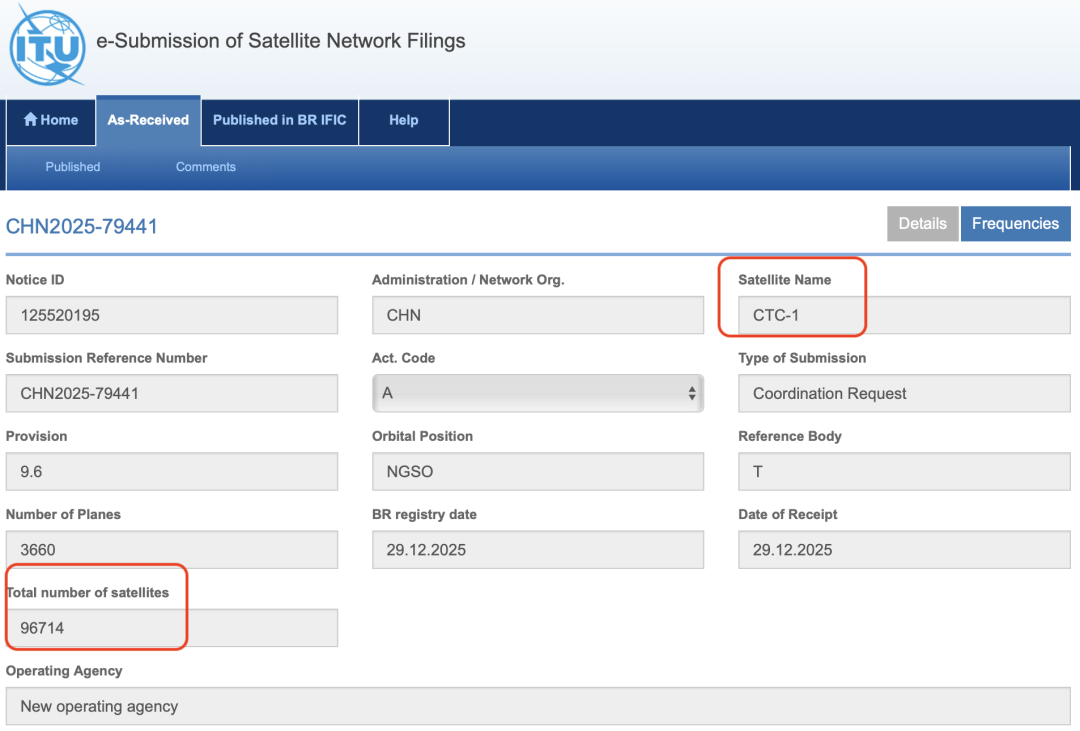
Core Viewpoint - China has applied to the ITU for over 200,000 satellite frequency resources, indicating a strategic reserve of frequency resources amid increasing competition for space resources among major countries [1][2]. Group 1: Application Details - The application includes over 200,000 satellites, with more than 190,000 coming from the newly established Radio Innovation Institute [2][3]. - The application covers 14 satellite constellations, with the largest being CTC-1 and CTC-2, each requesting 96,714 satellites, totaling 193,428 satellites [3]. Group 2: Diverse Application Entities - The application entities are diverse, including the Radio Innovation Institute, commercial space companies like Galaxy Space and State Grid High-Tech, and traditional telecom operators such as China Mobile and China Telecom [3]. Group 3: National Strategy and Background - The Radio Innovation Institute, established on December 30, 2025, aims to serve the satellite internet industry and is backed by several key organizations, indicating that satellite frequency resource applications have become a national strategic level concern [4]. Group 4: Resource Scarcity and ITU Regulations - Satellite frequency resources are non-renewable and highly scarce, with the ITU's "first come, first served" rule necessitating timely applications [5]. - The ITU requires that new satellite applications must launch the first satellite within seven years and meet specific deployment milestones, or the frequency resources will become invalid [5].

早报 | “死了么”APP突然爆火;特朗普被曝正考虑多个干涉伊朗方案;马斯克称3年内机器人将超越顶尖医生;演员闫学晶发文致歉
虎嗅APP· 2026-01-12 00:10
Group 1 - The U.S. government is considering multiple intervention options in Iran, including military strikes and deploying a carrier strike group to the region [2][3] - The Federal Communications Commission (FCC) has approved SpaceX's plan to deploy an additional 7,500 Starlink satellites, increasing its total to 15,000, which will enhance global internet services [4] - SpaceX's satellite upgrades will allow operations across five frequency bands and improve network capacity, supporting next-generation mobile communication services with speeds up to 1 Gbps [4] Group 2 - The app "Did I Die?" has seen a price increase from 1 yuan to 8 yuan after gaining popularity, with the developers planning to enhance features and ensure sustainable development [9][10] - San Francisco's Sam's Club has reported a surge in sales of a down jacket priced at 499 yuan, which has a filling weight of 400 grams, indicating strong consumer demand [11][12] - China has applied for over 200,000 satellite frequency resources, indicating a strategic national interest in satellite technology and positioning itself to compete with companies like SpaceX [13] Group 3 - SanDisk plans to raise enterprise-level NAND prices by over 100% in March and is requiring full cash prepayment from customers, reflecting a supply-demand imbalance in the storage market [14] - Semiconductor company Zhongwei plans to reduce its shareholding by up to 2% due to tax-related needs after the chairman renounced U.S. citizenship to regain Chinese nationality [15][16] - The stock of Guosheng Technology will resume trading on January 12 after a period of abnormal fluctuations, with a cumulative increase of 370.20% during the suspension [28]



新华财经早报:1月11日
Xin Hua Cai Jing· 2026-01-11 00:44
Group 1 - The National Internet Information Office has drafted the "Regulations on the Collection and Use of Personal Information by Internet Applications" and is seeking public opinion, emphasizing minimal impact on personal rights and the necessity of data collection for services [1] - The revised "Market Supervision Complaint and Reporting Handling Measures" will take effect on April 15, 2026, aiming to enhance the quality of complaint handling and regulate malicious claims [1] - The National Medical Insurance Administration has initiated a pilot program for the "Personal Medical Insurance Cloud," set to explore a new model for smart medical insurance management from February to December this year [1] Group 2 - The Supreme People's Procuratorate reported that from 2024 to November 2025, 191 individuals were prosecuted for financial fraud, with a 21% increase in prosecutions from January to November 2025 compared to the previous year [1] - The China Securities Regulatory Commission has imposed penalties on Jiang Wei for insider trading, resulting in the confiscation of illegal gains amounting to 4,709,741.41 yuan and a fine of 14,629,224.23 yuan [1] - The "China Ice and Snow Tourism Development Report (2026)" forecasts that the number of participants in ice and snow tourism will reach 360 million by the winter of 2025-2026, generating an expected revenue of 450 billion yuan [1] Group 3 - QDII funds are set to receive policy support, with adjustments required in the use of QDII quotas for public and private products, aiming for at least 50% of the adjustments to be completed by the end of 2026 [1] - The Beijing Electric Power Trading Center reported that inter-provincial electricity trading volume in the State Grid's operating area reached 1.67 trillion kilowatt-hours in 2025, a 10% year-on-year increase [1] - China has applied for frequency resources for over 200,000 satellites, indicating a strategic elevation of satellite frequency resource applications [1]

我国新增20万颗卫星申请,权威解读来了
Shang Hai Zheng Quan Bao· 2026-01-10 07:37
Core Insights - China has applied to the International Telecommunication Union (ITU) for over 200,000 satellite frequency resources, marking a strategic national initiative in satellite communications [1][8] - The application includes over 190,000 satellites from the newly established Radio Innovation Institute, indicating a significant move towards enhancing China's satellite internet capabilities [1][7] Group 1: Satellite Resource Application - The application consists of multiple satellite constellations, with the largest being CTC-1 and CTC-2, each comprising 96,714 satellites [2][5] - Other notable constellations include CHINAMOBILE-L1 with 2,520 satellites and SAILSPACE-1 with 1,296 satellites [2] Group 2: Establishment of Radio Innovation Institute - The Radio Innovation Institute was registered on December 30, 2025, in Xiong'an New Area, focusing on technological innovation and the transformation of research outcomes in the radio management field [6][7] - The institute is a collaborative effort involving seven organizations, aiming to integrate key technology research, incubation, and industry empowerment in the satellite internet sector [7] Group 3: Strategic Implications - The application reflects China's determination to compete in low Earth orbit against Western nations, particularly the U.S., which currently dominates satellite frequency resources [7][8] - The "first come, first served" rule by the ITU necessitates timely satellite launches to secure frequency rights, emphasizing the importance of this application for future satellite deployment [8] Group 4: Industry Impact - The application is expected to positively influence satellite launch expectations and may alter frequency allocation processes, potentially favoring national distribution over individual applications [10] - China's previous successful applications have totaled 51,300 low Earth satellites, indicating a growing presence in the satellite industry [9]