危机阿尔法

Search documents
不确定性下的“危机阿尔法”:洛书投资十余年CTA赛道的积淀!
私募排排网· 2026-03-05 07:15
Core Viewpoint - The article highlights the increasing interest of institutional investors and high-net-worth individuals in CTA (Commodity Trading Advisor) strategies, particularly in the context of market volatility due to geopolitical tensions, with a focus on 洛书投资 (Luo Shu Investment) as a leading player in the domestic CTA strategy field [1][2]. Company Overview - 洛书投资 was established in February 2015 and is one of the earliest private fund managers to complete registration with the Asset Management Association of China. By December 2025, the company’s assets under management (AUM) exceeded 10 billion yuan, with over 100 full-time employees, more than 70% of whom are involved in research and investment [3]. - The company prioritizes research and risk control over mere scale expansion, adhering to the philosophy of "risk prevention first, asset quality second, economic benefits third" [3]. - 洛书投资 has won the "Annual Golden Bull Private Fund Management Company (Managed Futures Strategy)" award three times, a significant recognition in the private fund industry [3]. Team Composition - The team at 洛书投资 possesses a global perspective while being deeply rooted in the Chinese market, with expertise in international quantitative models and an understanding of local market logic [4]. - The General Manager and Chief Investment Officer, 谢冬, has a strong background in quantitative analysis and trading, having worked at prestigious firms like Goldman Sachs and SAC Capital Advisors before founding 洛书投资 [4]. - The founding partners include experts with extensive experience in quantitative research and asset management, ensuring a high level of expertise within the team, with over 85% holding master's or doctoral degrees in relevant fields [4]. CTA Strategy Overview - 洛书投资 employs a medium to long-term CTA composite strategy that covers domestic commodity and stock index futures, primarily focusing on commodities. The strategy allocates across three sub-strategies based on volatility [5][6]. - The three sub-strategies include: - **Trend Following Strategy**: Involves going long on rising commodities and shorting declining ones, with strong short-term returns during trending markets but potential losses during reversals [7]. - **Term Structure Strategy**: Involves going long on commodities in contango and shorting those in backwardation, providing stable returns primarily from risk premiums transferred by spot traders [8]. - **Fundamental Quantitative Strategy**: Utilizes quantitative methods to assess supply and demand, going long on commodities with supply shortages and short on those with excess supply, with strong profitability when supply-demand dynamics dominate [8]. Performance and Risk Management - 洛书投资's medium to long-term CTA composite strategy has demonstrated resilience across various market conditions, providing stable returns for investors through a mature strategy framework and robust risk management [6]. - The performance of 洛书投资's products, such as "洛书管理期货拾壹号," launched in 2022, has significantly outperformed benchmark indices since inception, showcasing the firm's strong long-term profitability [6][11]. - The firm's CTA strategies exhibit low correlation with traditional assets, effectively diversifying portfolio risks, and their ability to engage in both long and short positions allows for profit opportunities in both bull and bear markets [13].


直面贵金属市场剧震:问波动、问逻辑、问对策
Qi Huo Ri Bao· 2026-02-11 08:42
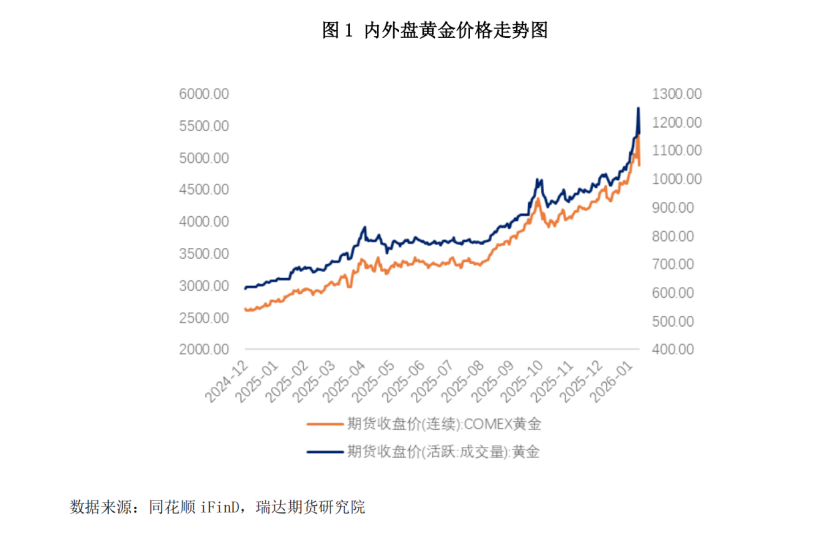
Core Viewpoint - The recent volatility in the precious metals market is unprecedented, with significant price fluctuations in gold and silver, raising questions about whether this is a short-term emotional reaction or a long-term trend reversal [1][4]. Group 1: Market Volatility - Since early February 2026, the precious metals market has experienced extreme fluctuations, with London gold spot prices showing daily price differences around $300 per ounce and silver exhibiting over 5% volatility on 11 occasions within seven trading days, leading to a monthly volatility rate exceeding 100% [1]. - The announcement of the nomination of Powell as the Federal Reserve Chairman has been perceived as a catalyst for market sentiment deterioration, coinciding with heightened trading activity and increased margin requirements by exchanges [1][4]. Group 2: Price Dynamics - The rapid decline in gold prices, reaching a 10.33% drop from a peak of 5626.8 to 5045.6 within a day, followed by a further decline to 4423.2, indicates that the price drop occurred independently of the nomination announcement, as the price trajectory remained consistent before and after the event [4]. - Indicators such as the decline in COMEX gold net long positions and rising volatility in gold ETFs had already signaled a potential price correction prior to the nomination announcement [4]. Group 3: Long-term Trends - Despite the short-term volatility, the long-term trend for gold remains positive, supported by factors such as increasing mining costs, which have risen from $250 per ounce in 2000 to an expected $1500 per ounce by 2025, providing a strong upward pressure on prices [5]. - The global reserve share of the US dollar has been declining, from 72.13% in 1999 to an anticipated 56.92% by September 2025, while gold prices have surged by 700% during the same period, indicating a shift in monetary dynamics [5]. Group 4: Investment Strategies - In light of the current macroeconomic and market sentiment fluctuations, investors are encouraged to adopt a comprehensive approach to commodity investments, integrating macroeconomic analysis with an understanding of international political dynamics [6]. - The CTA strategies developed by the company have demonstrated resilience during market downturns, showcasing effective risk management and decision-making frameworks that can help investors navigate volatility [6][9].
股债震荡,量化CTA又成了答案? | 策略解码
Xin Lang Cai Jing· 2025-11-28 13:30
Core Insights - The article discusses the performance of quantitative CTA strategies during recent market fluctuations, highlighting their ability to generate positive returns amid broader asset declines [1][2]. Group 1: Quantitative CTA Performance - Quantitative CTA strategies exhibited "crisis alpha" characteristics, with an average return of 0.43% during a recent downturn, making them one of the few strategies to show positive returns [1]. - In October, domestic A-shares and bond markets experienced volatility, while quantitative CTA strategies achieved an average return of 2.01%, leading among various strategies [1]. - Year-to-date, quantitative stock selection strategies have outperformed quantitative CTA strategies, with average returns of 42.71% compared to approximately 11% for CTA strategies [2]. Group 2: Market Conditions and Future Outlook - The article notes that the market is currently focused on potential interest rate cuts by the Federal Reserve in December and the upcoming Central Economic Work Conference in China [1]. - The current economic environment, characterized by rising inflation, may benefit commodity performance, with October CPI rising to 0.2% and core CPI increasing to 1.2% [6]. - The article suggests that the current market conditions may favor the allocation of quantitative CTA strategies, particularly in a high liquidity environment [7]. Group 3: Strategy Characteristics and Selection - The performance of CTA strategies is heavily influenced by volatility and trend-following characteristics, with a preference for annualized volatility above 15% [4]. - Investors are advised to consider a diversified approach by selecting multiple strategies or managers to mitigate risks associated with individual performance variations [8]. - The article emphasizes the importance of timing in investing in quantitative CTA strategies, recommending purchases during periods of lower volatility [7].

全球知名对冲基金投资人:中国业务超越预期
Sou Hu Cai Jing· 2025-11-24 16:27
Core Insights - Aspect Capital's private fund business in China has exceeded expectations despite being operational for less than a year, driven by high macroeconomic uncertainty and increasing demand for diversified returns from investors [1] - The firm has registered as a private securities manager in China with assets under management between 1 billion and 2 billion RMB [1] Group 1: Market Entry Strategy - Aspect Capital began researching models suitable for the Chinese market in 2011, ensuring they had the experience and capability to build competitive projects before establishing an office [4] - The company developed a comprehensive business plan, identifying necessary infrastructure, key market participants, and recruitment needs [4] Group 2: Cultural and Team Building - The core cultural values emphasized by Aspect include communication, openness, mutual respect, and enthusiasm for challenges, which are crucial for all employees in Shanghai [5] - Recruitment principles in China mirror those in London, focusing on diversity in viewpoints and educational backgrounds while ensuring alignment with core cultural values [5] Group 3: Strategy Customization for China - Chinese clients prioritize achieving or exceeding performance expectations, which include attractive absolute returns and low correlation with stock and bond markets [7] - Transparency is essential for investors, who need to understand the reasons behind performance, regardless of whether it is positive or negative [8] Group 4: International Investor Interest - There is a growing interest among European investors in allocating assets to Chinese stocks, particularly following China's economic recovery in recent years [14] - Investors are seeking strategies that provide low correlation with Chinese equities, which Aspect's futures strategies can offer [14] Group 5: Business Progress in Shanghai - Aspect Capital's strategies have shown competitive performance in the Chinese market, allowing for faster-than-expected asset growth due to team capabilities and established partnerships [15] Group 6: Historical Context of CTA Strategies - CTA strategies have a long history, with the first managed futures fund established in 1949, and have evolved through various market conditions [16] - The industry saw significant growth in the 1970s, driven by geopolitical tensions and economic turmoil, leading to the establishment of many existing CTAs [16][17] Group 7: Crisis Alpha Mechanism - "Crisis alpha" refers to the ability of CTAs to deliver strong returns during prolonged crises, with a proven track record during significant market downturns [18] - Historical data indicates that managed futures strategies can generate positive returns in environments where stock and bond markets are declining [19] Group 8: Model Adjustments for China - Aspect has tailored its models for the Chinese market, reducing the allocation to trend-following strategies and increasing the focus on other models such as rapid technical, fundamental, and value models [10] - Adjustments include changes in the weight of different frequency models and the unique market coverage available in China [11][12] Group 9: Research Methodology - Aspect employs a hypothesis-driven approach to machine learning to avoid overfitting, starting with market behavior assumptions rather than purely data-driven methods [22] - This approach allows for the development of models that capture market trends effectively while mitigating risks associated with overfitting [22]

全球知名对冲基金投资人:中国业务超越预期
中国基金报· 2025-11-24 16:14
Group 1 - Aspect Capital's private equity business in China has exceeded expectations despite being operational for less than a year, driven by high macroeconomic uncertainty and increasing demand for diversified returns from investors [2] - The firm has registered as a private securities manager in China with an asset management scale between 1 billion and 2 billion yuan [2] - There is a growing interest among European investors in allocating assets to China, particularly in light of the recent economic recovery [15] Group 2 - The company has been preparing for entry into the Chinese market since 2011, focusing on building competitive projects and understanding the necessary infrastructure and key market participants [5][6] - Aspect Capital emphasizes a culture of communication, openness, mutual respect, and enthusiasm for challenges, which is critical for all employees in Shanghai [7] - The firm aims to provide attractive returns that are lowly correlated with stock and bond markets, meeting or exceeding clients' performance expectations [8][10] Group 3 - Adjustments to the models for the Chinese market include a smaller allocation to trend-following strategies and a greater focus on various other models such as fast technical, fundamental, and value models [11] - The unique characteristics of the Chinese market, including a wide range of highly liquid futures products, allow for the development of tailored models that are not simply copied from other regions [13][14] - The company has observed that trend-following strategies can provide strong returns during crises, as evidenced by historical performance during significant market downturns [19][20] Group 4 - The firm has experienced competitive performance in the Chinese market, allowing for faster asset growth than initially anticipated [16] - The historical development of CTA strategies dates back to 1949, with a significant rise in the 1970s amid geopolitical tensions and economic turmoil [17][18] - The company employs a hypothesis-driven research method to avoid overfitting in machine learning models, focusing on market behavior assumptions [23][24] Group 5 - During the challenging period from 2016 to 2020, the company conducted extensive research to validate various hypotheses regarding market behavior and the performance of trend-following strategies [25][26] - The firm found no evidence of a crowded trade in the CTA space, nor any structural changes in market behavior that would undermine the effectiveness of their models [27][30] - The strong performance of CTA strategies in 2022 reaffirmed the company's belief in the temporary nature of weak trend returns, highlighting the importance of causal relationships in market analysis [31][32]