名义有效汇率

Search documents
人民币升值,只是开始
2025-12-26 02:12
Summary of Key Points from the Conference Call Industry Overview - The discussion revolves around the **Chinese Yuan (RMB)** and its appreciation against the US Dollar and other currencies, highlighting macroeconomic factors and seasonal trends affecting the currency's value [1][3][6]. Core Insights and Arguments - **RMB Appreciation**: Since August, the RMB has appreciated by **2.3%**, with the US Dollar's weakness contributing **1.6%** and active appreciation from China contributing **0.7%**. This indicates that both external and internal factors are driving the RMB's rise [1][3]. - **End-of-Year Trends**: Historically, the end of the year is a period when the RMB tends to appreciate due to increased demand for currency exchange as companies prepare for the new fiscal year. This seasonal trend has been observed in previous years, except for 2024 [4][5]. - **Long-term Outlook**: The current appreciation is not merely a short-term seasonal effect but may signal the beginning of a long-term trend. Factors such as improvements in the Chinese macroeconomy and ongoing global monetary easing, particularly in the US, are expected to support the RMB's strength [6][8]. - **Impact on Exports**: The rise in the RMB is not expected to significantly hinder Chinese exports. The trade surplus with major partners does not rely on currency depreciation or deflation, but rather on internal competition among Chinese firms [7]. - **Future Drivers**: In the coming year, several factors could influence the RMB's trajectory, including improvements in the Chinese economy, the breaking of capital outflow cycles, continued US monetary easing, and rising commodity prices. However, potential global economic changes or domestic policy adjustments could also impact this trend [8]. Additional Important Content - **Labor Productivity and Exchange Rate**: There is a historical correlation between labor productivity growth and nominal effective exchange rates. China's labor productivity has outpaced global averages over the past 20 years, but recent internal competition and investment issues have suppressed this relationship. A potential recovery in productivity by 2025 could help restore the nominal effective exchange rate to reasonable levels [2][9].
粤开证券:人民币汇率持续升值的原因、影响及展望
Xin Lang Cai Jing· 2025-12-25 12:23
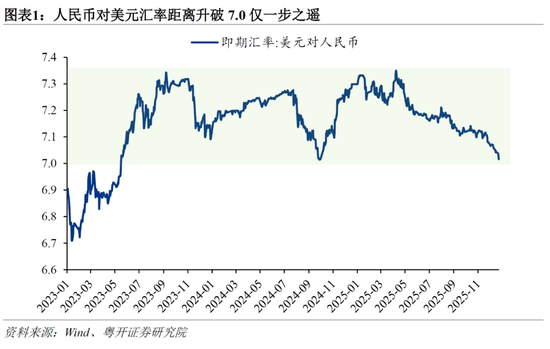
Group 1 - The core viewpoint of the article is that the Chinese yuan (RMB) against the US dollar is expected to strengthen significantly by 2025, driven by multiple factors, despite a slight depreciation against a basket of currencies [1][2][3] - As of December 25, the offshore RMB exchange rate against the US dollar has surpassed 7.0, with the onshore rate close to breaking the same level [1][3] - The RMB against the US dollar has appreciated by 4% as of December 24, while the US dollar index has decreased by 9.7%, indicating that the depreciation of the dollar is a primary reason for the RMB's appreciation [1][2][3] Group 2 - The appreciation of the RMB against the US dollar is driven by four main forces: the weakening of the US dollar index, the strengthening of the Chinese stock market, increased demand for currency settlement by export enterprises, and the People's Bank of China's (PBOC) guidance for a reasonable and orderly appreciation of the RMB [1][2][3] - The weakening US dollar index has been influenced by market expectations of a slowing US economy and potential interest rate cuts by the Federal Reserve, leading to a decline from around 110 points at the beginning of the year to approximately 96 points [6][25] - The Chinese stock market has shown strength, with the A-share market experiencing a "technology revaluation bull market," which has increased the attractiveness of RMB-denominated assets [7][26] Group 3 - Concerns exist regarding the potential negative impact of the RMB's appreciation against the US dollar on Chinese exports; however, the actual effective exchange rate of the RMB against a basket of currencies is more critical in determining export performance [2][12][22] - The nominal effective exchange rate of the RMB is expected to decline in 2025, while low domestic prices and high overseas inflation will keep the actual effective exchange rate at historical lows, enhancing the price competitiveness of Chinese exports [12][14][36] - The RMB's appreciation has both positive and negative effects; it can improve international balance of payments and reduce trade friction, while also increasing import costs for enterprises [23][32] Group 4 - The RMB against the US dollar is projected to maintain a strong trend into 2026, with 6.8 being a potential key level, although some risk of correction may exist [3][38] - The market anticipates that the US economy will face challenges, leading to a continued weakening of the dollar index, while the Chinese economy is expected to recover, supporting the RMB's appreciation [38][39] - Export enterprises are advised not to rely solely on RMB exchange rate trends but to focus on their core business and utilize foreign exchange hedging strategies to mitigate risks [3][39]

人民币汇率持续升值:原因、影响及展望
和讯· 2025-12-25 10:08
Core Viewpoint - The article discusses the recent appreciation of the Renminbi (RMB) against the US dollar and its implications for China's economy, particularly focusing on the factors driving this trend and its potential impact on exports and international trade [5][6][17]. Group 1: Factors Driving RMB Appreciation - The RMB has appreciated significantly against the US dollar, particularly since late November 2025, with the offshore RMB rate surpassing 7.0 on December 25, 2025 [5][8]. - Four main forces are driving the appreciation of the RMB against the US dollar: 1. The weakening of the US dollar index, which has declined by 9.7% [5]. 2. The strengthening of the Chinese stock market, increasing the attractiveness of RMB-denominated assets [10][12]. 3. Increased demand for currency conversion by export enterprises as the RMB appreciates, creating a positive feedback loop [12][13]. 4. The People's Bank of China (PBOC) guiding the RMB to appreciate in an orderly manner to maintain stability against a basket of currencies [13]. Group 2: Impact on Exports - Concerns exist that the appreciation of the RMB against the US dollar may negatively affect Chinese exports; however, the actual effective exchange rate against a basket of currencies is more critical [6][20]. - The appreciation of the RMB can lead to reduced income for export enterprises and pressure on profit margins, but the nominal effective exchange rate remains favorable due to low domestic prices and high overseas inflation [17][20]. - The article emphasizes that the real effective exchange rate, which accounts for inflation differences, is crucial for understanding the competitiveness of Chinese goods in international markets [20][21]. Group 3: Future Outlook - The RMB is expected to maintain a strong position against the US dollar in 2026, with 6.8 being a potential key level, although some risks of correction may arise [7][22]. - The article suggests that the RMB's appreciation is appropriate given its current level is below the reasonable equilibrium, but warns against excessive appreciation that could disrupt businesses and financial markets [24][25].