周期板块投资

Search documents
“大家一起找不同”之周期主题基金经理篇
Ping An Securities· 2026-03-10 01:48
1. Report Industry Investment Rating - The report does not explicitly mention the industry investment rating. 2. Core Viewpoints of the Report - The report reviews two rounds of A-share cyclical sector market trends since 2018, analyzes the changes in the holdings of cyclical theme funds, and conducts a detailed analysis of several cyclical fund managers [2]. - The cyclical sector has experienced two rounds of market trends since 2018. The first was from Q2 2020 to Q3 2021, driven by supply-demand mismatch after the global post-pandemic recovery. The second started in July 2025, driven by a weakening US dollar, global political and economic restructuring, and structural supply constraints in non-ferrous metals [2][5]. - The scale of cyclical theme funds has increased with several market trends, with significant overall fluctuations. Long - term cyclical theme actively managed funds can achieve relatively stable excess returns [2][20]. - The report analyzes the investment frameworks, performance contributions, industry allocations, stock - selection preferences, and trading capabilities of four cyclical fund managers: Han Chuang, Li Wenhai, Mu Yaqian, and Li You [2]. 3. Summary by Directory 3.1 Cycle Sector Market Review - **2020 Q2 - 2021 Q3**: The main driving factor was the supply - demand mismatch after the global post - pandemic recovery. The pandemic disrupted the global supply chain, and after the pandemic, large - scale fiscal stimulus overseas boosted commodity demand. The "dual - carbon" policy in China strengthened the supply - side contraction logic, leading to a sharp increase in commodity prices [2][7]. - **Since July 2025**: The main driving factors are a weakening US dollar, global political and economic restructuring, and structural supply constraints in non - ferrous metals. The "anti - involution" policy has accelerated the exit of backward production capacity. Non - ferrous metals led the market, and the market trend gradually spread from non - ferrous metals to sectors such as basic chemicals and petroleum and petrochemicals [2][11]. 3.2 Cycle Theme Fund Holdings Trends - **Scale and Performance**: The scale of cyclical theme funds has increased with market trends, with large fluctuations. Since Q3 2025, the scale has increased significantly. Actively managed cyclical theme funds can achieve relatively stable excess returns in the long run, as cyclical sectors have strong timing attributes [20]. - **Industry Allocation Characteristics**: Cyclical theme funds focus on non - ferrous metals, transportation, and basic chemicals. In 2025, the proportion of non - ferrous metals and basic chemicals increased, and they focus on sub - sectors such as industrial metals, precious metals, and aviation airports [21]. - **Funds with Growth Potential**: 40 cyclical theme growth - style funds were selected using the Morningstar style box to calculate growth scores [33]. 3.3 Cycle Theme Fund Manager Case Analysis 3.3.1 Han Chuang (Dacheng New - Edge Industry) - **Investment Framework**: Focuses on industry prosperity, company competitive advantages, and reasonable valuations, with a preference for resource products with obvious supply constraints [41]. - **Performance Attribution**: Both industry allocation and stock - selection and trading are important sources of excess returns. The main return - contributing sectors are industrial metals, precious metals, and automotive parts [54]. - **Industry Allocation**: In 2019, it was a full - market allocation. From 2020 - 2022, it increased positions in the cyclical sector, especially basic chemicals and non - ferrous metals. In 2023 - 2024, it increased positions in industrial metals. In 2025, it gradually took profits in industrial metals and increased positions in precious metals [56]. - **Stock - Selection Preferences**: Holds stocks with small - market - cap characteristics, relatively low total market value, and relatively high profitability [68]. - **Trading Capabilities**: Low trading frequency, high stock - holding concentration, and 28 effective stocks at the end of H1 2025 [68]. 3.3.2 Li Wenhai (Rongtong Industry Trend Selection) - **Investment Framework**: Combines top - down and bottom - up approaches, with a focus on industry forward - looking layout and stock - selection based on profit realization or inflection points, emphasizing valuation cost - effectiveness [71]. - **Performance Attribution**: Stock - selection and trading are the main sources of excess returns. The main return - contributing sectors are communication equipment, electricity, and precious metals [83]. - **Industry Allocation**: Heavily invested in the public utilities sector, especially the electricity and gas sectors. In 2024, it switched to non - ferrous metals and other sectors. In 2025, it increased positions in industrial metals and diversified the sector allocation [85]. - **Stock - Selection Preferences**: Holds stocks with low - valuation and high - growth characteristics, relatively high profit growth, and relatively low valuation [100]. - **Trading Capabilities**: High trading frequency, low stock - holding concentration, and 57 effective stocks at the end of H1 2025 [100]. 3.3.3 Mu Yaqian (ICBC Core Opportunity) - **Investment Framework**: Combines prosperity investment and quality investment, focuses on market expectations in the cyclical sector, and controls drawdowns. It also has a certain position in Hong Kong stocks to increase returns through AH premium [103]. - **Performance Attribution**: Stock - selection and trading are the main sources of excess returns. The main return - contributing sectors are precious metals, industrial metals, and energy metals [115]. - **Industry Allocation**: Initially built positions in the cyclical sector, focusing on industrial metals. Then it continuously increased positions in precious metals and industrial metals, and adjusted positions in other sectors [117]. - **Stock - Selection Preferences**: Holds large - cap and low - valuation stocks, with relatively high market value and relatively low valuation [129]. - **Trading Capabilities**: High trading frequency, high stock - holding concentration, and 31 effective stocks at the end of H1 2025 [129]. 3.3.4 Li You (Chuangjin Hexin Resources Theme) - **Investment Framework**: Selects high - quality sectors from a top - down perspective based on industry trends and competitive landscapes, and selects growth - oriented leading stocks from a bottom - up perspective, emphasizing safety margins [132]. - **Performance Attribution**: Both industry allocation and stock - selection and trading are important sources of excess returns. The main return - contributing sectors are industrial metals, coal mining, photovoltaic equipment, and precious metals [142]. - **Industry Allocation**: From 2017 - 2019, it increased positions in industrial metals, energy metals, and refining and trading. From 2020 - 2022, it adjusted positions in different sectors. From 2023 - 2024, it continued to increase positions in industrial metals. In 2025, it concentrated on industrial metals and adjusted positions in precious metals [145]. - **Stock - Selection Preferences**: Holds large - cap and high - profit - quality stocks, with relatively high market value and profit quality [159]. - **Trading Capabilities**: Low trading frequency, moderate stock - holding concentration, and 40 effective stocks at the end of H1 2025 [159].
周期板块节后开工及行情展望
2026-02-24 14:16
Summary of Conference Call Records Industry Overview - **Construction Industry**: The total new contracts signed in the construction industry decreased by 6.6% year-on-year to 31.5 trillion yuan, while the market share of the eight major state-owned enterprises increased by approximately 10 percentage points to 51% [1][3]. The industry is undergoing supply clearance and business restructuring, with a shift towards "two buildings" projects benefiting leading state-owned enterprises and their partnered material suppliers [1][4]. - **Non-ferrous Metals**: During the Spring Festival, overseas metal prices generally rose, positively impacting domestic non-ferrous metal stocks. Despite a hawkish stance from the Federal Reserve suppressing precious metal prices, geopolitical tensions in Iran provided upward catalysts [1][5][6]. - **Coal Industry**: Indonesia's production reduction plans are still being implemented, and domestic production may continue to decrease post-Spring Festival. The port inventory is lower than the same period last year, indicating potential price increases in the domestic coal market [1][7][8]. - **Real Estate Market**: Various cities are piloting state-owned enterprises to purchase existing residential properties for rental housing. The second-hand housing market showed stable growth in key cities, although the overall market requires further observation [1][9][10]. Key Insights and Arguments - **Investment Outlook for Construction Materials**: The investment outlook for the construction materials industry in 2026 is optimistic, with a focus on sectors like waterproofing, coatings, and steel structures. The market is expected to stabilize and potentially see positive growth due to significant project funding and early issuance of special bonds [3][4]. - **Energy Sector Performance**: The energy sector performed well during the Spring Festival, with significant price increases in crude oil and coal, providing a positive signal for the domestic coal sector post-holiday [3][8]. - **Market Dynamics in Non-ferrous Metals**: The non-ferrous metals sector is expected to stabilize after a short-term adjustment, with a focus on energy metals and leading companies in the sector [6]. Additional Important Information - **Construction Sector Changes**: The eight major state-owned enterprises have reversed negative growth trends in quarterly orders since Q2 2025, indicating a recovery in demand and market share [4]. - **Coal Supply and Demand**: Historical data suggests that the coal sector typically performs better than the Shanghai and Shenzhen 300 Index post-Spring Festival, leading to an optimistic outlook for coal prices [7][8]. - **Real Estate Policy Changes**: The Chinese government is emphasizing stability in the real estate market, with measures to control inventory and optimize supply, which may influence future market dynamics [9][10]. This summary encapsulates the key points from the conference call records, highlighting the current state and future outlook of the construction, non-ferrous metals, coal, and real estate industries.
石化ETF(159731)连续13天净流入,合计“吸金”6.1亿元
Xin Lang Cai Jing· 2026-01-26 02:18
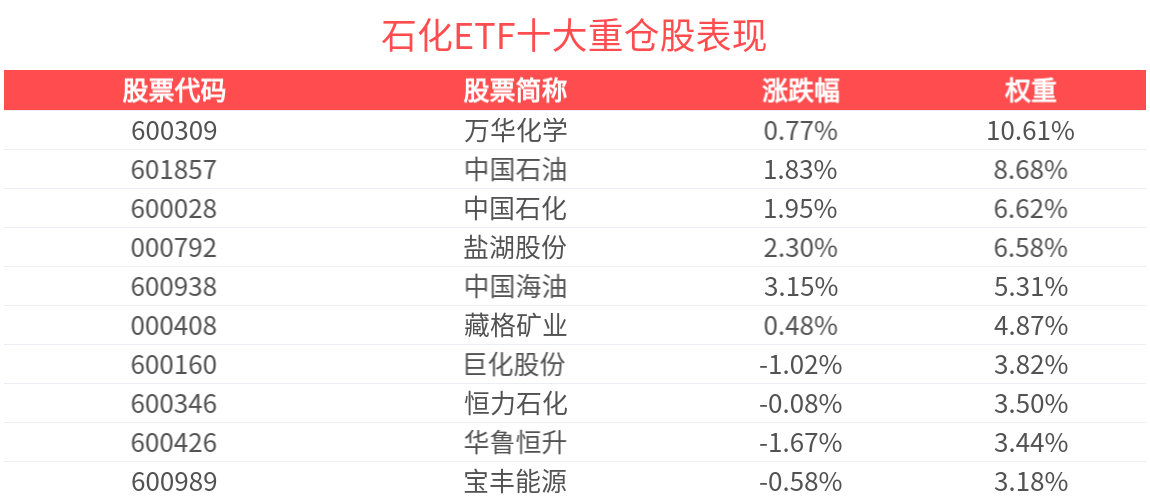
Group 1 - The core viewpoint of the news highlights the positive performance of the petrochemical sector, with the China Petrochemical Industry Index showing a slight increase and several key stocks experiencing notable gains [1][2] - The petrochemical ETF (159731) has seen a recent increase in trading volume and liquidity, with a turnover rate of 8.41% and an average daily transaction of 130 million yuan over the past week [1] - The petrochemical ETF has achieved a record high in terms of net inflow, accumulating 610 million yuan over the past 13 days, with a total share count reaching 887 million and a total scale of 910 million yuan [1] Group 2 - The cyclical sector is experiencing price increases in various sub-sectors, particularly in the lithium battery supply chain, with lithium hexafluorophosphate and lithium carbonate leading the price surge [2] - The chemical sector's allocation ratio has rebounded in Q4, indicating improved fundamentals, while the expansion cycle is nearing its end, suggesting potential investment opportunities in the large chemical sector [2] - The top ten weighted stocks in the China Petrochemical Industry Index account for 56.73% of the index, with major players including Wanhua Chemical, China Petroleum, and China Petrochemical [2][4]

年内涨75%,从有色板块看周期机遇
Sou Hu Cai Jing· 2025-10-16 09:33
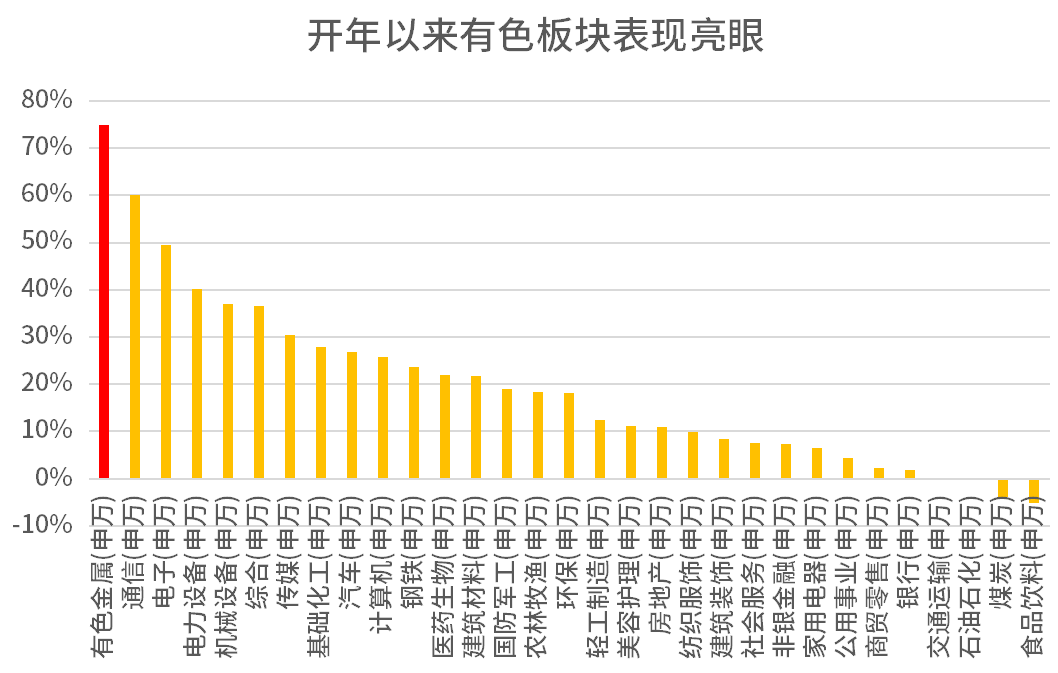
Core Viewpoint - The non-ferrous metals sector has shown outstanding performance in 2025, leading the market with a 75% increase year-to-date as of October 10, 2025, driven by various factors including the impact of interest rate cuts by the Federal Reserve [1][4]. Group 1: Performance Drivers - The strong performance of the non-ferrous sector is attributed to the rise in commodity prices across various sub-sectors, significantly influenced by the Federal Reserve's decision to cut interest rates by 25 basis points in September 2025, with expectations for further cuts [6]. - The anticipated continued rate cuts by the Federal Reserve are expected to further boost commodity prices in the non-ferrous sector, particularly for precious and industrial metals, which are sensitive to global interest rate environments [6]. Group 2: Investment Opportunities - There remains potential for investment in the non-ferrous sector, primarily due to the expected further rate cuts by the Federal Reserve, which could lead to additional price increases in the sector [6]. - Beyond the non-ferrous sector, other industries such as transportation (aviation, oil shipping), chemicals (pesticides, chlor-alkali), and construction materials (glass fiber, cement) are also approaching cyclical lows and turning points worth monitoring [10]. Group 3: Sector Comparisons - The non-ferrous sectors in Hong Kong and A-shares are fundamentally similar, with differences mainly in market conditions and investor types; currently, the valuation of the Hong Kong non-ferrous sector is relatively cheaper compared to A-shares [8]. Group 4: Investment Logic and Risks - The investment logic for the non-ferrous sector involves an initial phase driven by trading expectations based on macroeconomic conditions, followed by a second phase where actual commodity price increases may lead to stock price volatility [10]. - Key risks to monitor include potential price peaks, the pace of future Federal Reserve rate cuts, domestic macroeconomic conditions, and central bank gold purchasing activities [10].