
商业迭代

Search documents
奢侈品门店密集调整,北京高端商业新比拼
Bei Jing Ri Bao Ke Hu Duan· 2025-11-21 03:25
Core Insights - The luxury goods market in Beijing is undergoing significant changes, with brands like Gucci and Dior closing stores in traditional high-end shopping areas, while new flagship stores are emerging in more vibrant districts like Sanlitun [1][3][4] - The trend indicates a shift towards a "one city, one store" strategy among luxury brands, focusing on flagship locations in prime commercial areas while closing underperforming stores [1][6] - The competition among shopping districts is intensifying, with high-end brands exerting more influence over commercial leasing decisions, necessitating upgrades in both infrastructure and experiential offerings to attract these brands [6][8] Group 1: Market Dynamics - Financial Street Shopping Center has seen the closure of major luxury brands due to expired leases, while other brands like Burberry and LV continue to operate [3][4] - West Beijing's luxury market is experiencing a decline, contrasting sharply with the booming luxury scene in the Chaoyang district, which is attracting high-end brands and consumers [3][8] - The luxury market's evolution reflects broader trends in consumer behavior and commercial real estate, with a growing emphasis on experiential retail and brand alignment with shopping environments [7][9] Group 2: Strategic Implications - Luxury brands are increasingly selective about their locations, prioritizing areas with high foot traffic, unique experiences, and strong brand alignment [6][7] - The trend of luxury brands concentrating in top-tier shopping districts is leading to a polarization of the market, potentially disadvantaging smaller shopping areas [9][10] - There are opportunities for luxury brands in the western districts of Beijing, particularly in areas like Haidian, which have affluent consumer bases but lack suitable retail environments [8][9]


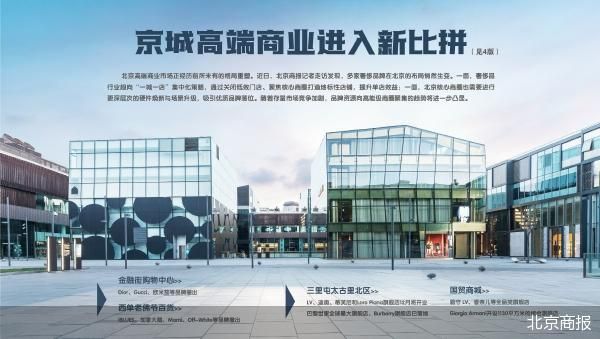
奢侈品门店密集调整 北京高端商业新比拼
Bei Jing Shang Bao· 2025-11-20 16:30
Core Insights - The luxury goods market in Beijing is undergoing significant changes, with brands like Gucci and Dior closing stores in traditional high-end shopping areas, while new flagship stores are emerging in more vibrant districts like Sanlitun [1][3] - The trend indicates a shift towards a "one store per city" strategy among luxury brands, focusing on flagship locations in prime commercial areas to enhance single-store efficiency [1][6] - The competition among shopping districts is intensifying, with a clear divide between the declining western commercial areas and the thriving eastern districts, particularly in Chaoyang [3][8] Group 1: Market Dynamics - Financial Street Shopping Center has seen the closure of major luxury brands due to expired leases, while other brands like Burberry and LV continue to operate [3] - Westside shopping areas, such as the West Wangfujing area, are experiencing a significant reduction in luxury brand presence, contrasting sharply with the "luxury frenzy" in the Chaoyang district [3][8] - The luxury brand selection criteria have evolved, with a focus on the alignment of brand positioning with shopping district characteristics and the necessity for high-quality infrastructure [6][7] Group 2: Strategic Adjustments - High-end shopping centers are actively upgrading their offerings to attract luxury brands, introducing trendy brands and unique experiences to enhance their appeal [4][6] - The introduction of flagship stores and unique retail experiences, such as themed pop-ups and interactive spaces, is becoming a strategy to maintain competitiveness in the luxury market [4][6] - The luxury market's focus on experiential retail is growing, with brands increasingly valuing the ability of shopping centers to create engaging content and experiences for consumers [7][10] Group 3: Future Opportunities - Despite the current challenges, there are still opportunities for luxury brands in the western regions of Beijing, particularly in areas like Haidian, which have affluent consumer bases [8][9] - The potential for luxury brands to establish a presence in western districts hinges on improving the quality of commercial spaces and enhancing transportation connectivity [8][9] - Strategies such as introducing high-end watch brands and leveraging local technological advancements could help attract luxury brands to underperforming areas [9][10]
青观察|解锁国贸商圈的迭代密码
Sou Hu Cai Jing· 2025-11-11 23:13
Core Insights - The development of the Guomao business district reflects the evolution of China's commercial landscape over the past 40 years, from its inception in 1985 to its current status as a major international trade center [2][10] Historical Development - The Guomao business district originated as a response to China's need for an international trade window during the early 1980s, with the construction of the China International Trade Center [3] - The first phase of the project, completed in 1989, marked the beginning of high-end retail in Beijing, attracting consumers from across the region [3][4] - The establishment of the CBD in 1993 solidified Guomao's position as a commercial hub, leading to the development of surrounding business facilities [3] Business Evolution - The second phase of Guomao expanded its retail space and introduced more international brands, transforming it into a key venue for business networking and socializing [4] - Following China's accession to the WTO in 2001, Guomao became the preferred location for international brands entering the Chinese market, with over 200 new international brand stores opening between 2002 and 2010 [5][10] - The annual sales of the Guomao business district surged from less than 1 billion yuan in 2001 to over 5 billion yuan in 2010, establishing it as one of Beijing's top sales districts [5] Recent Developments - The introduction of the first indoor ice rink in Beijing in 2010 marked a significant expansion of the Guomao complex, enhancing its appeal to families and business professionals [7] - The business district faced challenges from the rise of e-commerce post-2010, leading to a decline in sales growth rates, which prompted a strategic shift towards experiential and social retail [8][9] - Guomao has successfully integrated digital solutions and diversified its offerings, transforming from a high-end retail focus to a multi-faceted commercial ecosystem [9][10] Current Status - Guomao now features over 400 merchants within 230,000 square meters of commercial space, with more than 100 flagship stores, solidifying its status as a premier shopping destination [10] - The district has evolved into a vibrant community space, catering to a diverse consumer base, including business professionals, families, and young consumers [11][12]

商潮新象——解码商业迭代的中原故事
He Nan Ri Bao· 2025-07-01 23:47
Core Insights - The article highlights the emergence of new consumer brands in Henan, such as Mi Xue Bing Cheng, Pang Dong Lai, and others, which are reshaping the commercial landscape of the region [1][9][18] - Henan is transitioning from a traditional agricultural province to a hub of consumer innovation and modern retail, driven by a combination of local resources and market opportunities [12][13][19] Group 1: Commercial Development - The opening of Zhengdong Vientiane City marks a significant step in establishing Zhengzhou as an international consumption center, featuring a mix of urban retail and flagship stores [4][6] - The region has seen a surge in commercial complexes and flagship stores, with Mi Xue Bing Cheng achieving record sales of 600,000 cups in a single day [4][5] - The establishment of a "米" shaped high-speed rail network has transformed Zhengzhou into a consumer hub, facilitating access to 123 cities and an average daily passenger flow of over 300,000 [4][17] Group 2: Consumer Trends - New consumption patterns are emerging, with brands like Mi Xue Bing Cheng representing affordable consumption, while Pang Dong Lai symbolizes quality consumption [9][11] - The rise of experiential and emotional consumption is evident, as brands focus on creating unique shopping experiences and emotional connections with consumers [16][19] - The article notes that the success of these brands is rooted in their ability to understand and respond to the genuine needs of consumers [12][19] Group 3: Economic Impact - The retail sales in Henan are projected to reach 27,597 billion yuan in 2024, reflecting a year-on-year growth of 6.1% [17] - In the first five months of this year, the province's retail sales totaled 11,820.14 billion yuan, with Zhengzhou contributing 2,763 billion yuan [17] - The emergence of new consumer brands is expected to enhance the economic landscape of Henan, with more brands likely to gain national and international recognition [18][20] Group 4: Future Prospects - The article suggests that the rise of new consumer brands in Henan is not a fleeting trend but indicative of a deeper transformation in the region's commercial ecosystem [14][18] - The integration of local brands with international ones is anticipated to enrich the consumer market and elevate the region's commercial profile [20] - The potential for further innovation and brand development in Henan is significant, as the region continues to leverage its cultural heritage and entrepreneurial spirit [16][21]
