商品交易顾问(CTA)

Search documents
算法抛售风暴降至?高盛:标普500若跌破6707点,或触发800亿美元系统性卖盘
Jin Rong Jie· 2026-02-09 00:48
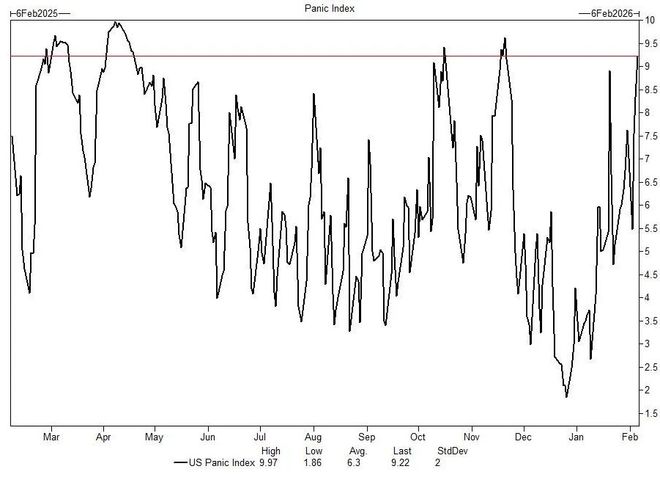
Core Insights - The article discusses the potential for further selling pressure in the U.S. stock market due to trend-following algorithmic funds, as indicated by Goldman Sachs' analysis [1][4] - The S&P 500 index has breached a short-term trigger point for Commodity Trading Advisors (CTAs) to sell stocks, with an estimated $33 billion in potential selling pressure if the market declines further [1][5] - Investor anxiety has increased significantly, with the fear index nearing "extreme fear" levels [1][3] Group 1: Market Trends and Indicators - The S&P 500 index rose by 2% last Friday, marking its largest single-day gain since May of the previous year, following a week of significant declines [3] - The average size of optimal liquidity for the S&P 500 has dropped over 70% this year, indicating a significant deterioration in market liquidity [3][4] - The current market liquidity is characterized by a shift from "long gamma" to a neutral or short gamma position among options traders, which may exacerbate market volatility [4][5] Group 2: Investor Behavior and Market Dynamics - Retail investors have shown signs of fatigue, with a net selling of $690 million in the last two trading days, indicating a shift from the previous "buy the dip" strategy [7] - Seasonal factors suggest that February is typically a weak month for the S&P 500 and Nasdaq 100, as the supportive capital flows from January diminish [7] - Systematic strategies, such as risk parity and volatility control, are currently positioned at high risk levels, which may lead to significant de-risking actions if market volatility remains elevated [5]


高盛交易员警告:美股抛售尚未结束
Xin Lang Cai Jing· 2026-02-08 16:24
Group 1 - The core viewpoint of the article indicates that the U.S. stock market experienced a rebound last Friday, recovering most of the week's significant losses, but is expected to face additional selling pressure from trend-following algorithmic funds this week [1] - Goldman Sachs predicts that regardless of market direction, systematic strategies that track market trends rather than fundamentals will continue to maintain net selling in the upcoming week [1] - If the stock market declines again, it could trigger approximately $33 billion in selling this week, and if the S&P 500 index falls below 6707 points, there may be up to $80 billion in systematic selling over the next month [1] Group 2 - In a stable market scenario, it is anticipated that CTAs will sell about $15.4 billion in U.S. stocks this week, and even if the market rises, these funds are expected to sell approximately $8.7 billion [1]
降息为柴油行情“火上浇油” 今秋涨势难熄?
Zhi Tong Cai Jing· 2025-09-02 23:55
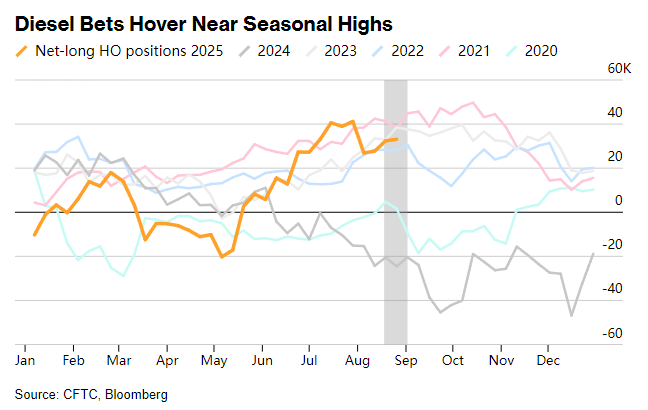
Core Viewpoint - Analysts suggest that if the Federal Reserve lowers interest rates this month, it will boost industrial activity powered by diesel, potentially extending the summer price surge of diesel into the fall [1] Group 1: Diesel Price Dynamics - Diesel prices have increased by approximately 20% since early May due to global supply shortages and refinery outages, outpacing the price increases of crude oil and gasoline [1] - The sensitivity of diesel prices to monetary policy has notably increased compared to the past two to three years, attributed to a significant influx of new investors [1] Group 2: Market Sentiment and Predictions - Investors currently estimate a 92% probability that the Federal Reserve will cut rates by 25 basis points next month [4] - In contrast, speculative positions on U.S. crude oil futures are at their lowest in nearly 20 years, indicating a weakening correlation between interest rate expectations and fuel prices [4] Group 3: Demand and Seasonal Factors - Lower interest rates are expected to provide stronger support for capital-intensive industries that are major diesel consumers, leading to increased diesel demand in a low inventory environment [4] - The seasonal factors, such as the harvest season and winter, may further drive up costs for agricultural machinery and home heating users [4] Group 4: Price Thresholds and Economic Impact - The critical point where high freight costs may suppress industrial activity could occur if diesel prices reach $10 per gallon, while current average prices are just below $4 per gallon, indicating room for further increases [5] - The impact of rising diesel prices is broader than that of gasoline, as it affects entire industries rather than just consumer driving habits, although the industry has not yet reached a contraction point [6]