
在地潮生

Search documents
年味里的消费迁移:2026春节消费趋势报告-知萌
Sou Hu Cai Jing· 2026-02-28 00:55
Core Insights - The 2026 Spring Festival consumption market shows a clear shift from functional satisfaction to a focus on "meaning and value," with a notable increase in both rational and emotional spending [1][20] - Daily sales revenue in consumption-related industries increased by 13.7% year-on-year, with significant growth in sectors such as cultural tourism, dining, and smart green consumption [1][26] - The "old-for-new" policy benefited 27.56 million people, indicating a new growth point in the market for smart and green products [1][17] Group 1: Consumption Trends - The report identifies 12 core trends in Spring Festival consumption, reflecting deep changes in the market, including the emergence of a new "reunion economy" and the rise of the Z generation as the main decision-makers in family consumption [2][28] - Consumers are increasingly prioritizing emotional healing and satisfaction over mere functionality, with "heart-price ratio" becoming a key consideration [11][12] - Local culture is becoming a new engine for consumption, with traditional experiences and local specialties gaining popularity among younger consumers [13][14] Group 2: Service and Retail Dynamics - Service consumption has seen explosive growth, with consumers willing to pay for time-saving and immediate gratification services, indicating a shift from buying products to buying time [19][20] - Instant retail is replacing traditional bulk purchasing for the Spring Festival, aligning with rational consumption trends [2][28] - The demand for pet-related services has surged, with pets becoming integral to family celebrations, reflecting a broader trend of emotional consumption [19][20] Group 3: Policy and Economic Impact - The "old-for-new" policy has significantly impacted consumer behavior, with a total sales volume of 193.09 billion yuan generated from this initiative, particularly in the automotive sector [17][27] - The overall consumption landscape is evolving, with a focus on quality upgrades and green products, driven by consumer awareness and policy support [15][17] - The Spring Festival period has highlighted the importance of understanding new consumption paradigms, emphasizing emotional fulfillment and real value over mere traffic competition [3][20]


2026消费风向标:精打细算的我们,为何仍愿为一场狂欢买单?
Sou Hu Cai Jing· 2026-02-05 11:34
Group 1 - The core position of consumption as the "mainstay" of China's economy is solidified, with final consumption contributing 52% to economic growth in 2025, indicating that over half of economic growth is supported by consumer spending [3] - The adjustment of the new energy vehicle purchase tax from full exemption to a 5% rate starting January 1, 2026, signals a shift from policy-driven support to market-driven growth, leading to a last-minute buying spree in late 2025 [3][12] - The consumer landscape is evolving, with over 60% of consumers adopting defensive saving behaviors while simultaneously showing a willingness to spend extravagantly on experiences like concerts, indicating a complex consumption pattern [4] Group 2 - Consumers in 2026 exhibit a "liquid personality," easily switching between different consumer identities based on context, with 50.4% identifying as "life accountants" focused on savings [6] - The trend of "rational emotionalism" emerges, where consumers save resources through careful budgeting to allocate for meaningful experiences, with 75.2% consciously managing their psychological accounts [7] - The "in-place awakening" trend highlights a growing preference for local culture and brands, with consumers favoring products that reflect local cultural elements and stories, pushing brands to be more transparent and authentic [8] Group 3 - The integration of AI into daily life has transformed it from a mere tool to a partner in various aspects, with over 80% of consumers using AI frequently across multiple dimensions of life [10] - Investment opportunities in 2026 are seen in traditional sectors like liquor, which may experience a value rebound, and companies with strong cash flow and dividend yields above 4% are worth monitoring [11][12] - Emerging fields such as discount retail, AI-enhanced consumer products, and local cultural experiences present structural growth opportunities for brands, emphasizing the importance of user experience alongside technological advancements [13]
2026北京青年消费图鉴:该省省该花花,“心价比”取代“性价比”
Bei Jing Qing Nian Bao· 2026-01-21 12:56
Core Insights - The article discusses the emerging consumption trends among Beijing's youth in 2026, highlighting their significant role in driving economic growth and the transformation of the capital's consumer market [2][3]. Group 1: Six New Trends in Youth Consumption - The youth consumption landscape in Beijing is evolving from simple transactions to a complex model centered around "technology empowerment, value orientation, emotional core, and local confidence" [2][3]. - The contribution of youth consumption to economic growth is increasing, with final consumption expenditure accounting for over 52% of economic growth by 2025 [2]. - The report identifies six leading trends that reflect the highly differentiated and deeply integrated consumption behaviors of Beijing's youth [2]. Group 2: Trend One - AI Integration - AI is becoming a core driver of consumption growth, with predictions indicating that the consumer-grade AI hardware market in China will exceed 1 trillion yuan by 2026, maintaining a compound annual growth rate of over 30% [3]. - Over 85% of surveyed youth regularly use AI assistants for shopping, indicating a shift in how consumption decisions are made [3][4]. Group 3: Trend Two - "Heart-Price Ratio" Consumption - Youth consumers are increasingly willing to pay for emotional satisfaction, leading to a new consumption philosophy termed "heart-price ratio," which balances functional value and emotional fulfillment [5][6]. - This trend reflects a broader shift in consumer behavior from survival-oriented to development and experience-oriented spending [5][6]. Group 4: Trend Three - Rise of Local Brands - Local brands in Beijing are gaining popularity, driven by cultural confidence and innovative business models, moving beyond being mere alternatives to international brands [7][8]. - The integration of local cultural elements into products is resonating with youth consumers, who prefer brands that reflect their identity and values [7][8]. Group 5: Trend Four - Proactive Health Consumption - Health has become a foundational aspect of consumption for Beijing's youth, influencing their choices across various sectors, including food, fitness, and wellness [9][10]. - The demand for health-related products and services is rapidly increasing, with significant growth in categories like organic food and health appliances [9][10]. Group 6: Trend Five - Experiential Consumption - Youth consumers are seeking deeper engagement and emotional resonance in their consumption experiences, leading to the blending of commerce, culture, tourism, and sports [11][12]. - The concept of "ticket economy" is emerging, transforming single purchases into ongoing experiences that enhance consumer engagement [11][12]. Group 7: Trend Six - "Insiderism" in Consumption - Youth consumers are becoming more knowledgeable and discerning, with a focus on professional insights and peer recommendations influencing their purchasing decisions [13][14]. - Brands are responding by refining their offerings to meet the demands of informed consumers, emphasizing core competencies and eliminating unnecessary features [15].
肖明超:十年消费趋势变迁,所有品牌都要思考“意义”与“价值”
Zhong Jin Zai Xian· 2025-12-31 06:54
Core Insights - The core viewpoint of the articles emphasizes the transformation of consumer behavior in China over the past decade, highlighting a shift from traditional experience-based decision-making to a more strategic, insight-driven approach in market and brand management [1][3][12] Group 1: Consumer Trends - The past decade has seen a profound evolution in China's consumer market, transitioning from the "New Premium Era" to "Meaning and Value" as the central theme for 2026 [1][3] - 75.2% of consumers are now engaging in psychological account switching, indicating a willingness to spend significantly on experiences they value, while being frugal in everyday purchases [5] - The consumer market is moving from a focus on scale and speed to a deeper engagement with consumer values, necessitating that companies provide products that offer meaningful benefits beyond functionality [6][7] Group 2: Key Trends for 2026 - The 2026 China Consumer Trend Report identifies ten key trends, with "Rational-Emotional Coexistence" and "Quality Calculation" being crucial for understanding current consumer behavior [8] - 77.8% of consumers are shifting from quantity-based consumption to a focus on quality, seeking products that provide personal growth or emotional recognition [8] - The trend "Local Flavor" is reshaping commercial geography, emphasizing the importance of local culture and experiences in consumer decision-making [8] Group 3: Business Strategies - Companies are advised to separate brand budgets from performance budgets, as brand equity is essential for sustainable growth, while performance marketing addresses immediate sales [9] - The concept of "Brand Consensus" is introduced, emphasizing the need for companies to build a coherent narrative that resonates emotionally with consumers [9] - Companies should develop three core capabilities: trend foresight, user empathy, and systemic aesthetics to navigate the evolving market landscape [11] Group 4: Future Opportunities - The "Three New" opportunities identified include new scenarios (emotional healing, daily highlights), new expertise (niche market specialization), and new intelligence (AI integration in services) [10][11] - Companies must cultivate trend foresight by establishing dedicated strategic insight teams to differentiate between fleeting trends and long-term shifts [11] - The ultimate competitive advantage in the user-centric era is establishing deep emotional consensus with consumers, transforming brands into "Consensus Brands" [12]
知萌发布《2026中国消费趋势报告》 持续十年预见消费趋势
Zheng Quan Ri Bao Wang· 2025-12-08 07:29
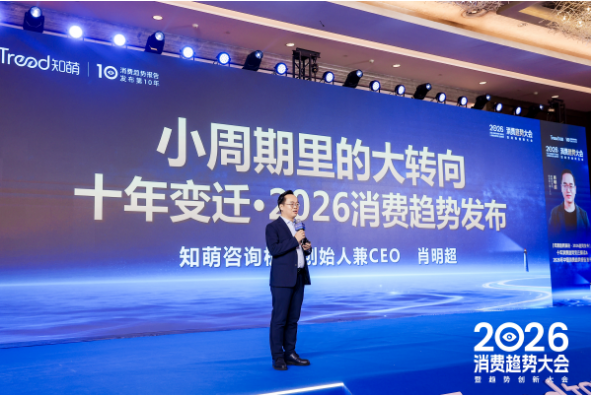
Core Insights - The 2026 Consumer Trends Conference, hosted by Zhimo Consulting, took place in Beijing on December 6-7, showcasing the annual China Consumer Trends Report, which has been a significant indicator of the Chinese consumer market for the past decade [1][2] Group 1: Conference Overview - The conference featured a two-day deep trend forum with 24 forward-looking speeches and 4 cross-industry roundtable discussions, covering ten key industries including food and beverage, home appliances, outdoor sports, retail, health, automotive, AI, and cultural tourism [1] - Zhimo's annual consumer trends report has evolved from a "small green book" in 2017 to a comprehensive analysis that includes 100 consumer trends and 450 brand case studies, serving as a crucial reference for corporate strategic decision-making and brand innovation [2] Group 2: Key Trends and Insights - Zhimo's founder and CEO, Xiao Mingchao, announced the top ten consumer trends for 2026, which include: rational-emotional symbiosis, quality calculation, spiritual nomadism, daily highlights, shared experiences, local trends, insiderism, health tuning, brand consensus, and AI scenario power [3] - The report emphasizes a shift in the commercial landscape from "high-speed growth" to "high-quality growth," highlighting a generational shift in "consumer discourse power" and a fundamental leap in the role of technology [3] Group 3: Practical Applications and Discussions - The conference included various segments such as industry roundtable discussions, brand case sharing, and trend exhibitions, attracting over a thousand attendees interested in consumer trends [4] - Experts from academia and industry discussed the underlying logic of changes in Chinese consumption and identified opportunities for the industry, focusing on themes like convenience in consumption and the upgrade of aesthetic and emotional needs [5]
AI场景力成2026年十大消费趋势
Bei Jing Shang Bao· 2025-12-08 04:41
Core Insights - The 2026 China Consumer Trends Report by Zhimeng highlights "meaning" and "value" as the annual keywords for consumer trends in 2026 [1] - The top ten consumer trends identified are: rational-emotional symbiosis, quality calculation, spiritual nomadism, daily highlights, empathetic experiences, local trend emergence, insiderism, health tuning, brand consensus, and AI scenario power [1] Group 1: Consumer Behavior Trends - "Rational-emotional symbiosis" defines the shift in consumer mindset and behavior, with 75.2% of consumers consciously engaging in psychological account replacement and planning [1] - "Quality calculation" deepens the concept of "rational-emotional symbiosis," with 77.8% of consumers pursuing "less but better," and 74.4% expecting consumption to contribute to personal growth [1] - The "spiritual nomadism" trend is supported by data showing that over 80% of consumers engage in "emotional consumption" at least once a month for purposes of healing, stress relief, or self-reward [1] Group 2: Lifestyle and Experience Trends - In lifestyle contexts, "daily highlights" and "local trend emergence" guide brands to become catalysts for ritualistic experiences and narrators of the value of local culture as a scarce lifestyle [2] - In terms of experiential aspects, "empathetic experiences" and "insiderism" reveal the value of offline flow and the power of professional recognition within circles, requiring brands to shift from creating resonant scenarios to building hard-core trust [2] Group 3: Development and Recognition Trends - The trends of "health tuning," "AI scenario power," and "brand consensus" indicate refined directions for health management, integration paths for AI as emotional partners, and the necessity for brands to establish deep consensus from cognition to experience in an era of information overload [2]