地缘定价

Search documents
股指二季度观点:地缘定价从混沌到清晰-20260331
Dong Zheng Qi Huo· 2026-03-31 08:44
1. Report Industry Investment Rating - Not provided in the given content 2. Core Viewpoints of the Report - The geopolitical pricing in the second quarter of the stock index has changed from chaos to clarity. The Middle - East situation is becoming more complex, and the war situation will affect the fundamentals of equity assets. It is expected that the US and Iran will go through a process of "war expansion - negotiation and compromise" in the second quarter. A - shares may experience a V - shaped trend in the second quarter. In the short term, the A - share bull market is tested, but in the medium term, the technology industry represented by artificial intelligence is still the main line of the A - share bull market. It is recommended to go long on the IM futures with higher technology content on dips [92] - High oil prices will lead to an increase in global energy and trade costs, and have an impact on China's imports and exports, inflation, and economic growth. The PPI and CPI are expected to rise, and the global economic growth is predicted to decline [21][53][67] - The Chinese government is taking measures to expand domestic demand and promote economic structural adjustment, such as increasing investment in infrastructure and adjusting policies on consumption and investment [79] 3. Summary by Related Catalogs 3.1 China - Iran and China - Persian Gulf Seven - Country Trade - Iran's direct trade volume with China is small, with a trade surplus of less than $4 billion. After the US sanctions in 2018, the direct trade between China and Iran decreased [5] - China's exports to the eight countries including Iran and the seven Persian - Gulf countries have been increasing in the past five years. In 2025, the total export amount to the eight countries was $169.27 billion, accounting for 4.3%. China's imports from the seven Persian - Gulf countries accounted for 6.1% of the total imports, and the trade deficit turned positive in 2025, reaching $5.7 billion [6][16] - If trade with the seven Persian - Gulf countries is interrupted, China's exports will decrease by 4.3% and imports by 6.1%. China's import dependence on these countries is mainly concentrated in crude oil, natural gas, chemical raw materials, and plastic products, and some products have a share of over 20%. The export of carpets, textiles, motor vehicles, steel products, and electromechanical products may be damaged [25][29] 3.2 Energy and Market Impact - The Strait of Hormuz is crucial for China. About 200 - 210 million barrels of crude oil pass through it every day, accounting for about 20% of the world's seaborne oil. The liquefied natural gas transportation accounts for about 20% of the world, and the methanol transportation accounts for about 35% of the world. The closure of the strait will lead to an increase in global energy and trade costs [21] - Crude oil accounts for 18.2% of China's total energy consumption, and the external dependence is about 72%. The crude oil imported from the seven Persian - Gulf countries accounts for about 40% of the total imported crude oil. China's oil reserves can support about 100 days. If the war persists and the strait is blocked, it will impact the economic growth [34] - Before the US - Iran war, the global equity assets were in a bull market. After the war, the global risk assets were under pressure, and the stock markets generally declined. In March, only the energy and mineral sectors rose, while the technology stocks and HALO assets fell significantly [38][46] 3.3 A - share Market Performance - In March, A - shares fell in line with the global stock markets. The rising sectors include energy (coal, power utilities, and new energy), defense (banks, public utilities), and AI infrastructure (communications). The falling sectors are mainly HALO heavy - hitters such as non - ferrous metals, steel, and building materials, concept stocks such as military industry, and technology stocks such as media and computer [49] - At the tertiary industry level, coal chemical industry, lithium batteries, new energy power generation, and optical communications performed well [50] 3.4 Inflation and Economic Growth - The increase in oil prices has led to an unexpected rise in PPI and CPI. In March, the PPI is expected to approach 0 year - on - year, turn positive in the second quarter, and the annual central level will rise to about 0.5%, 1.5% higher than the initial forecast. The CPI is expected to rise to about 1%, 1% higher than the initial forecast [60] - China's exports increased significantly in the first two months, but the impact of the US - Israel - Iran conflict on the global economy will be apparent from the second quarter. The OECD estimated in March that the GDP growth rate in the four quarters of this year will decline by 0.12, 0.23, 0.31, and 0.33 percentage points respectively compared with the February forecast [67] - China's economic growth is more dependent on foreign trade, and domestic demand is weak. The fiscal stimulus in 2026 is limited, and the incremental content is mainly in policy - based financial instruments and special funds for expanding domestic demand [72] 3.5 Policy and Industry Development - The government's work report in 2026 emphasizes building a strong domestic market, with a re - balance between consumption and investment, and an increase in support for fixed - asset investment. The positions of rural revitalization, new urbanization, and improving people's livelihood are advanced [79][80] - The National Development and Reform Commission will invest more than 7 trillion yuan in "six networks" and key areas this year, and the scale of artificial - intelligence - related industries will exceed 10 trillion yuan by the end of the 15th Five - Year Plan. The Ministry of Commerce focuses on service consumption, the central bank focuses on supporting domestic demand, innovation, and small and medium - sized enterprises, and the Ministry of Finance provides loan interest subsidies for individuals and enterprises [84] - Although the valuation of technology stocks is still high, their structure is relatively healthy after the profit upward revision and valuation downward revision in the fourth quarter of last year. The non - technology stocks have relatively mild changes in valuation and profit. The policy support for the technology industry is obvious [91]
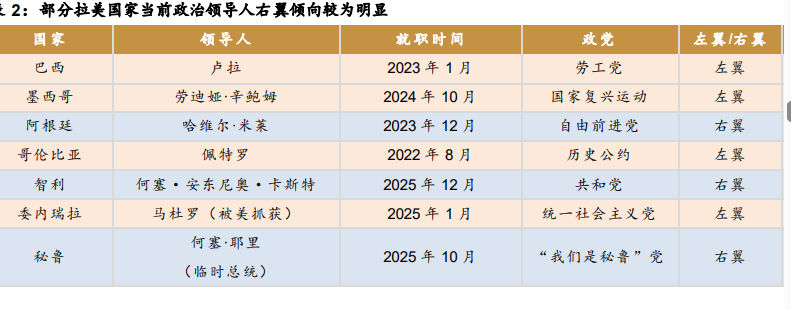
美国“门罗主义”如何影响大宗商品定价?
Hua Er Jie Jian Wen· 2026-01-29 07:09
Core Viewpoint - The article discusses the transformation of the commodity market driven by a new Monroe Doctrine centered around the "Trump Doctrine," which emphasizes the U.S. prioritizing the Western Hemisphere for geopolitical and resource security [1][4]. Group 1: Geopolitical Strategy - The U.S. is expected to shift its foreign and security policy direction by early 2026, formally incorporating the "Trump Doctrine" into its National Security Strategy [1]. - This new approach aims to establish a controllable pricing base for resources, shipping routes, and supply chains, integrating them into national security and military deterrence frameworks [1][4]. - The U.S. is likely to adopt a more aggressive stance in securing resources, as evidenced by recent actions regarding Venezuela's oil assets and Greenland's mineral rights [4]. Group 2: Commodity Pricing Changes - Commodity pricing, particularly for copper, lithium, rare earths, energy, and precious metals, is undergoing a fundamental shift, now reflecting "availability, controllability, and political reliability" rather than just marginal supply and demand [2]. - A new commodity cycle characterized by a "security premium" is emerging, indicating that resources are increasingly viewed as geopolitical assets rather than mere commodities [3][25]. Group 3: Regional Political Dynamics - The U.S. strategic focus on the Western Hemisphere coincides with a significant political shift in Latin America, where there is a noticeable rightward movement in the political spectrum [5]. - The political transitions in countries like Argentina and Chile are expected to reduce resistance to U.S. initiatives aimed at enhancing security, trade, and supply chain cooperation [5][6]. Group 4: Resource and Economic Dimensions - The U.S. is highly dependent on imports for critical minerals, with over half of its consumption of 46 minerals reliant on foreign sources, including complete dependence on imports for 15 of them [10]. - The U.S. is attempting to reverse the structural changes in trade and investment in Latin America, where China has become a dominant trade partner in key sectors [6][9]. Group 5: Strategic Resource Management - The U.S. is reclassifying key minerals and energy assets as strategic facilities, integrating them into national security considerations [7]. - Recent trade agreements with countries like Argentina and Ecuador reflect a shift towards a political and security-driven market allocation of Latin American resources [8][9]. Group 6: Pricing Logic and Market Dynamics - The pricing logic for strategic resources is expected to undergo structural changes as they are formally integrated into national security frameworks [16]. - Key minerals are entering a phase dominated by "geopolitical pricing," characterized by heightened sensitivity to geopolitical news and limited price correction space [17][21]. - Precious metals are becoming not only safe-haven assets but also tools for pricing policy uncertainty, with expectations of a bullish trend in the first half of 2026 [18][25].