地缘政治干预

Search documents
突袭委内瑞拉强掳马杜罗 “美式霸权”引发广泛谴责
Xin Lang Cai Jing· 2026-01-08 06:36
Core Viewpoint - The recent U.S. military intervention in Venezuela aims to control the country's vast oil resources, reshape regional influence, and bolster domestic political support for the Trump administration ahead of the 2026 midterm elections [7][8][11]. Group 1: U.S. Strategic Motivations - The U.S. military action is driven by Venezuela's significant oil reserves, which are crucial for both the Venezuelan economy and the international energy market [7]. - Trump has announced plans to send U.S. oil companies to Venezuela, investing $1 billion to restore the country's oil infrastructure, indicating a focus on economic benefits for the U.S. [7]. - The intervention is also seen as a way to reinforce U.S. dominance in the Western Hemisphere, aligning with the 2025 National Security Strategy that prioritizes the region [8]. Group 2: Legitimacy and International Response - The U.S. Justice Department has charged Maduro with drug-related crimes, but experts question the legitimacy of these claims, citing a lack of evidence for direct government involvement in attacks against the U.S. [9]. - The military action has faced criticism for violating international law and undermining Venezuela's sovereignty, with U.S. domestic political divisions emerging over the lack of congressional authorization for the intervention [9][10]. Group 3: Implications for Venezuela - Maduro's potential long-term control could lead to political instability, as his absence would disrupt the existing power balance, with the Vice President temporarily taking over [11]. - The opposition is seizing the opportunity to gain international recognition and support, viewing Maduro's situation as a critical moment for political change [12]. - The ongoing political uncertainty is likely to exacerbate Venezuela's existing social and economic crises, leading to increased inflation, shortages, and potential civil unrest [13].


荷兰政府暂停禁令,闻泰尚未完全重新掌控安世
Di Yi Cai Jing· 2025-11-19 14:30
Core Viewpoint - The control of the company over its subsidiary, Anshi Semiconductor, remains restricted, prompting the company to alert investors about potential investment risks [1][4]. Group 1: Developments on Anshi Semiconductor - The Dutch Minister of Economic Affairs announced on November 19 that the administrative order against Anshi Semiconductor has been suspended [2]. - Despite the suspension of the ministerial order, a court ruling from October 7 remains in effect, and the emergency measures previously announced by the company are still ongoing [2][4]. - The suspended ministerial order prohibits Anshi and its global subsidiaries from making any adjustments to their assets, intellectual property, business, and personnel for one year [4]. Group 2: Emergency Measures and Legal Actions - The emergency measures initiated by Anshi Semiconductor include suspending the current executive director and placing the company's shares under independent third-party management [4]. - The company is in communication with an international law firm to explore legal remedies to protect its and its shareholders' rights [4]. Group 3: Financial Implications - Anshi Semiconductor reported revenue of approximately 14.7 billion yuan last year [4]. - The company indicated that if control over Anshi is not restored by the end of 2025, it may face risks of revenue, profit, and cash flow adjustments [4]. - Following the freezing of Anshi's assets, the company's stock price fell by 8.99% from October 13 to November 19, with a slight recovery of 0.88% on November 19, closing at 42.3 yuan per share [5].

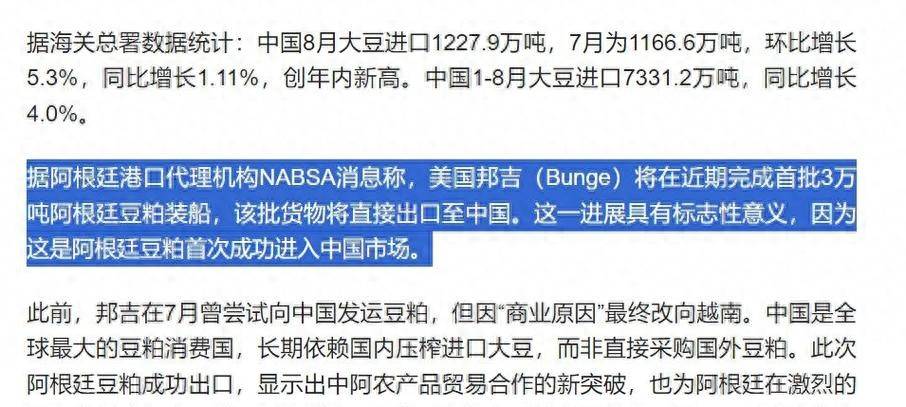
中国刚下大豆大单,美国却用两百亿逼撤互换,阿方公开下场拆台
Sou Hu Cai Jing· 2025-10-20 12:49
Core Viewpoint - Argentina has suspended export tariffs on soybeans, soybean meal, and soybean oil until October 31, creating a temporary cost advantage for global buyers, particularly benefiting Chinese companies facing low domestic soybean inventories [1][2]. Group 1: Policy Changes and Market Reactions - The suspension of the 26% export tax allowed Chinese buyers to quickly secure 10 vessels of soybeans, with potential orders increasing to 15 vessels, totaling over 2 million tons [1]. - The price of this batch of soybeans was nearly 200 RMB per ton lower than Brazilian prices, effectively supplementing domestic stocks and avoiding price volatility ahead of the U.S. harvest [2]. - However, the tax exemption was abruptly terminated when export declarations reached a $70 billion cap, leading to concerns about the completion of existing orders [2]. Group 2: U.S. Involvement and Conditions - Following a meeting between Argentine President Milei and U.S. President Trump, the U.S. announced plans to purchase Argentine pesos and initiate a $20 billion currency swap negotiation [2][4]. - The U.S. conditions for this support included terminating the currency swap agreement with China, reinstating and increasing agricultural export tariffs, expediting U.S. mining permits in Argentina, and linking financial aid to Milei's political future [4][5]. Group 3: Argentina's Economic Strategy - Argentina's economy minister emphasized the importance of the China-Argentina currency swap agreement, which has been in place since 2009 and has expanded significantly, providing crucial liquidity for imports and debt repayments [7]. - The bilateral trade relationship is underscored by China's dominance as the largest buyer of Argentine soybeans and its significant role in Argentine sorghum exports, with 99.2% of sorghum exports going to China [9]. Group 4: Infrastructure and Long-term Cooperation - Chinese investments in Argentina cover critical infrastructure projects, enhancing the country's energy and transportation sectors, which are vital for agricultural exports [9][11]. - The ongoing lithium mining project, supported by Chinese technology and funding, aims to increase local processing rates significantly, contrasting with U.S. demands for exclusive mining rights [13]. Group 5: Geopolitical Implications - The interplay between U.S. and Chinese interests in Argentina highlights the geopolitical tensions affecting trade dynamics, with Argentina caught between the two powers [15]. - The recent developments indicate a shift from purely market-driven interactions to a complex landscape involving financial, monetary sovereignty, and strategic resource considerations [15].
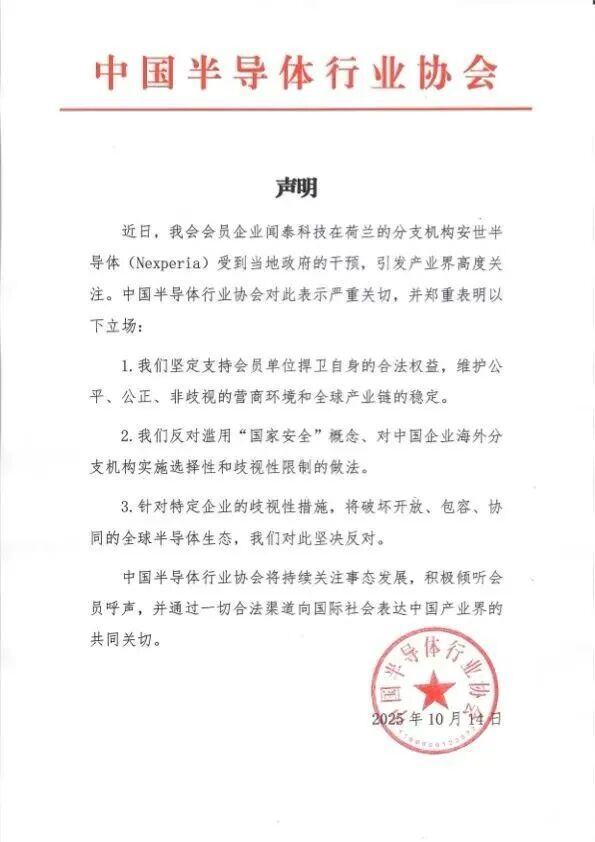
就荷兰政府不公正对待闻泰科技事件,刚刚,中国半导体协会发布声明
Mei Ri Jing Ji Xin Wen· 2025-10-14 04:33
Core Viewpoint - The Chinese semiconductor industry association expresses serious concern over the intervention by the Dutch government in the operations of Nexperia, a subsidiary of WWT Technology, emphasizing the need for a fair and non-discriminatory business environment [1][2][3][4]. Group 1: Industry Response - The association firmly supports its member companies in defending their legitimate rights and maintaining a stable global supply chain [1]. - It opposes the misuse of "national security" concepts to impose selective and discriminatory restrictions on Chinese enterprises operating abroad [2]. - The association warns that discriminatory measures against specific companies will undermine the open and collaborative global semiconductor ecosystem [3]. Group 2: Company Situation - WWT Technology claims that the Dutch government's actions, citing "national security," are based on geopolitical bias rather than factual risk assessment, violating EU principles of market economy and fair competition [6]. - The company condemns attempts by certain foreign executives to alter Nexperia's ownership structure through legal means, viewing it as a political maneuver to undermine shareholder rights and disrupt the company's governance [7]. - Nexperia, a key asset for WWT Technology, generated 14.715 billion yuan in revenue and 2.297 billion yuan in net profit in 2024, making it a crucial source of profit for the company [11]. - Following the news, WWT Technology's stock price experienced a limit down on October 13 and again on the following trading day [12].
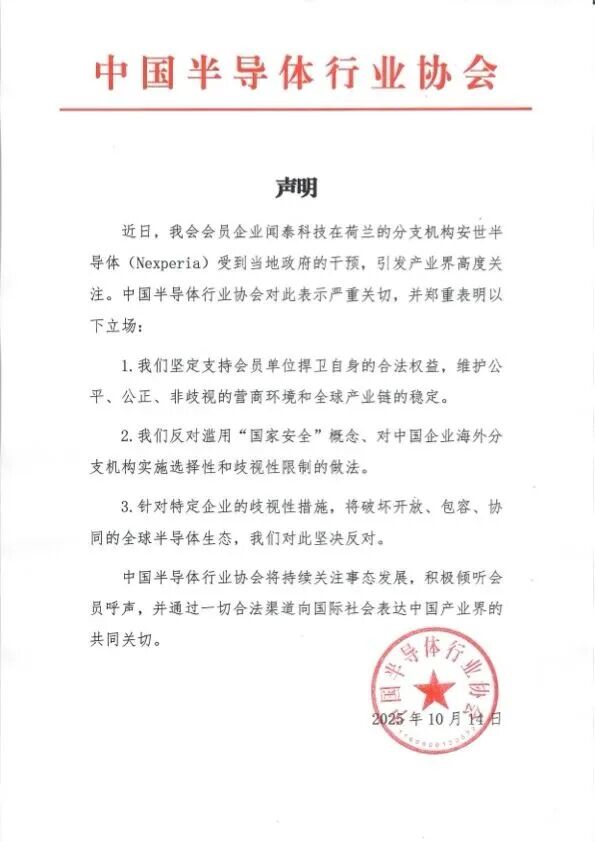
连续两日跌停!刚刚,中国半导体行业协会声明!
Zheng Quan Shi Bao· 2025-10-14 02:18
Core Viewpoint - The China Semiconductor Industry Association expresses serious concern over the intervention by the Dutch government affecting its member company, Wingtech Technology's subsidiary Nexperia, emphasizing the need for a fair and non-discriminatory business environment [1][2][3][4]. Group 1 - The association firmly supports its member companies in defending their legitimate rights and maintaining a stable global supply chain [1]. - It opposes the misuse of "national security" concepts to impose selective and discriminatory restrictions on Chinese companies' overseas branches [2]. - Discriminatory measures against specific companies are seen as detrimental to an open and collaborative global semiconductor ecosystem [3]. Group 2 - Wingtech Technology announced that its core semiconductor asset, Nexperia, faced dual restrictions from the Dutch government and courts, including a one-year freeze on operations and management changes [6]. - Following these developments, Wingtech's stock price experienced a significant drop, hitting the daily limit down on October 13 and again on the following trading day [6]. - The Chinese Ministry of Foreign Affairs reiterated its opposition to the politicization of trade issues and emphasized the need for adherence to market principles [8].
闻泰科技发布严正声明
财联社· 2025-10-12 12:33
Core Viewpoint - The Dutch government's decision to freeze global operations of Nexperia, a subsidiary of Wingtech Technology, is criticized as an excessive intervention based on geopolitical bias rather than factual risk assessment [1][2] Group 1: Company Actions and Financial Performance - Wingtech Technology has completed a 100% acquisition of Nexperia, leading to significant improvements in operational quality, financial performance, technological asset accumulation, operational resilience, and market position [6] - Nexperia's revenue reached a peak of €2.36 billion in 2022, with gross margin increasing from 25% in 2020 to 42.4% in 2022 [6] - By October 2024, Nexperia is expected to have paid off all previous debts, achieving a "zero debt" operation [6] - R&D investment at Nexperia has steadily increased from €112 million in 2019 to €284 million in 2024, with a growing proportion of capitalized investments [6] - The number of new patent applications globally has significantly increased since 2022, totaling more than the combined applications of the previous 3-4 years [6] Group 2: Legal and Political Context - Certain foreign management at Nexperia is attempting to change the company's equity structure through legal means, which is closely linked to the Dutch government's directives, essentially using political pressure to undermine shareholder rights and disrupt the company's legitimate governance structure [7] - The company condemns actions disguised as "compliance" that are fundamentally aimed at seizing control [7] - Wingtech Technology, as a long-term strategic shareholder, will not yield to external political pressure and has initiated all legal and diplomatic avenues to advocate for rationality and the essence of business [9] Group 3: Industry Perspective - The semiconductor industry is a product of globalization, and its future relies on collaboration rather than confrontation [10] - Governments should provide a fair and non-discriminatory business environment for enterprises instead of weaponizing technological cooperation [10] - The company expresses a commitment to work with all partners to maintain stability and innovation in the semiconductor industry [10]