基于风险的客户尽职调查

Search documents
个人存取款超5万不再登记:该严则严,当放则放
Xin Jing Bao· 2026-01-02 09:43
Core Viewpoint - The new regulations effective from January 2026 will eliminate the requirement for individuals to register the source of funds when withdrawing cash exceeding 50,000 yuan, allowing banks to assess risk and determine the necessity of inquiries based on individual circumstances [1][2]. Group 1: Regulatory Changes - The cancellation of the cash withdrawal registration requirement is seen as a positive response to public calls for optimizing regulations, which will ease the burden on both bank customers and financial institutions [2][3]. - The new policy emphasizes a risk-based approach, allowing financial institutions to conduct due diligence based on customer characteristics and transaction risk, rather than applying a blanket rule [2][3]. Group 2: Impact on Financial Institutions - Financial institutions are expected to adopt a more nuanced approach to risk management, balancing the need for security with the convenience of financial services [3]. - The previous one-size-fits-all approach created inefficiencies and conflicts in the service relationship between banks and customers, which the new regulations aim to address [3]. Group 3: Broader Implications - The article highlights that similar rigid practices exist in other sectors, suggesting a need for reform across various regulatory frameworks to enhance efficiency and reduce unnecessary burdens on individuals [4].
个人存取款超5万不再登记:该严则严,当放则放|新京报快评
Xin Jing Bao· 2026-01-02 08:16
Core Viewpoint - Starting from January 1, 2026, the requirement for individuals to register the source of funds when withdrawing cash exceeding 50,000 yuan will be abolished, allowing banks to determine inquiries based on risk assessment rather than a blanket rule [2][3]. Group 1: Regulatory Changes - The new regulation will eliminate the mandatory registration of cash withdrawals over 50,000 yuan, which has been a significant measure to combat financial crimes such as telecom fraud [2][3]. - The policy shift aims to balance financial risk prevention with the optimization of banking services, allowing for simplified measures in low-risk situations while maintaining rigorous checks in high-risk scenarios [3][4]. Group 2: Impact on Banking Operations - The previous requirement for registration and inquiries has been criticized for limiting personal banking freedom and increasing the workload for bank staff, leading to inefficiencies [2][3]. - The new approach emphasizes a risk-based principle, enabling banks to conduct due diligence tailored to customer profiles and transaction characteristics, thus enhancing service efficiency [4]. Group 3: Broader Implications - The shift away from a one-size-fits-all approach reflects a modernized governance strategy that seeks to align financial services with technological advancements and customer needs [4]. - Similar blanket policies have been observed in other sectors, indicating a broader need for regulatory reform to reduce unnecessary burdens on individuals [5].


新规来了!银行取钱不再一刀切式询问:取消“个人存取现金超5万元需登记”规定
Sou Hu Cai Jing· 2025-11-29 12:29
Core Viewpoint - The People's Bank of China, along with the National Financial Regulatory Administration and the China Securities Regulatory Commission, has officially released the "Management Measures for Customer Due Diligence and Customer Identity Information and Transaction Record Keeping" which will take effect on January 1, 2026, emphasizing a risk-based approach to customer due diligence in financial institutions [1][3]. Group 1: Regulatory Changes - The requirement for banks to register the source of funds for cash withdrawals exceeding 50,000 yuan has been removed, aligning with the previous draft [1]. - Financial institutions are now required to conduct customer due diligence based on the risk profile of the customer and the nature of the transaction, avoiding measures that do not correspond to the identified money laundering risks [3][7]. Group 2: Risk-Based Approach - The new regulations allow banks to simplify procedures for low-risk transactions, such as pension withdrawals, where the source of income is clear and stable [4][5]. - In contrast, for high-risk scenarios, such as unusual large transfers from a student’s account, banks must implement enhanced due diligence measures to investigate the source and purpose of the funds [6][7]. Group 3: Implementation and Impact - The measures aim to balance the need for financial security with the facilitation of financial services, promoting a more efficient banking experience for customers [3][7]. - The principle of "strict where necessary, lenient where possible" is emphasized to ensure that financial institutions can provide services while maintaining adequate risk management [3][7].

央行等三部门重磅发布:取消“个人存取现金超5万元需登记”规定,明年1月1日起施行
凤凰网财经· 2025-11-29 12:09
Core Viewpoint - The new regulations issued by the People's Bank of China and other financial authorities emphasize a risk-based approach to customer due diligence and transaction monitoring, aiming to balance anti-money laundering measures with the facilitation of financial services [5][10]. Group 1: Regulatory Changes - The new "Customer Due Diligence and Customer Identity Information and Transaction Record Management Measures" will take effect on January 1, 2026, focusing on the principles of safety, accuracy, completeness, and confidentiality in managing customer information [5]. - The requirement for customers to register the source of funds for cash withdrawals exceeding 50,000 yuan has been removed, aligning with the previous draft [2]. Group 2: Risk-Based Approach - Financial institutions are now required to conduct customer due diligence based on the risk profile of the customer and the nature of the transactions, allowing for simplified measures for low-risk situations and enhanced scrutiny for high-risk cases [5][10]. - For example, pension withdrawals from social security accounts are considered low-risk, requiring only basic identity verification without additional documentation [6][7]. Group 3: Practical Implications - The new regulations allow banks to tailor their inquiries based on the risk level associated with transactions, thus avoiding a one-size-fits-all approach [4][10]. - Instances of unusual transactions, such as a university student receiving multiple large transfers inconsistent with their typical activity, will trigger enhanced investigation protocols [8][9]. Group 4: Industry Perspectives - Industry insiders highlight the need for clearer rules to balance "withdrawal freedom" with financial security obligations, emphasizing that withdrawal rights are subject to compliance with legal and regulatory standards [12][14]. - The call for a collaborative effort among financial institutions, regulators, and customers is crucial to achieving a balance between risk management and service optimization [14][15].

央行等三部门重磅发布:取款超5万不再需要登记,杜绝“一刀切”询问,明年1月1日起施行
Sou Hu Cai Jing· 2025-11-29 11:12
Core Viewpoint - The People's Bank of China, along with the National Financial Regulatory Administration and the China Securities Regulatory Commission, has issued a new regulation on customer due diligence and transaction record management, effective from January 1, 2026, which simplifies the process for low-risk transactions while enhancing scrutiny for high-risk cases [1][5]. Group 1: Regulation Overview - The new regulation cancels the previous requirement for customers to register the source of funds for cash withdrawals exceeding 50,000 yuan, aligning with the earlier draft [1]. - Financial institutions are now required to conduct customer due diligence based on risk levels, allowing for a more tailored approach rather than a blanket inquiry for all customers [3][5]. Group 2: Risk-Based Approach - Banks will implement enhanced investigations for transactions deemed high-risk, while simplifying procedures for low-risk customers, such as those with consistent income sources [3][4]. - For example, a customer with a stable pension income will only need to verify their identity without further questioning about the funds' purpose [3]. Group 3: Transaction Monitoring - The regulation emphasizes the importance of maintaining accurate and complete records of customer identities and transaction histories to facilitate monitoring and investigation of suspicious activities [5]. - Financial institutions must balance the need for anti-money laundering measures with the optimization of financial services, ensuring that their actions are proportionate to the assessed risk [5].
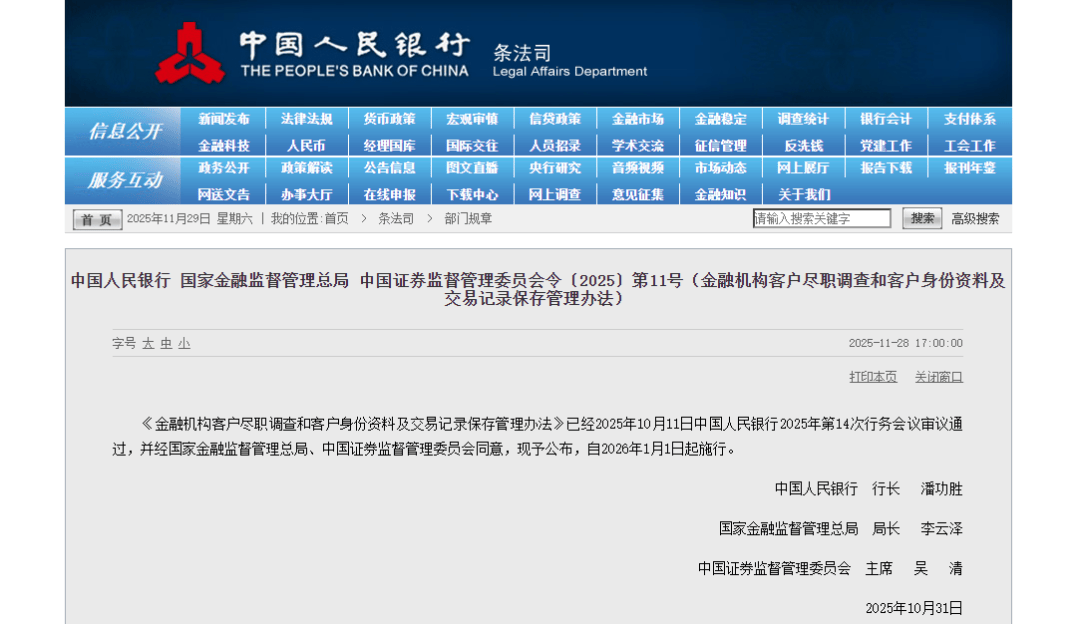
央行等三部门重磅发布:取消“个人存取现金超5万元需登记”规定
第一财经· 2025-11-29 08:50
Core Viewpoint - The new regulations issued by the People's Bank of China and other financial authorities emphasize a risk-based approach to customer due diligence, allowing financial institutions to tailor their inquiries based on the risk level associated with transactions and customers [3][9]. Summary by Sections Regulatory Changes - The requirement for customers to register the source of funds for cash withdrawals exceeding 50,000 yuan has been removed, aligning with previous drafts [4]. - Starting January 1, 2026, financial institutions must maintain customer identity information and transaction records securely and accurately, ensuring they can reproduce each transaction for due diligence and suspicious activity investigations [8]. Risk-Based Approach - The regulations mandate that financial institutions conduct customer due diligence based on the characteristics of the customer and the nature of the transactions, balancing anti-money laundering measures with the need to optimize financial services [9]. - Institutions are encouraged to simplify procedures for low-risk customers while implementing enhanced due diligence for high-risk scenarios [9]. Practical Examples - For instance, elderly customers receiving pensions are considered low-risk, requiring only basic identity verification without additional documentation [10][11]. - Conversely, if a university student suddenly receives multiple large transfers inconsistent with their usual transaction patterns, banks must initiate enhanced investigations to verify the source and purpose of the funds [12][13].

央行等三部门重磅发布:取消“个人存取现金超5万元需登记”规定,银行取钱不再一刀切式询问,明年1月1日起施行
新浪财经· 2025-11-29 08:18
Core Viewpoint - The new regulations from the People's Bank of China and other financial authorities aim to balance anti-money laundering measures with customer service, emphasizing a risk-based approach to customer due diligence and transaction monitoring [4][5][7]. Regulatory Changes - The new "Customer Due Diligence and Customer Identity Data and Transaction Record Management Measures" will take effect on January 1, 2026, and eliminate the requirement for customers withdrawing cash over 50,000 yuan to declare the source of funds [2][4]. - Banks will no longer apply a uniform questioning policy for all customers but will assess the risk level to determine the necessity of further inquiries [3][5]. Risk-Based Approach - Financial institutions are required to conduct customer due diligence based on the risk profile of the customer and the nature of the transactions, allowing for simplified measures for low-risk situations and enhanced scrutiny for high-risk cases [5][7]. - Examples include treating pension withdrawals as low-risk transactions, while sudden large transfers from a student’s account would trigger enhanced investigation protocols [6][7]. Industry Perspectives - The concept of "withdrawal freedom" is framed as a relative freedom constrained by financial regulatory obligations, emphasizing that banks must ensure the legality and compliance of transactions before allowing withdrawals [10][11]. - Industry experts suggest that a balance between risk prevention and service optimization requires collaboration among financial institutions, regulatory bodies, and customers [13].

央行等三部门重磅发布:取消“个人存取现金超5万需登记”规定
Mei Ri Jing Ji Xin Wen· 2025-11-29 05:33
Core Viewpoint - The People's Bank of China, along with the National Financial Regulatory Administration and the China Securities Regulatory Commission, has issued new regulations on customer due diligence and transaction record management, effective from January 1, 2026, emphasizing a risk-based approach to financial transactions [1][4]. Group 1: Regulatory Changes - The requirement for banks to register the source of funds for cash withdrawals exceeding 50,000 yuan has been removed, aligning with the previous draft [1][3]. - Financial institutions are mandated to maintain customer identity data and transaction records securely, ensuring they can reproduce each transaction for due diligence and suspicious activity investigations [4][8]. Group 2: Risk-Based Approach - The new regulations advocate for a risk-based customer due diligence process, allowing banks to simplify procedures for low-risk transactions while intensifying scrutiny for high-risk cases [4][8]. - For example, pension withdrawals from clear and stable income sources are considered low risk, requiring only basic identity verification [5][6]. Group 3: Practical Implications - The regulations aim to balance the need for security against the convenience of financial services, allowing banks to adjust their inquiry levels based on the risk profile of transactions [8][14]. - Instances of unusual transaction patterns, such as a sudden influx of large transfers inconsistent with a customer's typical behavior, will trigger enhanced investigations [7][8]. Group 4: Industry Perspectives - Industry experts emphasize the need for clearer rules to navigate the tension between withdrawal freedom and financial security, advocating for collaborative efforts among financial institutions, regulators, and customers [11][14]. - The concept of "withdrawal freedom" is framed as a relative right, subject to compliance with legal and regulatory obligations, particularly concerning anti-money laundering and fraud prevention [12][14].

三部门重磅发布:取消“个人存取现金超5万元需登记”规定
Mei Ri Jing Ji Xin Wen· 2025-11-29 05:30
Core Viewpoint - The People's Bank of China, along with the National Financial Regulatory Administration and the China Securities Regulatory Commission, has announced the cancellation of the requirement for individuals to register the source of cash withdrawals exceeding 50,000 yuan, effective January 1, 2026, allowing banks to adopt a risk-based approach in their inquiries [1][2][3]. Group 1: Regulatory Changes - The new regulation eliminates the blanket requirement for banks to inquire about the purpose of cash withdrawals over 50,000 yuan, aligning with previous drafts [2][3]. - Banks will now assess the risk level of transactions to determine whether to conduct further inquiries, enhancing the balance between anti-money laundering measures and customer service [3][4]. Group 2: Risk-Based Approach - Financial institutions are mandated to conduct customer due diligence based on the risk profile of clients and the nature of transactions, ensuring that measures are proportionate to the identified risks [3][5]. - For low-risk transactions, such as pension withdrawals, banks will only need to verify identity without additional questioning, while higher-risk transactions will trigger enhanced scrutiny [4][5]. Group 3: Industry Reactions - The recent changes come in response to public concerns over excessive questioning by banks, as highlighted by a recent incident involving a lawyer being interrogated about cash withdrawals [6][7]. - Industry experts emphasize the need for clearer regulations to balance customer withdrawal freedoms with the obligations of banks to prevent fraud and money laundering [7][8].
央行等三部门重磅发布:取消“个人存取现金超5万元需登记”规定,银行取钱不再一刀切式询问,明年1月1日起施行
Sou Hu Cai Jing· 2025-11-29 04:57
Core Points - The People's Bank of China, along with the National Financial Regulatory Administration and the China Securities Regulatory Commission, has officially released the "Measures for Customer Due Diligence and Customer Identity Information and Transaction Record Keeping Management" which will take effect on January 1, 2026 [4][6] - The new regulation eliminates the requirement for customers to register the source of funds for cash withdrawals exceeding 50,000 yuan, aligning with the previous draft [2][3] - Financial institutions are now required to conduct customer due diligence based on risk, allowing for simplified measures for low-risk situations while implementing enhanced scrutiny for high-risk cases [4][5] Summary by Sections Regulation Changes - The new regulation allows banks to determine the necessity of inquiries based on the risk profile of the transaction rather than applying a blanket approach [3][4] - The principle of "risk-based" customer due diligence is emphasized, requiring financial institutions to balance anti-money laundering measures with the optimization of financial services [4][6] Practical Examples - For low-risk transactions, such as pension withdrawals by elderly customers, banks will only need to verify identity without requiring additional documentation [5][6] - Conversely, if a university student suddenly receives multiple large transfers inconsistent with their usual transaction patterns, banks must initiate enhanced investigations to verify the source and purpose of the funds [6][7] Industry Perspectives - The recent changes have sparked discussions about the balance between "withdrawal freedom" and "fund security," highlighting the need for clearer regulations to address these concerns [7][8] - Industry experts suggest that achieving a balance between risk prevention and service optimization requires collaboration among financial institutions, regulatory bodies, and customers [10]