基金经理薪酬改革

Search documents
7亿基民迎来转机,基金经理薪酬大改,这招直戳行业痛点
Sou Hu Cai Jing· 2025-12-11 22:14
Core Viewpoint - The public fund industry in China is undergoing significant changes aimed at aligning the interests of fund managers with those of investors, particularly in response to poor performance and high salaries for fund managers despite losses for investors [2][18]. Summary by Sections Fund Manager Compensation Changes - The China Securities Investment Fund Industry Association has proposed a guideline that mandates a minimum 30% reduction in performance pay for fund managers who underperform [2][9]. - Fund managers who have underperformed by more than 10 percentage points compared to benchmarks and incurred losses will face this pay cut as a strict rule [9]. Performance Metrics and Accountability - The new regulations emphasize long-term performance, requiring that at least 80% of performance metrics be based on three-year results, discouraging short-term speculative strategies [12][14]. - Fund managers will be required to invest at least 40% of their performance pay into the funds they manage, ensuring that their financial interests are directly tied to the performance of those funds [15]. Industry Impact and Investor Sentiment - The proposed reforms are seen as a positive development for ordinary investors, as fund managers will now have a direct financial stake in their funds' performance, potentially leading to more responsible management practices [18]. - While the reforms are beneficial, there is caution regarding their implementation, as the guidelines are still in the draft stage and may be subject to manipulation by some fund companies [20][22].

基金经理薪酬迎重大改革!三年跑输基准超10%且利润率为负,绩效薪酬至少降三成
Sou Hu Cai Jing· 2025-12-08 07:41
Core Viewpoint - The China Securities Investment Fund Industry Association has revised the "Guidelines for Performance Assessment and Compensation Management of Fund Management Companies," now titled "Guidelines for Performance Assessment Management of Fund Management Companies (Draft for Comments)," focusing on establishing a performance assessment and compensation management system centered on fund investment returns [1] Summary by Sections Performance Assessment and Compensation Management - The revised guidelines consist of 7 chapters and 32 articles, emphasizing the need for fund companies to establish a robust performance assessment and compensation management system linked to fund investment returns [1] - The guidelines introduce a tiered performance compensation adjustment mechanism specifically for active equity fund managers, enhancing the clarity and operability of performance assessments [4][5] Salary Adjustments for Fund Managers - Fund managers whose products underperform the benchmark by over 10 percentage points over the past three years and have negative profit margins must see their performance compensation decrease by at least 30% compared to the previous year [6][7] - As of December 5, 2023, over 1,400 active equity products have underperformed their benchmarks by more than 10 percentage points, affecting nearly 1,000 fund managers, including notable figures like Shi Cheng and Liu Yan Chun [3][7] Performance Assessment Mechanism Reform - The guidelines require fund companies to create a performance assessment system centered on fund investment returns, incorporating actual profit and loss, and benchmark comparisons, with long-term indicators accounting for at least 80% of assessments [8] - Differentiated assessment indicators and weights must be set for senior management, investment personnel, and sales staff based on product type and responsibilities [9][10] Investor Interest Alignment - The guidelines mandate an increase in the co-investment ratio for senior management, key business department heads, and fund managers by 10%, with a minimum holding period of one year [12] - Senior management and key department heads must invest at least 30% of their total performance compensation in the funds managed by their company, with at least 60% of that in equity funds, while fund managers must invest at least 40% of their performance compensation in the funds they manage [12]

周末,大利好!
中国基金报· 2025-12-07 14:22
Key Points - The article summarizes significant events over the weekend and the latest assessments from major securities firms regarding the Chinese market and economy [2] Group 1: Economic and Policy Developments - Chinese Vice Premier He Lifeng held a video call with U.S. Treasury Secretary Janet Yellen and Trade Representative Katherine Tai to discuss practical cooperation and resolving economic concerns [3] - The People's Bank of China has increased its gold reserves for the 13th consecutive month, now holding 7.412 million ounces, reflecting a strategic move to bolster financial stability [4] - The China Securities Regulatory Commission (CSRC) is focusing on differentiated regulation for quality institutions while tightening oversight on problematic firms, aiming to enhance capital efficiency [5] Group 2: Market Insights and Predictions - Insurance companies are expected to benefit from lowered risk factors for long-term holdings in indices like CSI 300 and STAR Market, potentially leading to significant equity allocations [6][7] - A new performance assessment guideline for fund managers has been proposed, which may result in salary reductions exceeding 30% for underperforming managers, aiming to enhance accountability in the fund management industry [8] - The 2025 National Medical Insurance Drug List will include 114 new drugs, with 50 classified as innovative, indicating a focus on advancing healthcare and pharmaceutical sectors [9] Group 3: Securities Firms' Analysis - CITIC Securities suggests that the current market volatility is a normal phase before potential positive changes in fundamentals, with a focus on resource and traditional manufacturing sectors [12] - Shenwan Hongyuan highlights that the lowered risk factors for insurance companies could lead to significant equity investments, particularly in the context of the upcoming spring market [13] - China International Capital Corporation (CICC) believes that the recent bond market fluctuations will have limited impact on equity markets, supported by a strong RMB and favorable economic conditions [14] - Guotai Junan emphasizes the importance of upcoming policy meetings and their potential impact on market sentiment and structural opportunities [18] - GF Securities notes that while the market may experience short-term fluctuations, there remains significant upside potential, particularly in dividend-paying and consumer sectors [22]

业绩指标考核权重应当不低于80%!基金经理薪酬改革征求意见
Zheng Quan Shi Bao· 2025-12-07 00:42
Core Viewpoint - The newly released "Guidelines for Performance Assessment of Fund Management Companies" aims to standardize performance evaluation and compensation management, enhancing the alignment of interests between fund management companies and fund shareholders [1][2]. Performance Assessment System - Fund management companies are required to establish a performance assessment system centered on fund investment returns, incorporating quantitative indicators such as net asset value growth rate, performance benchmark comparison, fund profit margin, and the proportion of profitable investors [1][4]. - The weight of investment return indicators in the assessment of senior executives should not be less than 50%, while for active equity fund managers, the weight should be at least 80% [5][6]. Compensation Management - The total compensation of fund management companies must be linked to fund investment returns, operational performance, financial status, market levels, risk management, development strategies, and personnel conditions [3]. - A deferred payment system for performance compensation is mandated, with a minimum deferral period of three years and a deferred payment ratio of at least 40% for senior management and key personnel [10]. Long-term Incentives - Long-term incentives may include equity-based and cash incentives, with mechanisms designed to align with the long-term interests of the company and fund shareholders [3]. - Fund management companies are encouraged to optimize compensation distribution structures, ensuring a balance between different positions and levels, while controlling excessive pay disparities [3]. Performance Adjustment Mechanism - A tiered performance salary adjustment mechanism is to be established, where significant underperformance (more than 10% below the benchmark with negative profit margin) results in a salary reduction of at least 30% [11]. - Conversely, significant outperformance with a positive profit margin allows for reasonable salary increases [11]. Deferred Payment and Investment Requirements - Senior management and key personnel must invest a portion of their performance compensation into the company's managed public funds, with specific requirements for the proportion and type of funds [10]. - The guidelines stipulate that at least 30% of the total performance compensation for senior management should be invested in the company's managed public funds, with a minimum of 60% in equity funds [10]. Dividend Distribution Guidelines - Fund management companies are required to establish a scientific and reasonable shareholder dividend mechanism, adjusting dividend frequency and proportion based on the long-term performance of fund products and investor profitability [12].
重磅文件落地!事关基金经理薪酬改革
凤凰网财经· 2025-12-06 12:39
Core Viewpoint - The article discusses the newly released "Guidelines for Performance Assessment and Compensation Management of Fund Management Companies (Draft for Comments)", which aims to standardize performance assessment and compensation management in the fund industry, ensuring long-term incentives are aligned with the interests of fund shareholders [3][9]. Summary by Sections Performance Assessment and Compensation Structure - The guidelines emphasize strengthening performance assessments, requiring that the weight of long-term performance indicators (over three years) in overall quantitative assessments should not be less than 80% [4][10]. - For senior management, the weight of investment return indicators in performance assessments should be at least 50% [11]. Investment in Own Funds - Senior management and key personnel are required to invest a minimum of 30% of their total performance compensation in their company's funds, with at least 60% of that in equity funds [5][15]. - Fund managers must invest at least 40% of their total performance compensation in the funds they manage, excluding non-equity products [5][15]. Salary Adjustments Based on Performance - Fund managers whose performance lags behind the benchmark by more than 10% over three years and have negative profit margins will see a minimum 30% reduction in their performance compensation [6][16]. - The guidelines establish a tiered adjustment mechanism for performance compensation based on the fund's performance relative to benchmarks [16]. Long-term Incentives and Accountability - The guidelines allow for the use of equity, options, and other long-term incentives to align employee interests with the long-term benefits of fund shareholders [9][18]. - A strict accountability mechanism is introduced, which includes salary stoppage, recovery, and clawback provisions applicable even to departing employees [19]. Overall Compensation Management - Fund management companies are encouraged to manage total compensation budgets effectively, linking changes in total compensation to fund performance and company profitability [17]. - The structure of compensation should include basic salary, performance pay, benefits, and long-term incentives, ensuring a balanced approach to avoid risks associated with unreasonable compensation structures [18].
基金经理薪酬重大改革征求意见 业绩不达标可能降薪超30%
Sou Hu Cai Jing· 2025-12-06 09:53
Core Viewpoint - The newly released "Guidelines for Performance Evaluation and Compensation Management of Fund Management Companies (Draft for Comments)" aims to standardize performance evaluation and compensation management in the fund management industry, promoting sustainable development and robust operations by aligning employee incentives with long-term fund performance [1][2]. Summary by Sections Performance Evaluation - The guidelines emphasize strengthening performance evaluation, requiring that the weight of long-term investment return indicators (over three years) in overall quantitative assessments must not be less than 80% [2][9]. - For senior management, the weight of investment return indicators should be at least 50%, while for active equity fund managers, the performance indicators should account for no less than 80% [2][10]. Compensation Structure - Fund company executives must invest at least 30% of their annual performance compensation in their own company's funds, with fund managers required to invest at least 40% [3][16]. - The deferred payment of performance compensation must last for at least three years, with a minimum of 40% of the deferred payment for senior management and key personnel [3][16]. Salary Adjustments - Fund managers whose performance lags behind the benchmark by more than 10% over three years and have negative profit margins will face a minimum 30% reduction in their performance compensation [4][17]. - A tiered adjustment mechanism for performance compensation is established based on the fund's performance relative to benchmarks [17][18]. Long-term Incentives - The guidelines allow for the use of equity, options, and other long-term incentives to align with the long-term interests of fund shareholders [6][19]. - The compensation structure should include basic salary, performance pay, benefits, and long-term incentives, ensuring a balanced approach to avoid risks associated with unreasonable compensation structures [19][20]. Accountability Mechanism - A strict accountability mechanism is mandated, which includes salary suspension, recovery, and clawback provisions applicable even to departing employees [7][21]. - Fund management companies must clearly define the conditions under which performance compensation can be reduced or reclaimed in their internal management systems and contracts [21].
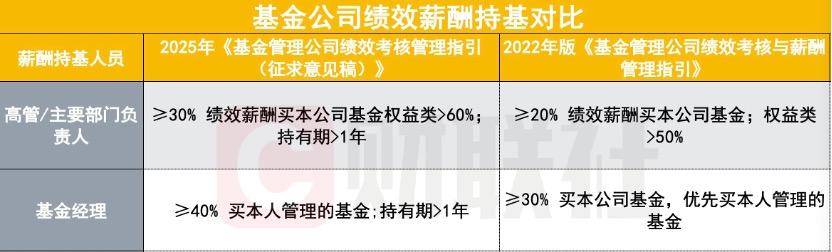
重磅文件落地!事关基金经理薪酬改革
财联社· 2025-12-06 08:55
Core Viewpoint - The newly released "Guidelines for Performance Assessment and Compensation Management of Fund Management Companies (Draft for Comments)" aims to standardize performance assessment and compensation management in the fund management industry, ensuring long-term incentives are aligned with the interests of fund shareholders and promoting sustainable development of the industry [1][2]. Summary by Sections Performance Assessment and Compensation Structure - The guidelines emphasize performance assessment, requiring that the weight of long-term indicators (over three years) in the overall quantitative assessment of fund investment returns must not be less than 80% [2][10]. - For senior management, the weight of fund investment return indicators should be no less than 50% [11]. - Differentiated assessments for fund managers are mandated, with performance indicators for actively managed equity fund managers having a weight of at least 80%, and the benchmark comparison weight not less than 30% [12]. Investment in Own Funds - Fund company chairpersons and senior executives must use at least 30% of their annual performance compensation to purchase their company's funds, while fund managers must invest at least 40% of their performance compensation in the funds they manage [3][20]. Deferred Compensation and Co-investment Requirements - The guidelines introduce new requirements for deferred compensation, mandating a minimum deferral period of three years and a co-investment ratio of at least 40% for senior management and key personnel [4][18]. - Senior management and key department heads must invest at least 30% of their total performance compensation in their company's funds, with at least 60% of that in equity funds [20][21]. Salary Adjustments Based on Performance - Fund managers whose performance lags the benchmark by more than 10% over three years and have negative profit margins will face a salary reduction of at least 30% [5][22]. - A tiered salary adjustment mechanism is established based on performance relative to benchmarks, ensuring that poor performance directly impacts compensation [22]. Long-term Incentives and Accountability Mechanisms - The guidelines allow for the use of equity, options, and other long-term incentives to align employee interests with the long-term benefits of fund shareholders [7][23]. - A strict accountability mechanism is introduced, which includes salary stoppage, recovery, and clawback provisions applicable even to departing employees [8][25]. Encouragement of Pension Systems - Fund companies are encouraged to establish enterprise annuities and support employees in participating in personal pension systems, integrating compensation mechanisms with pension insurance [9]. Overall Compensation Structure - The guidelines stress the importance of linking total compensation changes to fund investment returns and company performance, while ensuring a balanced structure that avoids excessive focus on senior management [24].

独家|基金经理薪酬重大改革征求意见,强化薪酬与业绩绑定
Sou Hu Cai Jing· 2025-12-06 08:37
Core Viewpoint - The newly released "Guidelines for Performance Assessment and Compensation Management of Fund Management Companies (Draft for Comments)" aims to standardize performance assessment and compensation management in the fund management industry, promoting sustainable development and aligning employee incentives with long-term fund performance [1][2]. Summary by Sections Performance Assessment and Compensation Structure - The guidelines emphasize performance assessment, requiring that the weight of long-term indicators (over three years) in the overall quantitative assessment of fund investment returns must not be less than 80% [2][7]. - For senior management, the weight of fund investment return indicators should be no less than 50% [8]. - Differentiated assessments for fund managers are mandated, with performance indicators for actively managed equity fund managers having a weight of at least 80% [2][8]. Investment in Own Funds - Senior management and key personnel must invest a minimum of 30% of their annual performance compensation in the company's funds, with at least 60% of that in equity funds [3][12]. - Fund managers are required to invest at least 40% of their annual performance compensation in the funds they manage, excluding non-equity products [3][12]. Deferred Compensation and Accountability - Performance compensation must have a deferred payment period of no less than three years, with a minimum of 40% of the deferred payment for senior management and key personnel [3][12]. - A strict accountability mechanism is established, allowing for salary suspension, recovery, and deductions for those who fail to meet performance expectations, applicable even to departing employees [5][17]. Salary Adjustments Based on Performance - Fund managers whose performance lags behind the benchmark by more than 10% and have negative profit margins over the past three years will face a salary reduction of at least 30% [3][13]. - A tiered salary adjustment mechanism is introduced based on performance relative to benchmarks, ensuring that poor performance directly impacts compensation [13][14]. Long-term Incentives and Salary Structure - The guidelines encourage the use of long-term incentives such as equity, options, and restricted stock to align with the long-term interests of fund shareholders [4][15]. - The overall salary structure should include basic salary, performance salary, benefits, and long-term incentives, with a focus on maintaining a reasonable ratio between basic and performance salaries to mitigate risks [15][16].
影响8亿基民的公募基金“大动作”,来了!
华尔街见闻· 2025-05-07 23:58
Core Viewpoint - The recently released "Action Plan for Promoting the High-Quality Development of Public Funds" includes 25 measures aimed at addressing industry pain points and enhancing the overall management and performance of public funds [1][2]. Summary by Sections Fund Fee and Manager Compensation Reform - The action plan emphasizes a shift towards a floating management fee model for actively managed equity funds, linking fees to fund performance against benchmarks [4][6]. - Specific measures include establishing a floating fee mechanism based on performance, with different fee rates applicable depending on the fund's performance relative to its benchmark [4][5]. - Fund managers' compensation will be tied to fund performance, with penalties for underperformance and rewards for exceeding benchmarks [9][10][12]. Strengthening Interest Alignment - The plan aims to enhance the alignment of interests among fund companies, managers, and investors by increasing the proportion of personal investments by fund managers in their own products [15][16]. - It proposes a comprehensive evaluation system that includes long-term performance metrics, ensuring that fund managers focus on sustainable returns rather than short-term gains [12][17]. Stability of Investment Style - The action plan addresses issues of investment style drift by requiring clear performance benchmarks for each fund, ensuring that investment behavior aligns with the fund's stated objectives [19][20]. - It emphasizes the importance of long-term assessments, with a minimum of 80% weight on three-year performance metrics to discourage short-term trading behaviors [20][21]. Fund Sales and Evaluation Requirements - The plan calls for improved investor service capabilities, including the establishment of regulations for fund advisory services and a centralized platform for institutional investors [22][23]. - It introduces a classification and evaluation mechanism for fund sales institutions, focusing on long-term performance and investor outcomes [24]. Governance Improvement - The action plan highlights the need for enhanced governance within fund companies, including better accountability for major shareholders and board members [26][28]. - It proposes reforms to improve the independence and effectiveness of fund company governance structures, aiming to prevent conflicts of interest and ensure compliance [26][27]. Encouragement for Growth and Innovation - The plan encourages fund companies to strengthen their research capabilities and adopt new technologies, such as AI and big data, to enhance operational efficiency [29][30]. - It supports the establishment of employee stock ownership plans and promotes mergers and acquisitions to foster industry consolidation and innovation [31].